
Artificial intelligence isn't some far-off idea for the legal world anymore—it's here, and it’s a powerful tool ready to be put to work. For personal injury lawyers, AI is essentially the ultimate paralegal. Think of it as an assistant that works around the clock to digest mountains of medical records, handle repetitive administrative tasks, and flag the kind of critical evidence that can make or break a case.
Your New Partner in Personal Injury Law

Anyone in a personal injury practice knows the grind. Attorneys and paralegals are constantly buried in administrative work, from manually combing through thousands of pages of medical files to drafting routine documents and client correspondence. This work is essential, but it’s also a massive time drain that pulls you away from what really moves the needle: crafting case strategy, negotiating with adjusters, and fighting for your clients.
This is exactly where AI changes the game. It’s not here to replace skilled legal professionals but to act as a powerful force multiplier for your team.
Imagine a tool that can take a 1,000-page medical record and give you a clean, accurate summary in just a few minutes, not a few days. That’s not a sci-fi fantasy; it’s what’s happening right now in firms that are embracing legal technology.
Demystifying AI for Your Firm
At its heart, AI for personal injury lawyers is all about smart automation. These tools are built to take on the data-intensive, repetitive tasks that eat up your team’s valuable time, freeing everyone up to focus on the work that requires their expertise.
This guide is designed to cut through the noise and give you a clear, practical path forward. We'll cover the essentials you need to know:
- Real-World Applications: We’ll look at specific ways to use AI, from instantly summarizing medical records to helping you draft better demand letters.
- The Strategic Payoff: You’ll see how small efficiencies add up to better case outcomes, higher settlement values, and a more profitable firm.
- A Clear Adoption Plan: We provide a roadmap for bringing AI into your practice without turning your existing workflows upside down.
- Navigating the Ethical Rules: We’ll discuss the professional responsibilities and best practices for using AI securely and ethically.
An Industry Already Making the Shift
Personal injury lawyers have quickly become some of the earliest adopters of artificial intelligence in the legal space. In fact, a recent report shows that 37% of personal injury professionals are already using generative AI in their daily work, a figure that’s higher than the lawyer average of 31%.
The goal here is simple: empower your team to spend more time on high-value strategy and client advocacy. Let AI handle the tedious work so you can focus on the art of being a lawyer.
This isn't just about adopting new technology for its own sake. It’s about securing a real competitive advantage. Firms that get this right are not only more efficient but are also in a much stronger position to build winning case narratives supported by perfectly organized evidence. To learn more about how AI can reshape your practice, check out this in-depth guide: AI for Personal Injury Lawyers: Your Firm’s Modern Growth Engine.
How AI Changes the Day-to-Day at Your Firm
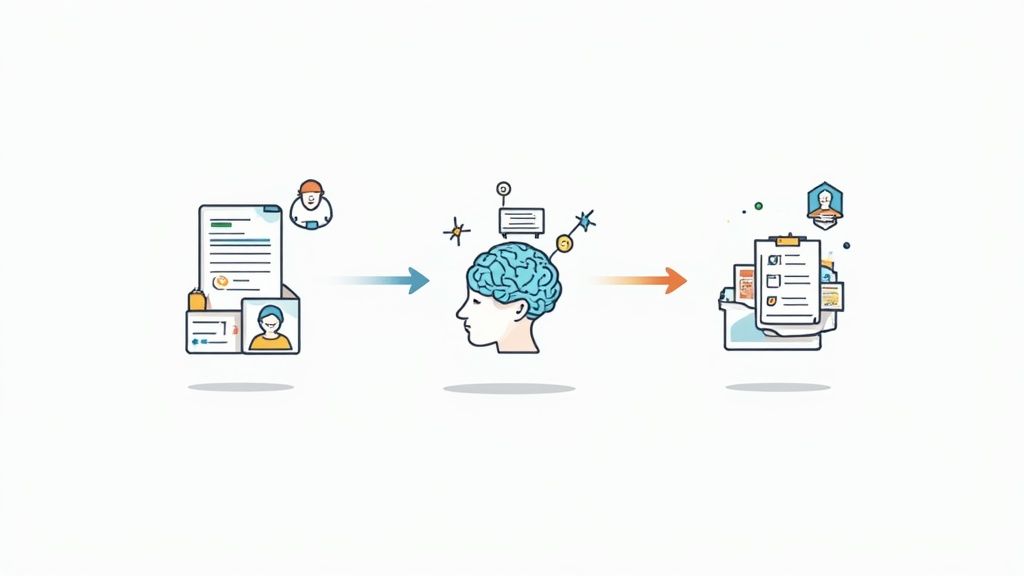
Let's move past the theory and get down to brass tacks. The real power of AI for personal injury lawyers isn't some far-off concept; it’s about what it can do for you and your team tomorrow. It's not about ripping out your existing systems. It's about surgically targeting the most tedious, time-sucking tasks and making them faster, smarter, and more accurate.
The goal is a smoother, more powerful workflow, from the moment a potential client first contacts you all the way through to the settlement check.
Taking Client Intake from Chaos to Clockwork
That first phone call or web form submission is where it all begins. But how many good cases slip through the cracks after hours or get lost in a sea of inquiries that aren't a good fit? AI-powered intake tools act as a 24/7 front desk, using intelligent chatbots or smart forms to gather the essential facts.
This means you never miss a solid lead, and just as importantly, you spend less time filtering out calls that are going nowhere.
Once you sign a new client, the administrative scramble begins. Or, at least, it used to. AI can kickstart the entire process automatically. It can create the case file in your management system, pull in all the intake data, and even draft a welcome email or initial client correspondence.
Your team can skip the mind-numbing data entry and get straight to the meaningful work. That’s how you build momentum from day one.
- Smarter Lead Qualification: The system can analyze intake forms and flag the most promising cases, sending them right to the correct attorney or paralegal.
- Instant Case File Creation: AI populates your case management software with client details, accident information, and key dates in seconds.
- Less Admin, More Strategy: Freeing up your team from repetitive setup lets them focus on what they do best: communicating with clients and building the case.
Conquering the Medical Record Mountain
If there's one universal headache in personal injury law, it's medical records. A single case can mean wrestling with thousands of pages from dozens of providers—a chaotic mess of handwritten notes, billing codes, and duplicate documents. Having a paralegal manually piece together a timeline can burn days, even weeks, of valuable time.
This is where AI delivers an undeniable return. Modern AI platforms can digest entire medical files in almost any format—scanned PDFs, EMR printouts, you name it—and process them in minutes. The system intelligently spots diagnoses, treatments, providers, and dates, then neatly arranges everything into a structured, chronological summary.
A task that used to eat up 10+ hours of skilled paralegal time can now be done in less than 10 minutes. This isn't just an efficiency gain; it’s a fundamental shift in how quickly you can get to the heart of a case.
Suddenly, you can see the entire story of an injury almost instantly. You can spot pre-existing conditions, find gaps in treatment, or flag conflicting reports that are absolutely critical to your case strategy. To see just how powerful this is, take a look at our detailed guide on AI-powered medical record summary.
Speeding Up Discovery and Drafting
The discovery phase is another prime candidate for an AI-powered upgrade. Think about all the time spent drafting initial requests, answering interrogatories, and organizing mountains of evidence. These are precise, but highly repetitive, tasks.
AI can now generate solid first drafts of these documents, pulling the specifics right from your case file. For example, it can produce a draft demand letter complete with a full medical timeline, injury summary, and itemized medical bills. This gives your attorneys a huge head start, allowing them to focus on adding the legal arguments and strategic finesse that wins cases.
Accurately capturing every word from a client or witness interview is also crucial. A practical guide to transcribing interviews with AI shows how this technology ensures no detail gets missed, saving countless hours of manual work.
To give you a clearer picture, here’s how AI tools slot into the different phases of a typical case.
AI Use Cases Across the Personal Injury Case Lifecycle
| Case Stage | Traditional Task | AI-Powered Solution |
|---|---|---|
| Intake | Manual data entry, phone screening, after-hours voicemails | 24/7 AI chatbots for lead capture, automated qualification, and case file creation. |
| Investigation | Manually reviewing and summarizing medical records | AI-driven medical record analysis for instant chronologies and key fact extraction. |
| Discovery | Drafting standard interrogatories, requests for production | AI document generators to create first drafts of discovery requests and responses. |
| Demand | Manually compiling medical specials and writing demand | Automated demand letter drafting with integrated medical summaries and expense calculation. |
| Resolution | Analyzing opposing counsel's arguments, settlement offers | AI tools for case law research and predictive analysis of potential settlement values. |
By automating these daily operations, firms aren't just saving time—they're building a more competitive and resilient practice. The industry is already taking notice. A recent legal report revealed that 61% of PI firms using AI expect a direct jump in productivity, and 36% believe AI will replace routine administrative functions, freeing up attorneys for high-value work.
How AI Gives You a Real Strategic Advantage
Saving time on administrative work is a nice perk, but that’s not the real story. The true power of AI for personal injury lawyers is how it delivers a serious strategic edge. We're not just talking about doing the same old tasks faster; this is about fundamentally upgrading your firm's ability to win bigger settlements and boost your bottom line.
This advantage really breaks down into three key areas.
First up is a massive boost in operational efficiency. Think about all the high-volume, low-strategy work that eats up your team's day—document review, initial drafting, organizing discovery. AI automates that grind, freeing up your most expensive resource: your people's time and brainpower. This means you can handle a larger caseload without burning out your staff or ballooning your overhead.
When your best paralegals and attorneys aren't buried in paperwork, they can focus on what actually moves the needle: crafting case strategy, building stronger client relationships, and negotiating with more leverage. It’s a huge morale booster, but more importantly, it sharpens your entire firm’s focus on the activities that generate revenue.
Uncover Game-Changing Case Insights
Beyond just getting more done, AI gives you an analytical depth that’s impossible to achieve manually. These tools can sift through mountains of information, cross-referencing details at a speed that no human team can match. They spot the hidden patterns and subtle connections that are often the foundation of a winning argument.
Picture this: you upload thousands of pages of discovery—police reports, medical records, witness depositions—into an AI platform. In minutes, it can flag inconsistencies in timelines, pinpoint contradictory statements, and surface details you might have missed after your fifth hour of review.
- Finding the Smoking Gun: One firm we know was handling a complex multi-car pileup case. They used AI to tear through thousands of pages of reports and depositions. The system flagged a tiny, overlooked detail in a third-party vehicle’s maintenance log, which pointed to another liable party. That single insight dramatically increased the client's potential settlement.
- Bulletproofing Causation Arguments: AI can map out every symptom and treatment from a client's medical history, drawing a clear, undeniable timeline from the accident to the injury. This is incredibly powerful for shutting down defense arguments about pre-existing conditions.
- Predicting Settlement Values: Some of the more advanced AI tools analyze historical case data from similar injuries, jurisdictions, and fact patterns. They can then generate a data-backed settlement valuation, giving you a powerful anchor for negotiations. You walk into the room armed not just with your gut feeling, but with hard numbers.
This kind of analytical horsepower turns information overload from a liability into your greatest strategic asset. You’ll never have to worry about missing the one detail that could turn a good case into a great one.
Deliver a Superior Client Experience
Finally, a huge strategic advantage comes from improving how you communicate with and care for your clients. In a crowded market, the client experience is what makes you stand out. AI gives you the tools to be more responsive and transparent, which builds trust and, ultimately, generates more referrals.
AI-driven intake systems, for example, ensure you never miss a new lead. A potential client gets an immediate, professional response, day or night. As the case progresses, automated updates can keep them in the loop on key milestones without your team having to constantly play phone tag.
When a client feels heard, informed, and cared for, they become your firm’s best advocate. AI provides the tools to deliver this premium experience consistently and at scale.
This level of communication does more than just keep clients happy; it frees up your team for more meaningful, strategic conversations. And by quickly assessing all facets of a client's damages, AI strengthens your position when fighting for their full compensation. If you're interested in digging deeper into that specific area, we have a helpful guide on how to calculate emotional distress damages. This tech-supported focus on the client’s total well-being is what truly sets a modern firm apart.
Your Practical Roadmap for AI Adoption
Bringing AI into your personal injury practice doesn’t require you to tear everything down and start over. In fact, that’s the worst way to do it. A smarter, phased approach is far more effective. It's about making targeted upgrades that give you a quick win, not about chasing every shiny new technology.
Think of it like renovating your home. You wouldn't gut the kitchen, both bathrooms, and the foundation all at once. You’d start where you can get the biggest impact for your effort, like finally updating that 1980s kitchen. The same logic holds true for your firm.
Start with a High-Impact Pilot Program
The best way to get started is to find your firm's biggest bottleneck. What administrative task creates the most friction and burns the most hours? For most PI firms, the answer is painfully obvious: slogging through and summarizing medical records.
This task is the perfect candidate for an AI pilot program. It's a high-volume, low-strategy job that eats up an astonishing number of paralegal hours. By picking a single, powerful AI tool built for this exact purpose, you can demonstrate a clear and immediate return on your investment.
Here’s a simple, four-step playbook for launching your pilot:
- Identify the Pain Point: Pinpoint the single most time-sucking administrative task. Medical record review is a classic, but so is drafting initial demand letters.
- Select a Focused Tool: Choose an AI platform specifically designed to solve that one problem. Forget the all-in-one "solutions" for now.
- Run a Small-Scale Test: Pick a few cases and process them with the new AI system. Run the numbers—time, cost, and quality—against your old manual workflow.
- Measure and Report: Document the results. How many hours did you save? Was the output accurate and useful? This data is your business case for a firm-wide rollout.
Vet Your Vendors for Security and Compliance
When you’re looking at potential AI partners, security has to be your number one concern. You are handing them protected health information (PHI), and the ethical and legal stakes couldn't be higher. This is where your due diligence is absolutely non-negotiable.
Get direct and ask pointed questions. Is the platform HIPAA compliant? Can they show you third-party security certifications, like SOC 2? You need a partner who takes data security as seriously as you do. Anything less than a clear "yes" is a massive red flag.
Remember, the responsibility for protecting client data ultimately lands on your firm's shoulders. Choosing a vendor with enterprise-grade security isn't just a best practice—it's an ethical duty.
Train Your Team for Success
Buying the software is easy. Getting your team to actually use it and embrace it is the real challenge. It's critical to frame AI not as a replacement, but as a powerful assistant—a tool that frees them from their most tedious work so they can focus on the strategic tasks that win cases.
This approach creates a virtuous cycle. AI drives efficiency, which uncovers better case insights, which ultimately leads to happier, more satisfied clients.
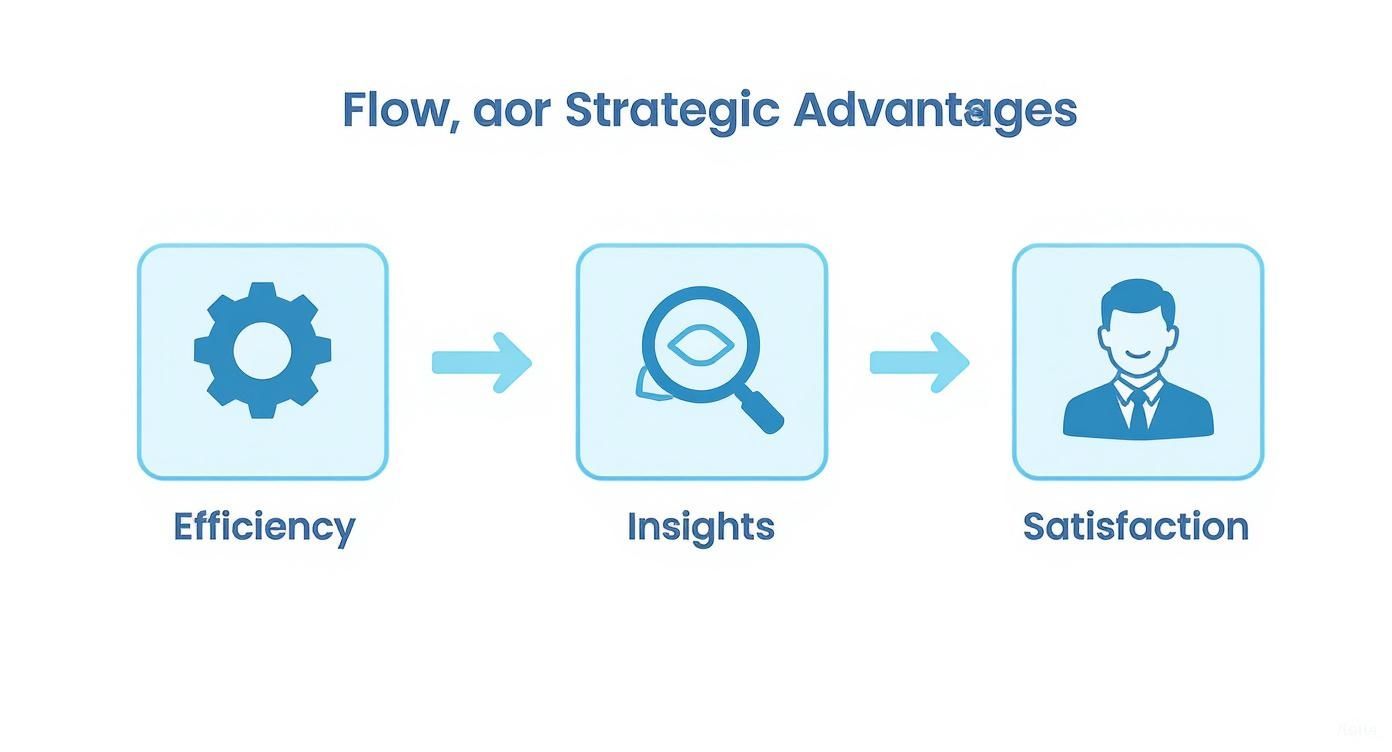
The path from efficiency to client satisfaction shows how technology should serve the human side of practicing law, not the other way around.
Focus your training on practical, real-world workflows. For instance, show your team how an AI-generated medical summary becomes the perfect starting point for building a compelling narrative in a demand letter. This directly connects the tech to better client outcomes.
New research reveals that while 37% of personal injury lawyers are already experimenting with AI on their own, their firms often lack any formal strategy for it. This means most of the current usage is ad-hoc, driven by curious individuals. For firms that put a clear roadmap in place, this is a massive opportunity. By following a structured approach, you can turn that individual curiosity into a powerful, firm-wide strategic advantage. You can explore the full data in the complete legal industry report.
Navigating Ethical Duties in the AI Era
Bringing AI for personal injury lawyers into your firm can unlock incredible efficiencies, but it also brings a set of non-negotiable professional responsibilities. With this new power comes the fundamental duty to protect your clients, your firm, and your license. The ethical landscape may seem new, but the core principles are the same ones we've always applied, just adapted for new technology.
The heart of the matter is this: AI is a tool, not a substitute for your professional judgment. It can draft, summarize, and analyze with breathtaking speed, but it can't exercise the nuanced ethical reasoning that defines a skilled attorney. That part is, and always will be, on you.
Upholding Client Confidentiality and Data Security
Your most sacred duty is to safeguard sensitive client information. When you use an AI tool, you are potentially sharing protected health information (PHI) and other confidential case details with a third-party vendor. This isn't a casual decision; it demands rigorous due diligence.
Before you even think about adopting an AI platform, you have to verify its security posture. Look for vendors who can prove they have enterprise-grade security and a serious commitment to data privacy. Anything less is a gamble you can't afford to take.
Here are the key security indicators you must demand from any AI vendor:
- HIPAA Compliance: This is the absolute floor for any tool that touches medical records. The vendor must be willing and able to sign a Business Associate Agreement (BAA). No BAA, no deal.
- SOC 2 Certification: This independent audit provides proof that a vendor manages data securely to protect the interests and privacy of its clients. It's a gold standard for a reason.
- Data Encryption: Make sure client data is encrypted both in transit (as it's being uploaded) and at rest (while stored on their servers).
And a critical warning: never upload confidential case documents to public, consumer-grade AI models. Those platforms often use your data to train their systems, which is a flagrant violation of your duty of confidentiality. Stick with secure, legal-specific tools built to handle this kind of sensitive information.
Mitigating Inaccuracies and AI Hallucinations
AI models, especially the generative ones, can get things wrong. These errors, often called "hallucinations," can range from small factual slip-ups to fabricating entire case citations that sound perfectly plausible but are completely fictional. Relying on unverified AI output is a fast track to professional sanctions.
The best way to think about it is to treat every AI-generated document as a first draft from a brand-new junior associate. It’s a starting point—a good one, hopefully—but it absolutely requires your expert review, verification, and refinement. You are the one signing your name to the final work product, and you own it.
Think of it this way: AI provides the raw materials, but you are the master craftsman. Your expertise is what shapes that material into a legally sound and factually accurate final product. The duty of supervision can't be delegated to an algorithm.
This "human-in-the-loop" approach is essential. Your entire team needs to be trained to critically evaluate and fact-check every piece of AI-generated content before it ever gets filed, sent to a client, or submitted to opposing counsel.
Establishing Clear Firm-Wide AI Policies
To manage these risks properly, your firm needs a clear and comprehensive AI usage policy. Just letting individual attorneys choose their own tools without any guidance is asking for trouble. It creates inconsistency and exposes the firm to serious liability. A strong policy gives you a framework for responsible innovation.
Your firm’s AI policy should spell out:
- Approved Tools: Keep a list of vetted AI vendors that meet the firm’s security and compliance standards. Forbid the use of unapproved, consumer-grade tools for any work related to a case.
- Data Handling Protocols: Be specific about what information can and cannot be entered into AI systems. For instance, you could mandate the removal of client names or other direct identifiers whenever possible.
- Mandatory Review Process: Require that all AI-generated drafts—from medical summaries to demand letters—are reviewed and signed off on by a qualified attorney or paralegal before being finalized.
- Transparency and Disclosure: Define when and how your firm will disclose the use of AI tools to clients or courts, making sure you stay aligned with evolving bar association guidelines.
By proactively addressing these ethical duties, you can confidently bring AI for personal injury lawyers into your practice. This approach allows you to capture the immense benefits of the technology while upholding the highest standards of professional conduct and protecting the clients who have placed their trust in you.
Answering Your AI Questions
It’s only natural to have questions when a new technology comes on the scene, and AI in the personal injury world is no exception. You’re likely wondering about the cost, the ethical tightropes, data security, and maybe even what this all means for your job. Let's tackle the big questions we hear from attorneys and firm leaders head-on, so you can move forward with clarity and confidence.
Will AI Replace Personal Injury Lawyers or Paralegals?
Let's get this out of the way: No. The idea that AI will replace lawyers or paralegals is a fundamental misunderstanding of what this technology actually does. It's a tool for augmentation, not replacement.
Think of it this way: AI is built to take on the repetitive, data-heavy, and frankly, mind-numbing tasks that bog down your team every single day. It’s the ultimate assistant, absorbing the administrative grunt work so your legal professionals can focus on what they do best.
AI can’t show empathy to a client who just had their life turned upside down. It can’t exercise nuanced legal judgment, build a rapport with a jury, or read the room during a tough negotiation. Those are uniquely human skills. The future isn't about lawyers versus AI; it's about lawyers who master these tools to become better at their jobs.
AI handles the administrative load so you can be a better lawyer. It automates the routine so you can focus on strategy, advocacy, and the client relationships that are the bedrock of your practice.
How Can a Small Firm Afford to Implement AI?
The term "artificial intelligence" sounds expensive, but the reality is far more accessible than you might think. Most modern legal AI tools are offered as a subscription, which means you don't need a huge upfront investment. This is a world away from the old days of buying expensive servers and software licenses.
For a small or solo firm, the trick is to start small and targeted. Don't try to boil the ocean with an all-in-one system. Instead, pinpoint your single biggest bottleneck—for most PI firms, it's summarizing medical records—and find one great tool that solves that specific problem. The return on investment (ROI) is often immediate and surprisingly easy to see.
For instance, if an AI tool costs you a few hundred dollars a month but saves your paralegal 10+ hours of tedious work on a single case, it has already paid for itself. That’s time they can now spend on billable tasks, helping with case strategy, or just giving you the capacity to handle more cases without burning out or hiring more staff.
What Are the Biggest Ethical Risks of Using AI?
This is a critical question. When you bring AI into your practice, you're still bound by your professional duties. The main risks fall into three buckets: client confidentiality, the accuracy of the work, and your non-delegable duty of supervision.
First, client confidentiality is absolute. You have to be certain that any AI vendor you work with has rock-solid security, including HIPAA compliance and SOC 2 certification. Your client's sensitive information must be protected at all costs.
Second, you have to remember that AI isn't perfect. It can make mistakes or even "hallucinate" information that sounds plausible but is completely wrong. You are professionally responsible for every document that leaves your office, whether it was drafted by a human or assisted by an algorithm. You can't blame the AI if a filing is wrong.
Finally, you have a duty to be competent in the technology you use. That means understanding what it can do and, just as importantly, what it can't do. The best way to manage these risks is to create a clear firm-wide policy for AI use, train your team properly, and make sure a "human in the loop" reviews and validates all critical work.
How Do I Ensure Client Data Is Secure When Using AI?
Data security has to be priority number one. The single most important thing you can do is partner only with vendors who were built specifically for the legal industry and take security as seriously as you do.
When you're vetting a potential AI partner, here are the absolute non-negotiables:
- HIPAA Compliance: This is the bare minimum for any tool that touches Protected Health Information (PHI). The vendor must be willing to sign a Business Associate Agreement (BAA) without hesitation.
- SOC 2 Certification: This isn't just a marketing claim; it's proof from an independent auditor that the vendor has strict, verified security controls in place to protect your data.
- Clear Data Policies: You need to know exactly where your data is going, how it's being stored, and who can access it. Frankly, the safest models are AI tools built directly into a secure case management platform. This completely avoids the risk of your team uploading confidential documents to random, unsecured websites.
Doing this level of due diligence isn't just a good idea—it's a core part of your ethical duty to protect your clients.
Are you ready to eliminate countless hours of manual work and gain a strategic edge in your cases? Ares provides a secure, HIPAA-compliant AI platform that automates medical record reviews and demand letter drafting, turning chaotic files into case-winning insights. See how top personal injury firms are settling cases faster and for more. Learn more and get started with Ares today.