Streamline Your Firm with AI Medical Record Review
AI medical record review is a game-changer for personal injury firms. It’s technology that automatically reads, organizes, and pulls out the crucial details from mountains of medical documents, saving your legal team hundreds of hours. It takes messy, scattered files and turns them into clean, structured information you can actually use to build stronger cases, way faster than you could by hand.
The Modern Approach to Personal Injury Case Preparation
Every personal injury lawyer knows the truth: the heart of a winning case lies buried in a mountain of medical records. The old way of digging through these files—page by tedious page—is a massive undertaking. It ties up your best people for hours, creates a logjam in your workflow, and puts a hard ceiling on how many clients you can realistically help.
Frankly, the manual process is like trying to build a 10,000-piece puzzle without the picture on the box. You know the key pieces are in there somewhere, but finding them and piecing together a clear story is painfully slow and full of risk. One overlooked note from a specialist or a misread lab report can unravel your entire case.
Shifting from Manual Labor to Strategic Analysis
This is where AI flips the script. It’s not about working harder; it’s about working smarter. This technology acts like an incredibly fast, detail-obsessed paralegal, taking over the most draining parts of the record review.
Think of it this way: the AI does the heavy lifting—all the monotonous reading, sorting, and organizing. It then hands your team a perfect summary. This frees up your attorneys and paralegals to focus on what they do best: applying their legal expertise, crafting winning arguments, and fighting for your clients. The point isn’t to replace your team, but to supercharge them. Our guide on using AI for personal injury lawyers dives deeper into how this powerful partnership works.
The real value of AI is not in its ability to think like a human, but in its capacity to process information at a scale and speed that humans cannot. It finds the needles in the haystack so you can decide what to do with them.
When you automate that initial, painstaking review, you unlock some serious advantages:
- Accelerates Case Timelines: What once took days or even weeks can now be done in minutes. This means you can get demand letters out the door faster and move cases toward resolution.
- Improves Factual Accuracy: An AI system doesn't get tired or distracted. It meticulously pulls every single diagnosis, treatment, and provider, minimizing the chance of human error and building your case on a rock-solid foundation of facts.
- Uncovers Hidden Insights: By analyzing thousands of pages at once, AI can spot connections and patterns a person might miss—critical details that could become the linchpin of your case narrative.
This guide will show you how AI medical record review isn't some far-off concept. It's a practical tool that’s here today, giving firms the power to craft more persuasive demand letters and secure better outcomes for their clients.
Manual vs. AI-Powered Medical Record Review
To truly grasp the shift, it helps to see the two approaches side-by-side. The traditional method is linear and labor-intensive, while the AI-driven approach is about speed, depth, and strategic advantage from day one.
| Aspect | Manual Review Process | AI Medical Record Review |
|---|---|---|
| Initial Sorting | Staff physically or digitally sorts hundreds of pages by date and provider. | AI automatically categorizes and chronologically orders all documents in seconds. |
| Time Investment | 20-40+ hours per case, depending on complexity. Creates significant delays. | Under 15 minutes per case. Analysis is completed almost instantly. |
| Data Extraction | Paralegal or attorney reads line-by-line, manually highlighting and noting key facts. | The system automatically extracts all diagnoses, treatments, providers, and billing information. |
| Accuracy | Prone to human error, fatigue, and missed details, especially in massive files. | Extremely high accuracy. The AI cross-references information across the entire record set. |
| Strategic Insight | Relies solely on the reviewer's ability to connect dots across different documents. | AI identifies patterns and surfaces non-obvious connections, providing deeper insights for case strategy. |
| Output | A hand-crafted summary or memo, which takes additional time to write. | An instant, structured summary, medical chronology, and organized data ready for the demand letter. |
The table makes it clear: this isn't just a minor upgrade. It's a fundamental change in how personal injury cases can be prepared, turning a major administrative burden into a source of strategic strength.
How AI Unlocks Critical Insights from Medical Records
Think of an AI medical record review platform as your firm’s most diligent, lightning-fast paralegal. It can read, comprehend, and organize thousands of pages of dense medical files in the time it takes you to finish your morning coffee—a job that would otherwise tie up a human team member for weeks. This isn't just about speed; it's about a sophisticated partnership between two core technologies.
It all starts with Optical Character Recognition (OCR), which acts as the system's eyes. OCR scans every page, from neatly typed hospital discharge summaries to a doctor’s nearly illegible handwritten notes, and turns those images into digital, machine-readable text. This is the crucial first step that gets the raw information off the page and into the system.
From there, Natural Language Processing (NLP) takes the baton. If OCR provides the eyes, NLP is the brain. This is where the real intelligence comes in. NLP doesn't just see words; it understands medical language, context, and nuance. It knows the difference between a patient complaining of "neck pain" and a physician's formal diagnosis of "cervical spine herniation"—a distinction that can make or break a case. Understanding the fundamentals of AI-powered document review can shed more light on how this technology works under the hood.
From Raw Text to Actionable Intelligence
This one-two punch of OCR and NLP transforms a mountain of disorganized documents into a perfectly structured, searchable case file. The AI isn’t just flagging keywords. It’s actively identifying and categorizing the specific data points that are legally vital to your case.
Trained on millions of real-world medical documents, these systems learn to pull out the most important information with incredible accuracy. Here’s a glimpse of what it finds and sorts for you:
- Diagnoses and Conditions: Every single diagnosis, from a minor "soft tissue injury" to a life-altering "traumatic brain injury," is identified and cataloged.
- Treatments and Procedures: It logs every medication, every surgery, and every physical therapy appointment.
- Providers and Facilities: The system builds a comprehensive list of every doctor, specialist, clinic, and hospital the client has visited.
- Key Dates and Timelines: It automatically assembles a complete medical chronology, laying out the entire sequence of events from the initial incident onward.
This concept map helps visualize the difference between the traditional, manual review slog and a modern, AI-driven workflow.
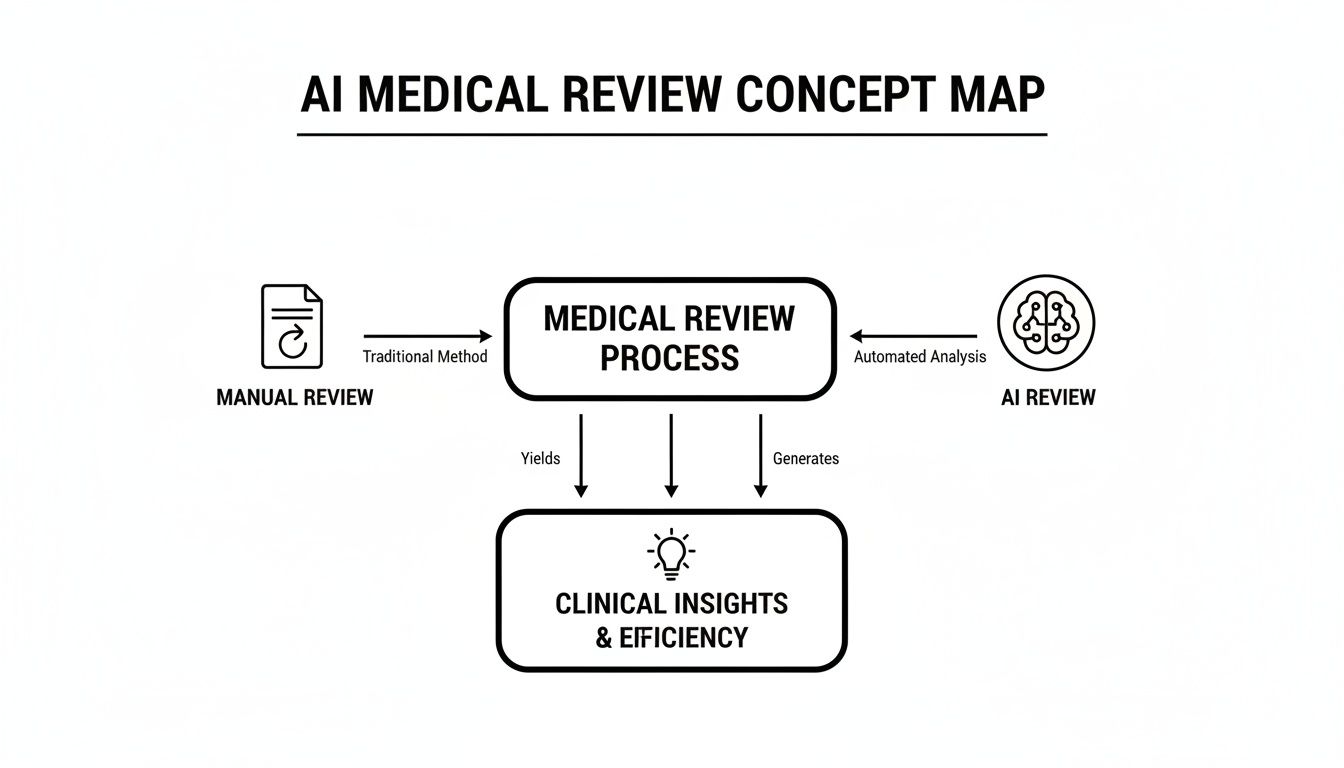
As you can see, both paths lead to the same goal—clinical insights—but the AI route gets you there faster and more efficiently, eliminating much of the manual friction.
The Strategic Value of Structured Data
So, why is having all this data neatly organized so powerful for a personal injury firm? It completely changes how you build your case. It provides an objective, complete, and instantly searchable foundation for your entire strategy.
Instead of your team spending hours flipping through binders to find one specific detail, they can now find it in seconds. This structured data becomes the unshakable backbone of your demand letter, enabling you to tell a clear, fact-based story of your client's ordeal and the true extent of their treatment.
The real advantage isn’t just speed; it's clarity. AI provides a 30,000-foot view of the entire medical story, revealing patterns and gaps that are nearly impossible to spot when reviewing documents one page at a time.
This birds-eye view empowers your team to quickly spot inconsistencies, identify missing records that need to be requested, and build a much stronger argument for negotiations. You can instantly see if a diagnosis was consistently treated or if there were long gaps in care that the defense might try to exploit. A well-organized output, like an AI-generated https://areslegal.ai/blog/medical-record-summary, is the first step toward building a more persuasive narrative.
In the end, this technology unlocks deeper insights by taking over the tedious work of data extraction and organization. This frees up your legal experts to do what they do best: use those insights to win cases.
Strategic Advantages for Personal Injury Firms
Understanding the mechanics of AI medical record review is one thing, but seeing how that technology actually moves the needle is what matters for a busy personal injury firm. This isn't just about plugging in a new tool; it's about gaining a serious competitive advantage that impacts your caseload, settlement values, and ultimately, your bottom line.
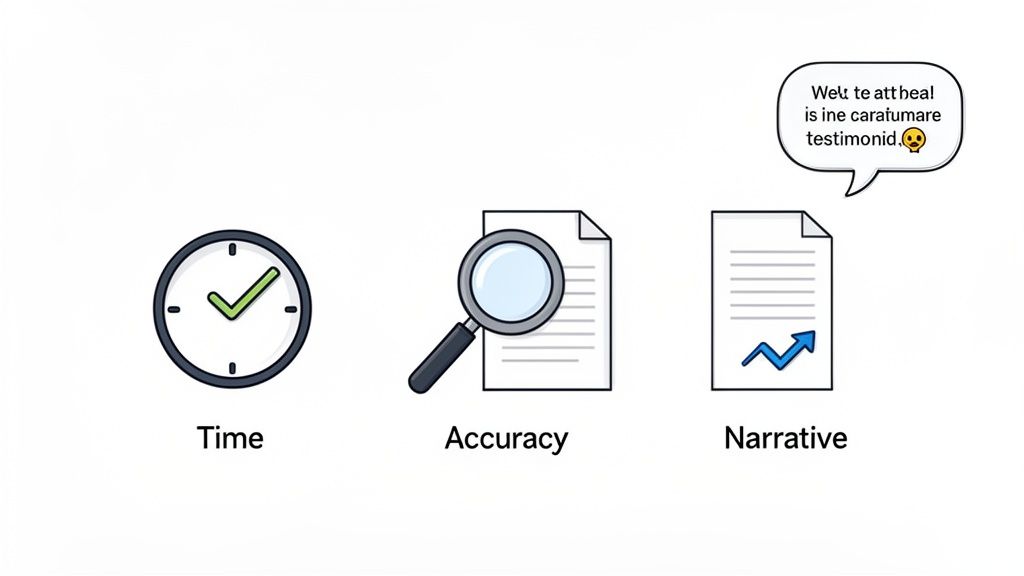
When you move past the "how it works" and get to the "why it matters," three core benefits jump out. These directly tackle the biggest headaches in personal injury law: reclaiming huge chunks of time, achieving near-perfect accuracy, and building much stronger case narratives. They work together to completely change how your firm preps for negotiation and trial.
Massive Time Savings and Increased Capacity
The first and most obvious win is how much manual work it eliminates. Any paralegal or attorney knows the grind of spending 20-40 hours, sometimes more, slogging through a dense medical history, page by tedious page. That administrative work creates a massive bottleneck, throttling the number of cases your team can handle well.
An AI platform smashes that bottleneck. By automating the extraction of key facts—diagnoses, treatments, providers, and dates—it condenses days of work into something you can finish in under 15 minutes.
This isn’t just a small efficiency gain. Think about what your team can do with all those recovered hours. Instead of being buried in paperwork, they're free to focus on high-value strategic tasks: drafting compelling motions, talking to clients, and sharpening legal arguments. It's about shifting your best people from data entry to advocacy.
The legal tech world is catching on fast. By late 2024, an estimated 85% of healthcare organizations had already started using or exploring generative AI. The reason? Specialized platforms are delivering up to a 65% boost in efficiency over manual methods. You can learn more about how AI summarization statistics are impacting both healthcare and legal workflows.
Superior Accuracy and Risk Mitigation
Let's be honest: human error is a real risk in manual review. A tired paralegal on their fifth thick file of the week can easily miss a subtle but critical detail. It could be an alternative diagnosis, a note about a pre-existing condition, or a medication that clashes with the client's story. Any one of those oversights can seriously weaken a case, leading to a lower settlement or a loss at trial.
AI doesn't get tired or distracted. It scans every single word, ensuring no critical piece of information falls through the cracks. This gives you a rock-solid factual foundation to build your case on.
"Before using AI, we lived in constant fear of what we might have missed. Now, we build our cases with confidence, knowing every single medical fact has been identified and organized. It's like having a safety net that catches everything, allowing us to focus entirely on strategy."
This complete picture also helps you get ahead of the defense. By spotting potential weaknesses or inconsistencies in the medical history early, you can craft your arguments to address them head-on, strengthening your position long before you even get to the negotiating table.
Crafting Stronger Case Narratives
At the end of the day, winning a personal injury case comes down to telling a clear, compelling, and fact-based story. A jumbled stack of medical records makes that incredibly difficult. AI is the solution, automatically generating a perfectly organized medical chronology that becomes the spine of your narrative.
This structured timeline makes it simple to draw a straight line from the incident to your client's injuries. You can clearly demonstrate the progression of their condition, the consistency of their treatment, and the true extent of their pain and suffering.
That clarity is pure gold during settlement talks. Instead of dumping a messy pile of documents on an adjuster, you can present a concise, powerful summary backed by a detailed chronology. This level of professionalism doesn’t just build credibility—it makes it much harder for insurance companies to poke holes in the facts. The result? Faster, more favorable settlements, all because the AI gave you the tools to tell your client's story with undeniable force.
Navigating HIPAA Compliance and Data Security
When you're dealing with Protected Health Information (PHI), data security isn't just a feature—it's the bedrock of your practice. For any personal injury firm looking at an AI medical record review tool, the first and most critical question is always about HIPAA.
Handing over sensitive client data to a third-party AI system can feel like a big leap. But here’s the thing: a modern, purpose-built AI platform is often far more secure than the old way of doing things. Just think about the risks of paper files in a cabinet, unencrypted emails flying back and forth, or documents scattered across local desktops. Each one is a potential breach waiting to happen.
A reputable AI provider acts as a Business Associate under HIPAA. This isn't just a title; it means they are legally obligated to protect your client's data with the same rigor you are. That relationship is built on a solid framework of technical safeguards designed to shield PHI at every turn.
The Pillars of AI Data Security
When you're vetting AI platforms, airtight data security and compliance are absolutely non-negotiable. The best tools build their entire security architecture on a few key principles to guarantee your client’s information stays private. For a deeper look, understanding HIPAA compliance in legal tech is a must-read for any modern firm.
These aren't just items on a checklist; they work together to create a formidable defense.
- End-to-End Encryption: From the moment you upload a file to the second it's stored, all data is encrypted. In the highly unlikely event of a breach, the information itself would be completely unreadable and useless.
- Strict Access Controls: Does every paralegal need to see every single client record? Of course not. Good platforms let you set role-based access, ensuring people only see the information they absolutely need to do their job.
- Secure Cloud Infrastructure: Top AI companies don't host this on a server in a back room. They use enterprise-grade cloud services that are constantly monitored and meet tough international security standards, complete with threat detection and disaster recovery plans.
It's a common myth that keeping data on-site is safer. The truth is, a specialized, HIPAA-compliant cloud environment managed by experts provides a level of security that's practically impossible for a single law firm to replicate on its own.
Your AI Vendor as a Compliance Partner
Picking the right AI partner is about more than just buying software. You're bringing on an ally in your compliance efforts. A vendor worth their salt will be completely transparent about their security protocols and hand you a formal Business Associate Agreement (BAA) without you even having to ask.
This partnership strengthens your firm's own security. By moving document management into one secure, audited system, you minimize the risks that come with scattered physical files and haphazard digital storage. Every action inside the platform—from an upload to a data search—is logged, creating a clean audit trail that's invaluable for showing due diligence. To learn more, check out our guide on HIPAA-compliant document management for law firms.
At the end of the day, bringing in a compliant AI tool is a proactive move to secure your data. It swaps out vulnerable manual processes for a controlled, monitored, and highly protected workflow. That frees you up to focus on winning cases, confident that your client's information is safe.
Weaving AI Review into Your Firm's Workflow
Bringing an AI medical record review platform into your firm doesn't mean you have to tear down your existing processes and start over. Think of it more like adding a supercharger to an already powerful engine. The goal is a smooth transition that plugs right into your current workflow, letting your team see the benefits almost right away.
This isn't about learning some complicated new system from scratch. It’s about upgrading one critical, and often frustrating, step. Instead of your team manually sifting through mountains of paper, a dedicated tool now handles the most time-intensive part of building a case. This frees up your paralegals and attorneys to start their strategic work with a complete, structured set of facts already on their desk.
A Practical Step-by-Step Workflow
Modern platforms like Ares are built for busy legal professionals, not tech wizards. The process is designed to be intuitive, and most teams can get up to speed in less than an hour.
Here’s what that looks like in practice:
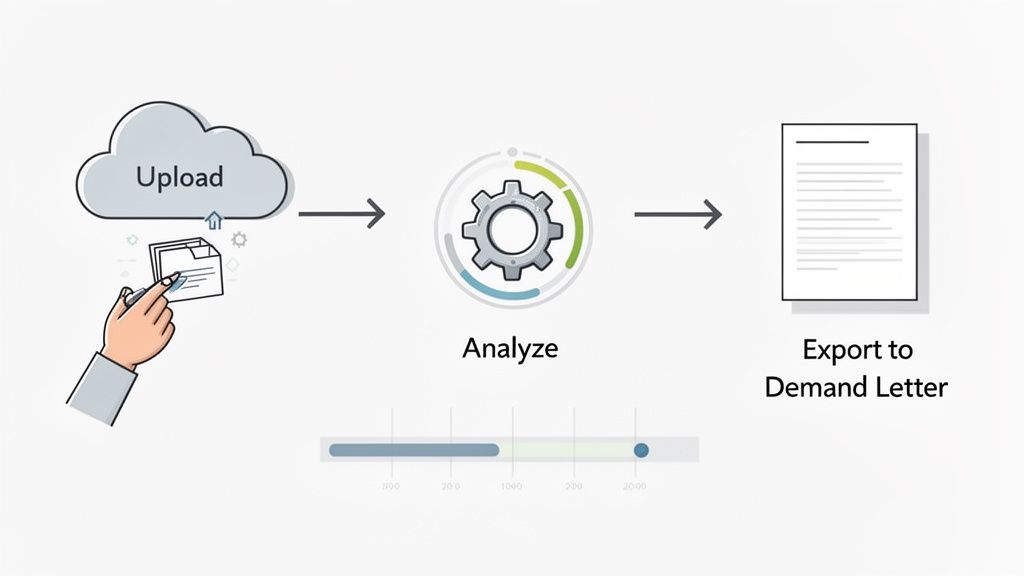
Secure Document Upload: First, you gather all the case's medical records—PDFs, scanned images, files from provider portals, you name it. Then, you simply drag and drop them into the secure, HIPAA-compliant platform.
Initiate AI Analysis: With the files loaded, a team member starts the review with a single click. The AI immediately gets to work, using OCR and NLP to read, understand, and pull out every important piece of information from the documents.
Review the Structured Output: In just minutes, the platform lays everything out on a clean, organized dashboard. You get a complete medical chronology, a list of every provider, all diagnosed conditions, and a clear timeline of treatments.
This structured output is the real game-changer. It’s a comprehensive, 30,000-foot view of your client's entire medical journey, primed and ready for your strategic analysis.
From Insights to Action
Once the AI has done the heavy lifting, your legal team steps in, armed with perfectly organized information. This is where human expertise and machine efficiency truly come together.
With this structured data, your team can instantly:
- Spot Missing Records: A glaring gap in the treatment timeline becomes obvious, prompting a quick request for the missing files.
- Identify Case Strengths: Key diagnoses and consistent treatment patterns are pulled to the surface, forming the backbone of your argument.
- Prepare for Depositions: Having a full list of providers and key dates makes deposition prep faster and far more thorough.
- Export for Demand Letters: This is huge. You can export the organized summary and medical chronology directly into your demand letter draft, cutting out hours of tedious writing and formatting.
The whole point is to let the machine handle the mind-numbing data organization so your legal experts can focus on what they do best: building a winning strategy. The AI delivers the "what," and your team provides the "so what."
This approach isn't new; it's already proven in the healthcare industry. Health systems, where AI adoption is highest at 27%, use these tools to summarize records while keeping human experts firmly in the driver's seat. In fact, trust in AI outputs can jump by 4x when a human expert is part of the review process. For personal injury litigators, this means you can confidently rely on platforms that digest massive files from countless sources to surface key facts with precision. You can discover insights about AI in the legal and medical space to see where the industry is heading.
Ultimately, adding an AI medical record review platform is a straightforward upgrade. It complements your existing case management software by feeding it higher-quality, better-organized information, allowing your firm to get up and running quickly and see an immediate return on investment.
Choosing the Right AI Medical Record Review Partner
Picking a technology partner is a huge decision, one that will echo through your firm’s workflow for years. The legal tech world is crowded, and it's easy to get overwhelmed. The real trick is to find a platform built from the ground up for the specific grind of personal injury litigation—not some generic AI tool that's been tweaked to "work" for legal.
A true partner gets it. They understand that reviewing medical records for a PI case is more than a simple keyword search. It's about grasping the medical-legal story behind the data to connect diagnoses, treatments, and causation. A generic tool might spot a word, but a specialized AI medical record review platform understands its weight and meaning, which is everything when you're building a case.
Essential Evaluation Criteria
To cut through the noise, you need a solid framework for evaluating your options. Focus on these core areas to figure out who the serious players are and who's just a generalist in disguise.
- PI-Specific Accuracy: Don't be shy—ask for their accuracy rates. A top-tier platform should be able to prove it can pull critical data like diagnoses and treatment dates from messy medical files with high precision, often over 94%.
- HIPAA Compliance and Data Security: This is a deal-breaker, plain and simple. Your vendor must provide a Business Associate Agreement (BAA) and be totally transparent about their security, from data encryption to who can access what.
- A User-Friendly Interface: The whole point is to make life easier. If your team needs weeks of training just to navigate the platform, you're creating a new bottleneck, not solving an old one. It has to be intuitive.
- Responsive, Knowledgeable Support: What happens when you're stuck on a complex file? You need a support team that actually understands the legal world and can give you a straight answer, fast.
Red Flags to Watch For
Knowing what to avoid is just as critical as knowing what to look for. If a vendor gets cagey when you ask about their tech or security protocols, that's a massive red flag. A lack of transparency is a sign of trouble ahead.
Another classic mistake is picking a tool that can’t handle the real world of medical documents—think handwritten notes from doctors or fuzzy, poorly scanned pages. A platform that crumbles when faced with less-than-perfect documents is a platform that will let you down right when you need it most.
The right AI partner doesn’t just sell you software. They give you a reliable, secure, and intelligent system that feels like a natural extension of your team, consistently delivering the clear insights you need to win.
Why Specialization is No Longer Optional
Across every industry, AI built for specific jobs is taking over. What started as a niche idea is now becoming standard practice. For example, adoption in healthcare organizations is projected to leap from just 3% in 2023 to 22% by 2025. Doctors are on board because they’ve seen AI find buried facts with 94% accuracy, crushing the 65% rate of manual review for crucial detections. You can read more about how clinical records trends are evolving.
This isn't just a trend; it's a fundamental shift. By carefully vetting potential partners using these criteria, you can choose an AI medical record review platform that does more than save time—it sharpens your competitive edge and helps you deliver better outcomes for your clients.
Common Questions About AI Medical Record Review
Even when you see the potential, bringing any new technology into your firm raises questions. It’s only natural. Let's tackle some of the most common ones we hear from personal injury firms weighing a switch to an AI medical record review platform.
We've pulled these questions directly from conversations with attorneys and paralegals to get straight to what matters when you're looking to upgrade your firm's process.
Can AI Completely Replace a Paralegal for Medical Record Review?
No, and that’s not the goal. Think of AI as a powerful assistant, not a replacement. Its real job is to handle the most draining parts of the review—pulling out the key facts and organizing everything. This frees up your paralegals and attorneys for the work that actually wins cases.
The AI is like the world's most diligent researcher. It finds every detail and organizes the evidence perfectly. Your legal team then takes that organized file and does what they do best: analyze the information, spot weaknesses in the case, and build a powerful narrative. The best approach is always human oversight. Your experts use the AI's output as a rock-solid foundation, not as the final word.
How Accurate Is the Data AI Pulls from Medical Records?
Top-tier AI platforms built for legal work are incredibly accurate, often hitting over 94% precision on critical data points like diagnoses, treatment dates, and providers. Honestly, that’s a big step up from manual review, which can fall victim to fatigue, distraction, or just plain human error.
Here's the key difference: specialized AI is trained on millions of medical documents. It learns to recognize complex medical jargon and messy formatting, ensuring the data is reliable enough to build a case on.
This level of precision gives you a factual backbone you can trust for your demand letters and settlement talks. You start from a much stronger position when your facts are airtight from the beginning.
Is It Difficult to Get My Team Onboarded with an AI Platform?
Not at all. The best platforms are designed to be intuitive right out of the box. The whole workflow is usually as simple as dragging and dropping files into your browser and working from a clean, straightforward dashboard.
Most firms get their teams up and running in under an hour. These tools are meant to make your life easier, not add another complicated piece of software you have to wrestle with. The focus is on getting you a fast return on your investment, so the transition is built to be smooth. You should start seeing the benefits in your firm’s efficiency almost immediately.
Ready to break the logjam in your case prep and build stronger demand letters in a fraction of the time? With Ares, your firm can transform mountains of medical records into clear, actionable insights in minutes. See how top personal injury firms are saving over 10 hours per case and settling for more.