

Think of AI software for law firms as your best paralegal on steroids. It's a powerful tool designed to tear through the high-volume, repetitive work that eats up a firm's most valuable resource: time. This isn't about replacing lawyers. It's about augmenting their expertise, freeing them up to focus on strategy, client relationships, and winning cases.
A Fundamental Shift in How Law is Practiced
For generations, legal work has been defined by painstaking manual effort. Think of the endless hours spent combing through discovery documents, redlining contracts, or piecing together legal research. This old model worked, but it was slow and created a natural ceiling on how much a firm could accomplish. AI shatters that ceiling.
Imagine a team member who can read and perfectly recall thousands of pages of medical records in the time it takes you to drink your morning coffee. That’s the reality of modern legal AI. We're not talking about robots making closing arguments. We're talking about smart algorithms built to handle specific, data-heavy legal tasks with a speed and accuracy no human can match. This lets attorneys shift their focus from processing information to thinking strategically about it.
More Than Just Automation—It's Augmentation
The real power here isn't just in doing things faster; it's in making your team smarter. Automation simply completes a rote task. Augmentation, on the other hand, enhances a lawyer's own skills and judgment.
For instance, a personal injury attorney might typically spend 20 hours meticulously reviewing a client's medical history. With AI, that same attorney can pull out every critical detail—diagnoses, treatments, and prognoses—in a matter of minutes.
That reclaimed time is where a firm gains its competitive edge. Those hours can be reinvested directly into work that wins cases:
- Building more compelling legal arguments based on AI-surfaced insights.
- Spending more time on the phone with clients, building trust and providing better counsel.
- Taking on a more complex caseload without burning out your staff.
- Entering negotiations armed with data-driven analysis of similar cases and likely outcomes.
The point isn’t just to work faster, it's to work with greater insight. When you delegate the meticulous, grunt work to AI, your legal team can apply its full brainpower to the nuanced, high-level thinking that clients truly value.
Leading law firms have stopped asking if they should adopt this technology and are now asking how quickly they can get it running. They understand that in today’s legal market, efficiency isn't a luxury—it’s essential for excellent client service and firm profitability. AI provides a clear path to that efficiency, giving practices that embrace it a serious advantage. As we’ll see, getting started is a practical step toward building a more responsive and successful firm.
What Can Legal AI Actually Do? A Look at Its Core Capabilities
So, let's get past the buzzwords. What can AI software for law firms really do on the ground? It's best to think of it not as a single, magical tool but as a highly specialized team. Each "member" of this AI team has a specific skill set built to handle the most repetitive, time-consuming parts of legal work. These aren't just abstract tech features; they produce real-world results that save countless hours and help build stronger cases.
At its core, legal AI is a master at processing and understanding huge volumes of unstructured text—the kind of dense, complex information that makes up most legal documents. This is where you see the most immediate, almost startling, impact. Instead of your attorneys or paralegals spending days or weeks slogging through thousands of pages, the software can do it in minutes. It's built to spot patterns, flag risks, and pull out critical details that a human might miss after hours of reading.
This diagram helps visualize how an AI legal assistant becomes a central hub, giving lawyers a massive advantage by handling the heavy lifting of research, data analysis, and strategy development.
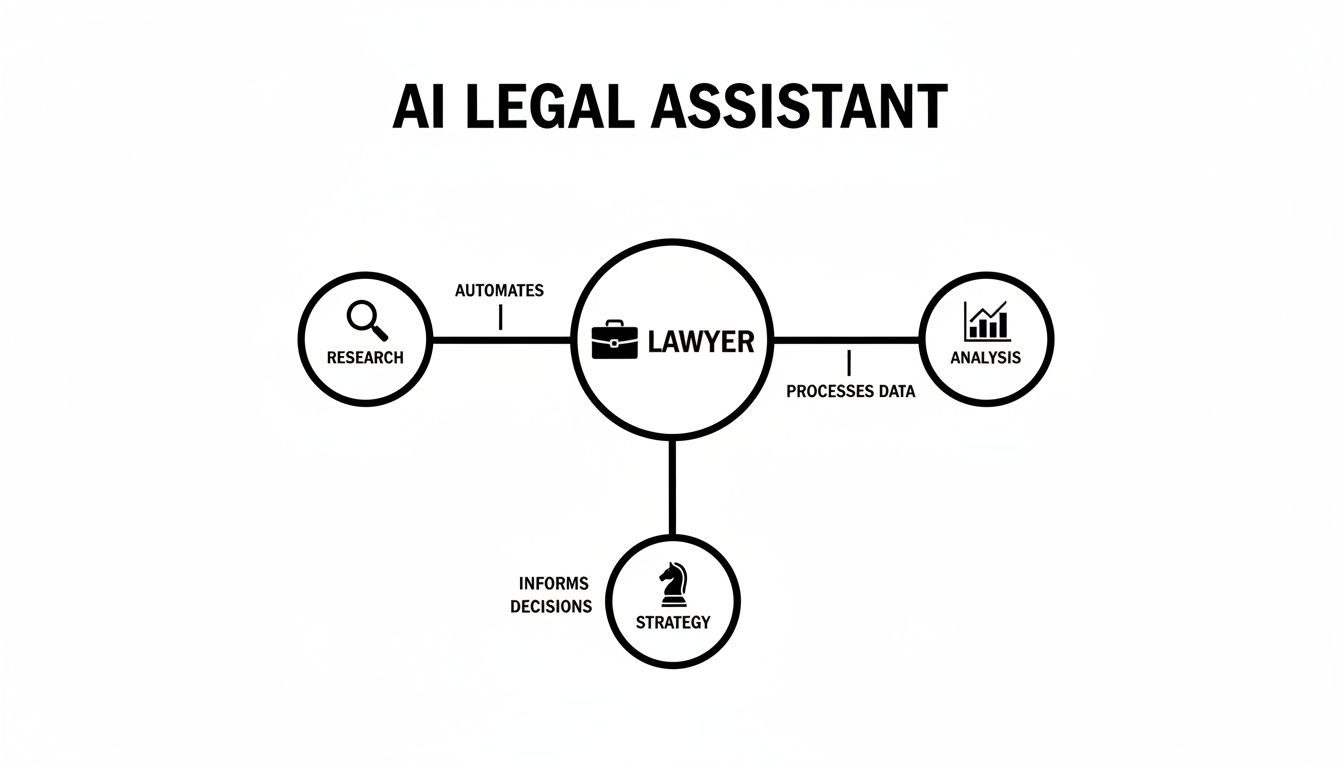
As you can see, AI isn't some separate, bolt-on function. It integrates directly into core legal workflows, empowering attorneys to make quicker, more data-driven decisions.
Intelligent Document Review and Analysis
The most fundamental—and arguably most powerful—capability is intelligent document review. Imagine you could feed thousands of pages of contracts, depositions, or medical records into a system and tell it to find every single mention of a specific injury or a problematic clause. That's exactly what it does.
For a personal injury firm, this is game-changing. AI can instantly pull out diagnoses, treatment dates, and provider names from hundreds of pages of messy medical records. And this isn't just a glorified "Ctrl+F" search. The AI understands context, so it can identify relevant concepts even if the wording isn't an exact match. This massively speeds up case prep and dramatically cuts down on the risk of human error.
A more advanced version of this is Conversation Intelligence, which uses AI to automatically transcribe and analyze client calls. This can uncover crucial details and patterns you might have otherwise missed, providing a goldmine of information for your case strategy.
Automated Legal Research and E-Discovery
Another major strength is automated legal research. We all know the drill: hours spent digging through databases, reading through endless case law, and hoping you find the perfect precedent. AI tools can take a case brief and almost instantly return the most relevant statutes, case law, and supporting arguments, often ranked by how applicable they are to your specific situation.
This doesn't just save time; it helps lawyers build much stronger arguments from the get-go. The same logic applies to e-discovery, where AI can sift through millions of emails and documents to flag privileged or relevant information, making a once-monumental task faster and far more defensible. The industry is catching on fast.
Back in 2024, only 22% of law firms had adopted AI. By 2025, that number skyrocketed to an incredible 80%. This isn't just growth; it's the fastest technological shift the legal profession has ever seen, largely because firms are scrambling to keep up with disruptive new tools.
AI is no longer an experiment. It's now a core strategic asset, with 46% of its applications focused on directly enhancing professional services like legal research and case preparation.
How AI Capabilities Streamline Key Legal Tasks
To put it all together, here’s a simple breakdown of how these powerful AI functions map directly to the high-value legal tasks your firm handles every day.
| AI Capability | Automated Legal Task | Primary Benefit |
|---|---|---|
| Natural Language Processing (NLP) | Document Review & Analysis | Finds key facts, dates, and clauses in thousands of pages instantly. |
| Machine Learning (ML) | E-Discovery & Predictive Coding | Identifies and categorizes relevant documents with high accuracy. |
| Generative AI | Legal Research & Memo Drafting | Surfaces relevant case law and generates initial drafts of legal documents. |
| Contract Analytics | Contract Lifecycle Management | Flags risks, ensures clause consistency, and extracts key terms. |
This table shows that for every core legal function bogged down by manual work, there's an AI capability ready to take over the heavy lifting.
Contract Lifecycle Management
For firms that handle a lot of transactional work, AI completely automates the contract lifecycle management (CLM) process. This isn't just one thing; it covers the entire journey of an agreement.
- Drafting: The AI can generate first drafts of contracts using pre-approved templates and clauses, ensuring a solid, consistent starting point.
- Review: It automatically flags non-standard terms, identifies potential risks, and points out missing clauses by comparing a new draft against your firm's established playbook.
- Analysis: Need to perform due diligence? The AI can analyze entire portfolios of existing contracts to extract key data points and assess overall risk.
This brings a new level of consistency to your agreements, speeds up negotiations, and minimizes risk across the board. For paralegals, this means evolving from tedious proofreading to more strategic oversight—a shift we explore in our guide on the artificial intelligence paralegal.
By automating these fundamental functions, AI software for law firms frees up legal professionals to focus on what they do best: thinking strategically and delivering better outcomes for their clients.
AI in Action for Personal Injury Law Firms

To really see what AI software for law firms can do, let's step away from general concepts and look at a specific, high-stakes practice area. Personal injury law is the perfect testing ground. It’s a field drowning in unstructured data, tangled timelines, and the constant pressure to build a powerful story for your client.
Historically, the grunt work of building a solid PI case meant hundreds of hours of manual labor. Paralegals and attorneys would spend days, even weeks, buried in stacks of medical records, police reports, and witness statements. They’d painstakingly piece everything together, trying to build a clear timeline and calculate damages, all with the clock ticking.
AI flips that script entirely. Think of it as a force multiplier for your team. It automates the most tedious, time-consuming parts of case prep, freeing up your legal professionals to focus on what humans do best: strategy, advocacy, and client relationships. This isn't just about shaving off a few hours; it's about building stronger, more valuable cases from day one.
Mastering Medical Records with Machine Intelligence
The single biggest bottleneck in any personal injury case? The medical record review. A single complex case can easily generate thousands of pages of dense, jargon-filled documents from a dozen different providers. Finding the critical details is like searching for a needle in a haystack—a very expensive and time-consuming haystack.
This is where AI platforms truly shine. An attorney can upload a client's entire medical history, and in just minutes, the software intelligently extracts and organizes the most vital information.
It pulls out details like:
- Key Dates: Pinpointing the exact dates of injury, diagnoses, surgeries, and follow-up treatments to build a rock-solid chronology.
- Diagnoses and Prognoses: Highlighting every formal diagnosis and the long-term outlook described by physicians.
- Treatment Histories: Assembling a complete list of every procedure, medication, and therapy session the client has gone through.
- Provider Information: Mapping out every doctor, specialist, and facility involved in your client’s care.
This instant organization gives your team a powerful, top-down view of the case facts. You can immediately spot gaps in treatment, identify pre-existing conditions that need addressing, and build a cohesive medical narrative without the manual slog. It also sets the stage for a much stronger demand letter. For a closer look, you can read our dedicated article on AI for personal injury lawyers.
Data-Driven Valuations and Stronger Negotiations
Beyond just organizing facts, AI gives you a serious strategic edge in negotiations. By analyzing huge datasets of past case outcomes, jury verdicts, and settlement amounts for similar injuries in your specific jurisdiction, these tools help you calculate potential case values with far greater accuracy.
Suddenly, case valuation shifts from an art based on gut feeling to a science backed by hard data.
When an attorney walks into a negotiation armed not just with a client's story but with concrete data on what similar cases are worth, their position becomes exponentially stronger. This data-backed approach leads to more compelling demand letters and often results in faster, more favorable settlements.
The legal community is taking notice. Civil litigation is leading the charge with 27% firm-level adoption, and personal injury is right behind at 20%. But when you look at individual lawyers, PI attorneys are some of the quickest to adapt, with 37% already using AI for tasks like drafting.
For a personal injury practice, AI software isn’t just an efficiency tool; it’s a strategic asset. By automating medical fact-finding and providing data-driven valuation insights, it empowers you to build bigger claims, justify higher settlement demands, and get better outcomes for your clients in a fraction of the time.
Calculating the True Return on Your AI Investment
Let's shift from features to the bottom line. For any firm partner, the most important question is always the same: what’s the actual return on this investment? Measuring the ROI of AI software for law firms is about much more than just subtracting the software cost from the time saved. It's about calculating the total value you unlock, from reclaimed billable hours to entirely new opportunities for growth.
Think of it like the jump from a manual typewriter to a word processor. The initial cost was one thing, but the real return was the explosion in productivity, quality, and capacity that followed. AI offers a similar leap, taking over the painstaking work that eats up hundreds of hours and freeing your legal team to focus on high-value, strategic work.
Beyond Direct Cost Savings
The easiest ROI to see is in direct time savings. When an AI tool takes over document review, it converts non-billable administrative time into billable strategic time. A task that once took a paralegal 10 hours of manual sifting might now be done in 30 minutes by the AI, followed by an hour of human verification.
That’s a net gain of 8.5 hours on a single case. That time can now be spent on client counsel, drafting a motion, or even starting work on the next matter.
But the financial impact doesn't stop there. The real value is found in the ripple effects across your entire firm.
- Increased Caseload Capacity: By automating the grunt work, your current team can handle a larger volume of cases without burning out or sacrificing quality.
- Larger, More Justified Claims: AI is relentless. It finds every relevant medical detail or legal precedent, allowing you to build ironclad cases that justify higher settlement demands.
- Faster Case Turnaround: When document review and research happen in a fraction of the time, you can file quicker and reach settlements faster. This dramatically improves cash flow and makes clients incredibly happy.
This efficiency is a direct engine for growth. The recent 2025 Clio Legal Trends Report uncovered a huge difference between firms using AI and those who aren't. Growing firms nearly doubled their revenue over four years with only a 50% increase in caseload, a feat largely credited to AI-driven efficiencies. Meanwhile, shrinking firms, which used far less AI, saw their revenues plummet by 50%.
Quantifying Indirect Benefits
To get the full picture, you have to look at the indirect benefits that still hit the bottom line hard. These are the advantages that give your firm a real, lasting competitive edge.
Take faster case turnarounds, for example. It’s not just about getting paid sooner. A client who gets a great settlement in six months instead of sixteen is going to be your biggest advocate. They’ll leave glowing reviews and send referrals your way, creating a powerful marketing engine that costs you nothing.
The strategic advantage is perhaps the most significant, yet hardest to quantify, return. AI gives your firm the analytical power to take on more complex, high-value litigation that was previously out of reach, fundamentally changing your growth trajectory.
Likewise, the improved accuracy from AI analysis cuts down on the risk of costly human errors—those missed details that can weaken a case or even lead to malpractice claims. Mitigating that risk is a tangible financial return, protecting the firm from losses and strengthening your reputation. If you're looking to capitalize on these benefits, our detailed guide on law firm automation software is the perfect place to start.
A Real-World ROI Example
Let's put this into practice. Imagine a mid-sized personal injury firm that handles 50 complex cases a year.
| Metric | Before AI Implementation | After AI Implementation |
|---|---|---|
| Manual Review Time per Case | 15 hours (Paralegal) | 2 hours (AI + Paralegal) |
| Total Review Hours Annually | 750 hours | 100 hours |
| Hours Reclaimed Annually | N/A | 650 hours |
| Equivalent Billable Value | N/A | $97,500 (at $150/hr rate) |
| Annual AI Software Cost | $0 | -$20,000 |
| Net Financial Gain (Year 1) | N/A | $77,500 |
This simple breakdown shows a nearly 4x return on investment from time savings alone. And that's before you even factor in the firm's new ability to handle more cases or secure larger settlements with stronger evidence. The true ROI of AI isn't just in the money it saves, but in the new value it empowers your firm to create.
Upholding Security and Ethics with AI Tools

In law, trust is everything. So when we talk about bringing new technology into a practice—especially AI software for law firms—the conversation has to start with security, confidentiality, and professional ethics. These aren't just technical details; they get to the heart of our duty to our clients.
Adopting an AI platform isn't like buying a new word processor. You're essentially partnering with a data processor. Every single document you upload, from sensitive medical records to internal case notes, is put in their hands. That makes choosing a vendor less of a tech decision and more of an ethical one.
The Non-Negotiable Standard of HIPAA Compliance
If your firm handles any medical information—think personal injury or med mal cases—then HIPAA compliance is the absolute baseline. There’s no wiggle room. Protected Health Information (PHI) is shielded by strict federal laws, and a single breach can bring on devastating penalties and shatter your firm’s reputation.
Your very first question to any potential AI vendor should be about their compliance. A genuinely compliant partner won't just tell you they're secure; they'll have a formal Business Associate Agreement (BAA) ready for you to sign. This contract is your proof that they are legally bound to protect PHI with the same rigor you are.
A vendor’s promise of security is meaningless without proof. Demand to see certifications, security audit reports, and a clear, transparent data handling policy. Your clients' privacy—and your firm's liability—depend on it.
This level of due diligence is critical. While lawyers are optimistic about AI's potential, recent studies show that 37% are holding back because of data security concerns. The only responsible way forward is to tackle these concerns head-on.
Core Security Features to Demand from a Vendor
Beyond the paperwork, you need to see specific security features in action. These are the digital equivalents of a locked file cabinet and a bonded courier. Think of this as your must-have checklist when evaluating any AI tool.
Your security vetting should include:
- End-to-End Encryption: This is non-negotiable. It means client data is scrambled and unreadable from the moment it leaves your computer to when it's stored on the vendor's servers.
- Robust Access Controls: You need granular control over who on your team sees what. Role-based permissions are essential for preventing unauthorized access to sensitive case files.
- Secure Cloud Infrastructure: Find out where your data will live. The vendor should be using a top-tier, secure cloud provider like Amazon Web Services (AWS) or Microsoft Azure, which have a proven history of protecting critical data.
- Transparent Data Policies: You have a right to know exactly how your data is used, where it’s stored, and what happens if you cancel your subscription. For a real-world example of what to look for, check out illumichat's privacy policy.
Your Ethical Obligation in the Age of AI
At the end of the day, the ethical buck stops with you, the attorney—not the software company. The ABA Model Rules of Professional Conduct demand that we make "reasonable efforts" to prevent the accidental or unauthorized disclosure of client information. Bringing an AI tool into your workflow without thorough vetting could easily be seen as falling short of that standard.
This means AI is a powerful assistant, not a replacement for your professional judgment. You must supervise the AI's work, double-check its accuracy, and ensure its use never, ever compromises your core duties of competence and confidentiality. Choosing the right AI partner is the first and most important step in upholding those duties.
Your Practical Roadmap to AI Implementation
Bringing AI software for law firms into your practice isn't about flipping a switch overnight. It’s a process. A poorly planned rollout can cause chaos and frustrate your team, so a deliberate, step-by-step approach is the only way to go. Think of it as a roadmap to get you from where you are to where you need to be, without getting lost along the way.
The first step has nothing to do with technology. It starts with a hard look at your firm’s current operations. Where are things getting stuck? You need to identify the specific, repetitive tasks that are eating up billable hours and causing the most headaches.
Is it the mountain of medical records that needs to be sorted and summarized? Or maybe the initial drudgery of legal research? Nailing down these specific pain points is everything. It gives you a clear target, ensuring you find an AI tool that solves a real problem, not just a solution looking for one.
Selecting the Right AI Partner
Once you’ve defined the problem, you can start looking for the right partner to help you solve it. This is about more than just slick features and impressive demos; you're looking for a tool that fits into your firm’s DNA. A powerful piece of software is worthless if it disrupts the good things you already have in place.
When you're evaluating your options, keep these things at the top of your list:
- Integration Capabilities: How well does it play with your existing case management system? The last thing you want is another piece of software that creates isolated data and more work.
- User Experience: Is it actually easy to use? Get your paralegals and attorneys involved. Insist on a trial run so the people who will use it every day can give it a real-world test drive.
- Support and Training: Find out what happens after you sign the contract. A dedicated support team that helps you get up and running—and is there when you hit a snag—is non-negotiable.
Look for a technology partner, not just a software vendor. The best companies act like an extension of your own team, invested in your success long after the initial sale is complete.
Managing Change and Driving Adoption
The final, and most critical, piece of this puzzle is your team. The most brilliant AI software for law firms will just gather digital dust if your people don't buy in. Getting your team on board requires a smart change management plan that builds trust and proves the tool’s value from day one.
Start by identifying a few internal "champions"—people on your team who are excited by the technology and can help guide their colleagues. Make sure you provide real, hands-on training that goes beyond a single boring webinar.
Most importantly, begin with a small pilot project. Pick one case and let the AI show what it can do. When your team sees the software save them 10 hours of tedious manual work on a single file, you'll see a shift. Adoption will happen naturally because they’ll want to use it. Celebrate those early wins to build momentum and prove this new tool is here to make their jobs better, not replace them.
Common Questions About AI for Law Firms
Bringing any new technology into your practice is a big decision, and it’s natural to have questions. When it comes to something as significant as AI software for law firms, you need straight answers, not just hype. Let's tackle some of the most common concerns we hear from legal professionals.
Will AI Replace Lawyers or Paralegals?
Not a chance. The real purpose of AI is to act as a force multiplier for your team, not to replace them. Think of it as the ultimate assistant, designed to take on the high-volume, repetitive work that eats up so much of your day.
Tasks like the initial pass on document review or pulling key details from hundreds of pages of medical records are perfect for AI. This doesn't get rid of jobs; it makes them better by freeing up your talented people to focus on what matters most: case strategy, client relationships, and the nuanced legal work that wins cases.
Is AI Secure Enough for Confidential Client Data?
This is a critical question, and the answer comes down to due diligence. Any credible legal AI provider builds their software with security as a top priority. But it’s your responsibility to verify their claims. You need to confirm that any tool you consider has end-to-end encryption and meets all necessary compliance standards, like HIPAA for personal injury firms.
Never take a vendor's security claims at face value. This is a non-negotiable part of the process. Ask for their security audits, certifications, and specific data privacy protocols. You have an ethical and legal duty to protect your client's information, and your tech stack must reflect that.
How Do We Ensure Our Team Actually Uses New Software?
Great technology is useless if nobody uses it. Getting your team on board comes down to a smart and deliberate rollout. Start by including them in the vendor selection process—it creates a sense of ownership right from the beginning.
Once you’ve chosen a platform, don't just schedule a one-off webinar. Invest in real, hands-on training. Appoint a few "champions" within your firm who are excited about the tech and can help their colleagues. The most effective step? Start with a pilot project. Let a small team use the AI on a single case type. Nothing convinces people faster than seeing the results for themselves.
Can a Small Law Firm Truly Benefit from AI Software?
Absolutely. In fact, you could argue that small firms and solo attorneys have the most to gain. AI is a great equalizer. It delivers the kind of analytical power that, until recently, was only accessible to massive firms with armies of support staff.
By automating tedious administrative work and speeding up case prep, AI allows a smaller team to manage a much larger caseload without burning out. It helps you compete with bigger players and boost your profitability without having to dramatically increase your headcount. For a small firm focused on growth, that’s a game-changer.
Ready to see how Ares can save your personal injury firm over 10 hours of manual work per case? Our AI-powered platform automates medical record review and demand letter drafting to help you build stronger cases and settle faster. Discover the difference at https://areslegal.ai.