
An artificial intelligence paralegal isn't a robot coming for your staff's jobs. It's a powerful set of software tools built to handle the kind of high-volume, data-heavy legal work that bogs down even the most efficient firms.
Think of it as a digital force multiplier. It supercharges your team by taking on tedious but critical tasks, freeing up your human paralegals to focus their expertise on more strategic work that truly moves a case forward.
What an AI Paralegal Really Is

At its heart, an AI paralegal represents a fundamental shift in how law firms can operate. It's not about replacing the invaluable judgment of a seasoned professional; it’s about augmenting it. This technology is a tireless assistant, trained on legal language to understand documents, pull out crucial data points, and perform repetitive work with speed and accuracy that's simply not humanly possible.
Personal injury firms, in particular, are constantly wrestling with mountains of medical records, police reports, and correspondence. An AI paralegal tackles this challenge head-on, automating the foundational grunt work that eats up so many billable hours.
By taking over the most monotonous parts of case preparation, an AI paralegal gives your human team the breathing room to focus on case strategy, client relationships, and complex problem-solving—the very things where people will always outshine machines.
A Key Tool for Today's Firms
Adopting this kind of AI is quickly moving from a "nice-to-have" to a necessity. The global legal AI market was already valued at USD 1.9 billion in 2024, and that number is climbing fast, largely because firms see the clear benefit of automating paralegal work. These tools are no longer a sci-fi concept; they're a practical reality driving real business results.
An AI paralegal gives a firm a serious competitive advantage across the entire case lifecycle. Firms that get on board find they can:
- Handle a larger caseload without needing to expand headcount.
- Drastically reduce the chance of human error during document review.
- Shorten case timelines, moving from intake to settlement much faster.
- Boost overall profitability and make their operations more efficient.
The following table breaks down how this shift looks in day-to-day practice.
Traditional vs AI-Powered Paralegal Tasks
This table contrasts the manual approach of traditional paralegal work with the automated, augmented capabilities of an artificial intelligence paralegal across key functions.
| Task Area | Traditional Paralegal Approach | Artificial Intelligence Paralegal Approach |
|---|---|---|
| Document Review | Manually reads through every page of medical records, reports, and discovery documents. This can take hours or even days. | Scans thousands of pages in minutes, automatically identifying and tagging key information like injury types, treatment dates, and provider details. |
| Information Extraction | Creates manual summaries or logs of important facts and figures, often involving tedious copy-pasting into spreadsheets or case management software. | Instantly extracts structured data from unstructured documents and populates case files, summaries, or other systems automatically. No manual entry required. |
| Initial Drafting | Drafts demand letters, discovery requests, and other routine documents from scratch using templates, a time-consuming and repetitive process. | Generates a complete first draft of a demand letter or other document in seconds, pulling all relevant facts directly from the case file. The human paralegal then reviews and refines. |
| Chronology Creation | Painstakingly pieces together a timeline of events by cross-referencing multiple documents, a process highly prone to error and oversight. | Builds a comprehensive, accurate medical or event chronology automatically by analyzing dates and events across the entire document set. |
As you can see, the AI doesn't do the thinking—it does the processing. This frees up the human paralegal to provide the critical oversight and strategic input that makes the final work product so valuable.
The Power of Human and AI Collaboration
The smartest firms are using AI to elevate, not eliminate, the role of their paralegals. An AI can comb through a 1,000-page medical file in two minutes, but it doesn't have the nuanced judgment to spot a subtle inconsistency or understand the emotional weight of a client's story. That's where human expertise comes in. The AI delivers the data; the paralegal provides the insight.
This partnership is where the legal profession is headed. It combines the raw processing power of technology with the irreplaceable critical thinking of a human expert. For a broader look at how this technology is reshaping the legal field, you can find great information on the role of an AI legal assistant.
To truly appreciate how AI enhances the role, it helps to understand what a traditional paralegal does day-to-day. We cover this in our detailed guide on what a litigation paralegal does.
What an AI Paralegal Actually Does: The Core Capabilities
An AI paralegal isn't a single magic button. It’s better to think of it as a set of highly specialized skills designed to take on the most tedious, time-sucking parts of legal work. These core functions are the engines that power the system, churning through mountains of information to pull out clear, usable insights your firm can act on right away. By handing off these foundational tasks, you free up your human team to focus on strategy and client relationships.
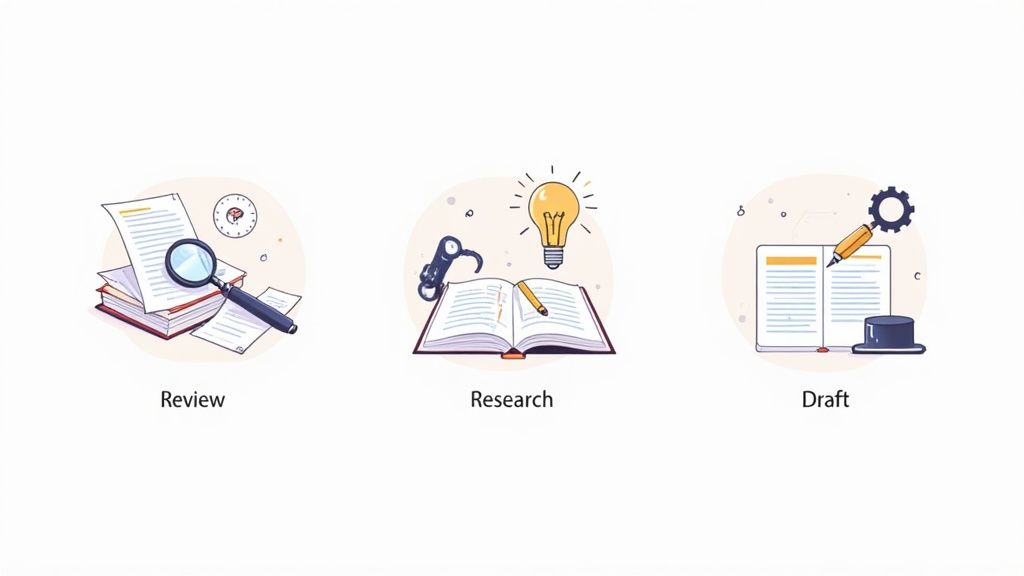
Let's break down the three main jobs an AI paralegal excels at, each one designed to smash a specific bottleneck in the typical personal injury case workflow.
Automated Document Review
Think about giving your team a genuine speed-reader who never gets tired or misses a detail. That's what AI brings to document review. A human paralegal might spend days, or even weeks, sifting through a client’s medical history. An AI can do it in minutes.
Using natural language processing, the technology reads and understands text just like a person would, but on a massive scale. It instantly flags and pulls out the key facts you need to build a winning personal injury case.
- Injury Details: It can pinpoint every diagnosis, prognosis, and mention of pain and suffering.
- Treatment Timelines: The AI automatically pieces together a perfect chronology of every doctor's visit, therapy session, and procedure.
- Medical Providers: It instantly compiles a list of every doctor, clinic, and hospital involved.
- Billing Information: It extracts the costs tied to each treatment, which is crucial for accurately calculating damages.
This isn’t just about being faster; it’s about being more thorough. The AI doesn't get fatigued and won't overlook a critical note buried on page 743 of a dense medical file.
Intelligent Legal Research
Beyond the case file itself, an AI paralegal can completely change how you approach legal research. We’ve all been there—stuck with keyword searches that spit out thousands of irrelevant cases. AI takes a much smarter, more conceptual path.
Instead of just matching words, it understands the context of what you're asking. You can ask it to find case law for a very specific injury scenario, and it will return truly relevant precedents, not just a list of documents containing your search terms.
The real game-changer is the AI's ability to synthesize information. It doesn’t just find rulings; it analyzes them and provides you with concise summaries, highlighting the key legal principles and outcomes. This lets attorneys grasp a case's relevance without having to read the whole thing.
This turns research from a draining, multi-hour chore into a quick, strategic exercise. It gives your firm a real advantage when preparing motions or getting ready for trial.
Streamlined Document Drafting
One of the most immediate "wow" moments comes from the AI's ability to draft documents. Think about creating demand letters, motions, or discovery requests. So much of it is repetitive work—finding and copying client data, treatment dates, and damage calculations into a template.
AI handles all of that automatically. Because it’s already reviewed the entire case file, it can take a template and instantly populate it with all the correct, case-specific information it just extracted.
The system will pull the complete medical timeline, all provider details, billing totals, and injury descriptions to generate a detailed, accurate first draft of a demand letter in a matter of seconds. All a human has to do is review it, refine the language, and add the strategic legal arguments. This frees up countless hours of tedious data entry and ensures every document your firm produces is consistent and accurate.
The Business Case for an AI Paralegal
Bringing any new technology into your firm isn't just about cool features—it’s about the bottom line. An AI paralegal offers a clear return on investment by reshaping your firm's efficiency, financial health, and ability to grow. This isn't about chasing trends; it’s about building a more resilient and profitable practice.
The real value comes from getting your most valuable resource back: your team's time. When you automate the tedious, high-volume work that eats up the day, you free up your people to focus on what truly matters—strategy, client relationships, and complex legal work.
Exponential Productivity Gains
The first thing you'll notice is a massive jump in productivity. Think about the bottlenecks in your current workflow: manually sifting through thousands of pages of medical records or piecing together a case chronology. An AI paralegal practically eliminates them.
Instead of a paralegal spending ten hours buried in a single case file, they can now supervise the AI and get the same work done in under an hour. That recovered time can be channeled directly into high-value work:
- Deeper Case Strategy: Using AI-generated summaries to quickly spot the strengths and weaknesses of a case.
- Better Client Communication: Having more time to build trust and keep clients in the loop.
- Stronger Negotiation Prep: Helping attorneys walk into settlement talks with more comprehensive, data-backed insights.
This change moves your paralegals from being data-entry clerks to strategic partners who directly impact case outcomes.
Enhanced Accuracy and Risk Reduction
Let's be honest, human error happens, especially when your team is overworked and up against a deadline. A missed detail in a medical report or a simple data entry mistake can weaken a case or even create compliance headaches. An AI paralegal serves as a remarkably effective safety net.
The technology processes every document with the same level of attention, ensuring no critical fact gets overlooked. It pulls out dates, diagnoses, and billing codes with precision, cutting down on the kinds of costly mistakes that come from fatigue or a simple oversight. This consistent, systematic approach improves your work product and reduces your firm's liability.
Significant Cost Savings and Higher Profitability
The financial argument for an AI paralegal is hard to ignore. When you automate tasks that can take up to 69% of a paralegal's time, your firm can handle a much larger caseload without hiring more people. That's a direct path to better profitability.
The ROI crystallizes when you realize your firm can take on more cases with the existing team. This lowers the overhead for each case and drives up overall revenue, making the practice far more competitive.
On top of that, faster case turnaround means you get paid sooner. By speeding up the initial document review and drafting stages, you move cases toward settlement much more quickly, which does wonders for your cash flow. In a competitive market, that kind of financial agility is a huge advantage.
Sustainable Scalability and a Competitive Edge
Finally, an AI paralegal sets your firm up for long-term, sustainable growth. As your practice grows, the mountain of administrative and prep work grows right along with it. AI gives you a way to absorb that workload without burning out your team.
This means you can confidently take on more clients and more complex cases. Firms that adopt this technology can deliver results faster, potentially offer more competitive rates, and provide a better client experience from start to finish. Ultimately, this isn't just a new tool—it's a powerful differentiator that positions your practice as a leader ready for what's next.
Implementing AI in Your Law Firm
Bringing an AI paralegal into your law practice isn't just a software upgrade—it's a fundamental shift in how your firm operates. A well-planned rollout is what separates a powerful tool from a genuine, day-in-day-out asset. The idea is to get from theory to real-world value without throwing your team's workflow into chaos.
This whole process has to start with an honest look at your current operations. Before you can even think about picking the right AI, you need to know exactly which problems you’re trying to fix.
Assessing Your Firm's Needs
First things first, you have to identify your biggest bottlenecks. Where do things grind to a halt? Pinpointing these pain points helps you define what a "win" actually looks like and ensures you choose a platform that solves your firm's specific challenges, not just some generic problem.
To get started, ask yourself and your team these questions:
- What specific tasks eat up the most paralegal hours every single week?
- Where are we seeing the most frequent errors or inconsistencies?
- On a typical case, how much time is lost to non-billable admin work?
- What parts of our current process are stopping us from taking on more clients?
The answers will help you build a solid business case for an artificial intelligence paralegal that’s firmly rooted in reality. For firms that want a guiding hand through this process, looking into specialized AI enablement services can make a world of difference.
Choosing the Right AI Platform
Once you have a clear picture of your needs, you can start evaluating potential AI partners. It's easy to get distracted by a long list of features, but the right fit goes much deeper. The platform you choose has to align perfectly with how your firm works and, most importantly, your security standards.
You should be looking for a solution that provides:
- Seamless Integration: The tool absolutely must play nice with your existing case management software to prevent creating isolated pools of data.
- Robust Security: Look for HIPAA compliance and enterprise-grade security. There's no room for compromise when it comes to protecting sensitive client data.
- User-Friendly Interface: If the technology isn't intuitive, your team won't use it. It should require minimal training to get people up and running.
- Dedicated Support: A responsive and helpful support team is non-negotiable for a smooth launch and long-term success.
The business case for making this move is pretty clear. When you get it right, the AI drives productivity and accuracy, which in turn leads to significant savings.
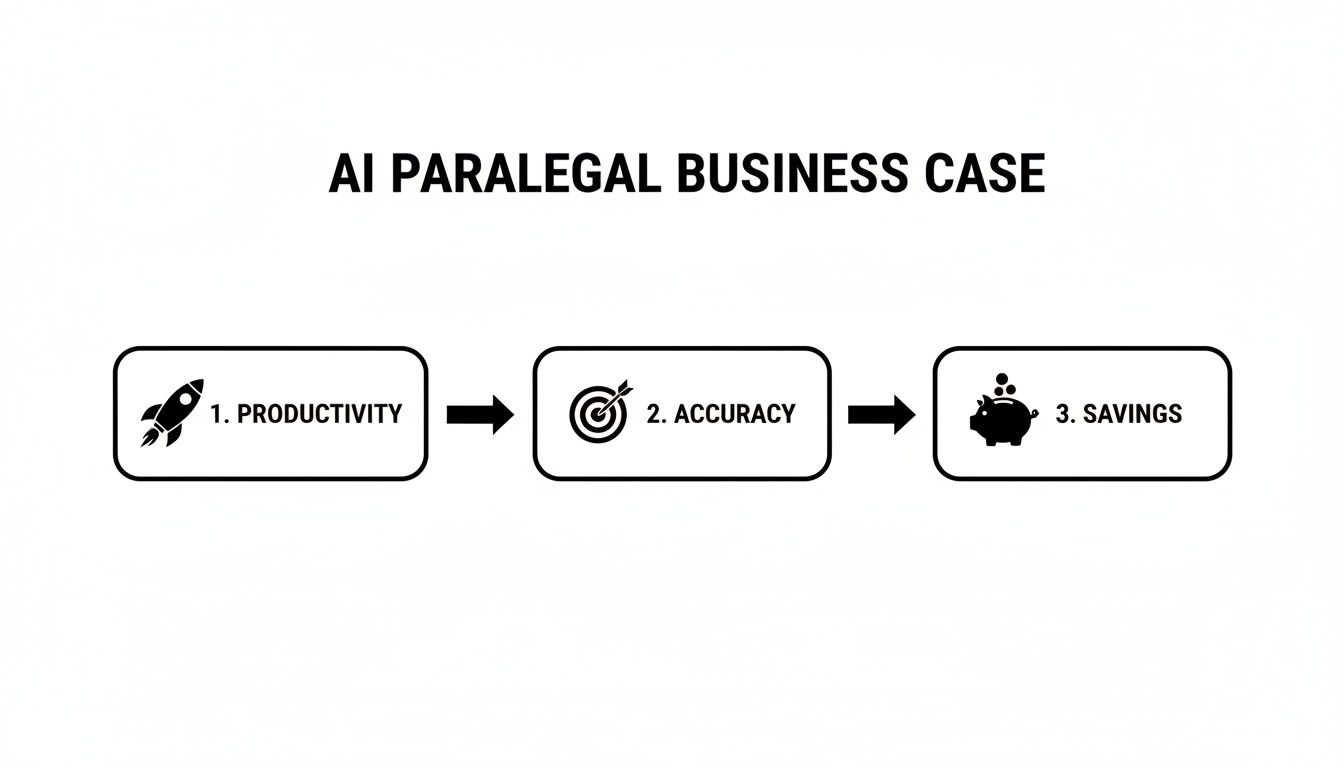
As you can see, boosting efficiency and precision isn't just about working faster—it has a direct and substantial financial upside for your firm.
Driving Team Adoption and Training
Here’s a hard truth: the most powerful technology in the world is completely useless if your team refuses to use it. Getting your people on board is the single most critical factor for success. You have to frame the AI as an assistant designed to take their most tedious work off their plates, not as a threat to their jobs.
A recent survey showed that while 85% of lawyers mess around with general AI tools, actual firm-wide adoption of legal-specific AI is lagging. Only about 20% of smaller firms and 39% of larger firms have truly implemented them. Why the gap? It often comes down to a failure to manage the human side of change.
The key is to focus on the "what's in it for me" for every person on your team. Show your paralegals exactly how this tool frees them from mind-numbing data entry, allowing them to focus on higher-value, strategic work that will actually advance their careers.
If you're interested in digging deeper into firm optimization, our guide on https://areslegal.ai/blog/legal-workflow-automation-software is a great place to start.
Measuring Performance and ROI
Finally, you can't improve what you don't measure. Before you even begin, you need to define your key performance indicators (KPIs). This is the only way you’ll be able to see the AI’s real-world impact and prove its return on investment to partners and stakeholders.
Here are a few effective KPIs to track for an AI paralegal:
- Reduced Document Review Time: Compare the average hours spent on a case file before and after you brought the AI online.
- Faster Case Turnaround: Measure the average time it takes to get from client intake to sending the demand letter.
- Increased Caseload Capacity: Keep an eye on the number of cases your existing team can manage without feeling overwhelmed.
Tracking these metrics gives you cold, hard data to prove the tool’s value and will almost certainly highlight other areas in your workflow that are ripe for improvement.
Navigating Ethical and Compliance Responsibilities
Bringing an AI paralegal into your firm can unlock some serious efficiencies, but it’s not just a plug-and-play solution. It introduces a new dimension to your professional responsibilities. Using these tools the right way means you have to be on top of the ethical and compliance duties that come with them. This isn't just a tech issue; it's about upholding your duties as a lawyer in a new era.
Think about it: the second you upload a client’s file, you're handing incredibly sensitive information over to a third-party system. That makes data security your number one job.
Protecting Client Confidentiality
For any PI firm, case files are packed with protected health information (PHI). This makes data privacy an absolute, non-negotiable priority. Any AI platform you even consider must be built on a rock-solid foundation of security to prevent data breaches and keep your clients’ trust. This is a basic duty of competence.
So, when you're kicking the tires on a new AI paralegal, what should you look for?
- End-to-End Encryption: You need assurance that data is unreadable from the moment it leaves your computer to the moment it's resting on the platform's servers.
- Secure Infrastructure: The platform should run on a reputable, enterprise-grade cloud environment—think of it as a digital Fort Knox.
- Regulatory Compliance: The system must meet all relevant data privacy laws, especially HIPAA, given the medical records you handle.
A failure to secure client data isn't a simple mistake; it's a major ethical lapse. To get a better handle on these obligations, you can dive deeper into what HIPAA-compliant document management really entails and why it’s so vital for your practice.
Upholding Ethical Obligations
An AI can draft a document or pull key facts from a medical record, but it cannot practice law. The American Bar Association and every state bar are crystal clear on this: the supervising attorney is always responsible for the final work product. Period. You can't point a finger at the algorithm if a mistake gets filed with the court or sent to an adjuster.
This means you have to treat an AI paralegal like a very talented, very fast junior assistant who needs 100% supervision. Its output must be verified. Its logic must be checked. Its conclusions must be validated by a licensed attorney who actually knows the case.
Adopting AI responsibly demands a new kind of diligence. Attorneys and their staff have to know the technology's limits and maintain critical oversight every step of the way.
Mitigating Algorithmic Bias
Finally, you have to remember that AI systems learn from the data they’re trained on. If that data reflects historical biases—and much of it does—the AI can accidentally carry those biases forward. An AI trained on decades-old legal texts, for example, might spit out language or interpretations that are completely out of step with today's standards.
This is exactly why choosing a vetted, industry-specific AI platform is so critical. A generic, off-the-shelf AI has no real grasp of legal nuances or the absolute need for fairness. Reputable legal AI companies invest a huge amount of resources into curating clean, unbiased training data and building in safeguards to promote objective results. Your job is to partner with a provider who takes ethical AI development seriously, ensuring the tool you use is a force for justice, not a reflection of old prejudices.
How an AI Paralegal Works in Practice

It's one thing to talk about what an artificial intelligence paralegal can do, but it’s another thing entirely to see it in action. So, let's walk through a real-world scenario you'd find in any personal injury firm. This is where the technology's value really clicks.
Picture this: a new client file hits your desk. It’s a messy multi-car accident case, and you’ve just been handed a jumble of documents—a dense police report, a few witness statements, a stack of insurance letters, and hundreds of pages of medical records from three different hospitals.
The old way of doing things meant a paralegal had to sit down and manually sift through every single page. They'd spend hours highlighting dates, flagging injuries, and painstakingly building a spreadsheet to track medical bills. That foundational work could easily eat up an entire day, maybe more.
The Intake and Analysis Stage
Now, let's look at the same job with an AI paralegal like Ares. The process is worlds apart. Your paralegal simply drags and drops that entire pile of scanned documents into a secure dashboard. The AI immediately springs into action.
In just a few minutes, the system has chewed through every document. It’s not just looking for keywords; it’s reading for context. The AI understands that a "cervical strain" is an injury, it pulls the exact date of the ER visit, and it connects the diagnosis to the cost on the billing statement.
The AI then organizes that initial chaos into a clean, structured summary. This is what it does almost instantly:
- Extracts Key Data: It pulls out critical details like injury dates, specific diagnoses, treatment costs, and provider names.
- Builds a Chronology: The AI assembles a perfect timeline of every medical appointment and procedure hidden within the records.
- Creates a Case Overview: It delivers a clear, easy-to-read summary of the case facts, so the legal team gets the lay of the land immediately.
This initial analysis, which used to take up to ten hours of manual labor, is now finished in the time it takes to make a cup of coffee.
From Data to Demand Letter
Okay, the data is organized. The next step is drafting the demand letter. In the past, this meant a paralegal had to meticulously copy and paste all that information from their notes and spreadsheets into a firm template. It’s tedious work, and a single misplaced decimal or wrong date can create huge problems down the line.
This is where the artificial intelligence paralegal really shines. Since all the case data is already analyzed and structured, the paralegal can simply instruct the AI to generate a first draft of the demand letter.
The AI doesn’t just fill in a template. It synthesizes the information it just organized to construct a narrative. It lays out the sequence of events, lists every documented injury, and calculates the total medical specials from the bills it reviewed.
The result is a comprehensive draft, complete with citations pointing to the exact document and page number where it found each piece of information. The human paralegal then steps in to do what they do best: review, refine, and add the strategic legal arguments and professional nuance that only an expert can. The AI handles the "what," which frees up your team to focus on the "why."
Common Questions About AI Paralegals
Whenever a major new tool comes along in the legal world, it’s natural to have questions. The idea of an artificial intelligence paralegal is exciting, but law firms are right to be cautious. You need to understand how it affects your people, your data, and your actual daily work before you commit.
Let’s tackle some of the biggest questions we hear from firms just like yours.
Will an AI Paralegal Replace Our Human Paralegals?
This is always the first question, and the answer is a firm no. The purpose of an AI paralegal isn't to replace your talented team; it's to supercharge them. Think of it as giving your best people a powerful assistant that can handle the most monotonous, time-draining tasks on their plate.
An AI can sift through thousands of pages of medical records in just a few minutes, a job that could take a human paralegal several days. But the AI doesn't understand the human story behind those records. It can't apply the critical thinking or legal strategy needed to build a winning case.
AI manages the grunt work. This frees your human paralegals to focus on what truly matters: digging into case strategy, communicating with clients, solving complex problems, and providing the kind of nuanced judgment a machine simply can't offer. The tech makes your team more effective, not obsolete.
How Secure Is Our Firm's Data on an AI Platform?
Handing over sensitive client files to any new system is a big deal. We get it. That’s why any reputable AI platform is built with security as its foundation, not as an afterthought. Protecting client confidentiality is non-negotiable, and the right partner will have serious safeguards built in.
Look for these essential security measures:
- End-to-End Encryption: This ensures your data is unreadable to anyone without authorization, both when it's being uploaded and when it's stored.
- Secure Cloud Infrastructure: Top-tier platforms run on enterprise-grade servers that have multiple layers of both physical and digital protection.
- Compliance with Legal Standards: For personal injury firms, the system absolutely must be HIPAA compliant to handle protected health information (PHI) correctly and ethically.
What Is the Learning Curve for Our Legal Team?
Modern AI tools are designed for busy legal professionals, not tech wizards. The best platforms have intuitive, user-friendly interfaces that are easy to navigate. If your team can drag and drop a file, they can use an AI paralegal. The goal is a quick, seamless transition—not weeks of frustrating training that grinds your firm to a halt.
Most teams get the hang of the core features in just a few hours. A good provider will also offer hands-on training and real-time support to make sure everyone feels comfortable and confident from the very beginning.
Can AI Handle Ambiguous or Complex Legal Documents?
This is where the human-in-the-loop model really shines. AI is phenomenal at pulling structured and semi-structured data—think specific dates, medical diagnoses, and billing codes from records. It can create an incredibly detailed first-pass summary or demand letter draft based on the facts it finds.
But a human expert always has the final word. When the AI comes across an ambiguous statement or a complex legal argument it doesn't recognize, its job is to flag that section for human review. The ideal workflow is to let the artificial intelligence paralegal do the heavy lifting, building a solid foundation that a seasoned professional then reviews, refines, and finalizes.
Ready to see how an AI-powered assistant can eliminate manual work and strengthen your cases? Ares turns your case files into clear, actionable insights in minutes. Discover how Ares can transform your personal injury firm.