

In 2024, the average third-party bodily-injury claim payout in the United States reached $27,373 per injured person, an 8% increase over the prior year, according to CCC Intelligent Solutions. A figure like that gets quoted everywhere and treated as a benchmark. It isn't one. An average collapses millions of claims that share almost nothing: different injuries, different fault pictures, different coverage limits, different quality of proof.
A body injury settlement is easier to understand as the price two sides agree on for a chain of proof. The treatment chronology has to hold. The causation opinion has to hold. The wage documentation, the liability evidence, the policy limit, and finally the lien payoff all have to hold. Break one link and the offer drops. Build every link and the number survives an adjuster's second read, a defense medical exam, and a mediator's skeptical questions.
What follows walks that chain in order, starting with what a settlement figure measures and ending with the cash an injured person keeps after every legitimate obligation is paid.
What a Settlement Figure Really Measures
The Bureau of Justice Statistics reported that 98% of the 98,786 tort cases completed in U.S. district courts during 2002-2003 ended through settlement or another non-trial disposition. Trials are the exception, not the norm. That single fact shapes everything about how injury claims get priced.
A body injury settlement is a negotiated payment, usually funded by an insurer, made in exchange for a release of the injury claim. It arrives before trial or instead of trial. The number on the release is gross, and the money the injured person eventually controls is net, after attorney fees, case costs, medical liens, subrogation claims and any unresolved balances. Those are two different numbers, and confusing them is the most common expensive mistake in this area of law.
Think about how a used car gets priced. The book value matters, but the actual sale turns on the service history, the visible condition, and how willing each side is to walk away. A settlement works the same way. The medical records are the service history. Liability is the condition report. Insurance limits and the client's willingness to file suit are what shapes bargaining strength.
Because 98% of cases resolve without a verdict, the evidence still has to be assembled as though a jury will see it. That file is what the other side is pricing. An insurer that believes the records are organized, the causation theory is clean and the attorney will file will pay differently than one that suspects the file is thin.
Keep this in mind: the federal figures describe federal cases, not every U.S. bodily-injury claim, and publicly reported data rarely shows the amounts or the reasoning behind pretrial deals. Nobody has a reliable national database of settlement values.
So the useful questions aren't "what's the average?" Three questions organize everything that follows: what drives the number, how medical and wage proof build it, and what remains after every legitimate obligation is paid.
Valuation Factors That Move the Number
Damages split into two buckets. Economic damages are measurable in money: medical bills, lost income, future treatment, out-of-pocket costs. Non-economic damages have no receipt: pain, limitation, lost sleep, the end of a hobby, the inability to lift a child. Liability strength and policy limits sit on top of both as adjustments and ceilings.
The table below is the working map. Read it in the order an adjuster does, starting with medical expenses because that's where the evaluation software starts.
| Factor | How It Moves Value | Evidence to Gather |
|---|---|---|
| Medical expenses | Sets the economic baseline; value is often judged against bills | Itemized bills, provider records, amounts paid versus billed |
| Lost income | Adds past and future wage loss | Pay stubs, employer letter, tax returns, work restriction notes |
| Future care | Adds projected treatment costs when medically supported | Treating physician opinion on future treatment with reasonable medical probability |
| Permanency and impairment | Raises general damages when the injury is lasting | Impairment ratings, objective imaging, functional test results |
| Pain and suffering | Non-economic harm, commonly estimated as a multiple of medical specials | Symptom journal, consistent treatment history, witness statements on daily limits |
| Liability strength | Clear fault raises value; disputed or shared fault lowers it | Police report, citations, witness statements, scene photographs |
| Policy limits | Caps the recovery available from an insured at-fault party | Declarations page, umbrella or excess policy information |
| Venue | Changes jury tendencies and typical award ranges | Local verdict and settlement research for the court where the case would be filed |
Two claims, same bills, different outcomes
Two claimants each carry $40,000 in treatment. The first has a rear-end collision with a citation issued to the other driver, an MRI showing a disc injury, an orthopedist's note restricting lifting, and an employer letter confirming twelve weeks of modified duty. The second has a sideswipe with disputed fault, an emergency-room visit, three chiropractic visits and a two-month hole in the record before anyone ordered imaging.
The bills match. The offers won't come close. In the first file, every factor pushes upward and the adjuster's exposure model has little room to argue. In the second, the gaps hand the insurer a credibility argument it can use to discount the whole claim, including the part that's legitimate.
Practical rule: total the economic damages you can document, then decide which factors justify a multiplier and write one sentence of proof for each. A multiplier you can't defend reads as an inflated demand and costs you credibility on the parts that are solid.
Notice which factor a claimant can still influence today. It's documentation. Fault evidence can be gathered, wage loss can be proven with a letter, gaps can be explained with a referral note, but only if someone collects them before the record closes.
Medical Bills, Causation and Treatment Chronology
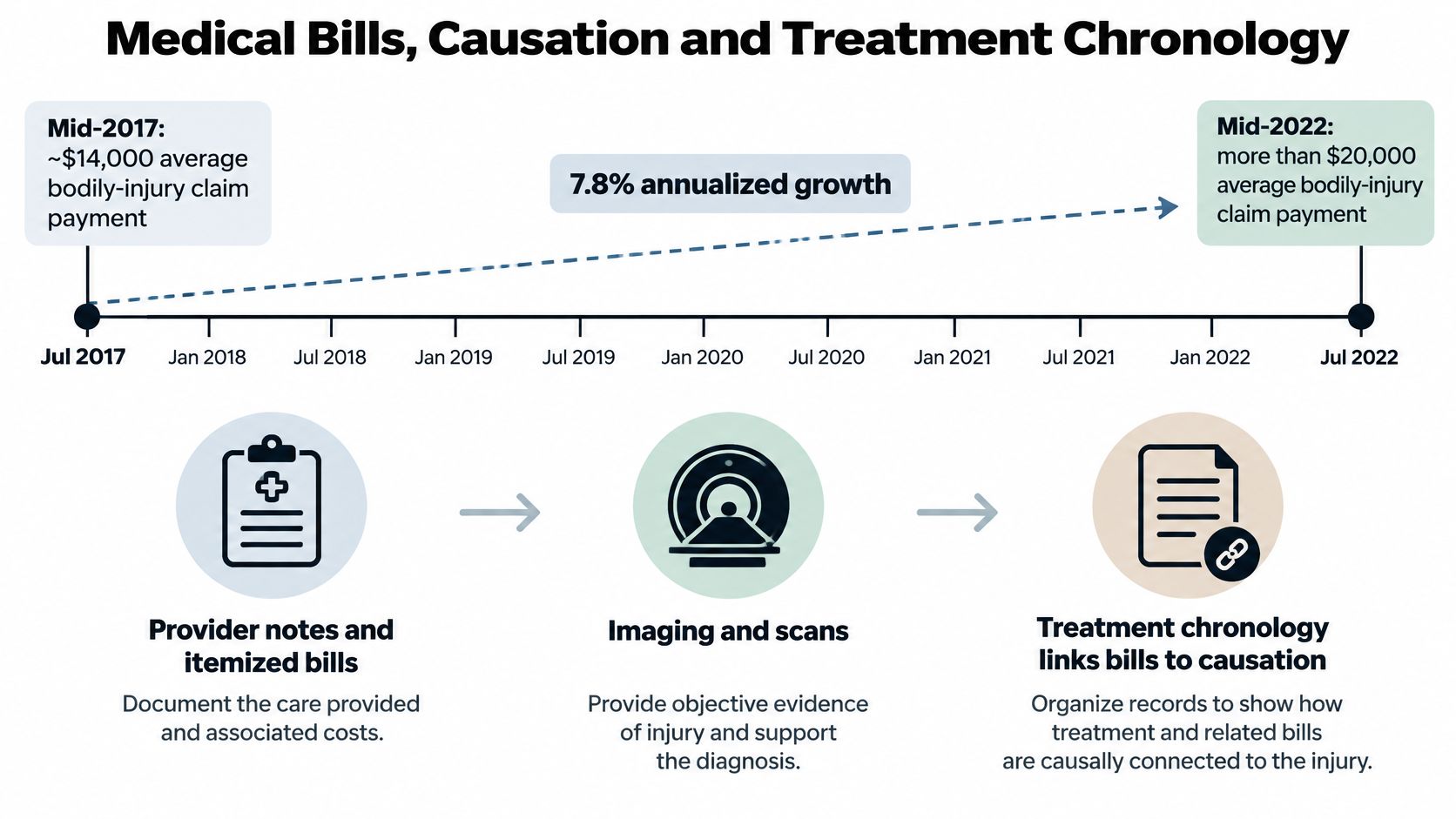
Medical bills anchor a claim. They don't value it. A national auto-injury claims study covering more than 7.4 million bodily-injury claims closed with payment between mid-2017 and mid-2022 found average claim payments rose from about $14,000 to more than $20,000, equal to 7.8% annualized growth, and that increase outpaced medical-care inflation. Over the same period, the average ratio of total settlement to medical bills was about 2.0:1, climbing past 2.3:1 by mid-2022.
That ratio is the whole argument in one number. The same $30,000 in bills supported something close to a two-to-one payment, and later in the period, closer to two and a third. Bills are the anchor, not the verdict. What moved the ratio is what both sides could prove about severity, duration, impairment and fault.
Current pricing runs higher. Sedgwick's 2024 year-end casualty auto report found average paid amounts for new auto bodily-injury claims rose 27.7% during calendar year 2024. Read that as a pressure signal on claim values, not a promise about any individual file.
The chronology a reviewer builds
Anyone evaluating a claim reconstructs a dated sequence, and they do it in this order:
- Pre-accident baseline: prior symptoms, prior injuries, prior providers, and any degenerative findings already in the chart.
- First treatment: the date, the facility, and the complaints recorded that day.
- Objective findings: imaging, examination findings, and diagnostic testing that don't depend on the patient's description alone.
- Specialist referrals: who was sent where, when, and whether the referral occurred.
- Treatment gaps and their reasons: a lapse of six weeks with no care reads very differently than one caused by an insurance authorization delay or a referral backlog.
- Escalation points: injections, surgery, nerve blocks, and the dates they first appear.
- Documented functional limits: lifting restrictions, driving limits, work modifications, sleep disruption.
That sequence is how a new injury gets separated from an old condition that was aggravated. Aggravation is compensable; a pre-existing problem that the incident didn't touch is not. The distinction changes the damages theory, and it's the fight most often lost on paper.
Say two claimants each carry $30,000 in bills. The first treats continuously, has an MRI confirming a disc injury at a level consistent with the mechanism of impact, and returns to light duty with a written restriction. The second stops after two visits, waits six months, then sees a specialist who orders imaging. The first file supports the bills plus a real general damages figure. The second invites an argument that the injury resolved and the later treatment was unrelated, and the bills get discounted along with it.
Before you argue damages, you have to win causation. That's why causation in personal injury cases deserves a separate pass through the file, with each diagnosis tied to both the mechanism and the first documented complaint.
Three record sets to request first
- Provider notes: every visit, including the primary care records that may reveal a prior complaint the defense will find anyway.
- Imaging reports and the images: the report gives the finding, the images let your own radiologist disagree with a defense read.
- Itemized billing ledgers: the ledger separates what was billed from what was paid and accepted, which is the number insurers argue about.
Lost Income, Future Care and Pain and Suffering
A settlement worksheet documenting hourly pay and missed work days looks like bookkeeping. It's really an argument about what the injury cost. 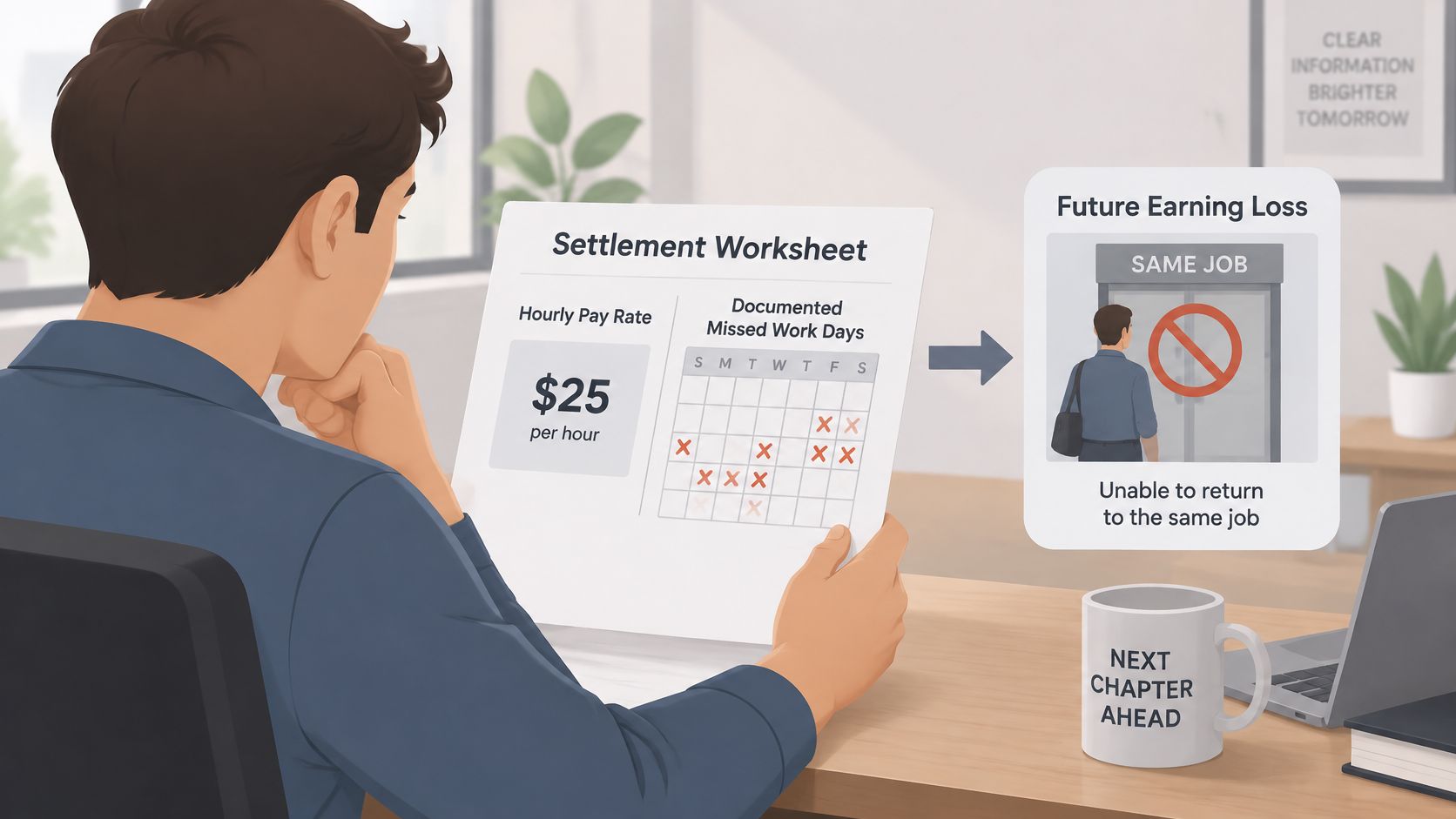
Lost income is arithmetic first
Multiply the documented pay rate by the documented missed time. A claimant earning $25 per hour on a 40-hour week misses 12 weeks: $1,000 per week times 12 weeks equals $12,000 in past wage loss. Self-employed claimants need a different route, usually a profit-and-loss statement for the same months in the prior year plus a client letter or two showing cancelled work.
Future earning loss is a separate claim and a harder one. It needs a vocational opinion on transferable skills and often an economist's present-value calculation. Where it breaks down: a claimant who returned to the same job at the same pay has no future loss, no matter how uncomfortable the work feels.
Future care needs a physician, not an estimate
A treating physician must state what treatment is expected, whether therapy, injections, surgery or ongoing pain management, and connect it to the injury with reasonable medical probability. Cost comes from the billing ledger or a fee schedule. Without that opinion, a projected-care number is a guess, and adjusters treat guesses as negotiating filler.
Pain and suffering runs on two methods
There's no receipt for pain, so value gets estimated two ways.
The multiplier method applies a factor to medical specials, and the factor rises with severity, duration and permanency. No fixed range applies, which is exactly why the multiplier has to be justified by documented severity rather than asserted.
The per-diem method multiplies a daily rate by the days symptoms lasted. At $100 per day over 420 days, the figure is $42,000. The weakness is obvious: 420 days has to be documented, not recalled.
Compare fourteen months of consistent treatment with a lasting lifting restriction against three months of care that ended with a full release. The first supports a real general damages figure. The second supports a modest one, and no method will change that.
The record nobody thinks to keep
Dated, specific entries about what the injury stopped are often the only evidence of limits on sleep, work and household tasks. Not "felt bad today." Instead: "couldn't lift the toddler out of the crib, had to wake my spouse at 5:40 a.m." Start in the first week, because the entries that matter most are the ones written before anyone knew they'd matter.
Liability, Venue and Insurance Limits
Every valuation runs into a ceiling before it runs into math. Three ceilings matter most.
Fault comes first
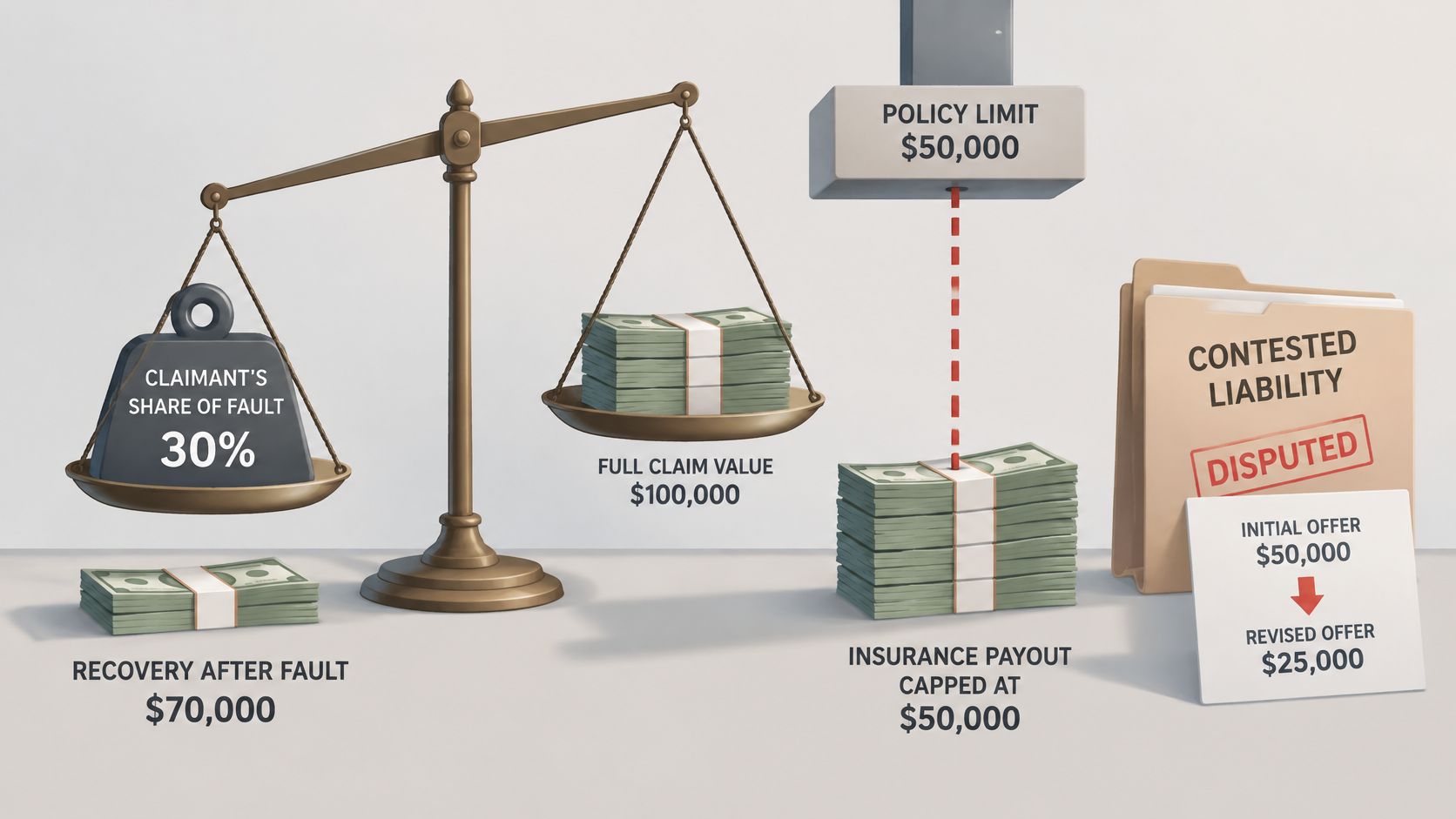
In a comparative-fault state, the claimant's own share of responsibility reduces recovery, and an adjuster who believes a jury will assign even a modest percentage will discount the offer immediately. A contested liability picture stalls negotiation until it's resolved with scene evidence, witness statements, vehicle damage photographs or a citation. Waiting is sometimes the right call; the discount for a genuine dispute is often larger than the time cost of resolving it.
The policy limit caps the insured's exposure
The at-fault driver's bodily-injury coverage sets the maximum the insurer must pay per person, regardless of what the damages support. A claim worth more than the limit has to look elsewhere: an umbrella or excess policy, a commercial policy if a work vehicle was involved, or the claimant's own underinsured-motorist coverage. Request the declarations page early. Discovering the limit at mediation, when the demand already assumed more, wastes months.
Venue sets the range
Location is its own variable. Bureau of Justice Statistics data summarized in a federal tort-system review found that automobile accidents accounted for 49% of tort trials in general-jurisdiction courts across the 75 largest U.S. counties in 1996, with premises liability at 22% and medical malpractice at 12%.
The same review sets out the trial medians below. Use them for lookup and context, never as an expected value.
| Dataset | Case type | Median award | Period |
|---|---|---|---|
| State-court tort trials, winning plaintiffs | All torts | $31,000 | 1996 |
| State-court tort trials, winning plaintiffs | Automobile | $18,000 | 1996 |
| Federal tort trials, plaintiff wins | All torts | $201,000 | 2002-2003 |
| Federal tort trials, plaintiff wins | Personal injury | $181,000 | 2002-2003 |
| Federal tort trials, plaintiff wins | Personal-injury motor vehicle | $91,000 | 1996-1997 |
The gap between the $18,000 state-court automobile median and the $91,000 federal motor-vehicle median is not a settlement range. Those datasets cover different courts, different years and different claim populations, and they include only cases that reached trial with a plaintiff who won. Cases that settle, and cases where the plaintiff loses, never enter the average. That's survivorship bias wearing a suit.
The practical order of operations is to answer the ceiling questions first, then value the damages underneath. A file with clear fault, a commercial policy and a conservative venue is worth real money. The same injuries with disputed fault, a minimum-limit policy and an unfavorable county are worth less, and no demand letter changes that.
How to Negotiate From Demand to Release
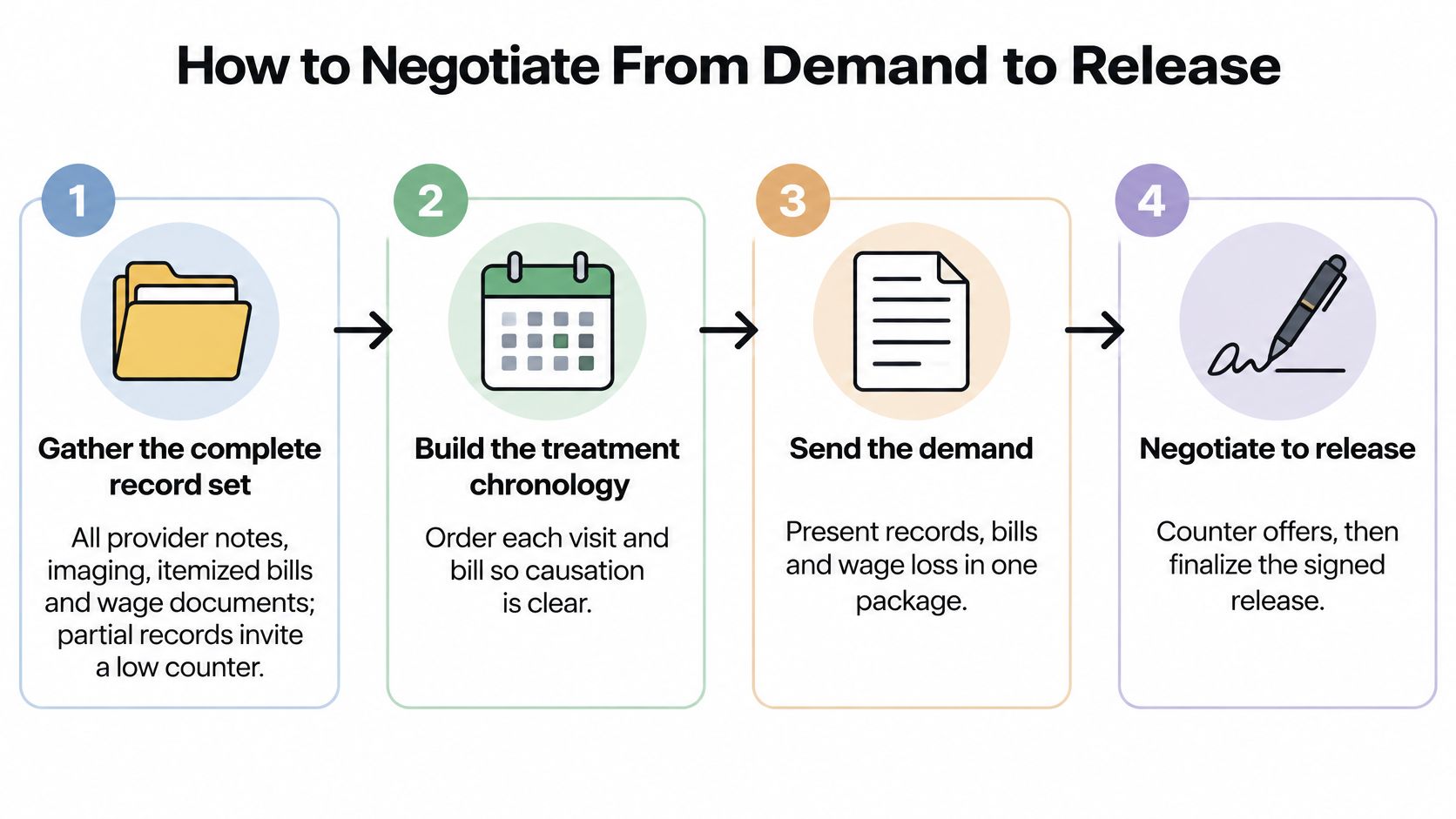
Negotiation is a sequence, and each step exists because skipping it creates a discount later. The order matters more than the volume of paper.
Close the record before anyone quotes a number. Collect every provider note, imaging report, itemized bill and wage document first. A demand built on a partial file invites a counteroffer built on exactly the same gaps, and the insurer gets to set the frame. Common slip: sending the demand while the MRI report is still pending because the client needs money.
Put every event on one dated line. Lay visits, procedures, imaging and bills on a single chronology with a one-line reason beside each gap. Adjusters read an unexplained gap as evidence the injury resolved; your note converts it into an authorization delay or a referral backlog. Common slip: presenting bills in a stack that no one can follow chronologically.
Draft a demand that cites its own evidence. Each causation sentence should point to the record that supports it, and each special damages total should trace back to a bill. Personal injury work produces causation narratives, special damages and liability arguments, and every claim should be substantiated and cited, which is also how Ares builds settlement demands and hearing briefs around treatment narratives, medical specials and impairment documentation. Common slip: a large headline number with records attached but never referenced.
Anchor the opening figure to a stated basis. Choose a demand you can defend line by line, then write the two or three sentences that explain how you got there. An opening number with visible arithmetic invites a reasoned counter. A number chosen for effect invites a lowball reply and a longer negotiation.
Log every offer with its date and its reasoning. The pattern of offers tells you where the insurer's internal valuation sits and whether it's moving. Note the reasons attached to each counter, because a repeated objection about causation or a pre-existing condition is the fight you have to win next. Read more on negotiating a personal injury settlement before you send the next round.
Escalate to mediation when the gap holds. A neutral can test both valuations and often moves a carrier that has stopped moving on its own. Bring the chronology, the imaging and a written damages summary, not just the demand letter again.
Read the release like a contract, because it is one. Check its scope, what claims it extinguishes, how and when liens get paid, and the payment deadline. The most expensive slip in the entire process is signing a release before disputed liens are resolved, because the release ends the claim while the bills don't end.
Check the Net Figure Before You Sign a Release
Medical debt doesn't disappear because a claim settled. A 2025 JAMA Network Open study of lawsuits over unpaid medical bills found that 54.6% of 973 cases resulted in judgments, and 87.0% of those judgments were default judgments where the defendant never showed up to contest. Lawsuit volume and judgment amounts ran substantially higher in majority-Black ZIP codes, while higher median income tracked with fewer lawsuits and lower judgments.
That study tracks debt collection rather than settlement payouts, and it still frames the question every injured person should ask before signing: how much of this money reaches me, and what happens if a disputed lien gets paid too early? The gross figure is the sticker price of the settlement. The net is what remains after every claim against it clears. Answer the second question in a fixed order.
- Gross settlement: the negotiated number on the release.
- Attorney fees and costs: the contingency percentage plus documented case expenses.
- Insurance limits applied: confirm the funded amount matches the available coverage.
- Verified liens: written payoff letters for every hospital, physician group, health plan and subrogation claim.
- Negotiated reductions: the difference you secured, in writing.
- Unresolved claims: amounts still in dispute, and whether the release holds them in trust.
- Expected net recovery: the number to compare against any offer.
Run that order on a hypothetical $60,000 settlement. A 33% contingency fee takes $19,800, case costs take $2,500, leaving $37,700. A $15,000 hospital lien negotiates down to $9,000, so the expected net is $28,700. Two files can settle at the same gross number and pay out thousands apart, because the gap lives in the liens and costs underneath.
Hold the release until the net is confirmed. Request written payoff letters, confirm disputed balances will be held rather than paid, and don't sign while any number in that list is still unknown.
Lien resolution is also an access issue. Claimants with fewer resources face more pressure to accept an early offer and less ability to challenge a balance, which is why this arithmetic belongs in the first client meeting rather than the last. Understanding what a medical lien is and how it gets resolved changes that conversation. Ares covers the document-heavy work of a personal injury case from intake to settlement, and one solo attorney at Moreno Legal reclaimed 10 hours per case by moving that work off a manual track.
A body injury settlement rewards the file that can prove its own story. The firms that win on value tend to build the chronology and the demand from cited records, so the chain of proof is finished before the first offer arrives. Ares turns provider notes, imaging and itemized bills into organized, source-cited treatment timelines and demand drafts. Visit Ares to see how it fits your next case.