

A chronological medical record is far more than just a list of dates. For a personal injury attorney, it's the narrative backbone of your entire case. It transforms a mountain of dense, often disorganized medical files into a clear, compelling story that connects the incident directly to your client’s injuries, treatments, and ongoing struggles.
The Strategic Power of a Chronological Medical Record
Let's be honest, receiving a new client’s medical records can be daunting. You’re handed a stack of ER reports, specialist notes, imaging results, therapy logs, and billing codes—all out of order. Trying to piece together a coherent argument from that chaos is nearly impossible.
This is where a meticulously prepared medical chronology becomes your most crucial strategic tool. It doesn't just organize the data; it weaves it into a powerful narrative. It builds an undeniable, linear path from the moment of injury to every diagnosis, treatment, and medical expense that followed. This clear timeline is what you need to prove causation and justify damages.
From Disorganized Files to a Clear Narrative
Think about a typical car accident case. Without a chronology, the records are just a random collection of events. You have an ER visit on the day of the crash, a follow-up with a specialist two weeks later, physical therapy notes that span months, and a surgical report from half a year down the road. Each document is a single puzzle piece.
Now, let's assemble those pieces into a chronology.
- June 1, 2023: Client involved in a rear-end collision; transported to Mercy General ER. Diagnosis: Acute lumbar strain.
- June 15, 2023: Follow-up with Dr. Smith (Orthopedist). MRI ordered due to persistent pain radiating down the left leg.
- June 20, 2023: MRI results show a herniated disc at L4-L5, consistent with traumatic injury.
- July 1 - Sept 30, 2023: Conservative treatment with physical therapy fails to resolve symptoms.
- October 15, 2023: Surgical consultation with Dr. Evans, who recommends a microdiscectomy.
Suddenly, the story is crystal clear. You've established a direct, logical progression from the crash to the surgery. This gives you incredible leverage in settlement talks because you’re presenting a narrative that adjusters and opposing counsel can't easily poke holes in. This process of turning disjointed files into a coherent story is a fundamental part of effective medical record review for attorneys.
A well-structured chronology is the backbone of a personal injury case. It provides a factual foundation that not only supports your legal arguments but also gives you a clear roadmap to navigate the complexities of your client's medical journey.
Essential Data for a Legal Medical Chronology
To build a chronology that truly works for your case, you need to extract specific, high-impact information from the records. The table below outlines the key data points that transform a simple list of dates into a powerful legal tool.
| Data Point | Description | Example in a PI Case |
|---|---|---|
| Date of Service | The exact date the medical encounter occurred. This forms the timeline's foundation. | "October 15, 2023" – Date of surgical consultation. |
| Provider/Facility | The name of the doctor, therapist, or medical facility where the service was provided. | "Dr. Evans, Apex Orthopedic Specialists" |
| Type of Record | Identifies the document, such as an ER report, MRI scan, physical therapy note, or surgical summary. | "MRI Report" or "Initial Orthopedic Consult" |
| Diagnosis/Chief Complaint | The patient's stated symptoms and the medical professional's official diagnosis. | "Chief Complaint: Persistent lumbar pain with left leg sciatica. Dx: L4-L5 herniation." |
| Treatment/Plan | The procedures, prescriptions, therapies, or future actions recommended by the provider. | "Plan: Microdiscectomy surgery scheduled. Prescribed Oxycodone for pain management." |
| Causation Statements | Any notes from the provider linking the injury to the incident. This is a critical piece of evidence. | "Patient's symptoms are a direct result of the MVA on June 1, 2023." |
Extracting these details consistently across all records is what gives your chronology its strategic weight, making it an indispensable asset during negotiations and trial preparation.
This isn't just about good practice; it’s about building a solid foundation for your case while maintaining strict HIPAA-compliant practices to safeguard your client's sensitive information. The idea of a unified patient timeline is over a century old. Back in 1907, Dr. Henry Plummer pioneered a single-patient record system that led to a 30% improvement in diagnostic accuracy at the Mayo Clinic. Today, that same principle—organizing medical data—is not only a best practice but has been shown to reduce medical errors by up to 55%, highlighting its value in both medicine and law.
Laying the Groundwork: How to Build Your Case from Day One
Crafting a powerful chronological medical record isn’t about just plugging dates into a spreadsheet. It’s a disciplined process that starts the moment the first medical bill lands on your desk. Get this foundational stage right, and you build a rock-solid case; miss a single report, and you risk leaving a crack in your narrative.
The first move is a comprehensive document sweep. This means going far beyond just the main hospital records. You have to cast a wide net, pulling in documents from every single touchpoint in your client's medical journey. Think every hospital, primary care doctor, specialist, physical therapist, imaging center, and even the pharmacy that filled their prescriptions post-incident.
This initial haul can be daunting, often swelling to hundreds or even thousands of pages. That’s why a clear, consistent organizational system is non-negotiable from the very beginning. Whether you’re a fan of digital folders meticulously labeled by provider and date or prefer old-school physical binders, consistency is your best friend. This isn't just about being tidy—it's about creating a searchable archive that becomes the bedrock of your chronology. For a deeper look at setting up your system, our guide on how to organize medical records has some great, practical strategies.
This workflow is all about turning a chaotic mountain of paper into a clear, strategic legal asset.
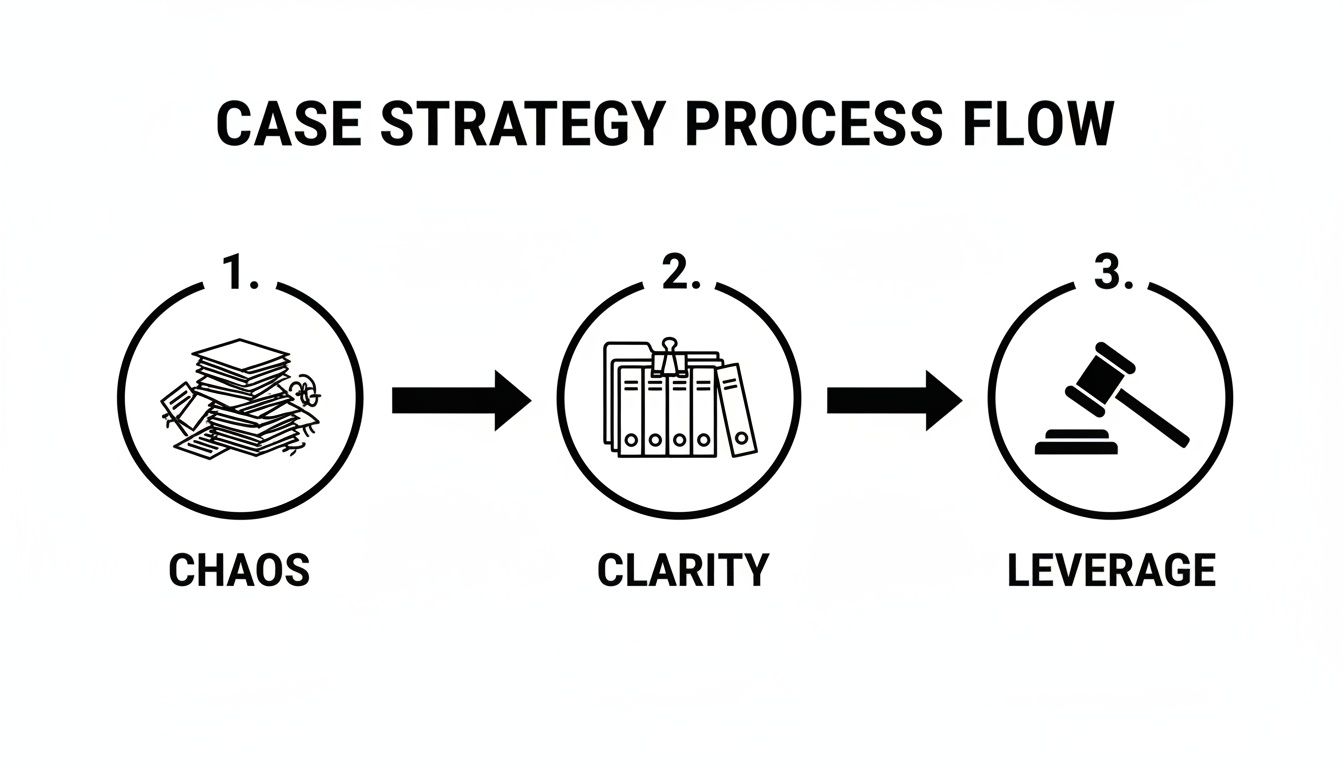
As you can see, this isn't just an administrative task. It’s a methodical process designed to move your case from total chaos to absolute clarity—the exact position you need to be in to gain real leverage.
The Art of Pulling Actionable Data
Once everything is gathered and sorted, the real work begins: data extraction. This is the painstaking part where you transform raw documents into the building blocks of your case narrative. Your goal is to systematically pull specific, high-value data points from every single page.
To make sure nothing slips through the cracks, your extraction checklist should be the same for every case. You're hunting for the key details that will eventually populate your timeline.
- Dates of Service (DOS): This is the absolute cornerstone of your chronology.
- Provider Details: Get the full name of the physician or therapist and the facility where the treatment occurred.
- Record Type: Was it a physician's note, an MRI report, a surgical summary, or a PT log? Each tells a different part of the story.
- Diagnoses & ICD-10 Codes: You need every official diagnosis, paying special attention to the codes directly linked to the incident.
- Prescribed Treatments: Document every medication, therapy session, procedure, and specialist referral.
- Patient-Reported Symptoms: What did the client actually say? Their own words—about their pain levels, limitations, and struggles—are pure gold.
This methodical approach is what separates a simple list of dates from a true chronological medical record. It’s how you prepare to weave a compelling story backed by undeniable evidence.
A rookie mistake is to just skim for the big events, like a surgery. The real power is often buried in the details—the escalating pain scores in physical therapy notes or the documented failure of conservative treatments that led to a specialist referral. Extracting these nuances is what makes a case airtight.
Putting Extraction into Practice
Let's walk through a real-world example. Say you're reviewing an initial orthopedic consultation for a client with a back injury. Here’s what your extraction should capture:
| Data Point from Report | What You Pull for Your Chronology |
|---|---|
| "Date of Visit: 07/15/2023" | Date: 07/15/2023 |
| "Provider: Dr. Angela White, MD" | Provider: Dr. Angela White, Seaside Orthopedics |
| "Chief Complaint: Low back pain..." | Symptoms: Patient reports 7/10 low back pain with sciatica. |
| "Assessment: Lumbar disc herniation (M51.26)" | Diagnosis: Lumbar disc herniation (M51.26) |
| "Plan: Begin course of physical therapy..." | Treatment: Prescribed 8 weeks of PT, anti-inflammatories. |
Applying this level of detail to every document ensures no critical fact gets lost in the shuffle. It's this rigorous, front-end work that makes constructing the timeline smooth, accurate, and ultimately, far more persuasive when it's time to talk numbers.
Weaving the Data into a Compelling Timeline
Once you've pulled all the raw data from the medical records, the real work begins. This is where you transform that stack of information into a story. A chronological medical record isn't just a clinical list of dates and procedures; it's the narrative of your client's life from the moment of injury to today. Your job is to connect the dots in a way that’s crystal clear to attorneys, adjusters, and eventually, a jury.
The best way to do this, hands down, is with a structured spreadsheet or table. This format keeps dense information clean and scannable, making it incredibly easy to see how one event led to the next. A well-built chronology makes the cause-and-effect relationship between the incident and the subsequent medical journey impossible to ignore.
The Essential Columns for a Powerful Chronology
To build a narrative that has real impact, your timeline needs a logical structure. While you might tweak it from case to case, there are a few core columns that are non-negotiable for a strong chronology.
- Date of Service (DOS): This is the backbone of your timeline, always organized from the earliest date to the most recent.
- Provider and Facility: Who provided the care and where did it happen? Be specific.
- Record Summary: This is your "plain English" synopsis of the visit. Your goal here is to translate dense medical jargon into something anyone can understand.
- Diagnosis: List the specific conditions the provider identified. Including ICD-10 codes adds a layer of precision.
- Treatment and Plan: What was done and what's next? Detail every prescription, therapy session, and recommended procedure.
This structure turns a messy pile of facts into a straight line that tells a powerful story. It lets you visually map how a client's pain score went from a 3/10 at the initial ER visit to an 8/10 after several orthopedic appointments, directly justifying the need for surgery.
The real magic of a chronological medical record is its ability to show the story, not just tell it. It illustrates how a single incident snowballed into multiple surgeries, a lifetime of pain management, and significant financial hardship.
From Clinical Data to a Human Story
The real craft comes alive in the "Record Summary" column. This isn’t just data entry; it’s storytelling. You have to distill complex medical terminology into clear, persuasive points that resonate with a non-medical audience.
Think about a typical entry you might see in a doctor's note: "Patient presents with cephalgia and cervicalgia post-MVA. MRI reveals C5-C6 disc protrusion. Plan includes NSAIDs and referral to PT."
Your summary needs to translate that into a human experience:
"Patient reported severe headaches and neck pain after the car accident. An MRI confirmed a herniated disc in his neck, and the doctor prescribed anti-inflammatory medication and physical therapy."
That simple rephrasing makes the client’s situation immediately relatable and impactful. In the legal world, clear timelines are indispensable. With over 400,000 personal injury lawsuits filed in the U.S. each year, a thoughtfully crafted chronology can improve a case's outcome by 40-60%. This kind of clarity played a role in securing a piece of the $250 billion awarded in U.S. personal injury settlements in 2023. You can find more insights on how chronologies drive case value from experts at Lexitas Legal.
Modern tools can even help visualize this data, making it easier than ever to spot key trends and turning points in the client's care.
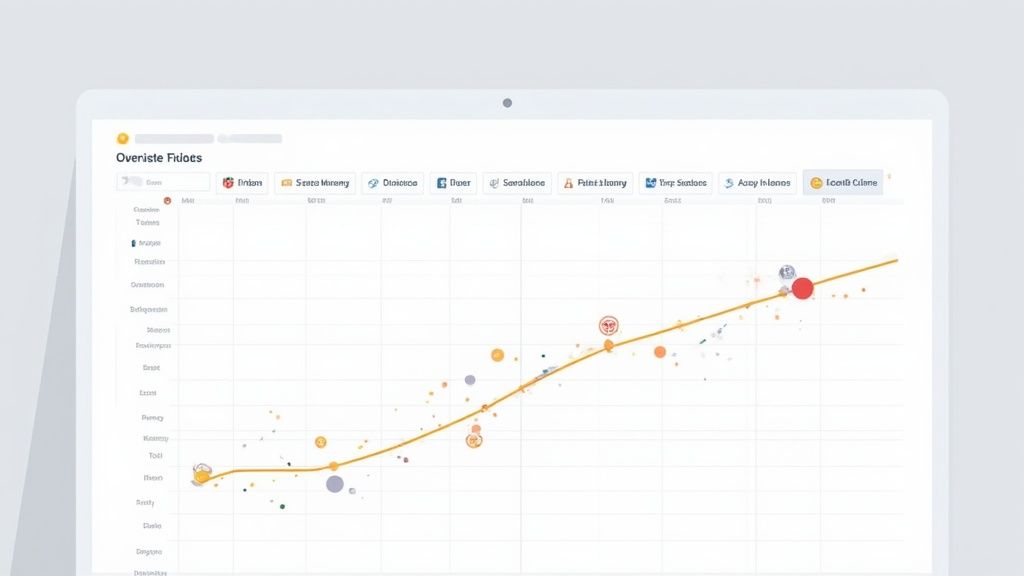
Visuals like this take a static table and turn it into a dynamic overview of the case, allowing legal teams to grasp the client’s entire medical journey in a single glance.
By meticulously building this narrative, you’re creating the foundational document for the entire legal argument. It's this structured story that gives the chronological medical record its undeniable power.
Reading Between the Lines: Finding Red Flags and Case Strengths
Once you’ve assembled the full chronological medical record, the real work begins. This isn't just about data entry; it's about strategic analysis. The completed timeline is an analytical tool, and your job is to read between the lines to uncover the patterns that will either make or break your personal injury case.
This deep-dive review has two main goals. First, you're on the hunt for vulnerabilities—the red flags you know opposing counsel will pounce on. At the same time, you're pinpointing the undeniable strengths that will become the bedrock of your argument for causation and damages. This step is what turns a simple list of dates into a strategic roadmap for your entire case.
Spotting the Red Flags That Can Weaken a Case
No file is perfect. The key is to find the weaknesses before the defense does, so you can build a strategy around them instead of being caught off guard. A detailed chronology makes these potential problems jump right off the page.
Keep a sharp eye out for these common issues:
- Gaps in Treatment: Big delays between appointments are one of the first things a defense attorney looks for. If your client waited six weeks after the accident to see an orthopedist, you need to have a very good reason why. Otherwise, the defense will argue the injury wasn't that serious.
- Conflicting Histories: Did the client tell the ER doctor the pain started "a few days ago" but told their primary care physician it began immediately after the collision? These little inconsistencies can be used to attack your client's credibility.
- Undisclosed Pre-Existing Conditions: The chronology might suddenly reveal physical therapy for a "sore back" a year before the incident. You have to get out in front of this. Proactively addressing pre-existing conditions is far better than letting the defense frame them as the real cause of your client's pain.
- Issues with Compliance: Records showing missed physical therapy appointments or unfilled prescriptions are damaging. The defense will use this to argue that the client failed to mitigate their own damages and is at least partially responsible for their condition.
Think about a standard workers' comp claim where the client alleges a severe back injury from a fall. The chronology shows the initial ER visit, but then there's a six-month gap before they see a specialist. That’s a huge red flag. The defense will argue the injury was either minor or that something else must have happened during those six months to cause the real damage.
A medical chronology doesn't just show you what happened—it shows you what didn't happen. Those gaps and inconsistencies are often where a case is won or lost. You have to address them head-on.
Pinpointing the Strengths That Build a Powerful Narrative
Just as it exposes weaknesses, a well-organized chronology is your best tool for finding the powerful evidence that validates your client's claim. These are the factual anchors you’ll use to build a compelling story about their suffering.
You're looking for patterns that draw a clear, unbroken line from the incident to your client's current condition. Focus on finding these strengths:
- Consistent Treatment: A record showing your client attended every single physical therapy session and followed all medical advice is gold. It paints a picture of a diligent person who did everything in their power to get better.
- Clear Escalation of Symptoms: The timeline can vividly show how a "minor" complaint of stiffness in the ER evolved into documented reports of debilitating pain. Tracking pain scores that climb from a 2/10 to a 9/10 over several visits provides objective proof of a worsening condition.
- Direct Causation Opinions: Hunt for those golden-nugget notes from physicians. A statement like, "Patient's lumbar herniation is a direct medical result of the motor vehicle accident on 5/15/2023," is a powerful weapon for proving causation.
- Evidence of Failed Conservative Care: A chronology that lays out months of unsuccessful treatments—like injections, chiropractic care, and therapy—builds an ironclad justification for needing a more invasive and expensive surgery.
Let's go back to that workers' comp case, but with a different set of facts. This time, the timeline shows consistent physical therapy three times a week for four straight months, with detailed notes documenting increasing pain and limited mobility despite perfect attendance. This record becomes the backbone of your argument that the injury was severe and the resulting surgery was a medical necessity, directly tied to the fall. You've turned a claim into a powerful, evidence-backed story.
How Automation Is Shaking Up the Medical Record Review Process

Anyone who's ever built a medical chronology from scratch knows it's a monumental task. It’s tedious, time-consuming work that forces experienced paralegals to spend hours upon hours combing through records, pulling out dates, and making sense of dense medical terminology. This administrative grind is a huge bottleneck for personal injury firms, tying up skilled staff and putting a hard cap on caseloads.
The good news is that technology is completely rewriting the rules. Modern AI platforms are built to do the heavy lifting, automatically extracting key information and generating timelines. This simple shift frees your team from the drudgery of data entry and lets them jump straight into analysis.
The Real Price of Doing It by Hand
For a moderately complex case, you can expect a paralegal to spend 20 to 40 hours manually piecing together a chronology. Got a massive case with thousands of pages? That number can easily skyrocket to 80+ hours. It’s just not an efficient use of anyone’s time.
In contrast, a purpose-built AI tool can digest the same volume of records and produce a more accurate, structured timeline in just a few hours. This isn't just about saving time; it's about unlocking massive cost savings and boosting your firm's overall productivity. Your team gets to stop wrestling with paperwork and start focusing on what they do best: building a winning case.
The biggest win with automation isn't just getting things done faster. It’s about giving your team back their most valuable resource—time. When you automate the medical chronology, you empower your best people to dive deep into legal analysis, client communication, and case strategy.
Achieving Accuracy and Efficiency at Scale
AI platforms don't just work faster; they bring a level of precision and consistency that’s nearly impossible to replicate manually. These systems are trained to spot and pull out the crucial data points—dates of service, provider names, diagnoses, treatments—with incredible accuracy.
The advantages here are clear:
- Fewer Mistakes: AI dramatically cuts down on the human errors like typos or missed entries that can weaken a timeline's credibility.
- Quicker Turnaround: A job that used to take days or even weeks can now be finished in a matter of hours, helping you move cases along much faster.
- Effortless Growth: Your firm can take on more cases without having to hire a proportional number of administrative staff to handle the extra paperwork.
Tools like Ares were designed specifically to solve this problem. Using a dedicated https://areslegal.ai/blog/medical-record-review-service, firms can transform thousands of pages of jumbled records into a clean, case-ready chronology in a fraction of the time. The AI doesn’t just organize the data; it can also flag missing records and gaps in treatment—critical insights that can make or break your arguments.
Staying Secure and Compliant with AI
Bringing any new technology into your workflow, especially one that handles Protected Health Information (PHI), means you have to put security first. When you're evaluating an automation platform, confirming its commitment to HIPAA guidelines is non-negotiable.
You should be looking for vendors with enterprise-grade security, including data encryption both at rest and in transit. Any reputable provider will readily offer a Business Associate Agreement (BAA), which is your legal assurance that they’re committed to protecting your clients’ sensitive information. This allows you to reap the benefits of new technology without ever compromising your legal and ethical duties. For a deeper dive into how AI can improve operations, check out this guide on how to streamline business processes with AI automation.
Common Questions About Medical Chronologies
Even with a solid workflow in place, preparing a chronological medical record always brings up a few tricky questions. The nuances of handling conflicting records, picking the right format, and making sure everything is compliant can trip up even seasoned professionals. Let's walk through some of the most common hurdles you'll likely face.
How Should You Handle Discrepancies Between Different Medical Records?
Conflicting information is practically a guarantee in complex personal injury cases. You'll see it all the time—an ER report says the accident was on May 5th, but the physical therapist's intake form says May 6th. The golden rule here is simple: document, don't interpret.
Your job is to present the facts exactly as they appear in the source documents. In your chronology, you should list both dates and clearly note where each piece of information came from. For example, you’d create one entry for the ER visit and another for the specialist's appointment, each one accurately reflecting what that specific record says. A "Notes" or "Discrepancy" column is the perfect place to flag the inconsistency for the attorney.
Never try to "fix" a factual discrepancy yourself. Highlighting these conflicts is one of the most valuable things you can do. What looks like a typo could become a major point of contention in a deposition, and spotting it early gives your legal team a chance to get ahead of the issue.
What Is the Best Format for Presenting a Medical Chronology?
The best format is always the one that makes the medical story easy to understand at a glance. Think about the end user—an adjuster, an attorney, or an expert witness. They need to grasp the entire timeline without having to work for it. That's why a clean, well-organized table or spreadsheet is still the gold standard.
At a minimum, your columns should include:
- Date of Service: The backbone of your timeline.
- Provider/Facility: Who provided the care and where.
- Summary of Visit/Treatment: A short, plain-English summary of what happened.
- Diagnoses: List all official diagnoses. Adding ICD codes adds a layer of precision.
- Notes: A catch-all column for your own insights, source page numbers, or flags for review.
If you really want to impress, create a hyperlinked PDF of the final chronology. Each entry in the timeline can link directly to the specific page in the source medical record where the information is found. It's an incredibly powerful tool for negotiations or mediations, letting anyone verify a fact with a single click.
What HIPAA Considerations Are Necessary When Outsourcing Chronology Preparation?
Outsourcing the prep work on a chronological medical record can be a huge time-saver, but it means you have to be absolutely rigorous about HIPAA. The moment you share Protected Health Information (PHI) with an outside vendor, the legal responsibility for its safety still rests heavily on your shoulders.
The first and most critical step is to get a Business Associate Agreement (BAA) signed before a single file is transferred. This is a non-negotiable legal contract that holds the vendor to the same strict confidentiality and security standards your firm follows. If a vendor hesitates to sign a BAA, that's a dealbreaker.
Beyond the contract, do your homework on their security. You need to ask direct questions about how they protect sensitive data.
- Data Encryption: Is client data encrypted both when it’s stored (at rest) and when it’s being sent (in transit)?
- Access Controls: How do they restrict who can see sensitive information within their own company?
- Breach Notification Policy: What’s their plan for letting you know if a data breach occurs?
Cutting corners when vetting a vendor can expose your client and your firm to serious legal and financial penalties. Protecting client data is a fundamental professional duty, not something to be sacrificed for convenience.
Creating an accurate, detailed, and defensible medical chronology is a high-stakes job that takes a ton of time and an expert eye. Ares was designed to get rid of that bottleneck. Our AI-powered platform automates the entire process, turning thousands of pages of raw medical files into a clear, case-ready timeline in minutes instead of days. By taking over the tedious data extraction and organization, Ares frees your team to focus on what really matters: building a winning legal strategy. Learn how you can get back 10+ hours on every single case.