You're reviewing an intake memo after a collision. The injured person says the other driver caused the crash, the insurer's adjuster calls for a recorded statement, and a draft pleading is waiting for a caption. The terminology can look simple, but complainant vs respondent isn't a personality contest or a synonym for “good side” and “bad side.” It identifies procedural position.
In modern U.S. legal usage, the complainant generally initiates a lawsuit or administrative proceeding. The respondent is the party called upon to answer, particularly in a petition or appeal. That distinction affects notice, service, pleading sequence, evidence review, and how you explain the case to a client. Cornell's legal reference on respondent describes that appeal-stage use alongside the broader meaning.
For a personal-injury lawyer, the practical question is never only, “Who was injured?” Ask instead, who invoked this forum, what paper started the proceeding, and who must answer it? The answer changes when the same underlying facts move from a civil complaint to a criminal prosecution, an agency investigation, a Title IX process, or an appellate petition.
Two Parties Walk Into a Case File
The first ten minutes of intake should establish posture before anyone starts arguing liability. Write down who alleges harm, who is accused of causing it, what forum is contemplated, and what document will initiate the process. Those answers give you the working distinction: the complainant starts the proceeding, while the respondent is brought into it and must answer.
In a typical personal-injury matter, the injured client may become the complainant when the firm files a civil complaint or submits an administrative claim. The driver, property owner, employer, manufacturer, or other entity alleged to be responsible becomes the respondent in a forum that uses that label. In ordinary civil captions, “plaintiff” and “defendant” may be the operative terms, but the procedural relationship remains comparable.
At intake, separate the roles from the insurance relationships. An insurer may communicate for the alleged tortfeasor without becoming the respondent. A business may be sued directly while its carrier handles defense. A subrogation carrier that was merely involved in the original claim may later initiate its own proceeding and take the complainant position.
Practical rule: Label the party by the proceeding in front of you, not by the party's emotional or factual role in the accident.
The first demand letter should preserve that clarity. Identify the claimant, the alleged wrongdoer, the incident, the injuries, the liability theory, and the requested response. If the matter involves a third party whose conduct or legal relationship matters, use a resource such as this overview of third-party liability claims to keep the intake analysis separate from the caption analysis.
Those labels then attach to service instructions, response deadlines, discovery requests, and client communications. They'll also shift if the case moves forums. A criminal prosecutor may become the initiating party, an agency may file the charge, and an appellate petitioner may occupy the complainant-equivalent position. The rest of the analysis turns on that movement.
Where the Labels Come From and Why They Stick
The terms survive because they describe direction. A complainant presents a grievance or claim to a tribunal. A respondent answers the pleading, petition, charge, or appeal directed at that party. Their historical use is tied to adversarial procedure, including older equity and appellate practice, where the initiating party presented a bill or petition and the opposing party responded.
That history matters because modern labels often preserve procedural functions even when the forum uses different vocabulary. Civil courts commonly use plaintiff and defendant. Administrative bodies may use complainant and respondent. Appellate courts often use petitioner and respondent, while the party defending the existing judgment may be called the appellee. The words differ, but the filing direction still controls who must respond first.

Procedure preserves the distinction
The initiating party generally frames the allegations and requests relief. The responding party receives notice, decides whether to answer or challenge the proceeding, and contests the allegations or raises defenses. That doesn't mean the respondent is presumed liable. It means the respondent has been placed in the position of answering.
The terminology became especially operational in Title IX and related civil-rights procedures. The 2020 Title IX definitions identify a complainant as the individual alleged to be the victim of conduct that could constitute sexual harassment and a respondent as the individual reported to be the perpetrator. The labels help institutions organize notice, evidence presentation, investigation, and response duties without importing criminal assumptions.
A junior lawyer should treat terminology as a procedural map. Before drafting, check the forum's rules, caption convention, service provisions, and available motion practice. A useful companion is this guide to injury law definitions from Spivak & Sakellariou, particularly when translating broad legal terms into a client-facing explanation.
The labels stick because they remain useful. They tell the clerk who filed, tell the opposing party what must be answered, and help the court or agency organize the evidentiary sequence.
Roles and Procedural Position Across Forums
The same factual dispute can produce different labels depending on where the matter is filed. That's why a lawyer should identify the forum before describing a party's role to a client, witness, insurer, or court.
| Forum | Complainant | Respondent | Operative Pleading | Initial Procedural Right |
|---|---|---|---|---|
| Civil personal-injury action | Injured plaintiff or other initiating claimant | Alleged tortfeasor, employer, owner, manufacturer, or other answering party | Complaint | Notice, service, and opportunity to answer or move |
| Criminal matter | Government or prosecuting authority initiating the charge | Accused person answering the charge, usually styled defendant in U.S. practice | Information or indictment | Notice of accusation, counsel, and opportunity to contest proof |
| Administrative or institutional proceeding | Charging party or person invoking the agency or institutional process | Accused individual, employer, licensee, or institution answering the charge | Administrative complaint, charge, or notice | Notice, response, evidence review, and hearing rights under the forum's rules |
| Appellate proceeding | Petitioner seeking review or reversal | Respondent, often the party defending the order or judgment | Petition for review or appellate petition | Notice of appeal, response, and opportunity to defend the result |
Civil and criminal posture
In a civil PI case, the injured person normally initiates the complaint. The defense may include the driver, an employer under a vicarious-liability theory, a property owner, or a product seller. The caption and service package establish who must respond, but they don't establish liability.
Criminal proceedings operate differently. If a collision also produces allegations of hit-and-run or assaultive conduct, the government initiates the criminal case. The injured person may be a witness or complainant in an ordinary-language sense, but the state controls the prosecution. Treating the victim as the criminal charging party can confuse client expectations and undermine communication about who controls dismissal, plea decisions, or trial strategy.
Administrative and institutional forums use the pair more directly. Title IX materials distinguish the individual alleging harm from the individual reported to have committed the conduct. Workplace, licensing, discrimination, and research-misconduct processes may use the labels under their own rules, so don't assume that a term has the same discovery rights or hearing mechanics everywhere. Lighthouse Consultants' litigation guide offers useful comparative context for understanding how procedural roles operate across court systems.
Appeals reverse the intuitive answer
At appeal, the party seeking review is the petitioner, the complainant-equivalent for purposes of initiating the next proceeding. The respondent defends the judgment or order, even if that party was the defendant below. That rotation is one reason a case chart should record posture separately for every proceeding.
For practical file management, three respondent protections travel broadly across forums:
- Notice: The respondent must know the allegations, requested relief, or ruling being challenged.
- Opportunity to be heard: The respondent must have a meaningful chance to answer, present evidence, or make legal argument.
- Demand for proof: The respondent can require the initiating party to establish the claim under the governing standard.
Discovery mechanics depend heavily on forum rules. Before serving or answering requests, use a focused explanation of discovery in law to distinguish information exchange from the ultimate burden of persuasion.
Burden of Proof and How It Moves
A PI lawyer sees the labels change as the file changes forums. The injured person may be the complainant in an agency charge, the plaintiff in a civil complaint, or the petitioner in an appeal. The opposing party may be a respondent, defendant, or appellee. Those labels identify procedural position, not a permanent allocation of proof.
Burden analysis has three separate layers. The pleading burden asks whether the initiating paper alleges facts supporting each required element. The production burden concerns who must produce evidence and answer discovery. The persuasion burden asks who must convince the decision-maker under the governing standard. Keep those questions separate when drafting requests, evaluating a motion, or explaining the case to a client.
In a civil discrimination or administrative proceeding, the complainant typically starts by proving a prima facie case by a preponderance of the evidence. The respondent may then need to articulate a legitimate, nondiscriminatory reason or another defense. Some regimes place a rebuttal burden requiring clear and convincing evidence, including certain whistleblower matters. Wisconsin's burden-of-proof discussion shows why counsel must check the forum's actual allocation rather than import a civil PI assumption. For a broader reference, see Nares Law Group burden of proof.
| Forum | Complainant Standard | Respondent Standard | Key Motion Trigger |
|---|---|---|---|
| Civil PI action | Usually must establish liability and damages under the applicable civil standard | Must answer allegations and support defenses when properly placed in issue | Pleading challenge, summary judgment, or trial proof |
| Criminal proceeding | Government must prove the charged offense under the criminal standard | Generally has no obligation to prove innocence and may challenge sufficiency | Motion to dismiss, suppression issue, or failure of proof |
| Administrative proceeding | Often must establish a prima facie case under the forum's standard | May need to articulate or prove an affirmative defense or rebuttal | Agency motion, evidentiary ruling, or hearing decision |
| WTO dispute settlement | Complainant must establish a prima facie case by asserting and proving the alleged violation | May prove an exception or defense after the initial showing | Prima facie showing and defense allocation |
The WTO explanation of evidentiary burdens states that the party asserting the affirmative of a claim or defense carries the burden. Apply that principle practically. If a respondent pleads an affirmative defense, identify the documents, witnesses, and testimony needed to support it. If the same matter reaches an appellate forum, the petitioner carries the burden tied to the requested reversal, while the respondent defends the ruling.
Drafting should follow the allocation. A complainant pleads causation, injury, and damages with enough factual detail to provide fair notice and withstand a sufficiency challenge. A respondent answers each material allegation, preserves jurisdictional objections, and pleads affirmative defenses without previewing every trial exhibit.
Summary judgment changes the immediate pressure. The moving party must identify the absence of a genuine factual dispute or establish entitlement under the governing rule. Before that motion, organize records, admissions, expert opinions, and deposition testimony around disputed elements. Tie the medical chronology to liability and causation, and use this practical guide to prove pain and suffering as a drafting aid, not as a substitute for medical and damages evidence.
Practical Implications for Personal Injury Practice
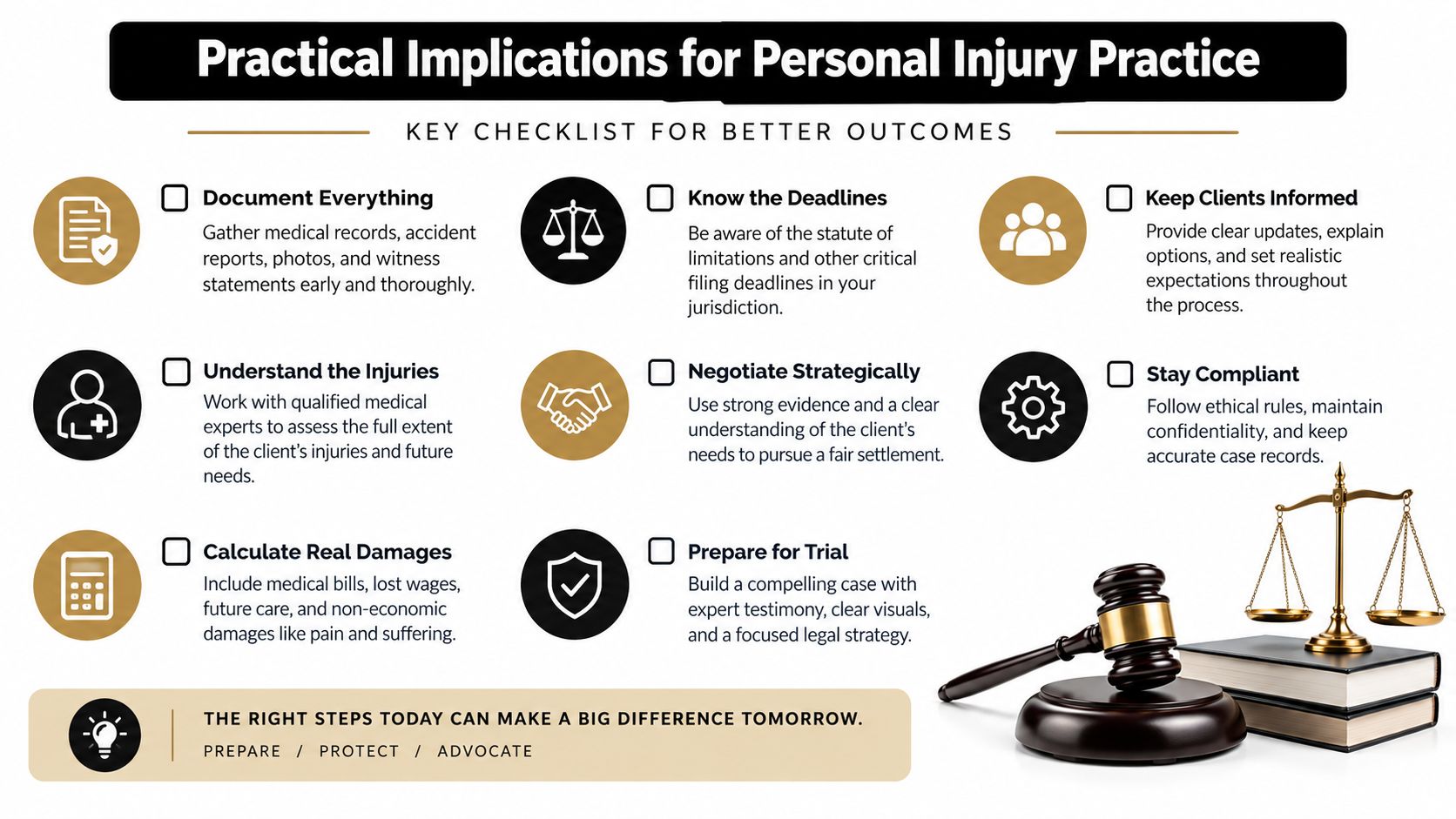
In PI practice, labels become useful only when they change what you do next. Start with the caption, then make every pleading and communication consistent with the client's position.
A civil caption may identify the injured party as plaintiff and the alleged tortfeasor as defendant:
[Injured Person], Plaintiff, v. [Driver or Entity], Defendant.
If the responsible party isn't known, a permitted placeholder can preserve the claim while investigation continues:
[Injured Person], Plaintiff, v. John Doe and ABC Transportation, Defendants.
The caption isn't a substitute for a proper party investigation. Confirm names, ownership, employment, agency, insurance, and service addresses before limitations issues make correction expensive.
Build the opening paper around elements
The complaint should establish jurisdiction and venue, identify the parties, state the occurrence in a readable chronology, and connect facts to legal theories. In a vehicle case, separate ordinary negligence from negligent entrustment or vicarious liability when the evidence supports those theories. In a premises case, identify the dangerous condition, the owner or occupier's relationship to it, notice, breach, causation, and damages.
The ad damnum clause should match the jurisdiction's pleading rules and the evidence you can responsibly describe. Don't use the complainant label as a substitute for medical proof. Attach or summarize records as permitted, identify providers and treatment, and preserve wage-loss documentation and future-care evidence for discovery and expert review.
A respondent-side answer has a different job. It should address admissions, denials, insufficient knowledge, jurisdictional objections, comparative-fault contentions, causation defenses, and indemnity or contribution rights where appropriate. A Rule 12(b) motion may challenge jurisdiction, service, venue, or failure to state a claim, but an aggressive motion that ignores curable defects can waste credibility and delay useful discovery.
Keep discovery matched to the posture
The complainant's early production usually centers on medical records, bills, wage documentation, authorizations where appropriate, photographs, incident materials, and witness information. The respondent's file may include incident reports, preservation materials, insurer communications, investigation notes, electronic messages, maintenance records, employment records, and expert materials, subject to privilege and applicable disclosure rules.
Use a written discovery chart rather than relying on the caption alone:
- Complainant's theory: What element does each record prove?
- Respondent's defense: Which allegation is disputed, and what evidence supports the dispute?
- Causation gap: What alternative explanation must be investigated?
- Preservation issue: Who holds the relevant video, device data, claim file, or communication?
In a demand package, state the liability position, injury chronology, medical support, wage loss, requested resolution, and response deadline. If the respondent's carrier sends a reservation-of-rights letter, analyze coverage separately from liability and avoid allowing the coverage dispute to distort the factual record. At deposition, preserve the burden posture: ask the respondent's witness to identify facts supporting each defense, while refusing to concede an element merely because the question is framed as an assumption.
Worked Examples That Put the Labels in Motion
Rear-end collision. The injured driver sends a demand before suit, identifying the other driver as the proposed respondent and organizing liability facts, treatment, bills, and wage loss. The adjuster asks for a recorded statement. The claimant's lawyer should decide whether the statement advances resolution or creates avoidable testimony, then document that decision in the file. If suit follows, the same factual theory appears in the complaint and later discovery, but the formal civil caption controls the parties' procedural names.
Premises liability. A visitor alleges a fall caused by a condition in a store. The owner responds with a motion based on an open-and-obvious theory. The complainant's opposition should focus on the condition's characteristics, the owner's notice, the circumstances of the fall, and evidence explaining why the defense doesn't resolve the claim as a matter of law. The labels reappear in the motion caption, opposition, affidavits, and any hearing order.
Independent medical examination. The respondent seeks an examination under the governing civil rules. The complainant must coordinate records, identify legitimate scheduling or scope concerns, and avoid turning a cooperation dispute into a credibility problem. The respondent must provide the notice, conditions, and disclosures required by the applicable statute or rule so the examination can be used properly. The procedural fight appears in the motion to compel, opposition, and examination order.
Appeal. The trial court enters an inadequate-damages award. The injured party, now seeking a different result, may become the appellant or petitioner. The opposing party, even if it was the defendant below, may become the respondent or appellee defending the judgment. The labels rotate in the notice of appeal, appellate briefs, and argument schedule, and the record must preserve the trial evidence supporting the challenged ruling.

Each example presents the same discipline. Identify the forum, read its terminology, locate the operative document, and ask what the current party must prove or answer. That sequence prevents a lawyer from carrying a trial-court label into an appeal or treating an administrative respondent like a criminal defendant.
Choosing a Posture and Acting on It
Every filing, demand, and call should reflect a conscious choice between a complainant-style offensive posture and a respondent-style defensive posture. The posture is tactical, not permanent. It can change when the matter moves from a claim to a lawsuit, from a trial judgment to an appeal, or from a civil case to a related administrative process.
Run the posture check
Name the forum and its labels. Confirm whether the rules use complainant and respondent, plaintiff and defendant, petitioner and respondent, or another pair. Identify the document that starts the proceeding.
Map the burden. List each element, affirmative defense, production duty, and likely motion. If the firm represents the complainant, build the factual record around elements and causation. If it represents the respondent, identify unsupported allegations, preserve defenses, and force the other side to prove its theory.
Sequence the first paper. Draft the complaint, charge, petition, answer, or motion that matches the forum. Check service, jurisdiction, deadlines, verification requirements, and the record needed for later review.
Align communication with posture. A complainant's demand should make the theory easy to evaluate without overstating proof. A respondent's response should protect the client's position, avoid accidental admissions, and separate coverage, liability, and settlement communications where necessary.
A practical file checklist should answer these questions before the next milestone:
- Is the caption accurate and consistent with the current forum?
- Does the opening paper plead or answer every material element?
- Does discovery request the records needed to prove the theory, not merely broad categories?
- Have deposition themes been reserved for disputed liability, causation, notice, and damages?
- Have objections and offers of proof preserved issues for appeal?
- Has the client been told who controls the proceeding and what the label does, and does not, mean?
A label tells you where the party stands in the proceeding. It doesn't tell you who will win.
A firm may represent the complainant in a negligence action and the respondent in a related coverage or appeal matter. Re-run the checklist whenever the forum changes. That small habit prevents caption errors, misplaced burdens, and client explanations that become harder to correct once the record is fixed.
Ares helps personal-injury firms organize medical records, extract dates, diagnoses, providers, treatment, and symptom chronology, and turn that information into case-ready summaries and demand drafts. Use Ares to support discovery preparation, deposition planning, and a clearer complainant-side evidentiary record before the next filing or response is due.