
A settlement closes, the client receives the agreed distribution, and the file looks profitable. Then someone notices that records fees, courier charges, medical chronology work, filing expenses, or lien-related payments never made it into the final accounting. The money is gone because the firm failed to identify, document, or present the cost before negotiation ended.
That problem isn't bookkeeping trivia. Cost recovery methods determine whether a firm gets reimbursed for the resources it invested before it calculates profit. A strong liability case can still produce a weak return if the file doesn't show what the firm spent, why the expense was necessary, and how the expense connects to the client's recovery.
For a PI attorney, paralegal, or managing partner, the practical question is simple: What did the case consume, what can the settlement reimburse, and what proof will make the request defensible? The answer depends on the recovery model, the fee agreement, applicable rules, lien obligations, internal classifications, and the way the demand letter tells the financial story.
Introduction to Cost Recovery in Personal Injury Practice
A paralegal finishes a demand package after weeks of gathering records. The medical bills are summarized, liability is supported, and the damages narrative is persuasive. The firm also paid for records, postage, expert review, filing services, medical billing analysis, and other case-specific work. Yet the demand presents only the medical charges and a general request for fees and costs.
The adjuster sees a large damages number without a clear cost ledger. During settlement discussions, the carrier challenges several expenses as unsupported or unrelated. The attorney resolves the claim, but the closing statement omits costs that nobody can verify quickly. The client receives a distribution, while the firm absorbs expenses that should have been addressed before the negotiation concluded.
That outcome usually doesn't result from bad faith or careless work. It results from treating recovery as an administrative task performed at the end of the case. By then, invoices are scattered across email, accounting software, vendor portals, and medical-record folders. A cost that isn't categorized and connected to the case becomes difficult to defend, even when the firm incurred it.
Senior litigators learn to treat expenses as evidence. Each cost should answer three questions:
- What was purchased or performed?
- Why was it reasonably necessary for this claim?
- Where does the supporting documentation appear?
The same logic appears outside litigation. In upstream petroleum contracts, contractors may recover approved exploration, development, and operating expenses from a capped share of production before profit sharing begins, a structure described in this analysis of cost oil and production-sharing contracts. Universities recover portions of research overhead through negotiated indirect-cost systems. Government agencies allocate direct, indirect, and capital costs before calculating charges.
PI practice uses different legal and commercial rules, but the underlying advocacy problem is familiar. The party seeking recovery must define the cost base, support the allocation, respect any cap, and explain the timing of reimbursement. The rest of this guide applies that principle to personal injury work, from selecting a method to documenting expenses and presenting them in settlement negotiations.
What Cost Recovery Really Means and Why It Matters
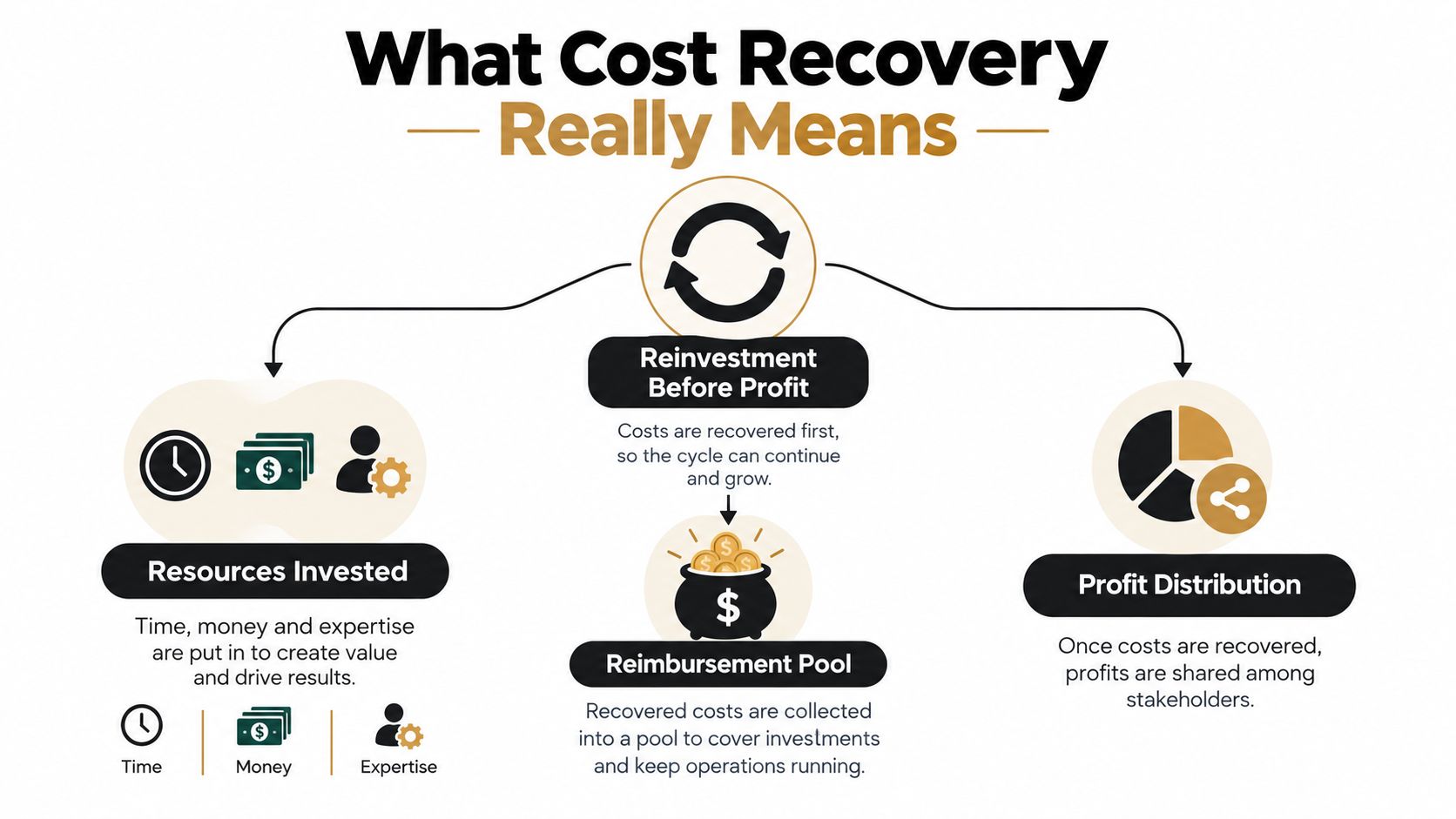
Cost recovery starts with a business bargain. One party invests resources to produce an outcome, and the proceeds are divided only after the agreed costs are accounted for. In a contingency case, the firm advances money, staff time, and professional effort. The client later receives a recovery, and the fee agreement determines how fees, expenses, liens, and distributions interact.
That doesn't mean every expense is automatically recoverable. A case cost is different from general overhead. A medical-record invoice tied to one claim is easier to identify than office rent, ordinary software access, or a managing partner's general administrative time. Capital costs create another category, because equipment and long-lived systems may benefit many matters rather than one file.
The first task is to define the cost object, meaning the matter, activity, or output that receives the cost. Government guidance describes a structured sequence: define the output, determine the cost base, select allocation processes and bases, then calculate charges. The Canadian government costing guide also identifies activity-based costing as preferable where demand can be traced to identifiable activities because it links charges to resources consumed.
The venture analogy
Think of a personal injury case as a venture with a defined purpose. The firm supplies litigation infrastructure and advances expenses. The client supplies the claim and authorizes representation. The settlement or judgment creates the recovery pool. Before anyone calculates the final profit, the file needs a reliable accounting of what the venture consumed.
That analogy clarifies why firms use different cost recovery methods:
- Direct recovery assigns an identifiable expense to the file that generated it.
- Allocated recovery distributes shared resources according to a reasonable basis.
- Activity-based recovery ties the charge to a specific task, such as records retrieval or billing review.
- Capped recovery limits the portion that can be taken before the remaining proceeds are shared.
A petroleum contract might reserve a capped share of production for approved costs, while a PI firm may deduct documented case expenses under its fee agreement. The industries differ, but the governing question is the same: which resources come out first, and what evidence supports that treatment?
Key Cost Recovery Methods Every PI Firm Should Know
No single method fits every PI practice. A solo attorney handling a small number of straightforward claims may track direct expenses matter by matter. A high-volume firm may need allocation rules for shared staff, record processing, technology, and litigation support. The appropriate model should match the firm's agreement, jurisdictional requirements, workflow, and ability to produce supporting records.
| Method | Costs Covered | Best For | Trade Off |
|---|---|---|---|
| Contingency cost reimbursement | Documented case expenses advanced for a particular client | Matters with a clear client-level expense trail | Recovery depends on the agreement, applicable rules, and available proceeds |
| Fully distributed cost allocation | Direct, indirect, and capital costs assigned to an output | Firms seeking a complete view of matter economics | Allocation can become difficult to explain if the basis isn't transparent |
| Activity-based costing | Costs linked to identifiable tasks or services | Records retrieval, billing review, expert coordination, and other traceable work | Requires consistent activity records and time or unit data |
| Capped recovery model | Approved costs reimbursed only up to a contractual or procedural limit | Matters subject to recovery ceilings or restricted deductions | Unrecovered costs may carry forward or reduce firm margin |
| Cost recovery before profit | Proceeds first offset the defined cost basis, with profit calculated afterward | Files where the firm wants a clear break-even threshold | The model can obscure profitability if expenses aren't updated throughout the matter |
The contingency reimbursement model is the familiar PI starting point. The fee agreement should state which expenses the firm may advance, how those expenses are treated at resolution, and whether the client remains responsible if the claim produces no recovery, subject to applicable law. The file still needs more than a clause. It needs invoices, dates, vendors, descriptions, and a connection to the case.
Fully distributed cost allocation is broader. Victoria's cost recovery guidance on fully distributed costing describes an approach that includes direct, indirect, and capital costs in the output cost. For a law firm, that model may help management understand the true resources consumed by a practice area, but it doesn't mean every internal cost belongs on a client's settlement statement.
Activity-based costing offers a more defensible middle ground. Instead of assigning a general overhead percentage to every matter, the firm identifies activities and allocates resources based on actual use. A records request, medical billing review, or expert conference can be tied to a file more readily than general office administration.
Capped models require particular care. The petroleum example shows how a ceiling changes the timing of profit sharing. If a contract sets a 50% cost-recovery ceiling, half of production is reserved for costs and the remainder becomes profit oil or gas, while unrecovered costs may carry forward into later periods. In PI work, contractual or procedural limits can produce a similar economic effect, even though the legal mechanics differ.
Legal Foundations and Procedures Behind Recovery
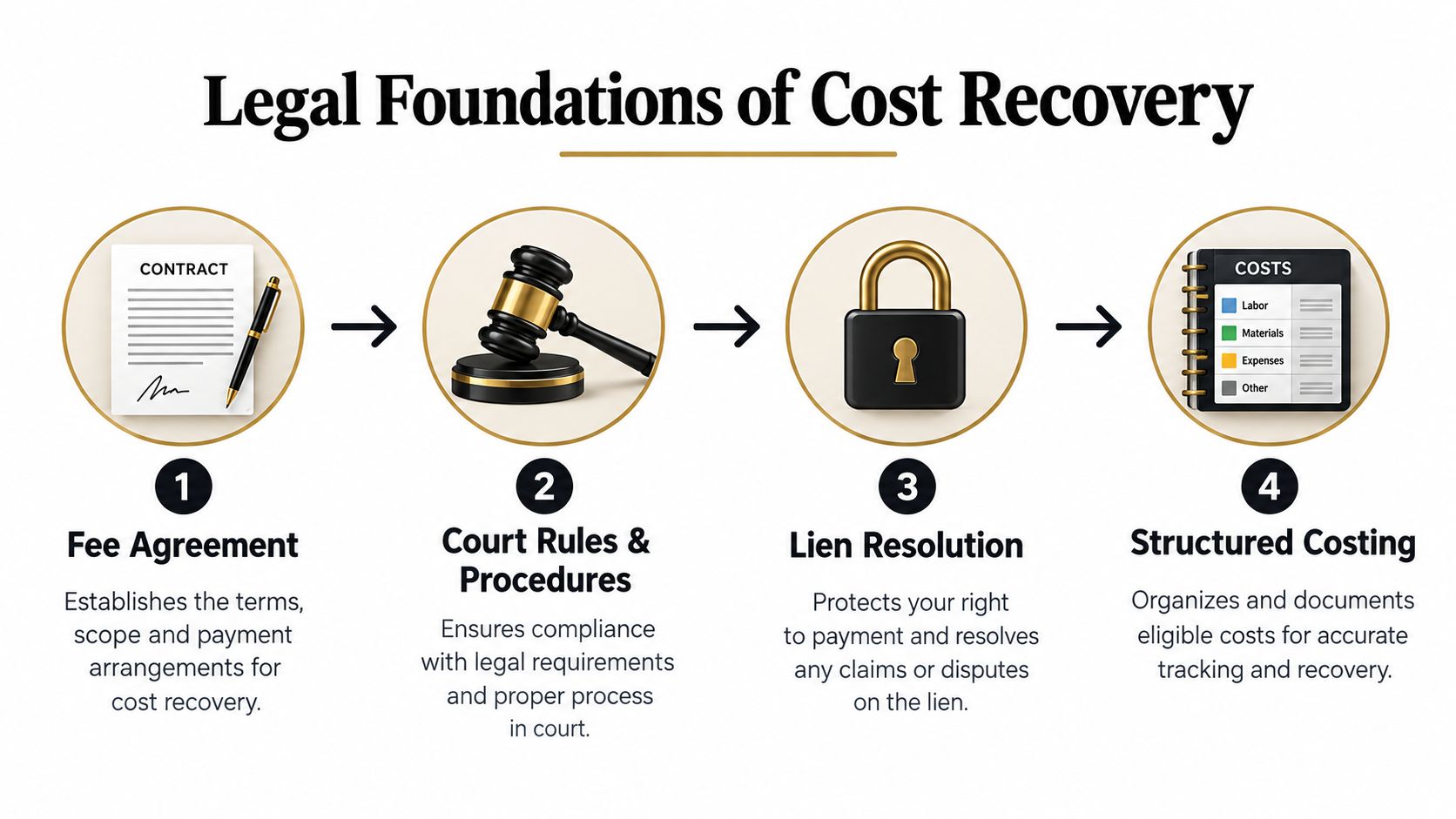
A cost becomes persuasive only when the firm can show the authority for recovering it and the procedure used to calculate it. Start with the engagement agreement. The document should identify the fee structure, explain expense responsibility, describe deductions at resolution, and address how advances are handled if the matter doesn't produce proceeds. Local professional-conduct rules and court procedures may impose additional limits.
The next question is classification. Separate client-specific expenses from firm overhead, and distinguish money paid to third parties from internal labor or technology costs. A clean ledger lets the attorney explain each line without asking the adjuster or client to accept an unexplained bundle.
A defensible procedure
Use a repeatable sequence:
- Define the output. Identify whether the charge relates to the claim, a litigation task, a settlement service, or general firm operations.
- Determine the cost base. Gather invoices, payment records, time entries, vendor statements, and any approved internal allocation.
- Select the allocation basis. Use direct assignment where possible. If a cost is shared, document the reasonable basis used to distribute it.
- Calculate the charge. Apply the fee agreement, client instructions, court requirements, and any applicable cap or exclusion.
- Preserve the proof. Keep the source document and a concise explanation in the matter file.
This sequence mirrors the structured costing process used in government guidance, but PI firms must apply it through the lens of fiduciary duties, client communication, settlement accounting, and lien resolution. A line item isn't defensible merely because accounting software produced it.
Lien work creates a separate procedural risk. Medical providers, insurers, governmental programs, and funding entities may assert interests that affect the amount available for distribution. Before finalizing a settlement statement, compare claimed balances with supporting records and settlement terms. For a focused explanation of the issue, see what a medical lien is and how it affects a claim.
A firm that wants to strengthen its general financial controls can also review the MyOfficeOps law firm accounting guide, particularly when it is standardizing trust accounting, expense classification, and matter-level reporting.
The following video provides additional context for organizing financial procedures around law-firm operations.
Practical rule: If an expense would be difficult to explain to the client in a closing conference, it isn't ready for a settlement statement.
How to Document and Present Costs in Demands and Settlements
A demand letter should make the cost story easy to audit. The adjuster shouldn't have to search through hundreds of pages to determine which provider billed the client, when treatment occurred, or whether an invoice corresponds to the treatment described in the narrative.
Begin with the records, not the demand template. Extract the key dates, providers, diagnoses, procedures, treatment gaps, charges, payments, adjustments, and outstanding balances. Then build a chronology that connects medical activity to the claimed injury and identifies missing documentation before the carrier uses the gap as a negotiation point.
Build the file in layers
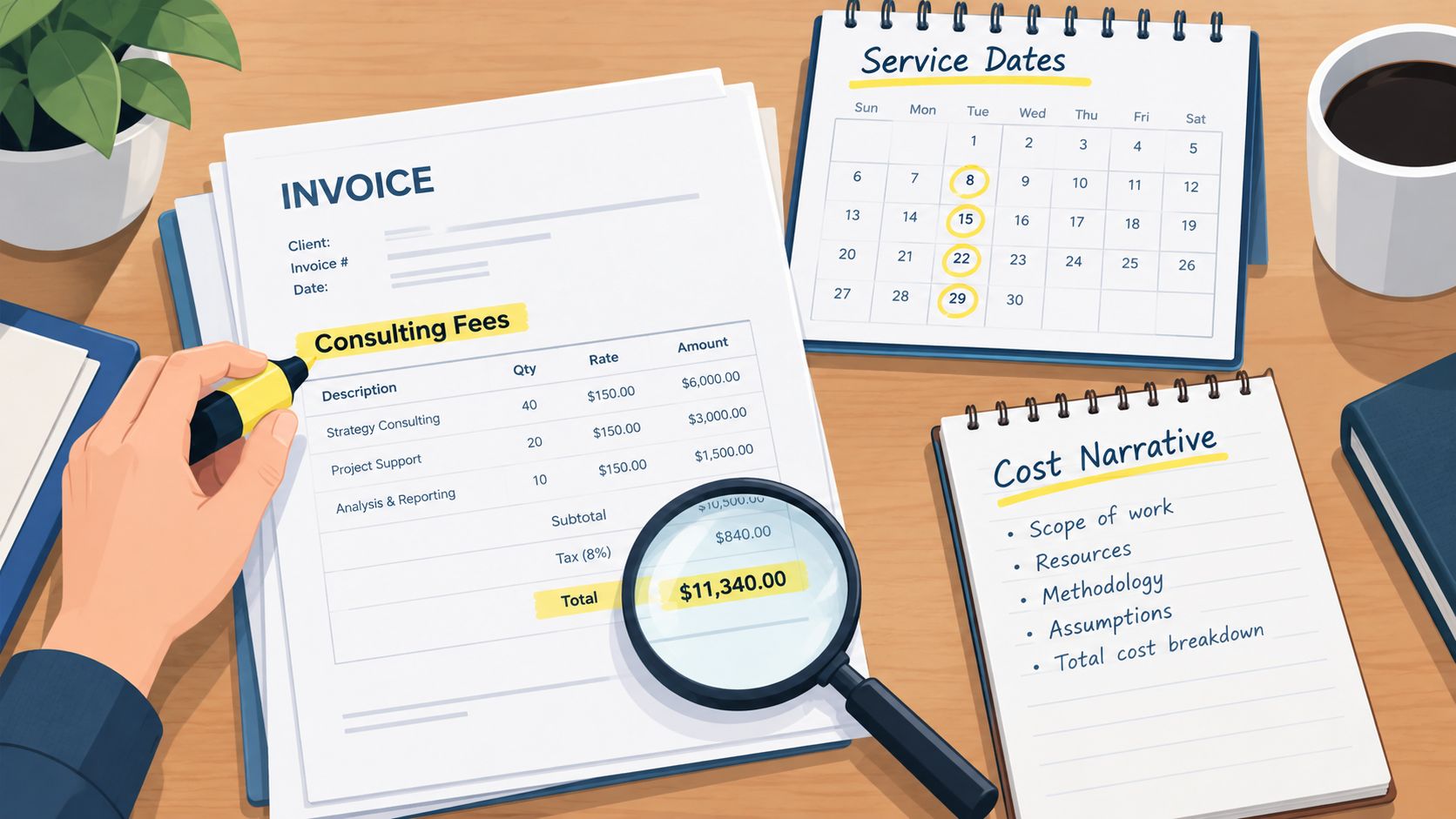
A practical workflow has four layers:
- Chronology: List each material date, provider encounter, diagnostic event, procedure, and follow-up.
- Billing map: Match every bill to the provider, date of service, treatment category, and claimed balance.
- Expense ledger: Record case-specific charges paid or advanced by the firm, including vendor, purpose, date, and amount.
- Exhibit index: Give every supporting document a short identifier so the reader can verify the line quickly.
The narrative should explain necessity without overstating certainty. Instead of inserting a long list of charges, connect the expense to the event that caused it. For example, identify the initial evaluation, the diagnostic work that followed, the treatment response, and the outstanding amount supported by the attached bill.
A weak presentation might say:
“Medical expenses are substantial. The client incurred various bills and costs, all of which are included in the demand.”
That sentence asks the carrier to trust the attorney's conclusion. It doesn't identify providers, dates, services, or documentation.
A stronger presentation states the categories, identifies the supporting records, and explains the relationship between treatment and injury:
“The attached billing summary identifies each provider, date of service, treatment category, billed charge, payment, adjustment, and remaining balance. The chronology ties the post-collision evaluation to the subsequent diagnostic and therapeutic care. Firm-advanced record and litigation expenses appear in the separate cost ledger, with invoices indexed to the corresponding service.”
The second version doesn't guarantee payment. It does remove avoidable ambiguity. The attorney can defend a disputed item because the file shows what it was, why it was incurred, and where the proof sits.
Use this guide to writing a demand letter for personal injury when refining the broader liability and damages presentation. Cost recovery should support the demand's theory, not appear as an afterthought appended to the closing page.
Before sending, perform a reconciliation. Compare the medical summary with every bill, verify that totals aren't duplicated, confirm that missing records are flagged, and check that the requested deduction follows the engagement agreement. The demand should tell one consistent story from incident through treatment, expenses, settlement, and distribution.
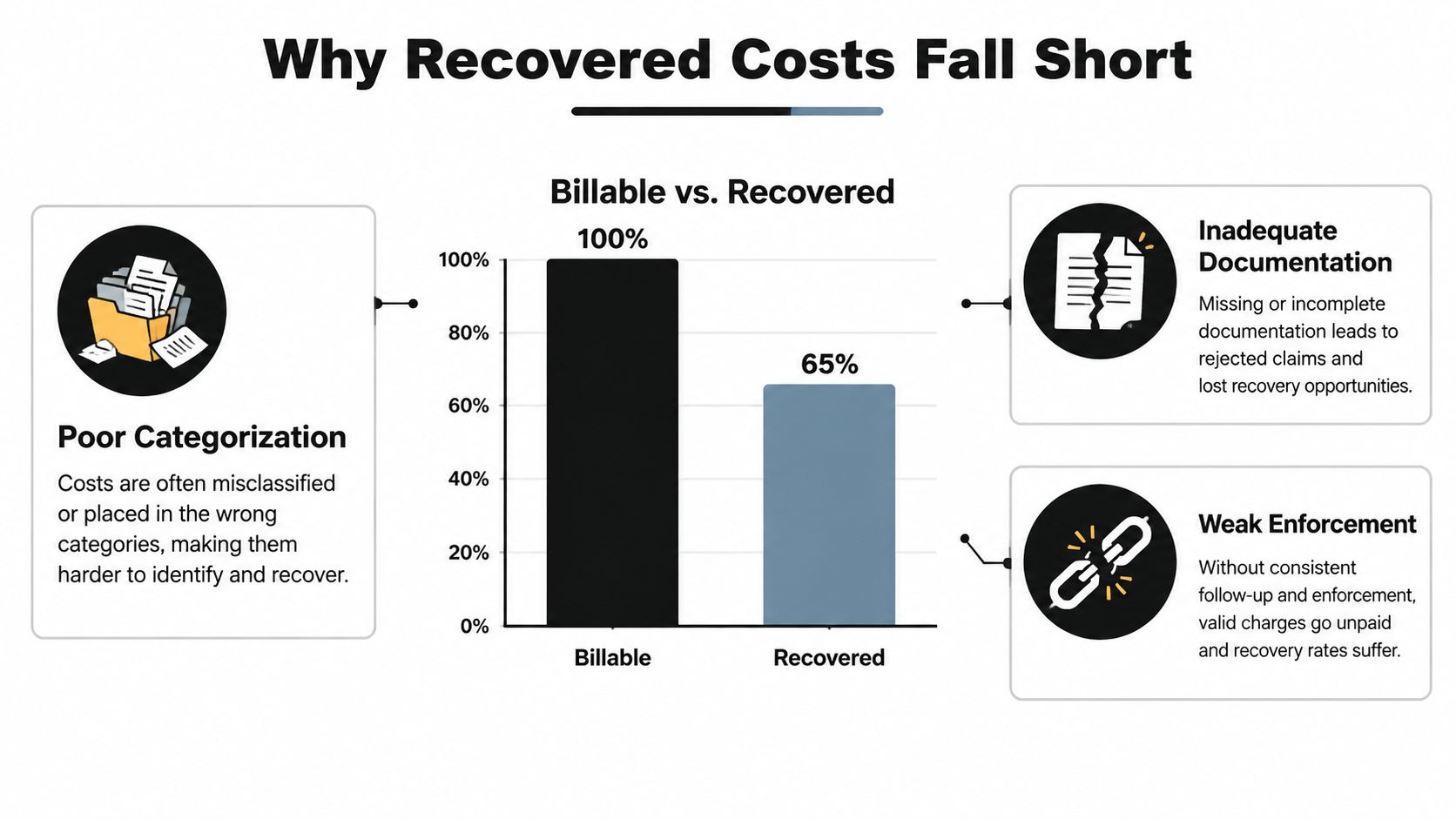
Common Pitfalls and Why Recovered Costs Fall Short
Billable isn't the same as recovered. A negotiated rate can describe what an institution is permitted to claim, while the effective rate shows what it receives after exclusions, caps, and administrative adjustments. That distinction matters for PI firms because a line in an internal ledger doesn't automatically become a reimbursable settlement deduction.
The difference appears clearly in federal research funding. A 2025 NBER working paper on indirect cost recovery used data from more than 350 institutions and reported average negotiated indirect-cost recovery rates of 58%, compared with average effective rates paid by NIH of 42%. The gap shows why firms should forecast actual cash recovery rather than rely on a headline reimbursement formula.
Common failure points include:
- Poor categorization: The ledger combines medical records, postage, expert work, general administration, and technology without explaining which items belong to the claim.
- Inadequate documentation: The firm records a vendor name and total but can't produce the underlying invoice or show the service date.
- Unclear authority: The fee agreement doesn't explain the deduction, or the proposed charge conflicts with a court rule or professional obligation.
- Recovery ceilings: A contractual or procedural cap limits the amount that can be taken before proceeds are distributed.
- Inflation and capital erosion: Inflation and high interest rates can reduce the value of capital allowances, a concern highlighted in the OECD and Tax Foundation analysis of capital cost recovery.
Tax policy can also change the economics of capital-intensive operations. The OECD-wide analysis reports that businesses recovered, on average, 85.3% of machinery investment costs in 2025, while also explaining that inflation and high interest rates reduce the value of capital allowances. The United States made full expensing permanent in 2025 and added temporary 100% expensing for qualifying structures, so the best method can't be selected from a generic straight-line-versus-declining-balance comparison.
For PI firms, the lesson is operational. Audit the effective result after exclusions, client agreements, caps, write-offs, and unresolved liens. A clean invoice trail won't rescue a cost that the governing agreement or rule doesn't permit, but a permitted cost with a weak trail is also likely to be challenged.
See how medical-record fees affect personal injury claims before finalizing a cost schedule that depends on extensive records retrieval.
Building a Stronger Cost Recovery Strategy for Your Firm
A durable strategy has three parts: choose the right method, enforce it consistently, and make the evidence easy to review. Start by auditing closed files. Compare the expenses advanced, the expenses requested, the expenses approved, and the expenses recovered. Then identify where the gap began, whether at intake, invoice capture, demand drafting, negotiation, or closing.
Standardize the matter ledger around direct costs first. Add allocation rules only when the firm can explain the basis and apply it consistently. Require a source document for every reimbursable line, and create a settlement checklist that confirms the fee agreement, liens, expenses, client approval, and final distribution.
Technology can reduce the manual burden, but it doesn't replace judgment. Ares can extract dates, diagnoses, treatments, providers, charges, and missing bills from medical records, then organize those details into medical summaries and demand drafts. Firms should still review the output, verify the source records, and decide which costs the governing agreement and applicable rules permit them to recover.
A managing partner should ask:
- Are costs captured when incurred?
- Can each item be tied to a matter and purpose?
- Does the demand explain the expense instead of merely listing it?
- Does the closing statement reconcile with the ledger?
- Can the firm measure effective recovery after challenges and write-offs?
Build that process before the next settlement arrives. A repeatable system protects client trust, improves negotiation clarity, and gives the firm a more reliable view of matter profitability.
If your firm wants to organize medical-record review, billing details, and demand preparation into a repeatable workflow, visit Ares. Ares helps personal injury teams turn raw case documents into structured, case-ready summaries and demand drafts, so attorneys can review costs and damages with less manual searching.