
A document review attorney isn't just someone who reads documents; they're the evidence hunters of a legal team. They dive deep into massive volumes of information to find the critical pieces of evidence that can make or break a case. Think of them as digital detectives, meticulously sifting through everything from complex medical charts to internal company emails, all to unearth information that’s relevant, privileged, or strategically vital.
The Role of a Modern Document Review Attorney
Let's get one thing straight: the old picture of a lawyer drowning in stacks of paper is long gone. The modern document review attorney is a tech-savvy expert navigating huge digital datasets to find the facts that truly matter in a personal injury claim. They are, in a sense, the digital archaeologists of the legal field, piecing together a powerful case narrative from scattered bits of data.
From Manual Sifter to Digital Detective
The job has changed dramatically. It's no longer about manually flipping through dusty bankers' boxes. Today, it’s about skillfully using sophisticated software to analyze digital files that can number in the hundreds of thousands, or even millions. Their core mission is to categorize these documents with absolute precision, making sure the trial team gets exactly what it needs for depositions, motions, and court.
To do this well, you need a specific mix of talents:
- Keen Analytical Insight: The ability to grasp the subtleties of a case and instantly recognize what counts as important evidence.
- Technological Proficiency: Comfort and skill in operating eDiscovery platforms, using advanced search filters, and interpreting analytics.
- Unyielding Attention to Detail: The focus to catch a tiny inconsistency or that one "smoking gun" document that everyone else might have scrolled right past.
The High Stakes of Document Review
This process is far more than just administrative work—it's a cornerstone of modern litigation. One overlooked email or a mislabeled medical record can completely alter a case's trajectory. The financial investment is also huge. Document review is consistently one of the most labor-intensive and expensive parts of any lawsuit. In fact, law firms report it eats up roughly 52% of their total eDiscovery budget.
The real challenge isn't just the sheer volume of documents. It's the complexity. A great document review attorney can connect the dots between seemingly unrelated pieces of information—a doctor's note here, a corporate email there—to build a cohesive and compelling story.
Thankfully, technology is making a massive difference. Firms that have adopted advanced AI have seen document review times slashed by up to 75%. This proves that automation is essential for keeping costs in check and boosting efficiency. You can learn more about how AI is reshaping eDiscovery solutions for law firms.
This evolution means the document review attorney is no longer just a manual reviewer. They've become a strategic operator, directing powerful tools to get faster, more accurate results and providing critical support to the entire legal team.
A Look Inside the Document Review Workflow
Forget the movie trope of lawyers buried under mountains of paper. Modern document review is a highly structured, almost surgical process. It’s all about taking a chaotic mess of digital files and turning it into a clean, organized, and strategic asset for the trial team. The entire workflow is designed to make sure every single piece of information gets a thorough, systematic evaluation before it’s used in a personal injury case.
This evolution from a manual paper-chase to a tech-driven analysis is a game-changer.
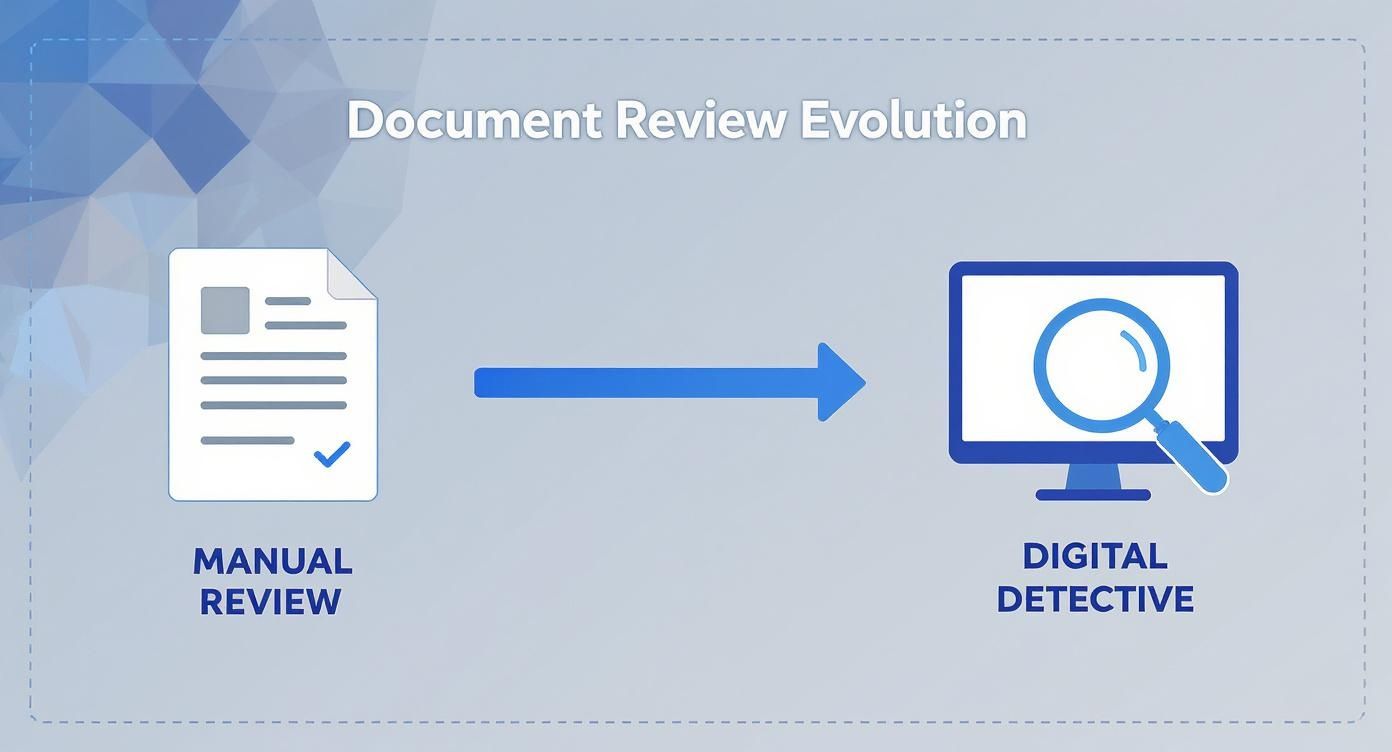
As you can see, the role has shifted from simple sorting to something more akin to being a digital detective, using sophisticated tools to uncover the facts.
Stage 1: The Briefing and Review Protocol
No reviewer ever goes in blind. The process always kicks off with a detailed case briefing where the lead attorneys lay out the core facts, legal arguments, key people, and important dates. This meeting is absolutely essential for creating the review protocol, which is basically the playbook for the entire project.
Think of the protocol as the rules of the game. It clearly defines what makes a document "relevant," what qualifies as "privileged," and lists the specific "tags" or "codes" reviewers need to apply. For example, in a personal injury lawsuit following a car crash, the protocol might tell reviewers to tag any medical records mentioning a pre-existing back injury or any emails that discuss the vehicle's maintenance history.
Stage 2: The First Pass for Relevance
Once the protocol is set, the first-pass review begins. This is where the heavy lifting happens. The main goal here is to separate the wheat from the chaff—to quickly and accurately pull out documents that are responsive to discovery requests and truly matter to the case.
During this stage, reviewers are making thousands of rapid-fire decisions, applying tags such as:
- Responsive: This document contains information that relates to the legal claims or defenses.
- Non-Responsive: This one is irrelevant and can be put aside.
- Further Review: This document is tricky or potentially sensitive and needs a senior attorney to take a closer look.
This phase is all about speed and consistency. A skilled document review attorney can fly through hundreds of documents an hour, making quick judgments based on the rules laid out in the protocol. For a deeper dive into making processes like this more efficient, check out our guide on https://areslegal.ai/blog/legal-workflow-automation-software.
Stage 3: The Second Pass for Privilege and Redactions
After the relevant documents have been isolated, the work shifts to a more nuanced second pass. Here, the focus is on finding and protecting privileged information. This includes any communications covered by attorney-client privilege or materials prepared for litigation (known as the work product doctrine).
Protecting privilege isn't just a best practice; it's a non-negotiable part of the legal process. Accidentally producing a privileged document can waive that protection forever, which could be catastrophic for a case. This is where a document review attorney’s legal training is absolutely critical.
In this phase, any privileged documents are carefully logged and held back from production. If a document has both relevant and privileged information—say, a doctor's report that also contains notes from a chat with the client's lawyer—the attorney will perform redactions. This means blacking out the sensitive parts while letting the non-privileged information go through. The same goes for redacting sensitive personal health information (PHI) to stay compliant with HIPAA. To handle audio files found during discovery, reviewers often use specialized legal transcription software solutions to create searchable text.
Comparing Document Review Staffing and Billing Models
So, how do firms actually manage this whole workflow? It really depends on the size of the case and the firm's own resources. With data volumes exploding, most firms now rely on a mix of in-house staff and outside specialists to get the job done efficiently.
Here's a breakdown of the most common models firms use to staff and pay for document review.
| Model Type | Typical Use Case | Pros | Cons |
|---|---|---|---|
| In-House Teams | Smaller, sensitive cases or firms with steady review needs. | Maximum control, deep case knowledge, enhanced security. | High overhead costs, difficult to scale up or down quickly. |
| Managed Review Services | Large-scale litigation with massive data volumes. | Scalability, access to specialized tech, predictable costs. | Less direct control, potential for reviewer learning curve. |
| Hybrid Models | Complex cases requiring both scale and specialized in-house expertise. | Balances cost-efficiency with high-level oversight. | Requires strong coordination between internal and external teams. |
Ultimately, the goal is to find a model that provides flexibility and predictable costs. While some contract attorneys still bill by the hour, many managed review providers have shifted to per-document or flat-fee pricing. This helps law firms lock in their eDiscovery costs, turning document review from a reactive task into a strategic part of building a winning case.
How AI is Changing the Game for Document Review

Technology is genuinely changing how legal work gets done, and document review is right at the epicenter of this shift. AI-driven platforms are taking what was once a grueling, manual task and turning it into a much more dynamic, tech-assisted process. These tools give a document review attorney the ability to sift through massive amounts of information with incredible speed and accuracy.
The core technology behind this is often called Technology-Assisted Review (TAR), which includes methods like predictive coding. The easiest way to think about it is as a super-smart search filter that learns directly from an attorney's expertise. An attorney will review a small batch of documents, marking them as relevant or irrelevant. The AI watches, learns the attorney's logic, and then applies that same reasoning to the entire document set, flagging everything else it thinks the attorney would find important.
This "learning" process is what allows a legal team to surface the most critical evidence without having to read every single page. It's a true partnership between a lawyer's seasoned judgment and a machine's raw processing power.
More Than Just Speed: How AI Supercharges an Attorney's Work
AI does a lot more than just make things faster; it opens up entirely new ways to analyze and connect information. It essentially acts as a force multiplier, letting a single document review attorney accomplish what used to require a whole team.
- Finding the "Hidden" Patterns: AI is brilliant at spotting subtle connections across thousands of documents that a person might easily miss. Think about it flagging a sudden burst of emails between two key employees right after an incident—a potential smoking gun.
- Grouping by Concept, Not Just Keywords: Instead of just searching for specific words, AI can group documents by the ideas they contain. This helps attorneys explore related topics and stumble upon evidence they didn't even know to look for.
- Instant Summaries: Many modern platforms can create quick, accurate summaries of long documents like depositions or complex medical reports. This gives attorneys a bird's-eye view in seconds, helping them prioritize what needs a deeper dive.
This isn't just a niche trend. Recent reports show that roughly 74% of legal professionals use generative AI for document review, and 72% are using it to summarize documents. The goal here isn't to replace the attorney but to handle the heavy lifting of classification and risk-spotting, freeing them up for higher-level strategic thinking.
Taming the Chaos and Keeping Data Secure
Personal injury cases are notorious for their mountains of disorganized medical records from dozens of different providers. It's organized chaos. AI-powered platforms like Ares Legal are designed to bring order to that mess. By ingesting all the case files, the AI can automatically pull out key information like dates of service, diagnoses, treatments, and provider names.
It then organizes everything into a clean, chronological medical timeline. This gives the document review attorney a clear map of the client's care, making it simple to spot treatment gaps, flag pre-existing conditions, and build a powerful narrative for the case. That level of organization used to take days of tedious, manual work.
AI isn't a replacement for a document review attorney; it's a powerful tool that amplifies their expertise. The attorney’s judgment is still needed to train the system, handle nuanced privilege calls, and weave the AI-surfaced facts into a winning legal strategy.
Of course, with medical records comes the critical responsibility of security. Any platform handling Protected Health Information (PHI) has to be airtight. Reputable AI tools are built with enterprise-grade security and are HIPAA compliant, ensuring all client data stays confidential. This allows firms to adopt powerful technology without risking their ethical or legal duties. For a closer look at this, our article on AI for personal injury lawyers goes into greater detail.
To see the difference in black and white, here’s a quick comparison of the old way versus the new.
Manual Review vs. AI-Powered Document Review
| Task | Manual Review Approach | AI-Powered Approach | Key Benefit |
|---|---|---|---|
| Initial Sorting | Attorneys read documents one-by-one, tagging them based on keywords or instinct. Highly time-consuming. | An attorney reviews a sample set; AI learns the criteria and sorts the rest of the documents automatically. | Drastic reduction in time spent on low-value sorting. |
| Finding Key Facts | Relies on keyword searches and an attorney's ability to remember details from thousands of pages. | AI extracts key entities (names, dates, diagnoses) and identifies conceptual patterns across the entire dataset. | Uncovers connections a human might miss and surfaces critical facts instantly. |
| Creating Timelines | An attorney or paralegal manually pieces together a medical timeline from scattered records. Prone to human error. | The AI platform automatically generates a chronological medical summary from all uploaded records. | Saves dozens of hours and provides an accurate, organized narrative from day one. |
| Privilege Review | Every document is manually reviewed for privileged communication, a slow and high-risk process. | The AI flags potentially privileged documents based on names, law firm domains, and keywords for targeted attorney review. | Increases accuracy and focuses attorney attention on the most sensitive documents, reducing risk. |
Ultimately, by pairing human oversight with AI's analytical engine, law firms aren't just working faster—they're achieving better, more secure, and more accurate outcomes for their clients.
Protecting Privilege and Ensuring Accuracy

Finding the right information is only half the battle. The true work of a document review attorney rests on two critical pillars: protecting client privilege and maintaining unwavering accuracy. These aren't just best practices; they're non-negotiable duties. Get them wrong, and a personal injury case can unravel in an instant.
Think of the document set as a minefield. The review attorney is the expert navigator, trained to spot and neutralize threats—like an inadvertently disclosed email between a client and their lawyer—while safely extracting the evidence needed to win. One wrong step can be catastrophic.
This is what makes the role so crucial. These attorneys are the guardians of sensitive information and the architects of the factual foundation for the entire case.
The Art and Science of Document Coding
At its core, accuracy comes down to consistent and correct "coding" or "tagging." Every single document is evaluated against the case protocol and assigned specific labels that determine its fate in the litigation. This isn't just mindless clicking; it's a series of nuanced legal judgments, repeated thousands of times over.
A document review attorney meticulously applies codes that might include:
- Relevant: The document contains information directly pertinent to the claims or defenses.
- Privileged: The document is legally protected from disclosure. Hands off.
- Confidential: Contains sensitive personal or business data that needs protection.
- Key Document: A "hot" or "smoking gun" document—something central to the case narrative.
This methodical coding ensures the trial team gets a clean, reliable, and strategically sound set of evidence. In a product liability case, an attorney might tag internal engineering reports as a Key Document, the client's emails about their injury as Relevant, and communications with in-house counsel as Privileged.
Demystifying Privilege Review
Privilege is one of the most sacred concepts in law, and protecting it is arguably the single most important job for a review attorney. If you accidentally hand over a privileged document to the other side, you can trigger a "waiver of privilege," meaning that protection could be lost forever.
A privilege review is the legal equivalent of separating state secrets from public records. It demands an attorney's training to recognize the subtle markers of legally protected communications and thought processes, ensuring the client’s confidential information remains secure.
Two main types of privilege are at the center of this process:
- Attorney-Client Privilege: This shields confidential communications between a lawyer and their client made for the purpose of getting or giving legal advice.
- Work Product Doctrine: This protects materials an attorney (or their team) creates in anticipation of litigation, like internal case analyses, interview notes, and strategic memos.
An email from your client describing their post-accident pain? That's covered by attorney-client privilege. A paralegal’s notes summarizing witness interviews? That's work product. Finding and walling off these documents is a critical defensive play.
Creating Defensible Privilege Logs
When you withhold a document on privilege grounds, you can't just hide it. You have to record it on a privilege log, a document you provide to the opposing counsel and the court to explain why certain documents aren't being produced.
Creating a defensible log is an art form. Each entry has to provide just enough information to justify the privilege claim without giving away the privileged content itself.
A typical entry includes:
- The date of the document
- The author(s) and recipient(s)
- A brief, non-revealing description of the subject matter
- The specific privilege being claimed (e.g., Attorney-Client)
An inadequate or sloppy log can be challenged in court, potentially forcing you to disclose the very documents you fought to protect. This is exactly why you need a skilled document review attorney who lives and breathes these standards.
When dealing with medical records, this precision is even more critical. For a deeper dive on this, check out our guide on HIPAA compliant document management. Ultimately, getting these details right transforms document review from a tedious chore into a source of real strategic advantage.
Measuring Success in Document Review
So, how does a law firm know if its document review is actually working? To move past simple guesswork, you need to focus on specific key performance indicators (KPIs) that track both efficiency and quality. A good document review attorney and their project manager live and die by this data to monitor progress, spot trouble early, and prove the team’s value.
Without clear metrics, a review project is like driving blind. You're moving, sure, but you have no idea if you're on the right road, how fast you're going, or if you're about to hit a wall. Data is the dashboard you need to navigate the maze of eDiscovery.
These numbers aren't just for managers, either. They help individual reviewers see how they're doing and how their work fits into the team's bigger goals.
Core Metrics for Efficiency and Cost Control
The first set of KPIs is all about the operational side of things: speed and budget. These numbers tell project managers if the team is on track to meet deadlines without blowing up the budget. Think of them as the foundational metrics for any well-run review.
Three metrics really stand out here:
- Review Speed (Documents Per Hour): This is the classic efficiency metric. It tracks how many documents a reviewer gets through in an hour. While a higher number looks good, it means nothing if the quality isn't there.
- Cost Per Document: This one is simple but powerful. You take the total project cost and divide it by the number of documents reviewed. It gives you a clear financial benchmark to see if the project is cost-effective.
- Project Completion Rate: This metric tracks the team’s progress against the total pile of documents, showing whether you’re on schedule to meet those unforgiving court deadlines.
These KPIs help answer the big questions about a project's health. Is the team working fast enough? Are costs getting out of hand? Will we make our production deadline? Having solid data gives you clear, defensible answers.
Measuring Quality with Precision and Recall
Speed is one thing, but accuracy is everything. A fast review that misses the smoking gun document or accidentally produces privileged information is far worse than a slow one. This is where the concepts of precision and recall come into play, especially when you’re using Technology-Assisted Review (TAR).
Think of it like fishing. Recall is how many of the total fish in the lake you managed to catch. Precision is how much of what's in your net is actually fish, not old boots or seaweed. In document review, you want to find all the relevant documents (high recall) without also grabbing a bunch of irrelevant junk (high precision).
These two metrics are constantly in a tug-of-war. Pushing to improve one can often hurt the other. A skilled document review attorney knows how to strike the right balance to build a defensible and effective review process.
A high recall rate gives you confidence you haven't overlooked critical evidence. On the flip side, high precision means the litigation team won't waste countless hours sifting through non-responsive documents you've produced. Finding that sweet spot between the two is the hallmark of a smart, data-driven document review strategy.
The Future of the Document Review Attorney
The idea that technology will make document review attorneys obsolete is a common misconception. In reality, the role is shifting, becoming more strategic and more critical to personal injury law than ever before. The profession isn't disappearing; it's getting an upgrade.
Gone are the days of lawyers manually flipping through endless stacks of paper. The modern document review attorney is a tech-fluent legal strategist, guiding powerful AI to pinpoint the exact piece of evidence needed with incredible speed and accuracy.
This blend of human expertise and machine intelligence is a game-changer. An experienced attorney’s intuition is still irreplaceable for tricky privilege calls, for grasping the subtle context of a conversation, or for weaving discovered facts into a compelling story for a jury. When you combine that legal skill with AI-powered platforms, firms can dramatically cut review costs, move cases along faster, and ultimately win better outcomes for their clients. It’s a true partnership: technology manages the sheer volume, and the attorney provides the strategic direction.
The Rise of the Tech-Savvy Legal Professional
The future belongs to legal professionals who can confidently blend their legal knowledge with technology. Firms are actively seeking out attorneys who don't just use software, but who understand how to deploy it as a strategic weapon. These are the people who can architect smarter workflows, make sense of data-driven insights, and use AI-generated summaries to build a rock-solid case from day one.
The real value of a document review attorney is moving from manual labor to strategic oversight. They’re no longer just finding documents; they’re conducting a tech-powered investigation to find the truth faster and more reliably than ever before. This shift makes them a more valuable asset to the team, not a less essential one.
Adopting this integrated approach isn't just a good idea anymore—it's essential for staying competitive. Law firms that equip their teams with advanced tools like Ares Legal are setting themselves up to handle bigger caseloads and deliver better results. They’re not just keeping up; they’re raising the bar for client service. The future for the document review attorney is bright, analytical, and powered by smart technology.
Frequently Asked Questions
If you're thinking about a career in document review or looking to hire one for your firm, you probably have a few questions. Let's tackle some of the most common ones to clear up the confusion around the skills, future, and payment models in this unique legal niche.
What Skills Really Matter for a Document Review Attorney?
Of course, a law degree and bar admission are the table stakes. But what truly sets a great document review attorney apart is an almost obsessive attention to detail, razor-sharp analytical skills, and a genuine comfort with technology. The best in the business can spot a tiny discrepancy or a critical date buried in a mountain of files.
Technology isn't just a "nice-to-have" anymore, either. Deep knowledge of eDiscovery platforms, AI-assisted review tools, and data analytics has become a fundamental requirement. It's what separates a good reviewer from a highly efficient and successful one.
Is AI Going to Make This Job Disappear?
Absolutely not. What AI is doing is changing the role from a manual sifter of documents to a strategic manager of a tech-driven process. Think of AI as the first line of defense—it’s brilliant at making that first, high-volume pass to flag potentially relevant documents on a scale no human team could ever match.
AI is great at finding the "what"—documents with certain keywords or patterns. The human attorney is still essential for figuring out the "why." They make the tough calls on nuanced legal issues like privilege, intent, and context that an algorithm just can't understand.
An attorney's expertise is crucial for training the AI model, running quality control, and making the final, defensible judgment calls on the most complex information. It's a collaboration, not a replacement.
How Do Document Review Attorneys Bill for Their Time?
The billing structure can look pretty different depending on the project and how the attorney is engaged. Knowing the options helps firms keep their budgets in check.
- Hourly Rate: This is the classic model. You'll see it most often with contract attorneys who are brought on for a specific case.
- Per-Document or Per-Gigabyte Pricing: This approach is common with managed review companies because it makes costs more predictable for massive projects.
- Salaried Position: If a firm has a constant need for review, they might bring someone on as a full-time, salaried employee.
The right model really comes down to the size of the case, how long the review is expected to take, and the firm’s budget and staffing plan.
Ready to transform your firm’s document review process? Ares turns chaotic medical records and case files into organized, case-ready insights in minutes. Eliminate hours of manual work and build stronger cases faster. Discover how by visiting the Ares Legal website.