
A folder lands on the desk with an emergency department discharge summary on top, a stack of follow-up notes underneath, and a bill that doesn't match any of the visit dates. Somewhere in that stack is a claim worth real money. The adjuster has already called once, and what you said was that you'd send a demand when the records were in.
That moment decides more of the outcome than anything you write afterward. A dog bite demand letter isn't a persuasive essay about a frightening afternoon. It's a damages model with auditable inputs, wrapped around a liability argument that has to match the rule in the state where the bite happened. Every figure traces to a bill. Every claim about the owner's duty traces to a statute, an ordinance, or a record of what that animal did before.
Get those two structures right and the negotiation moves on your terms. Get them wrong and you'll spend three months arguing about a treatment gap you could have closed in a week. What follows is the order I'd work in, and the checks I'd run before anything leaves the office.
Confirm the Liability Theory Before You Draft
Two dogs bite two people on the same afternoon, and one claim is worth five times the other. The wound isn't the difference. The rule is. Before you write a sentence of narrative, you need to know which liability standard governs the bite, because that standard decides which facts the letter has to prove and which ones a judge will ignore.
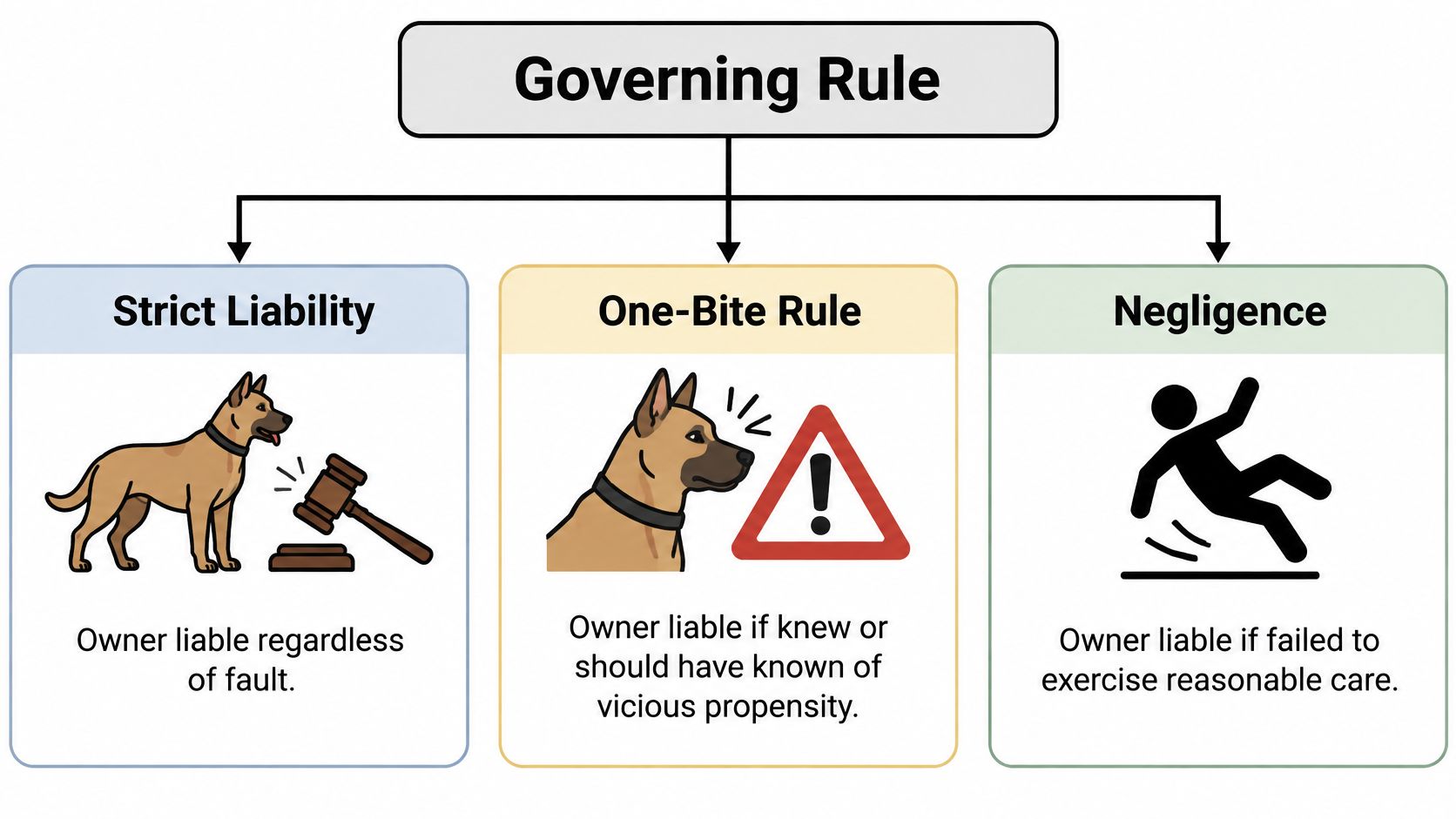
Three regimes cover nearly every file. Under strict liability, the owner answers for the injury whether or not the animal ever showed aggression. Under the one-bite rule, you have to establish that the owner knew or should have known the dog was dangerous. Under negligence, the question shifts to control: did the owner break a leash law, ignore a fence requirement, or fail to restrain an animal they couldn't handle?
A recent state-by-state summary of dog bite liability rules classifies roughly 35 states, the District of Columbia and four territories as strict liability jurisdictions, with about 10 states retaining some variation of the one-bite rule. Treat those categories as a starting point only. The current statute and any municipal ordinance control, and both get amended.
The evidence matrix comes before the prose
| Regime | What the letter must prove | Evidence to request first |
|---|---|---|
| Strict liability (about 35 states, DC and four territories) | The dog caused the bite, injury and damages, with no statutory exception | Licensing and ownership records, animal control report, medical causation records |
| One-bite rule (about 10 states) | The owner knew or should have known of the dog's dangerous propensity | Prior complaints, earlier bite or aggression reports, animal control files |
| Negligence | The owner failed to control the dog, such as breaking a leash law or fence rule | Leash and fence ordinances, witness statements, surveillance footage, property-management records |
Sequencing rule: request the liability records the same week you take the case. A preservation letter for surveillance footage is worth more to the file than a beautifully written paragraph about pain.
Request animal control history, licensing and vaccination records, prior neighbor complaints, and any incident logs the property manager keeps. An early spoliation notice, a public-records request, or a coverage inquiry to the insurer often answers the notice question outright. If the file is thin and you're still deciding whether to take it, run a structured personal injury case evaluation before you sink hours into drafting.
A polished account of a child's injury changes nobody's position if it never establishes that the owner knew. Prove the right elements first. The narrative earns sympathy once liability is fixed, not instead of it.
What a Dog Bite Demand Letter Must Contain
More than 4.5 million people in the United States are bitten by dogs each year, with children the most vulnerable group, according to the Insurance Information Institute. At that volume, an adjuster reading your letter has seen the same story a hundred times. What separates a demand that gets a number from one that gets a form denial is documentation, not description.
Seven parts do the work. Most weak demands aren't missing an argument, they're missing a part.
| Part | What it contains | Exhibit to attach |
|---|---|---|
| Claim header | Claimant, owner, insurer, claim and policy numbers, date and location | Incident report, policy declarations page |
| Liability statement | The owner's legal duty under the state rule and the facts showing the duty was breached | Animal control report, prior complaints, witness statements |
| Injury narrative | Bite mechanism, wounds, diagnosis, infection risk, scarring | Emergency department record, wound photographs |
| Treatment chronology | Each provider, visit, procedure and symptom in date order | Medical records and provider list |
| Damages summary | Medical specials, wage loss, out-of-pocket costs, and non-economic harm | Itemized bills, pay records, receipts |
| Settlement request | The specific amount, response deadline, and release terms | Exhibit index and cover summary |
| Exhibit index | Each exhibit number, title, date and the section that cites it | Compiled exhibit binder |
The header and liability statement tell a claims handler which policy responds and whether the duty is statutory or fault-based. The injury narrative and chronology carry causation, which is where a demand either earns trust or loses it. The damages summary, the request and the index carry value, and they only work if the first five parts are already sound.
Why the shape of the letter matters
The document is best understood as a structured pre-litigation damages presentation, per the Triple-I overview. It organizes liability facts, identifies the responsible owner or insurer, summarizes objective medical evidence, and assigns a monetary value that records support. That's a package, not a letter with numbers stapled to it.
Adjusters check cited causation, special damages and the liability argument first, usually in that order, and usually in ten minutes. An exhibit sitting behind every factual sentence is what keeps them reading past page two.
Confirm an exhibit exists for each of the seven parts before you draft a single paragraph. If the answer is no for one of them, you're not ready to write, you're ready to request records.
Build the Medical Chronology Step by Step
A child is seen in the emergency department, referred to a plastic surgeon three days later, then returns for scar revision ten months on with nothing in between. That ten-month silence is the first objection an adjuster will raise. Answer it in the chronology, with a record, before you total a dollar.
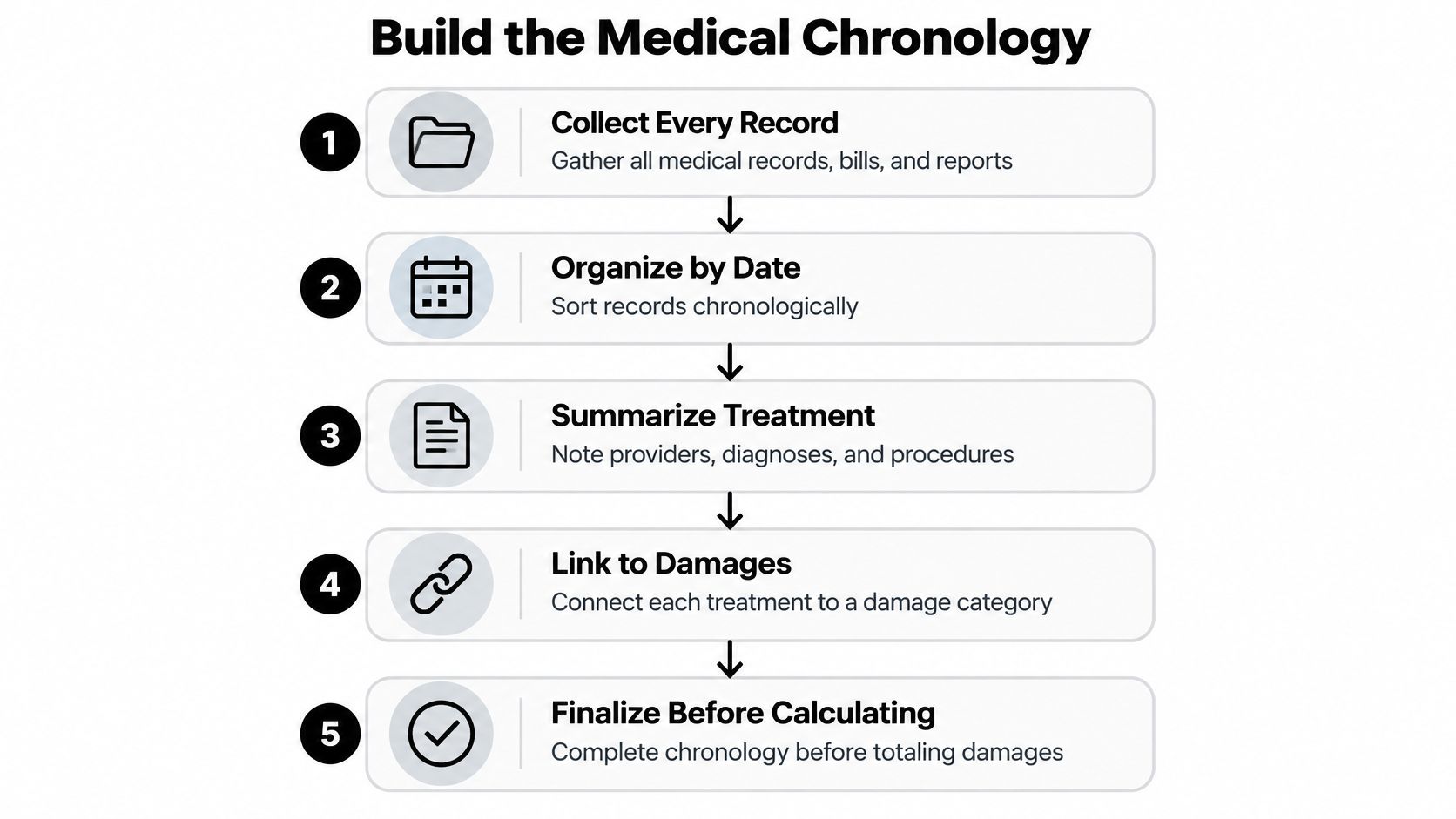
Finish the timeline before you price the case. Reversing that order produces a demand figure you cannot defend and a treatment gap you cannot explain. The Assembly Software demand letter workflow framework treats the package as an evidence-traceability exercise. That instinct is right. If a material assertion cannot be audited back to a document, it does not belong in the letter. Every date, diagnosis, and charge should point to a source page the same way a later damages figure points to a bill.
- Collect everything, then list the providers. Emergency visit, follow-up notes, imaging, prescriptions, therapy logs, vaccination records, and the plastic surgery consult. Build a provider list with specialties and addresses. The adjuster will cross-check that list against the bills.
- Sort by date, starting with the first emergency contact. Sort by the sequence the patient lived through, including the 2 a.m. visit and the three-day follow-up. Provider order and bill order hide gaps.
- Link each entry to the bite. For every record, capture provider, diagnosis, procedure, symptom progression, and prognosis. A record with no stated connection to the attack is a line item an adjuster will discount. Note where the treating notes tie the injury to the attack.
- Reconcile every charge to a matching visit. Flag anything without a pair. An unbilled procedure and an unexplained bill are the same problem from opposite directions. Both invite a credibility fight you do not need.
- Write a sourced sentence for every gap. The ten-month silence before scar revision is the clearest version of this. Say what the chart shows in that interval: a planned wait for scar maturity, missed appointments, or no care at all. A sentence with a citation reads as diligence. A bare assertion reads as padding.
- Label and cite the exhibits. Number them, cite the number in the text, and send copies rather than originals. If a record is missing from the binder, the assertion that depends on it is missing too.
A missing surgery bill or an unexplained break in treatment is the most common reason an adjuster cuts an offer, and it is the cheapest problem to fix before the demand goes out. Surface the gap yourself, with a settled explanation. If the adjuster finds it first, the rest of the numbers look inflated.
The medical record chronology workflow guide walks through the same sequencing for firms building the timeline from scratch.
Decision point: if any entry in the chronology lacks a record, hold the demand. A week spent chasing an operative report is cheaper than a month spent rebuilding credibility.
Document Damages Without Overreach
The multiplier method is a shortcut, and adjusters recognize it in seconds. Three times medical specials tells a claims handler you didn't build a model, you applied a formula. What holds up under scrutiny is a damages model with auditable inputs: reconciled charges, documented wage loss, a treating-provider opinion on future care, and non-economic harm argued from concrete functional evidence rather than assumed.
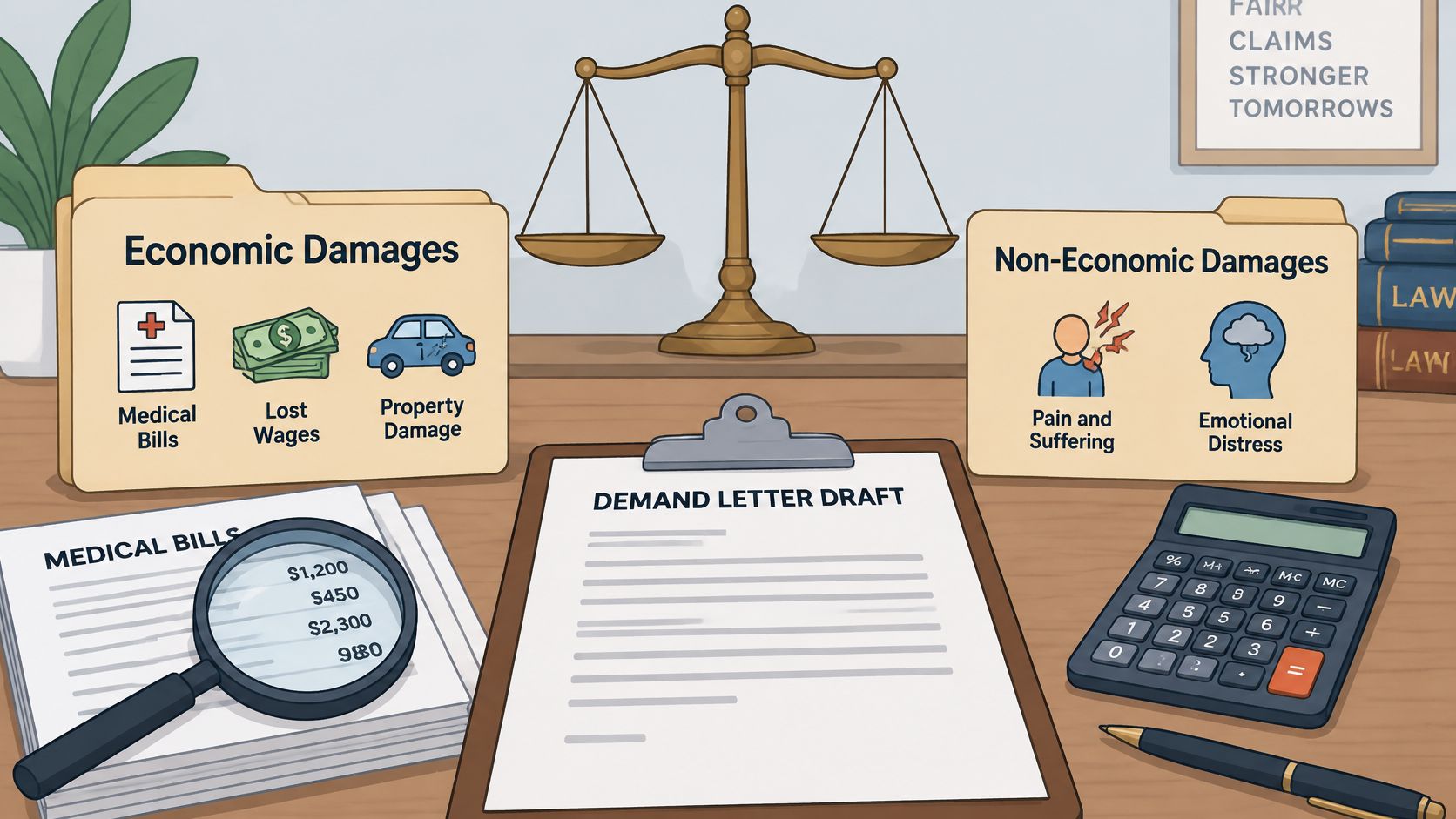
Economic damages come from the ledger. Non-economic damages come from what the person can no longer do: sleeping in fragments, avoiding the park, missed shifts, a scar the patient covers at work, dressing changes a family member performs. The demand package guidance from Oklahoma Lawyer makes the same split and adds the piece most drafts skip: show amounts paid, outstanding balances, liens and insurance adjustments next to billed charges so the adjuster sees the whole picture instead of a single gross number.
| Category | Proof to attach | How to calculate |
|---|---|---|
| Past medical expenses | Itemized bills matched to each visit | Total billed charges, noting paid amounts, liens and adjustments separately |
| Lost wages | Pay records, employer letter, time-off records | Days missed multiplied by daily rate, plus lost overtime |
| Future medical care | Treating-provider opinion on need and cost | Provider estimate or documented cost of the procedure |
| Out-of-pocket costs | Receipts for prescriptions, transport and home care | Sum of verified receipts |
| Scarring and disfigurement | Dated photographs and a scar evaluation | Non-economic; argued from the evidence, not a formula |
| Pain, fear and sleep disruption | Treatment notes, a symptom journal, witness statements | Non-economic; supported by concrete limits on daily life |
Future care needs an opinion from the treating provider, not an assumption that treatment will continue because it usually does. If the plastic surgeon says revision is likely at skeletal maturity, get that in writing with a cost estimate. If nobody will say it, don't price it.
Set yourself a quality-control benchmark of zero unexplained variance between the specials table, the attached bills and the chronology. Every visit has a matching record and charge. Every future item has medical support. Anything that fails moves to a to-do list, not into the letter.
What not to promise
No reliable success-rate statistic for dog bite demand letters exists, so don't quote a settlement probability to a client and don't anchor to an average settlement figure you can't source. Track your own numbers instead: days from records-complete to demand, the share of damages carrying a source citation, adjuster response time, counteroffer-to-demand ratio, and pre-suit resolution rate. Those metrics tell you where files stall, which is more useful than a benchmark someone invented.
For the specials side of the ledger, this walkthrough of special damages in personal injury cases covers how to categorize and total the economic component cleanly.
Write the Settlement Request and Deadline
The request is where a well-built file either converts or stalls. Work through it in this order and the arithmetic defends itself.
- Total the verified specials. Use the damages summary, and exclude every charge that lacks a matching record. A demand that survives a line-by-line audit is worth more than one that's 15% higher.
- Set the non-economic figure with a short justification. Tie it to the functional evidence: the sleep loss, the fear response, the visible scar, the shifts missed. Give the reasoning in two or three sentences and skip the formula.
- State one full settlement amount, with both components shown so the adjuster can see how the total was built.
- Put a calendar date on the response. Thirty days is the common window. Name the date rather than "within a reasonable time", because a vague deadline is no deadline.
- Define the release scope and state that liens will be satisfied from the proceeds. Ambiguity here delays funding after everyone has agreed on the number.
- Specify delivery and confirm the enclosures. Copies, not originals, and an exhibit index that matches the numbering in the text.
Say a file lands with a nine-year-old bitten on the face, $18,200 in documented specials, a scar revision still pending, and a treating-provider estimate covering the future procedure. The letter states the total, shows the specials and the future-care component separately, justifies the non-economic figure against the scar photographs and the school absences, and sets a date 30 days out.
The market context explains why precision pays. U.S. homeowners insurers recorded 22,658 dog-bite and other dog-related injury claims in 2024, and the average cost per claim reached $69,272, according to the Insurance Information Institute and State Farm claims analysis. Adjusters test every demand against policy limits and severity, and a package that shows paid amounts, liens and outstanding balances lets them do that testing in one pass.
Where the damages approach or exceed known policy limits, a time-limited demand can carry bad-faith implications. Confirm your state's rules before you set that date.
Catch Errors Before the Demand Goes Out
Run the review in one pass, in this order, and treat any failure as a hold rather than a note for later.
- Wrong or unproven liability theory. A strict-liability state needs the animal control report and the medical causation record; a one-bite state needs prior complaints and earlier aggression reports. Fix: reread the statute, then check that the liability paragraph cites evidence matching it.
- A chronology with holes. A missing referral record or a ten-month silence between visits is the first thing an adjuster challenges. Fix: every entry gets a record, every gap gets a sourced sentence.
- Damages that don't reconcile. If the specials table, the itemized bills and the chronology disagree by a dollar, the whole number loses authority. Fix: reconcile line by line and show paid amounts, liens and adjustments separately instead of applying a multiplier to billed charges.
- A vague close. A settlement figure with no component breakdown, or a deadline with no date, invites a counteroffer built on nothing. Fix: total, components, calendar date, release scope, and how liens get paid.
- An index that doesn't match the text. Numbers in the letter have to match the tabs in the binder. Fix: renumber once, at the end, and check the enclosure list against the copies going out.
If every item passes, send it. If a future-care opinion, a bill or a preservation response is still outstanding, the file isn't ready, and sending anyway trades a week of waiting for a month of argument.
This is also where a repeatable build process saves the most time. Demand letters can be built from your own case evidence using your template or the Ares Blueprints templates, and the platform reports an 80% reduction in time spent drafting demands. Every output still needs your eyes: you're responsible for reviewing and verifying anything before it goes into a legal proceeding or a client communication.
Ares builds demand letters from the medical evidence and case records in your file, with causation narratives, special damages and liability arguments cited back to the source document and arranged around your own template. If the chronology and the specials table should already agree before the adjuster starts looking for the gap, visit Ares to see how the draft comes together and where your review takes over.