When it comes to putting a number on pain and suffering, there's no magic formula. Instead, we rely on established methodologies to build a logical case for what a client has endured. The two most common approaches are the Multiplier Method and the Per Diem Method.
Think of these as starting points—frameworks for translating a very human experience into a monetary figure an insurance adjuster can understand. The final number will always come down to the unique details of the case.
What "Pain and Suffering" Really Means in a Personal Injury Claim
Before we get into the math, let's be clear about what we're trying to value. In legal terms, "pain and suffering" is the catch-all for non-economic damages. These are the intangible, deeply personal losses a person suffers after an accident.
They stand in contrast to economic damages, which are the clear, out-of-pocket costs like medical bills and lost paychecks. Non-economic damages compensate for the human cost of the injury.
This is a broad umbrella that covers a lot of ground, including:
- Physical Pain: This is the most straightforward component. It covers the actual physical hurt from the injury itself, the pain during recovery, and any chronic pain or permanent discomfort that will linger for months, years, or even a lifetime.
- Emotional Distress: The mental toll of a serious injury is often just as debilitating as the physical one. We're talking about the anxiety, depression, fear, sleepless nights, or even Post-Traumatic Stress Disorder (PTSD) that can follow a traumatic event.
- Loss of Enjoyment of Life: This is about the things you can no longer do. If a client was an avid gardener and a back injury now prevents them from kneeling, that's a loss. If a parent can no longer pick up their child, that loss has real, tangible value.
The crucial thing to remember is that pain and suffering is intensely personal. Two people with the exact same broken leg can have wildly different experiences. That’s why documenting every detail is non-negotiable for building a strong claim.
The process of turning these experiences into a settlement figure can be visualized like this:
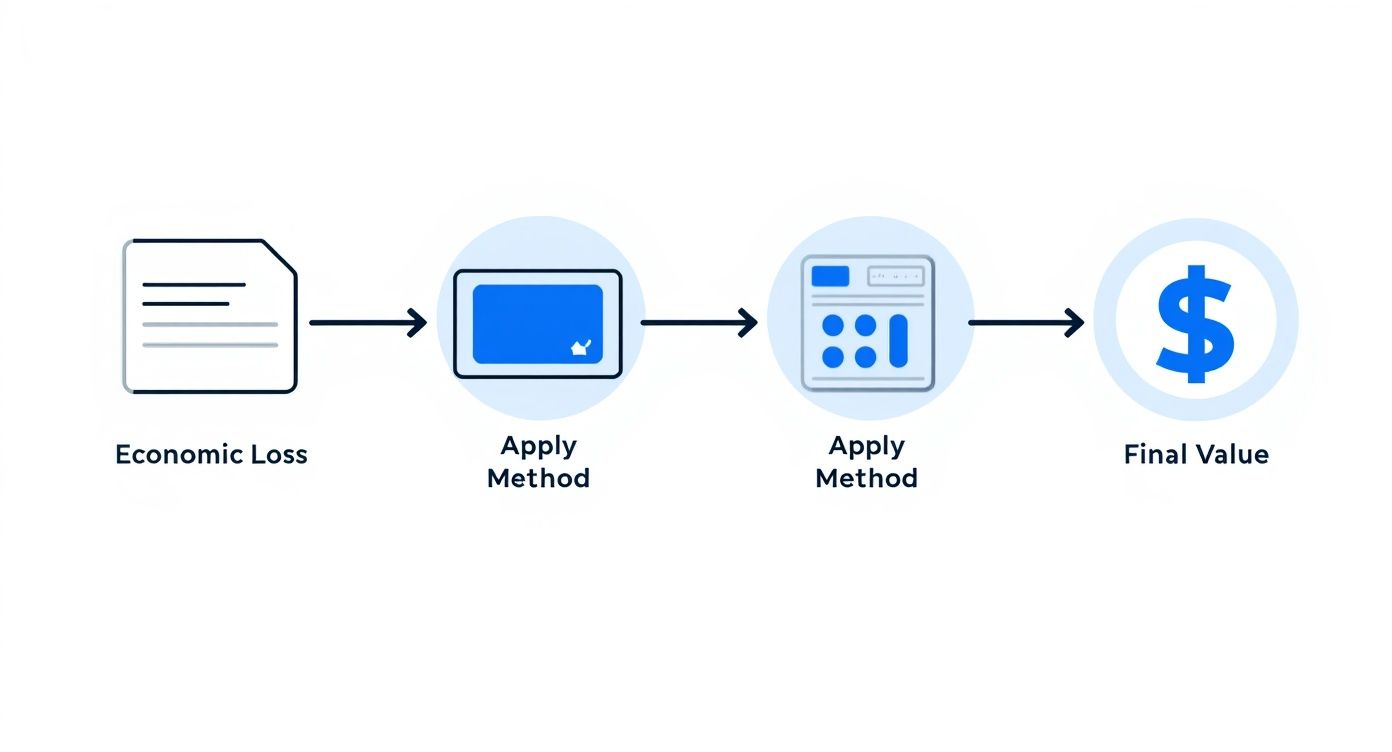
As you can see, the hard numbers from economic losses form the foundation. From there, we apply a valuation method to arrive at a defensible figure for the client's suffering.
Comparing the Two Main Calculation Methods
While no law dictates a specific formula, the legal and insurance industries have settled on two primary models to bring some objectivity to an otherwise subjective valuation. The Multiplier and Per Diem methods are the workhorses of personal injury negotiation.
They each have their place, and knowing which one to lean on depends entirely on the case specifics.
Pain and Suffering Calculation Methods At a Glance
Here’s a quick breakdown of how these two common methods stack up against each other.
| Calculation Method | How It Works | Best Suited For |
|---|---|---|
| The Multiplier Method | You take the total economic damages (medical bills, lost income, etc.) and multiply that figure by a number, typically between 1.5 and 5, based on the severity of the injury and its impact. | Cases involving significant, long-term, or permanent injuries. The higher medical bills naturally create a stronger foundation for a larger pain and suffering award. |
| The Per Diem Method | You assign a daily rate for the client's suffering—often benchmarked against their daily earnings—and multiply it by the number of days they were actively recovering from their injuries. | Injuries that have a clear and definable recovery timeline. Think of a broken arm that heals completely in eight weeks. It's less effective for chronic or permanent conditions. |
Ultimately, many seasoned practitioners will calculate the damages using both methods. This gives you a settlement range—a high and a low number—that provides a powerful and flexible starting point for negotiations.
Putting the Multiplier Method to Work in Your Case
The multiplier method is probably the most well-known approach for calculating pain and suffering, but don't let its simple math fool you. The calculation itself is easy, but the real skill lies in choosing a multiplier that you can defend—one that truly captures the human cost of an injury. This is where you move from simple arithmetic into the art of building a compelling case.

Everything starts with your client's "special" damages, which are their total economic losses. This is the sum of every concrete, provable financial hit they've taken because of the accident. Before you even think about a multiplier, you have to get this number locked down.
These hard costs typically include:
- All medical bills, both past and future (think hospital stays, surgeries, therapy, and prescriptions)
- Lost wages and income from being unable to work
- Loss of future earning capacity if the injury is permanent
- Property damage, like car repairs in an auto accident
- Any other direct out-of-pocket expenses
Once you have a solid, evidence-backed total for these economic damages, you can move on to the more subjective—and often more contentious—part of the equation: picking the right multiplier.
Choosing the Right Multiplier
The multiplier is a number, usually between 1.5 and 5, that you'll multiply by the total economic damages. A number on the lower end is for less severe injuries where the client makes a full and relatively quick recovery. The higher end of the scale is reserved for injuries that are catastrophic, permanent, or life-altering.
This is the most critical step. The number you choose can't be pulled out of thin air; it has to be a defensible figure grounded in the specific facts of your client’s life post-injury. You can be sure the insurance adjuster will pick it apart, so you have to be ready to justify it.
Let's look at a common scenario. Your client gets a minor whiplash injury in a rear-end collision. Their medical bills come to $5,000, and they missed a week of work, losing $1,000 in pay. Their total economic damages are $6,000. If they're back to normal in six weeks with no lasting issues, a multiplier of 1.5 or 2 is pretty standard. That would put their pain and suffering value somewhere between $9,000 and $12,000.
Key Takeaway: The multiplier isn't just a number; it's the numerical representation of your client's story. It quantifies the severity, duration, and overall disruption the injury has caused. A higher multiplier needs a powerful narrative to back it up.
Now, contrast that with a far more serious case. A construction worker falls from a ladder and suffers a spinal cord injury. Their economic damages—covering multiple surgeries, years of rehab, and a total loss of future earning capacity—are calculated at $800,000. The injury has left them with permanent paralysis and a lifetime of chronic pain. In a situation like this, a multiplier of 5 is not only justified but might not even feel like enough. The calculation would result in pain and suffering damages of $4,000,000.
Justifying a Higher Multiplier
Insurance adjusters are paid to minimize payouts, so you can expect them to push back hard and argue for the lowest possible multiplier. To effectively counter this, your job is to build a clear, evidence-based case that shows exactly why your client's suffering commands a higher figure.
Here are the factors that will give you leverage to argue for a higher multiplier:
- Severity of the Injury: Catastrophic injuries like traumatic brain injuries (TBIs), amputations, or third-degree burns will always push the multiplier up.
- Length of Recovery: A long, grueling recovery that drags on for months or years, involves multiple surgeries, or requires intense physical therapy adds significant weight.
- Permanent Consequences: Any permanent disability, disfigurement, noticeable scarring, or chronic pain is a major justification for a multiplier at the top of the scale.
- Impact on Daily Life: Can your client no longer play with their kids, engage in their favorite hobbies, or maintain their relationships? This is powerful evidence.
- Emotional and Psychological Trauma: A documented diagnosis of PTSD, anxiety, or depression from a mental health professional is concrete proof of the invisible wounds.
From a practical standpoint, it's worth noting that insurance companies often try to cap multipliers at 3 or 4, even for very serious injuries, as a cost-control measure. In some states, multipliers above 5 are rarely seen in verdicts due to fairness concerns, which makes your justification absolutely critical. You can find more practical insights on how these calculations are applied in states like Texas on brakerwhite.com.
In the end, a persuasive demand letter doesn't just state the multiplier you've chosen. It tells a vivid story of your client's pain, using medical records, personal journals, and witness statements to paint a picture so compelling that your number feels not just reasonable, but necessary.
A Different Approach: The Per Diem Method
While the multiplier method is the go-to for many practitioners, it's not the only way to frame pain and suffering. Sometimes, a more granular, day-by-day valuation—the Per Diem method—can be incredibly effective.
This strategy assigns a specific dollar value for each day of suffering, starting from the day of the incident all the way to the point of "maximum medical improvement" (MMI). You’re essentially arguing for a daily wage to compensate for the full-time job of enduring pain and navigating recovery. It’s a powerful framing device because it translates a large, abstract concept into a concrete, daily figure that adjusters and jurors can easily grasp.
Anchoring the Daily Rate
The key is to justify your daily rate. You can't just pull a number out of thin air. The most defensible and compelling way to do this is to tie the per diem rate directly to your client's pre-injury earnings.
The argument is simple and powerful: if a day of your client's time and labor was worth a certain amount to their employer, then a day spent in agony, unable to function normally, is surely worth at least that much.
Let's say your client earned $60,000 a year. You can calculate their daily rate by dividing that by the standard 250 working days in a year, which comes out to $240 per day.
If they were an hourly worker making $30 an hour, the math is even simpler: $30 x 8 hours = $240 per day. By grounding your valuation in a tangible, verifiable number like daily earnings, you build a rational foundation that’s much harder for the other side to chip away at.
Here’s a quick example in practice. Your client slips, falls, and breaks their leg. Their orthopedist projects a full recovery period, from the incident through physical therapy, of 150 days. If the client earned $200 a day at their construction job, the calculation is straightforward:
- 150 days of recovery x $200 per day = $30,000
This isn't an arbitrary number; it's a logical conclusion based on a clearly defined timeline and a provable daily value.
When to Use the Per Diem Method
This method is most potent in cases with a clear and finite recovery period. It’s the perfect tool for injuries that are serious and disruptive but not permanent.
Think about cases involving:
- Broken bones that heal cleanly.
- Whiplash from a car accident that resolves after a few months of treatment.
- Post-surgical recovery periods for things like a resolved herniated disc.
The Per Diem method’s greatest asset is its transparent logic. It anchors the subjective experience of pain to the objective reality of lost time and earning capacity, making it a highly persuasive instrument in demand letters and settlement talks.
It’s just as important, however, to know when not to use it. For cases involving permanent or long-term chronic conditions, the per diem model falls apart. Calculating a daily rate for the rest of someone’s life is not only impractical but also drastically undervalues the lifelong burden of chronic pain, disability, or disfigurement. In those situations, the multiplier method is almost always the superior strategic choice.
Gathering the Evidence That Makes Your Number Stick
Coming up with a number for pain and suffering is one thing; making it stick is another. Whether you’ve used the multiplier or per diem method, that final figure is only as strong as the evidence you've gathered to back it up. Let's be honest, insurance adjusters are paid to be skeptical. Your job is to build such a compelling, evidence-backed case that your valuation doesn't just look reasonable—it looks undeniable.

This isn't just about handing over a stack of medical bills. It's about telling a story. You need to paint a vivid picture of your client's life before the accident and starkly contrast it with their new, painful reality. Every single document, photo, and statement you collect should serve that one purpose.
Medical Documentation: The Bedrock of Your Claim
The cornerstone of any personal injury claim is, without a doubt, the medical documentation. These records are your objective, third-party proof of the injury and its consequences. A well-organized, comprehensive medical file is non-negotiable.
Here’s what you absolutely must have:
- Physician’s Notes and Diagnoses: This is where it all starts. These records establish the official nature and severity of the injuries.
- Treatment Plans: This lays out the road to recovery—or at least, the attempted road. It includes therapies, prescriptions, and specialist referrals.
- Surgical Reports: For serious injuries, these operative reports provide a detailed look at the invasive procedures your client endured.
- Mental Health Records: Don't overlook the psychological toll. If your client is struggling with anxiety, depression, or PTSD, records from a therapist or psychiatrist are critical for proving emotional distress.
Keeping this mountain of paperwork straight is a challenge in itself. For a closer look at best practices, you can learn more about how to organize medical records to make sure no crucial detail gets lost in the shuffle.
The Pain Journal: Turning Data into a Human Story
Medical records show what happened. A pain journal shows how it felt. It translates a clinical diagnosis into a raw, day-to-day human experience. I always encourage clients to keep a regular journal, because it creates an invaluable, real-time record of their suffering that's far more powerful than memory alone.
This journal isn't just a diary; it's a contemporaneous account of the injury's daily impact. It captures the unfiltered reality of their struggles in a way that retrospective testimony simply can't match.
A truly effective pain journal should detail things like:
- Daily Pain Levels: A simple 1-10 scale works perfectly to track intensity and frequency.
- Sleepless Nights: How often is pain or anxiety keeping them awake?
- Emotional State: Documenting the frustration, sadness, and fear is just as important as the physical pain.
- Missed Activities: What specific things did they miss out on? A child's soccer game, a family wedding, a weekly coffee with friends—these details matter.
- Daily Hurdles: Note the simple tasks that are now monumental challenges, like getting dressed, cooking a meal, or even driving to the store.
This detailed log transforms an abstract number into a tangible, human narrative. It makes it much harder for an adjuster to minimize what your client has been through.
Witness Statements: Painting the "Before and After" Picture
Sometimes the most powerful testimony comes from others. Statements from family, friends, and coworkers can add a profound layer of credibility to your client's story by offering an outside perspective on the changes they've endured.
When you talk to these witnesses, focus on the "before and after." What was the client like before the accident? Active? The life of the party? The person everyone relied on? And how are they now? Withdrawn, irritable, or unable to do the things they once loved?
These personal accounts provide the emotional weight that can tip the scales in negotiations. When you present a demand that’s supported by meticulously organized medical records, a detailed pain journal, and corroborating witness statements, you’re no longer just asking for a number. You're demanding fair compensation for a well-documented human loss.
Key Factors That Influence Your Final Settlement
The calculation methods we've covered give you a solid mathematical starting point, but they don't tell the whole story. Several other factors can dramatically swing the final value of your pain and suffering damages, either up or down.
Think of these as the narrative elements that give context to your numbers. An insurance adjuster or opposing counsel will seize on these every single time, so knowing them cold is essential to building a resilient case.
The Defendant’s Conduct Matters
In the eyes of a jury—and by extension, the insurance adjuster—not all accidents are created equal. The at-fault party's behavior is a huge deal. There’s a world of difference between a fender-bender caused by a momentary lapse of attention and a catastrophic crash caused by someone’s outrageous choices.
Let's imagine two identical car accidents with identical injuries and medical bills.
- Scenario A: The defendant ran a red light while briefly distracted by their car's GPS.
- Scenario B: The defendant was driving with a blood alcohol content twice the legal limit, speeding through a school zone.
The physical injuries are the same, but the settlement value for Scenario B will be significantly higher. Why? The defendant's conduct is appalling. This level of gross negligence often opens the door to punitive damages, which are meant to punish the defendant. But even without that, it naturally inflates the perceived value of the victim's pain and suffering.
Juries and adjusters are human. They react strongly to actions they find morally offensive. When a defendant's behavior is particularly reckless, it creates a powerful emotional anchor that drives the settlement value way up.
The Impact of Your Own Actions
Just as the defendant’s actions are under a microscope, so are yours. Your credibility is one of your most valuable assets in a personal injury claim, and your conduct after the accident can either protect it or hand the defense a weapon.
Following your doctor’s orders is non-negotiable. If you're prescribed six weeks of physical therapy but only show up for half the sessions, the defense will argue that your injuries aren't as severe as you claim. They'll say you failed to mitigate your damages, and they'll use it to slash your valuation.
On the other hand, diligently adhering to your treatment plan creates a clear, consistent record. It proves you're serious about your recovery and validates the severity of the pain you're enduring.
State Laws and Damage Caps
The most unyielding factor influencing your settlement is the law in your jurisdiction. State statutes can place a hard ceiling on what you can recover, no matter how catastrophic your suffering or how strong your case.
This is especially common in medical malpractice claims. For example, California recently updated its laws, raising the cap on non-economic damages in malpractice cases to $350,000 for non-death cases as of 2023. While that’s a big improvement over the old $250,000 cap, it's still a limit.
Many states also follow "comparative" or "contributory" negligence rules. If you're found partially at fault, your award gets reduced by your percentage of blame. In the toughest states, being found even 1% at fault can prevent you from recovering a single dollar.
You absolutely have to know these jurisdictional rules. They define the battlefield. A brilliant argument for a high multiplier is worthless if it smashes into a state-mandated cap. These legal guardrails must be factored into your valuation from day one. You can see how these factors come together when you're ready to make your case by reviewing our guide on writing a demand letter for personal injury.
The table below gives you a quick summary of how these key factors can sway the final value of a claim.
Key Factors Influencing Pain and Suffering Valuation
| Factor | Potential Positive Impact (Increases Value) | Potential Negative Impact (Decreases Value) |
|---|---|---|
| Defendant's Conduct | Gross negligence (e.g., drunk driving, reckless behavior) can lead to higher awards. | An accident resulting from a simple, honest mistake may result in a lower valuation. |
| Your Credibility | Diligently following all medical advice and treatment plans strengthens your claim. | Gaps in treatment or non-compliance with doctor's orders can be used to argue you aren't truly hurt. |
| State Laws | States with no caps on non-economic damages allow for higher potential recoveries. | Strict damage caps or unfavorable comparative negligence laws can severely limit your final award. |
Ultimately, these factors are just as important as the initial multiplier or per diem calculation. A thorough valuation considers all of them to arrive at a settlement figure that is not just mathematically sound, but also realistic and defensible.
Common Questions About Calculating Damages
Even when you have the multiplier and per diem methods down, the real world always throws a few curveballs. Actually putting a dollar figure on pain and suffering is where the theory ends and the practical challenges begin. Every case is different, and those unique variables can turn a simple calculation on its head.
Let's walk through some of the questions that come up time and time again from both lawyers and their clients. My goal here is to give you direct, practical answers to help you feel more confident in your valuation.
Are Online Pain and Suffering Calculators Accurate?
My advice? Think of those online calculators as a starting point, but never, ever treat them as the final word. They're built on a very basic multiplier formula, which means they are completely blind to the human details that actually drive a case's value.
An online form can't possibly grasp the defendant's degree of negligence, the specific damage caps in your jurisdiction, or the power of your client's personal story. At best, they spit out a rough estimate. A true, defensible valuation requires a deep dive into the evidence, and that’s something only a seasoned legal professional can do.
Key Insight: Online calculators are a blunt instrument. They give you a ballpark figure but completely miss the legal strategy and narrative elements essential to justifying and winning a fair settlement.
How Do You Actually Prove Emotional Distress?
Proving emotional distress takes a lot more than just saying your client is struggling. To make it a real, compensable part of the claim, you have to build a case with objective evidence that shows the true psychological fallout from the injury.
Strong evidence is everything here. You need to gather:
- Professional Medical Records: Notes from a therapist, psychologist, or psychiatrist are invaluable. They provide a clinical diagnosis and treatment plan for conditions like PTSD, anxiety, or depression.
- Prescription History: A paper trail of prescriptions for medications to manage anxiety, depression, or sleep disturbances offers tangible proof of the struggle.
- Personal Testimony: A detailed journal tracking symptoms—panic attacks, sleepless nights, persistent fear—creates a powerful, day-by-day record of your client’s experience.
- Witness Statements: Getting testimony from family, friends, or coworkers about the changes they've seen in your client's personality, mood, and behavior can be incredibly compelling for an adjuster or jury.
Documenting these non-physical injuries is a nuanced task. For a more detailed guide on this specific topic, you can explore our article on how to calculate emotional distress damages.
What if the Accident Was Partly My Fault?
If you bear some of the blame for the accident, you can bet it will reduce the final award. This is governed by a legal doctrine called comparative negligence, and almost every state has its own version of this rule.
Here’s how it works: a jury assigns a percentage of fault to everyone involved. Your total compensation is then reduced by your percentage of fault. So, if you're awarded $100,000 but the jury decides you were 20% responsible, your final award gets slashed to $80,000.
It is absolutely critical to know your state's specific laws. Most states use a "modified" comparative fault rule, which means you can't recover anything if you are 50% or 51% at fault. But a few stricter states still use "pure contributory negligence." In those jurisdictions, being found even 1% at fault can bar you from recovering any damages at all.
At Ares, we understand that building a strong personal injury claim requires meticulous organization and a deep understanding of the case narrative. Our AI-powered platform automates the time-consuming process of medical record review, turning stacks of documents into clear, actionable insights in minutes. Eliminate manual review, draft demand letters faster, and build stronger cases. See how Ares can help you settle faster and claim bigger.