To truly prove pain and suffering, you need more than just a stack of medical bills. It’s about building a bridge between concrete medical evidence and a deeply human story. The goal is to meticulously document everything—from the cold, hard facts in a doctor’s report to the raw emotion in a personal pain journal—creating an undeniable record of your client's physical and emotional ordeal.
This is how you translate a subjective experience into objective, compensable damages.
The Art and Science of Quantifying Suffering
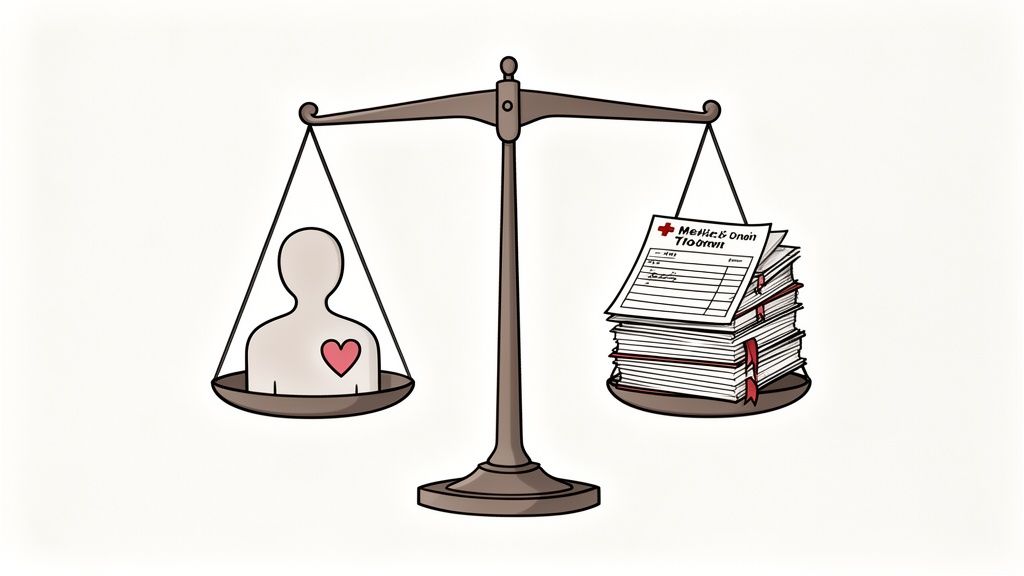
Putting a number on someone’s suffering is one of the thorniest challenges in any personal injury claim. You can't issue an invoice for anxiety, chronic pain, or the loss of life’s simple joys. This is precisely why a strong claim blends art with science—you have to marry the clinical facts with a compelling story that an insurance adjuster, or a jury, can connect with.
The heart of your case lies in transforming an abstract concept like "pain" into a defensible dollar figure. This demands a methodical approach to collecting and presenting evidence. You’re building a clear, chronological narrative that shows exactly how the injury rippled through every aspect of your client's life.
Beyond the Medical Bills
While economic damages like medical expenses are straightforward, non-economic damages are far more subjective. As a result, they're the first thing insurance companies attack. Proving pain and suffering effectively requires a multi-pronged strategy that brings different types of proof together.
- Objective Medical Documentation: This is the bedrock of your claim. It includes everything from MRIs and X-rays to physical therapy reports and prescription histories that clinically validate the injury’s severity.
- Personal and Witness Testimony: This is where you add the human element. A client's detailed pain journal or testimony from family and friends can paint a powerful "before and after" picture that numbers alone can't convey.
- Expert Opinions: Medical experts can explain the long-term prognosis in plain English. Vocational experts can detail how the injury impacts your client’s ability to earn a living and function day-to-day.
The sheer scale of this issue is immense. The global chronic pain market was valued at $72.10 billion in 2024 and is projected to hit $115.51 billion by 2031. This isn't just an abstract economic forecast; it reflects the real-world cost of persistent pain.
In fact, back in 2019, 20.4% of U.S. adults reported living with chronic pain. These statistics help frame your client's struggle not as an isolated emotional plea, but as a verifiable condition with significant, recognized consequences. You can learn more about the staggering economic impact of chronic pain on Biospace.
To effectively build your case, it’s helpful to categorize the evidence you'll need. The following table breaks down the key components for proving pain and suffering.
Key Evidence for Proving Pain and Suffering
| Evidence Category | Primary Purpose | Examples |
|---|---|---|
| Medical Records | Objectively document the physical injury and treatment. | Doctor's notes, ER reports, surgical records, prescription history. |
| Diagnostic Imaging | Visually prove the existence and extent of the injury. | X-rays, MRIs, CT scans, ultrasounds. |
| Personal Journals | Provide a day-to-day account of pain and its impact on life. | A daily "pain diary" detailing pain levels, limitations, and emotional state. |
| Testimony | Corroborate the client's experience from other perspectives. | Statements from family, friends, and co-workers about changes they've observed. |
| Expert Testimony | Provide professional opinions on prognosis and future impact. | Reports from physicians, life care planners, and vocational experts. |
| Visual Evidence | Show the tangible effects of the injury on daily activities. | Photos of injuries, videos demonstrating mobility issues or daily struggles. |
Ultimately, each piece of evidence serves a distinct purpose, and when combined, they create a comprehensive and persuasive argument that is difficult for the opposing side to refute.
By weaving these different threads of evidence together, you build a powerful and irrefutable case. The objective is to leave no room for doubt about the profound and lasting impact the injury has had on your client’s life.
Laying the Groundwork with Documentary Evidence
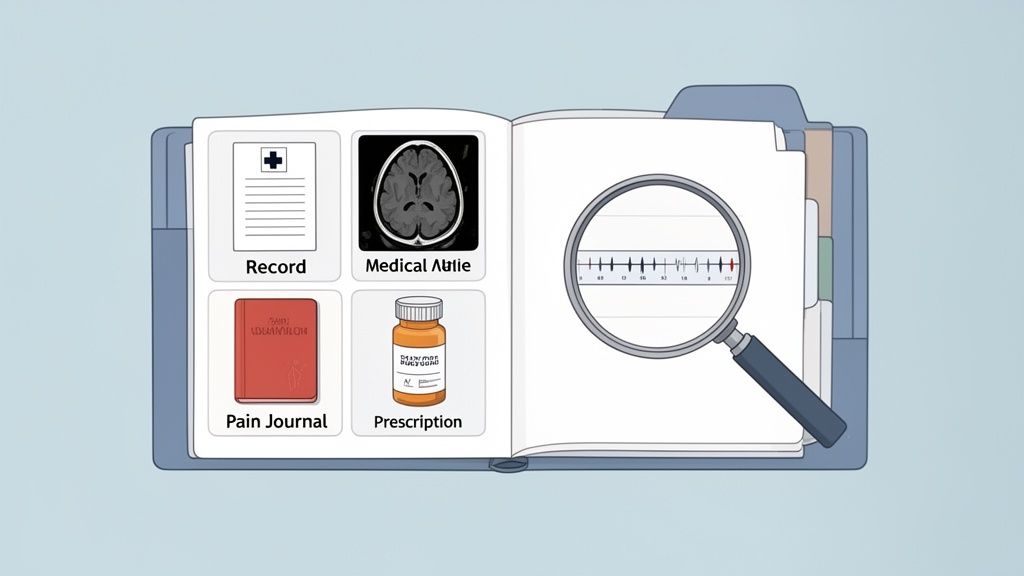
While a client's testimony can be powerful, your claim for pain and suffering absolutely must be built on a solid foundation of documents. This collection of records, reports, and personal logs is what turns a subjective experience into an objective, verifiable narrative of hardship. It's the hard proof that backs up every single claim your client makes.
Think of each document as a brick in a wall. A single doctor's note might not seem like much on its own. But when you stack it with treatment histories, imaging results, and a detailed pain journal, you build an irrefutable structure that demonstrates the full scope of their damages.
This is where you show, not just tell, the insurance adjuster or jury the day-to-day reality of living with the injury. Your job is to create a paper trail so clear and comprehensive that it leaves no room for doubt.
Weaving a Timeline with Medical Records
Your client's medical records are the cornerstone of the entire case. They provide a clinical, third-party validation of the injury, its severity, and the long road of treatment that followed. Don't just collect the bills; you need to dig deep into the narrative buried in the physician's notes and reports.
Look for the specific language that paints a picture of ongoing distress. Phrases like "persistent pain," "limited range of motion," or "symptoms of anxiety" are gold. These clinical observations are incredibly powerful because they come from a medical professional, adding a layer of credibility that is tough for the other side to dispute.
Putting these records in chronological order is non-negotiable. For a deeper dive, our guide on how to organize medical records provides a practical framework. A well-organized timeline shows a clear, undeniable link between the accident and the continuous medical care your client needed.
Making Invisible Injuries Visible
Diagnostic imaging—MRIs, X-rays, and CT scans—has a special role in these cases. These tests make invisible injuries visible, offering undeniable proof of physical damage that can't be faked. A herniated disc on an MRI, for instance, is a powerful visual that immediately explains why your client is in chronic back pain.
These images serve as objective evidence that directly connects your client’s complaints of pain to a tangible, medically confirmed source. This is a critical step because it proactively shuts down the common defense tactic of claiming your client is exaggerating their symptoms.
By presenting clear diagnostic evidence, you forge a direct link between the physical injury and the resulting suffering. This kind of visual proof often speaks louder than words, making the client's experience concrete and understandable.
The Power of the Pain Journal
Perhaps the single most compelling piece of evidence you can present is a pain journal kept by your client. While medical records give you the clinical perspective, a well-kept journal offers an intimate, day-to-day account of the injury's true impact on their life.
This document needs to be more than just a list of pain scores from 1 to 10. Encourage your client to record the specific, real-world details of how their pain affects their daily routines, emotional state, and even their relationships.
- Daily Limitations: "Couldn't lift my granddaughter today because my back seized up."
- Emotional Toll: "Felt a wave of panic while driving past the intersection where the crash happened."
- Medication Side Effects: "The new pain medication makes me too foggy to focus at work."
- Missed Activities: "Had to cancel our weekly family hike. Again."
This level of detail transforms a simple log into a powerful narrative tool. It captures the small, daily indignities and the larger life disruptions that truly define pain and suffering.
Documenting More Than Just Medical Visits
Beyond the core medical file, other documents can significantly strengthen your case. As you gather evidence, it's also wise to understand the legal considerations for recording conversations, as this can be a source of information if handled carefully and in strict compliance with state laws.
Also, be sure to gather these other crucial documents:
- Prescription History: A complete log of all medications—painkillers, anti-inflammatories, even antidepressants—proves the need for ongoing treatment.
- Therapy and Counseling Records: Notes from a mental health professional can officially diagnose conditions like PTSD, anxiety, or depression that stem directly from the accident.
- Correspondence with Employers: Emails or letters that document missed work, modified duties, or an inability to perform certain job functions provide clear evidence of the injury's professional impact.
Every document you add contributes another layer of proof. Together, they create a cohesive and detailed portfolio that validates your client’s experience from every angle, building a case that is both factually sound and emotionally resonant.
Bringing the Human Story to Life
Clinical evidence—the MRIs, the doctor's notes, the physical therapy logs—forms the undeniable foundation of your case. But let's be honest, a medical chart doesn't convey the gut-wrenching despair of not being able to pick up your child. It doesn't ache. It doesn't bleed.
To truly prove pain and suffering, you have to bridge the gap between cold, hard facts and the raw human experience. This is where you move beyond the what of the injury and dive deep into the so what—the real, tangible impact on a person's life, their relationships, and their very sense of self.
The most effective way to do this is by weaving together a powerful "before and after" narrative. While a medical record confirms a herniated disc, it's the spouse, the friend, or the colleague who can paint the picture of the person who once loved to hike but now struggles just to walk to the mailbox. This is the context that gives a claim its emotional weight.
The Power of Third-Party Perspectives
Testimony from people who know your client best can be absolutely devastating to the defense's case. Friends, family, and coworkers provide a perspective that is both deeply personal and yet objectively grounded in their own observations. They aren't the ones asking for money; they're simply telling the truth as they see it.
Their stories need to be built on specific, concrete examples.
- A spouse might share: "He used to be the one who spent every Saturday morning in the yard, teaching the kids how to throw a baseball. Now, I handle all of it. He just watches from the porch, and I can see how much it kills him."
- A coworker could explain: "She was the live wire of our team, always organizing happy hours and morale events. Now, she's often quiet. She has to leave meetings early because sitting for more than 20 minutes is just too much."
These "before and after" moments are what make the loss real for an adjuster or a jury. They establish a baseline of a full, vibrant life and make the post-injury deficits impossible to ignore.
Guiding Your Client to Give Authentic Testimony
Your client’s own testimony is often the centerpiece of the case. Whether in a deposition or on the stand, this is their chance to tell their story in their own words. Your job is to prepare them, not to script them. The goal is authenticity, not a performance.
Help your client find the words to describe their pain specifically. Instead of just saying "my back hurts," guide them to articulate what it actually feels like. Is it a sharp, stabbing jolt? A dull, constant throb? Does a burning sensation shoot down their leg?
The key is to be honest, not hyperbolic. A heartfelt, unvarnished account of daily struggles is infinitely more persuasive than an exaggerated one. Juries and adjusters have a finely tuned radar for inauthenticity, and any testimony that seems embellished will undermine the credibility of the entire case.
Using Expert Witnesses to Explain the "Why"
While friends and family provide the "what," expert witnesses explain the "why" and the "for how long." Their testimony provides an authoritative, professional context for the injury's long-term consequences, adding a layer of credibility that is tough for the other side to dismantle.
Consider bringing in these types of experts:
- Vocational Experts: These professionals are crucial for showing how an injury torpedoes a career. They can testify about lost earning capacity, the inability to perform old job duties, and the immense challenges of finding new work with permanent physical limitations.
- Mental Health Professionals: A psychologist can officially diagnose PTSD, anxiety, or depression stemming directly from the accident and its aftermath. This clinical diagnosis gives objective weight to the emotional and mental suffering your client has endured.
- Life Care Planners: For catastrophic injury cases, a life care planner is indispensable. They create a detailed, data-driven report that projects all future needs—from ongoing medical care and therapies to home modifications and assistive devices.
This expert testimony connects all the dots. It demonstrates that the pain and suffering aren't just temporary inconveniences but have lasting, verifiable consequences that will shadow your client for years, if not a lifetime. The stakes are high. A 2023 WHO report found that the richest 10% of nations consume 90% of the world's opioids, a stark reminder of how untreated or undertreated pain can compound an injury's impact. For a client whose access to proper pain management was limited, this context can be a powerful part of the narrative. You can explore the full report on global disparities in pain relief access from the WHO.
By blending personal stories from lay witnesses, genuine testimony from your client, and authoritative analysis from experts, you build a multi-layered narrative that is both emotionally compelling and factually undeniable. This approach ensures the full scope of your client’s suffering is understood not just as a diagnosis, but as the profound disruption of a human life.
Strategies for Quantifying Damages
You've painstakingly gathered all the evidence and built a compelling narrative of your client's suffering. Now comes the hard part: putting a number on it. How do you assign a dollar amount to something as intangible as pain? It’s a process that can feel more like art than science, but it’s absolutely critical for getting your client the compensation they deserve.
Insurance companies and courts won't just accept a figure plucked from thin air. They expect a logical, defensible valuation. The key is to use established methods to translate your client's human experience into a concrete number that can stand up to scrutiny in a demand letter or at trial.
The Multiplier Method Explained
The go-to approach for most personal injury attorneys is the multiplier method. It’s straightforward but incredibly powerful when used correctly. You start by calculating the total economic damages—the hard numbers like medical bills and lost wages. Then, you multiply that total by a factor, usually between 1.5 and 5.
That multiplier is where the story you've built comes into play. It’s a direct reflection of the severity, permanence, and overall life impact of the injuries.
A minor injury with a quick, full recovery might only justify a multiplier of 1.5 or 2. But you'll argue for a much higher number—closer to 4 or 5—in cases involving:
- Permanent Disability: Life-altering injuries that leave your client with lasting physical limitations.
- Severe Disfigurement: Significant scarring or other visible trauma that profoundly affects self-esteem and daily life.
- Protracted Recovery: A healing process that drags on for months or years, often involving multiple painful surgeries and setbacks.
- Significant Emotional Trauma: When the incident leads to diagnosed conditions like PTSD, severe depression, or anxiety.
Your job is to connect the dots. Use the "before and after" testimony, the entries from the pain diary, and the expert’s prognosis to justify why a higher multiplier isn't just appropriate, but necessary. For a deeper dive, our guide on how to calculate pain and suffering damages offers more detailed scenarios.
The right witnesses are crucial for justifying that multiplier. A strong case pulls from multiple perspectives to paint a complete picture of the client's new reality.
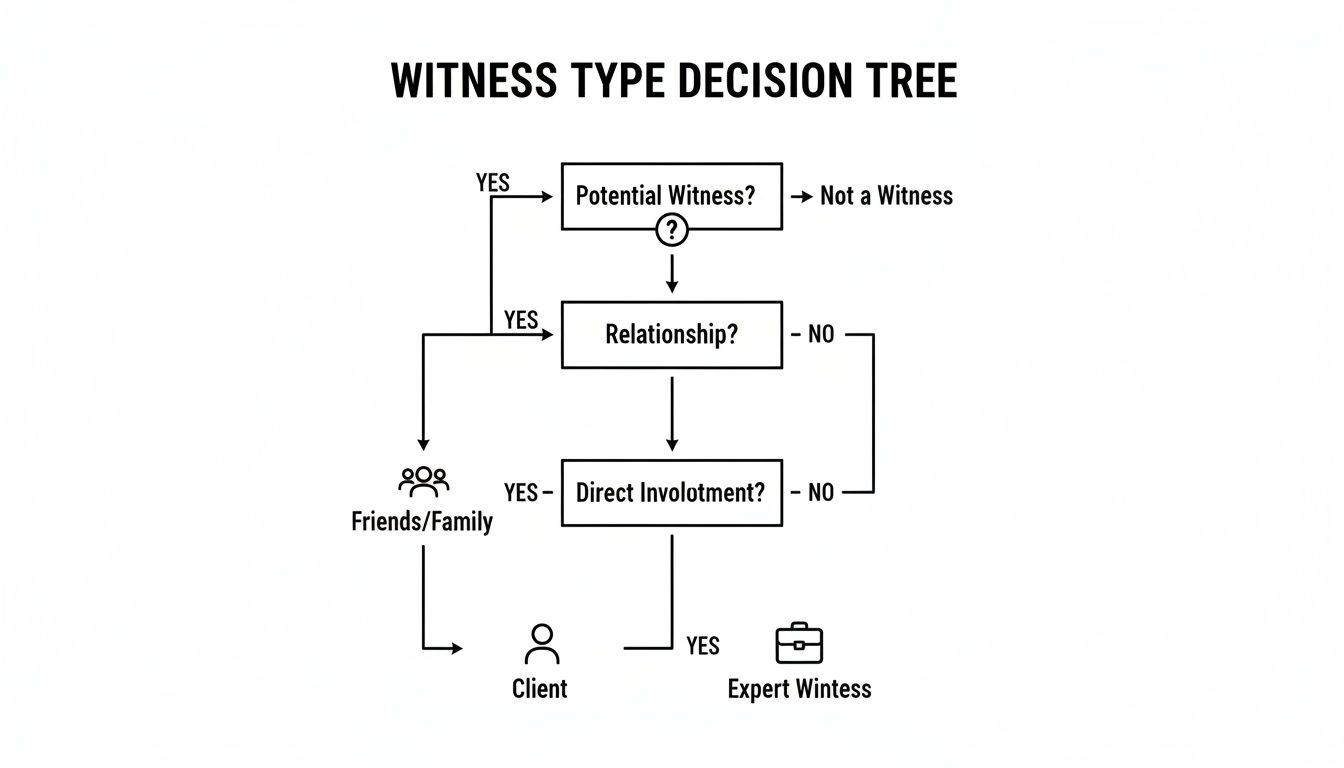
As this shows, layering testimony from your client, their friends and family, and objective experts creates a narrative that's difficult for the other side to refute.
The Per Diem Approach
Another strategy you can keep in your toolkit is the per diem method. Here, you assign a daily monetary value to your client's suffering and multiply it by the number of days they were in pain. "Per diem" is just Latin for "by the day."
So, how do you come up with a fair daily rate? A common and highly defensible tactic is to tie it to the client's daily earnings before the accident. The argument is simple and resonates with adjusters and juries alike: if a day of your client’s time and labor was worth $X, isn't a day spent enduring agonizing pain worth at least the same?
This method works best for injuries with a clear start and end point for recovery. If you're dealing with a permanent, lifelong condition, the multiplier method is almost always the better choice.
Comparing Pain and Suffering Valuation Methods
Choosing between the multiplier and per diem methods depends entirely on the specifics of your case. Each has its strengths and is better suited for different injury scenarios.
| Method | How It Works | Best For | Potential Drawback |
|---|---|---|---|
| Multiplier Method | Total economic damages (medical bills, lost wages) are multiplied by a factor (e.g., 1.5 to 5) based on injury severity. | Serious, long-term, or permanent injuries with significant life impact and high economic damages. | Can feel arbitrary if the multiplier isn't strongly justified by compelling evidence. |
| Per Diem Method | A daily rate is assigned for pain, then multiplied by the number of days of suffering. The rate is often tied to daily earnings. | Injuries with a clear and finite recovery period (e.g., a broken bone that heals completely). | Less effective for permanent injuries, as calculating "days of suffering" for a lifetime can lead to an astronomical, less credible number. |
Ultimately, understanding both methods allows you to select the one that will create the most logical and persuasive valuation for your client's unique circumstances.
Using Precedents to Ground Your Valuation
No matter which method you use, your demand has to be rooted in reality. This is where research comes in. By citing jury verdicts and settlement figures from similar cases in your jurisdiction, you provide an essential benchmark.
This comparative analysis shows the insurance adjuster you've done your homework and that your valuation is in line with what courts have deemed fair. It's a powerful way to frame your demand as reasonable and based on established precedent.
Key Takeaway: Juries and courts are increasingly recognizing the profound, long-term impact of serious injuries. Staying informed about recent verdict trends is a non-negotiable part of advocating effectively for your client.
For example, compensation awards for pain and suffering have been trending upward for years. Maximum awards in Germany that hovered around €100,000 in the 1990s have now climbed to over €1 million in the most severe cases. We see similar trends elsewhere. In Canada, the number of clients receiving compensation from Veterans Affairs more than doubled from 19,050 in 2019-20 to 41,865 by 2023-24.
These numbers aren't just statistics; they're proof of a growing understanding of non-economic damages, and you can use them to anchor your argument for a higher award.
Presenting Your Case from Demand Letter to Trial
All that meticulous work—gathering medical records, coaching your client on their pain journal, lining up experts—it all comes down to this. How you present the case, whether in a demand letter to an adjuster or in front of a jury, is where the rubber meets the road. This is your moment to connect the dots and transform a file of documents into a compelling story of human suffering.
Your first shot across the bow is the demand letter. Don't mistake this for a simple request for money; it's your opening argument. A powerful demand letter is a comprehensive, persuasive summary of your case that makes it crystal clear you have the evidence and are fully prepared to litigate if a fair offer doesn't materialize.
Crafting a Compelling Demand Letter
A great demand letter tells a story, but one that is anchored firmly in fact. Your job is to weave the cold, hard medical evidence into a personal narrative, forcing the adjuster to see your client as a person whose life has been turned upside down, not just a claim number.
You want to structure the letter to build a logical, undeniable case for your client.
- Open with a clear narrative. Briefly summarize the incident and the immediate, painful aftermath.
- Layer in the medical proof. Detail the key findings from medical records, MRI reports, and treatment timelines. Use bold text to make crucial diagnoses like "C5-C6 disc herniation" or "post-traumatic stress disorder" jump off the page.
- Show the human impact. This is where your client's pain journal and witness statements become invaluable. Quote a particularly powerful entry or summarize a "before and after" account to illustrate the devastating loss of their quality of life.
When you're ready to put it all together, using a well-structured personal injury demand letter template can provide a solid framework. For an even deeper dive, our guide on writing a demand letter for personal injury is packed with actionable strategies.
Making an Impact in the Courtroom
If negotiations stall and you're headed to trial, your strategy needs to evolve. A jury needs to see and feel the injury's impact in a way a written demand letter simply can't achieve. This is where demonstrative evidence becomes your most powerful tool.
These visual aids make complex medical jargon understandable and, more importantly, they humanize your client’s daily battle. You're not just describing the injury anymore—you're showing it.
Key Takeaway: Demonstrative evidence translates clinical data into a powerful, emotional reality for a jury. A single, well-chosen visual can be more persuasive than hours of testimony.
Some of the most effective tools I've seen used in court include:
- "Day-in-the-Life" Videos: These short documentaries are pure gold. They give the jury a window into the daily struggles your client faces, from the agonizing difficulty of getting dressed in the morning to the inability to play with their children.
- Medical Illustrations and Animations: Use these to visually explain the mechanics of the injury. An animation showing exactly how a disc was herniated in the collision is infinitely more impactful than a doctor trying to describe it verbally.
- Enlarged Medical Charts and Timelines: Blowing up key pages from the medical records or creating a large, visual timeline of every treatment, surgery, and therapy session helps the jury grasp the long, arduous road your client has been forced to travel.
Anticipating and Countering Defense Tactics
A huge part of a successful trial presentation is playing chess, not checkers. You must anticipate the defense's arguments and be ready to dismantle them before they can gain any traction. You can bet the opposition will try to minimize your client's suffering or suggest they're not being truthful.
Be prepared for these common defense tactics:
- Allegations of Malingering: The defense loves to suggest a client is exaggerating their symptoms for a payday. You shut this down with the mountain of objective medical evidence you've gathered, consistent testimony from your experts, and statements from friends and family who have witnessed the decline.
- Blaming Pre-existing Conditions: They will dig for any prior injury to argue it's the true source of your client's pain. This is where your medical expert earns their fee, clearly establishing causation and explaining how this accident aggravated or lit up a previously asymptomatic condition.
By addressing these predictable attacks head-on and backing up every single claim with undeniable proof, you maintain control of the narrative. Your presentation, whether on paper or in person, must leave no room for doubt about the reality of your client’s pain and the justice they deserve.
Answering Your Top Questions About Pain and Suffering Claims
When you're dealing with a personal injury claim, the idea of proving "pain and suffering" can feel abstract and overwhelming. It's not like a medical bill with a clear dollar amount. Let's break down some of the most common questions that come up and get you the straightforward answers you need.
What if I Already Had a Medical Condition Before the Accident?
Yes, you can absolutely still claim pain and suffering. This is a situation we see all the time, and it hinges on a legal principle known as the "eggshell plaintiff rule."
Think of it this way: the person who caused the harm has to take the victim as they find them, pre-existing conditions and all.
If their negligence took a minor, manageable back issue and turned it into debilitating, chronic pain, they are responsible for that escalation. The key is to clearly show the "before and after." We need to prove how their actions worsened your condition. This is where strong medical evidence is non-negotiable; an expert can draw a bright line between what your life was like before the incident and the new level of pain you've been forced to endure since.
How Do You Put a Dollar Amount on My Pain and Suffering?
This is the million-dollar question, and the honest answer is: there's no magic calculator. Every case is different because every person's experience is unique. The value of your claim will come down to the specific details of your injury and, just as importantly, how profoundly it has impacted your life.
Attorneys and insurance companies typically start with one of two methods to get a baseline valuation:
- The Multiplier Method: This is the most common approach. We take the total of your concrete financial losses (medical bills, lost income) and multiply it by a number, usually between 1.5 and 5. A more severe, life-altering injury warrants a higher multiplier.
- The Per Diem Method: This "per day" approach assigns a daily dollar value for your suffering, often tied to what you would have earned at work. That amount is then multiplied by the number of days you've been in pain.
Remember, these are just starting points. A higher valuation is only possible with powerful evidence. We need rock-solid medical records, credible testimony, and a compelling story that paints a vivid picture of what you've lost.
My Medical Bills Aren't That High—Can I Still Make a Claim?
Significant medical bills are often a sign of a serious injury, but they are not the only sign. You can absolutely suffer a great deal from an injury that doesn't require a six-figure surgery but still turns your world upside down.
Take a soft tissue injury, for example. The treatment might not be incredibly expensive, but the resulting chronic pain could rob you of your ability to work, lift your kids, or enjoy your favorite hobbies.
In these situations, other forms of proof become the stars of the show. A detailed pain diary becomes invaluable. Testimony from your spouse, friends, or coworkers about the changes they've seen in you can be incredibly persuasive. The focus simply shifts from the cost of your treatment to the immense cost of living with the injury day in and day out.
At Ares, we understand that building a powerful narrative for pain and suffering starts with mastering the medical evidence. Our AI-powered platform automates the review of medical records, extracting key diagnoses, treatments, and timelines to give you a clear, chronological overview of your client's case in minutes. Eliminate hours of manual work, spot critical details, and build stronger demand letters that get results. Learn how Ares can help you settle faster and for more.