
You're staring at a blank screen because you need legal help, but you're not sure what belongs in the letter. The facts feel urgent, the paperwork is scattered, and every sentence seems capable of affecting your case. That's normal. The solution isn't to write more. It's to give the lawyer the right information in an order that supports fast review.
A strong letter identifies the people involved, states the legal problem, organizes the facts, explains what you want, and points to the documents that support your account. That structure helps a lawyer decide whether to take the matter, advise you further, or request missing records. If you're building a broader law-firm intake or content workflow, guidance from top legal SEO experts can also help you think about how prospective clients find and communicate with legal teams. For drafting workflows, Ares' document drafting platform offers another practical reference point.
Why Structure Matters in Legal Correspondence
Legal correspondence isn't a casual note. It becomes part of the communication record, and the attorney must be able to identify the issue without searching through an emotional or disorganized narrative. A fixed sequence gives the reader an immediate map: who sent the letter, when it was sent, what matter it concerns, what happened, and what response is requested.
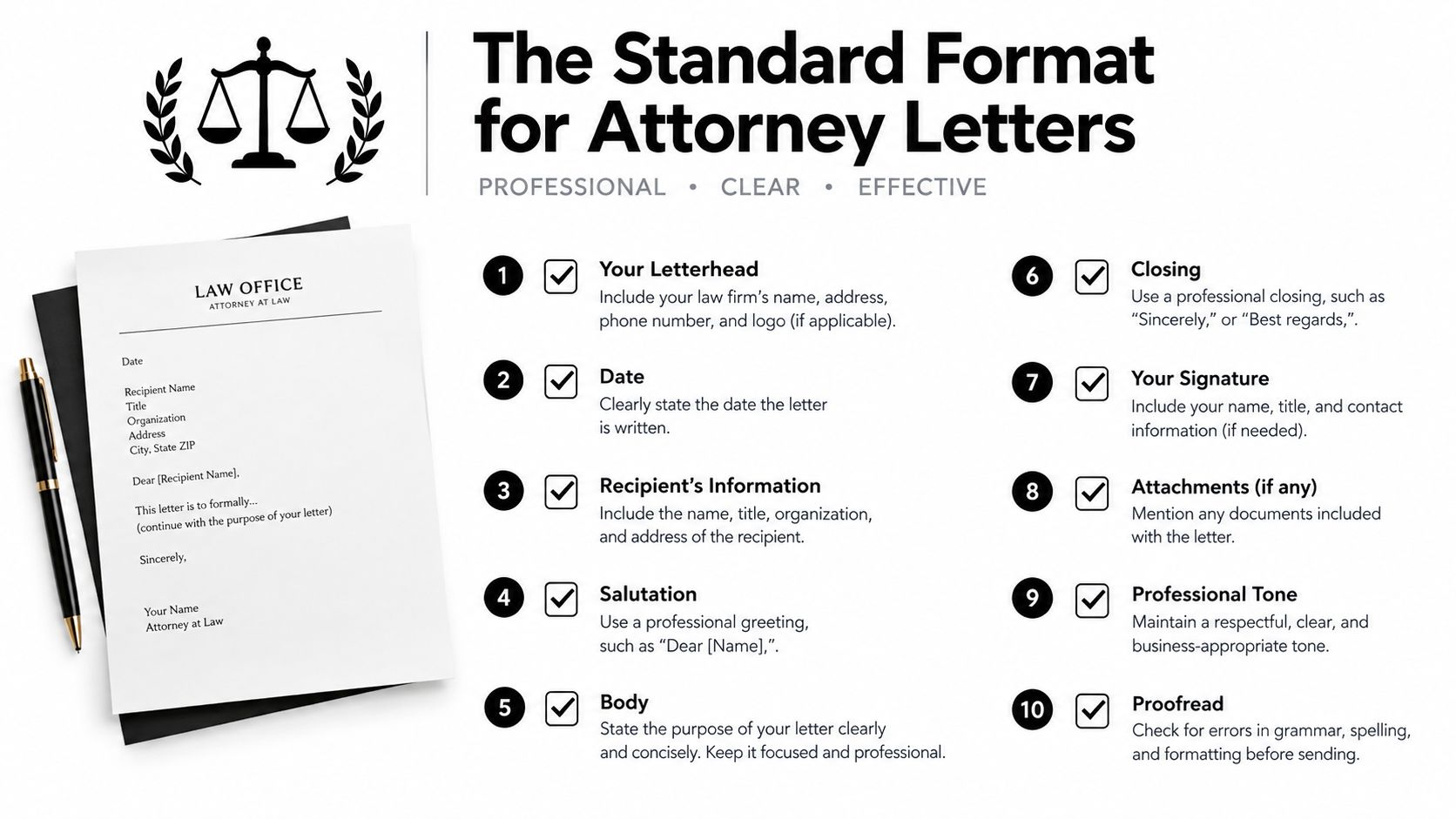
A widely used format places the writer's contact details first, followed by the date, attorney's name and firm address, subject line, salutation, body, closing, and enclosures. Legal Beagle's guide to writing a lawyer describes this order and recommends addressing the lawyer by surname, using a professional closing such as “Sincerely,” and attaching copies of relevant supporting documents.
Write for intake and triage
Law firms assess incoming communications quickly. Your letter should therefore answer practical questions early:
- Who are you? Include your full name, reliable contact information, and any existing client or matter reference.
- What happened? State the central event or dispute in a short opening paragraph.
- Who is involved? Identify the opposing party, insurer, employer, business, or other relevant person.
- What do you need? Ask for a consultation, advice, representation, records review, or a defined next step.
- What supports your account? List the documents you've enclosed or can provide.
The format has remained stable because it supports documentation, traceability, and professional communication across different legal settings. A lawyer can scan a dated, organized letter and quickly determine whether the matter appears urgent, whether a conflict check may be needed, and which records should be requested.
Practical rule: Draft the letter so a busy lawyer can understand the problem from the subject line and opening paragraph, then verify the details from the timeline and attachments.
Don't begin with your entire life story. Begin with the decision the lawyer needs to make. “I'm seeking advice about injuries sustained in a vehicle collision” gives the reader a useful starting point. A long account of every conversation, frustration, and speculation does not.
The Standard Format for Attorney Letters
A professional attorney letter follows a recognizable anatomy. Each part has a job, and skipping one creates avoidable back-and-forth.
Build the letter from the outside in
Start with your full name, address, telephone number, and email address. Add the date. Below that, write the attorney's name, the firm name, and the firm's complete address. Confirm the address from the firm's official contact information rather than relying on an old envelope or search result.
Your subject line should identify the matter in plain language. “Request for consultation regarding workplace injury” is more useful than “Important information.” If the attorney already represents you, include the matter reference or client number if one exists.
Use a professional salutation. Address the lawyer by surname, such as “Dear Ms. Patel,” unless the attorney has specifically invited a different form of address. The opening paragraph should state your problem and the legal issue, which is consistent with the CUNY Legal Writing Center's guidance on drafting client letters.
Organize the body around the lawyer's questions
Use short paragraphs or headings for:
- The issue: Explain why you're writing and identify the result you want.
- The timeline: Present relevant events in chronological order, with dates where you know them.
- The parties: Name the people, companies, insurers, providers, or agencies involved.
- The requested action: State whether you want advice, representation, a demand, a records request, or another step.
- The documents: Identify each enclosure and explain what it shows.
End with a professional closing, such as “Sincerely,” followed by your name and signature. Label attachments clearly. If you're preparing the document in Microsoft Word, a guide on how to format a letter in Word 2026 can help you keep the page presentation orderly. For a personal injury example, compare your structure against this sample attorney demand letter, while remembering that a sample isn't a substitute for case-specific legal advice.
Timing and Evidentiary Readiness
Don't send a formal injury demand because you're anxious to move the case forward. Send it when the factual record is mature enough to support the position you're asking the lawyer to take.
For personal injury matters, useful guidance emphasizes waiting until medical treatment is complete or the injured person has reached maximum medical improvement before finalizing a demand. That timing matters because a premature letter may describe an incomplete injury picture, omit later treatment, or force the legal team to revise the demand after new records arrive. The complete guide to demand-letter readiness also stresses injury chronology, treatment documentation, and complete exhibits.
Separate fact gathering from formal advocacy
Before sending a demand-oriented letter, assemble the material that allows counsel to test your account:
- Medical records: Gather records from each relevant provider and organize them by treatment date.
- Billing documents: Collect invoices, statements, and payment information that support claimed expenses.
- Incident materials: Preserve photographs, reports, correspondence, witness information, and insurance communications.
- Work documentation: Include records that help show missed work or other claimed effects, if relevant.
- Personal chronology: Write a factual account of symptoms, treatment, restrictions, and changes over time.
You don't need to wait for every minor administrative detail before asking a lawyer for an initial consultation. You should, however, distinguish that consultation request from a final settlement demand. An attorney can advise you while evidence is still developing, but a formal demand should reflect the strongest complete record reasonably available.
A premature demand can create a clean-looking document with an incomplete factual foundation.
Deadlines still control your decisions. Treatment and records collection shouldn't become an excuse for inaction, so review the relevant personal injury statute of limitations guidance and speak with qualified counsel about the law that applies to your jurisdiction. The correct timing depends on the matter, the evidence, and applicable procedural requirements.
Standard Updates Versus Formal Demand Letters
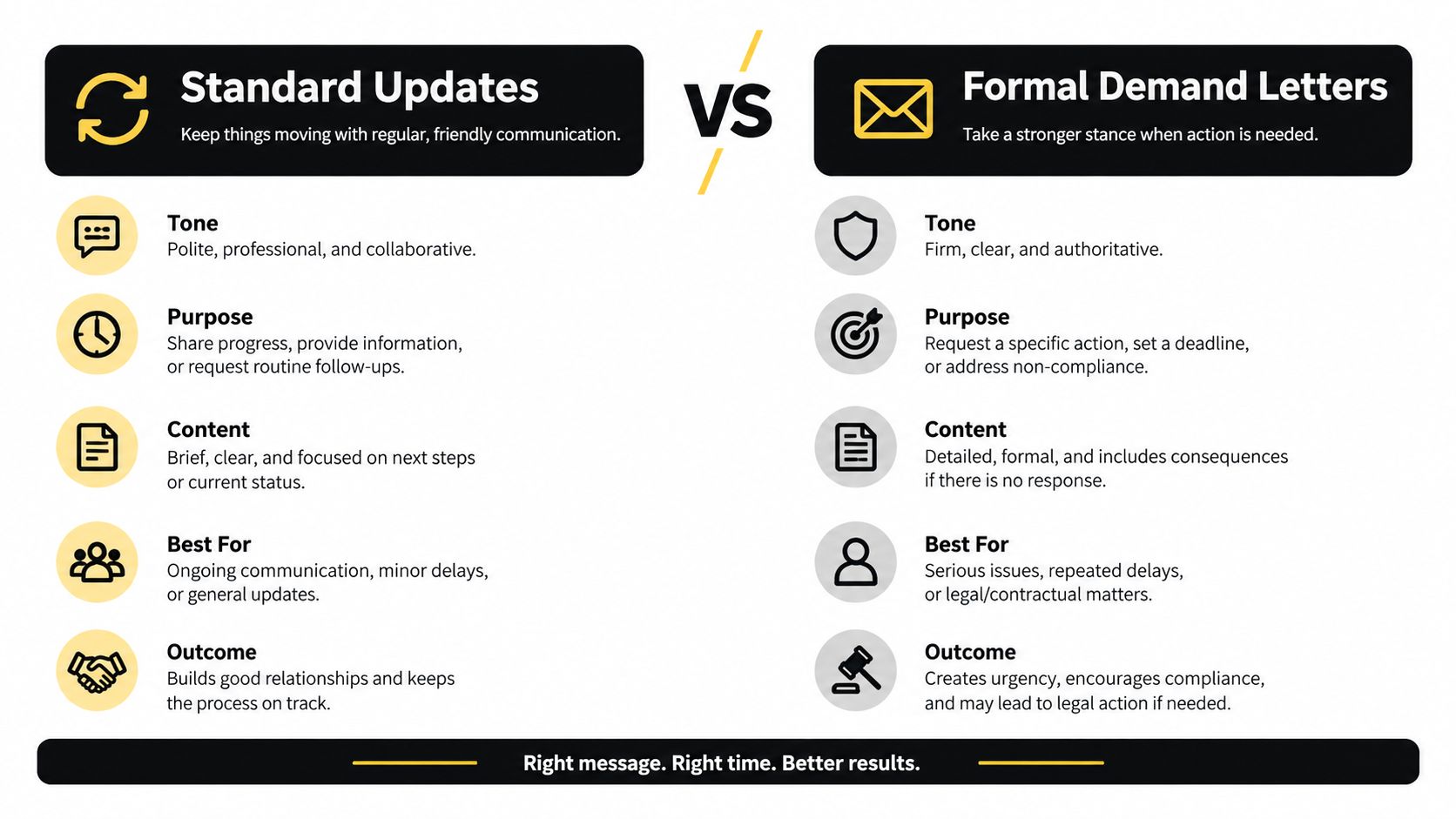
A standard update tells the lawyer what has changed. A formal demand tells an opposing party what must happen and by when. Treating those documents as interchangeable is a drafting mistake.
A client update may say that treatment continues, a new provider has been added, an insurer has responded, or a witness has been located. Its purpose is to keep counsel informed and identify the next decision. It usually needs a concise timeline, the parties involved, the desired outcome, and any new documents.
A pre-suit personal injury demand letter has a different function. It's a negotiation document that presents the claim in a way designed to support a settlement position. Neutral guidance on personal injury demand letters before a lawsuit identifies the core components as a chronological factual narrative, explanation of liability, itemized damages, a specific demand, and a deadline.
Use the right document for the right job
| Standard update | Formal demand letter |
|---|---|
| Reports new facts or developments | Presents a settlement position |
| Helps counsel decide what to do next | Explains why the recipient is responsible |
| May identify incomplete evidence | Should include organized supporting exhibits |
| Requests advice or action from the lawyer | States a specific remedy and response deadline |
| Can be brief and administrative | Must be precise, complete, and strategically reviewed |
For a demand, write the factual narrative in chronological order. Explain the conduct or event that supports liability, but don't overstate what the evidence proves. Itemize damages by category and connect each category to records. Then state the specific remedy sought and the date by which a response is required.
Avoid vague language such as “I want fair compensation.” That phrase doesn't tell the recipient or the lawyer what position is being advanced. A demand should identify the requested outcome clearly, while the attorney determines the appropriate legal and negotiation strategy.
Missing exhibits weaken the document because the recipient can challenge unsupported assertions. Label attachments consistently, refer to them in the body, and keep a complete copy of the final letter and enclosures. Don't turn an update into a demand by adding an aggressive closing. The document's purpose should determine its structure and tone.
Mastering Tone and Plain Language Drafting
The strongest legal letter sounds controlled, factual, and readable. Dense legal language doesn't make a letter more persuasive. It often hides the point the lawyer needs to evaluate.
Legal-writing guidance has moved toward plain language and reader-focused drafting. A Canadian legal-writing resource explains that effective legal writing starts by clarifying the purpose and considering the reader, while public legal-aid guidance emphasizes the firm's address, date, headings or references, prior-letter references, a clear response, a request for action, a signature, and relevant documents. These practices make the letter easier for clients, lawyers, and courts to understand.
Replace emotion with usable facts
You can describe distress without turning the letter into an accusation. Write, “The insurer denied the claim in its letter dated [date],” rather than “The insurer treated me terribly and clearly doesn't care.” The first sentence identifies an event and points to evidence. The second expresses an opinion that may not help counsel assess the matter.
Use these drafting habits:
- Prefer direct verbs: Write “The driver struck my vehicle,” not “My vehicle was involved in an impact.”
- Use headings: Separate the incident, treatment, communications, losses, and requested action.
- Keep paragraphs short: Give each paragraph one job.
- Mark uncertainty: Say “I believe” or “I don't recall” when the record is incomplete.
- Cut speculation: Don't label conduct fraudulent, intentional, or illegal unless counsel has advised that the evidence supports the characterization.
Protect sensitive information
Include information the lawyer needs, but don't distribute unnecessary personal data. Avoid sending unrelated medical records, passwords, full account credentials, or sensitive identifiers that have no connection to the legal issue. Ask the firm how it prefers to receive confidential documents if you're unsure.
If a firm needs help with intake, document organization, or routine drafting support, it may consider options such as hiring legal virtual assistants. Whether a staff member or outside assistant prepares the first draft, a qualified lawyer should make the legal and strategic decisions before a formal letter leaves the firm.
Reader test: If someone unfamiliar with the matter can identify the issue, timeline, requested action, and supporting documents from one careful read, the draft is doing its job.
Your Pre-Send Checklist for Legal Letters
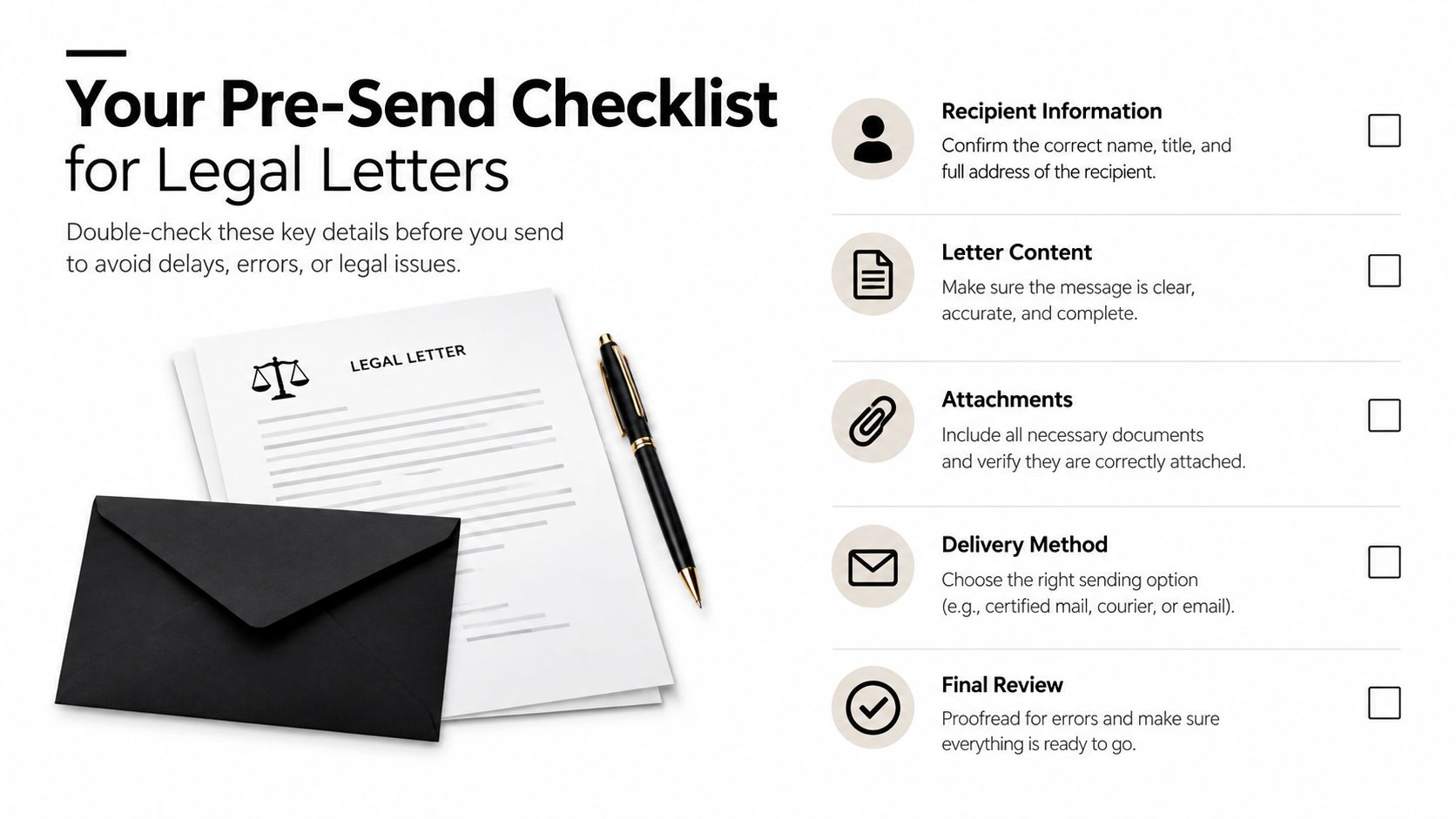
Before you sign, run the letter through an operational check. Good prose won't fix a wrong address, missing attachment, or unclear request.
Verify the document
- Recipient details: Confirm the attorney's name, firm name, and complete mailing address.
- Your details: Check your name, telephone number, email address, and matter reference.
- Date and subject: Make sure the date is correct and the subject identifies the legal issue.
- Opening paragraph: Confirm that it states why you're writing and what response you need.
- Timeline: Check that events appear in chronological order and that dates are accurate.
- Names and roles: Verify every person, company, insurer, provider, and agency mentioned.
- Enclosures: Match every attachment to a reference in the letter and label each document clearly.
- Confidentiality: Remove unrelated sensitive information and use the firm's preferred delivery method.
- Records: Save a copy of the signed letter and every enclosure for your files.
If the letter is a formal demand, confirm that the liability explanation, damages itemization, requested remedy, and response deadline are complete. If it's only an update, don't add demand language that changes the document's purpose.
Ares helps personal injury teams turn case materials into organized medical overviews and demand-letter drafts, including key dates, diagnoses, treatments, providers, and symptom chronology. Visit Ares to see how its drafting workflow can help your firm prepare clearer, more review-ready correspondence from the records already in the file.