
You've submitted the claim, attached the photographs, forwarded the medical bills, and answered every question the adjuster sent. Then the request arrives: clarify the accident date, explain the treatment gap, provide a missing estimate, or reconcile two records that describe the same event differently. The claim hasn't necessarily failed, but the file no longer tells one clean story.
That's the practical problem with insurance claim documentation. A large folder can still be weak evidence if the dates conflict, the source of a document is unclear, or the reviewer can't connect an invoice to the event it supposedly proves. A persuasive file isn't a paperwork dump. It's an evidentiary system with a reliable chronology, identifiable sources, and visible quality controls.
Why Insurance Claim Documentation Decides Your Outcome
A personal injury file can unravel through a small contradiction. The incident report places the collision on one date, an emergency department record uses another, and an early intake form lists a different location. Each record may look reasonable by itself. Together, they give an adjuster a question that your submission hasn't answered: which version should the insurer trust?
That question can delay evaluation, weaken negotiations, or invite a request for records that should have been reconciled before submission. In practice, the strongest claim files don't merely contain proof of injury or damage. They show how each document fits into a sequence, who created it, when it was created, and what proposition it supports.
Documentation follows the claim through the system
Claims history feeds quoting, assessment, and premium-setting decisions. A 2022 report commissioned by Financial Rights found that every My Insurance Claims Report reviewed in its field study contained at least one material error, including missing or additional claims, misleading or inconsistent information, and incorrect personal details such as addresses. The report warned that insurers could rely on erroneous or misleading claims-history information when assessing later claims or pricing coverage. Financial Rights' report on insurer data practices shows why a documentation error isn't merely a clerical nuisance.
The same principle applies inside an individual claim. A wrong provider name can make a bill appear unrelated. An omitted discharge summary can leave the treatment sequence incomplete. An unsigned record can raise an authorization question. Once an error enters the file, later reviewers may repeat it because they're working from the record rather than the underlying event.
Practical rule: Treat every document as evidence with a job. If you can't explain what it proves, where it came from, and where it belongs in the timeline, it isn't ready for submission.
Large-scale claims databases made this problem more significant. The National Library of Medicine's explanation of claims data describes claims data as electronic administrative records collected at much larger scale, covering appointments, bills, insurance details, and patient-provider communications. The Financial Conduct Authority's 2025 Value Measures data also demonstrates how formalized insurance reporting has become. Firms must submit complete and accurate data annually, and the FCA contacted 35 firms during its 2025 validation cycle, with around half resubmitting data after clarification or correction. The FCA publishes claims frequency, acceptance rates, average payouts, and complaints as a proportion of claims, all of which depend on structured claim records.
For a practitioner, the conclusion is straightforward. Build the chronology first, verify the source second, and submit only after a reviewer can move from incident to treatment, expense, and outcome without guessing. A useful medical record review workflow follows that same discipline by turning scattered records into an organized factual record rather than relying on a narrative written from memory.
What to Include for Every Major Claim Type
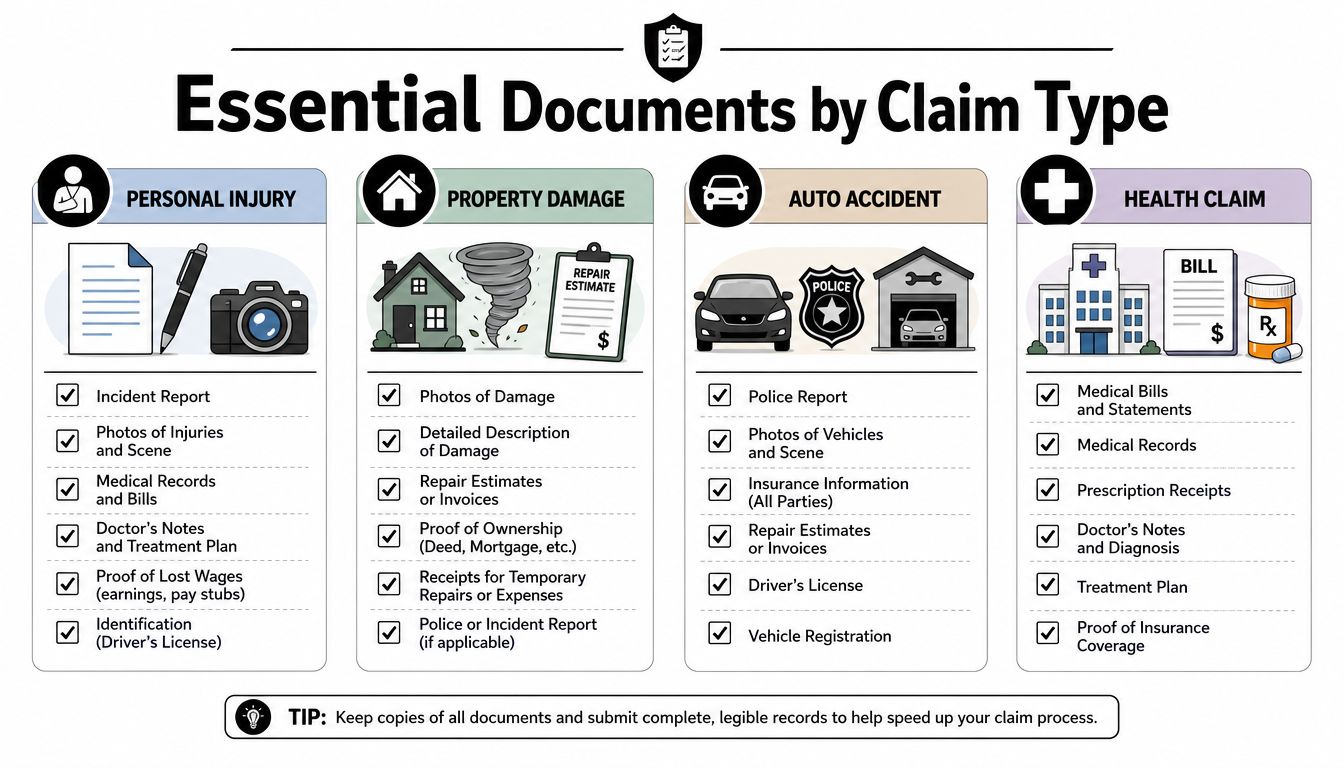
Start with the claim type, not a universal checklist. A personal injury file needs a treatment narrative and damages proof. A property file needs condition, ownership, cause, and repair evidence. An auto file needs collision facts, vehicle damage, liability materials, and related losses. A health-related claim needs eligibility, treatment, coding, billing, and payment records.
Personal injury claims
Build the core file around identity, liability, injury, treatment, and loss.
- Identity and coverage: Collect the claimant's identifying information, policy details, claim number, insurer correspondence, and signed authorizations where required.
- Incident proof: Preserve the police or incident report, photographs, witness information, statements, scene materials, and any available video.
- Medical records: Request records from every relevant provider, including emergency care, primary care, specialists, therapy, imaging, surgery, prescriptions, and discharge materials.
- Financial damages: Match each bill to the provider, service date, diagnosis or treatment, amount billed, amount paid, and balance. Add wage-loss records, employer verification, tax materials where appropriate, and out-of-pocket expenses.
- Claim communications: Save notices, recorded statement requests, reservation-of-rights letters, medical authorizations, evaluations, offers, and responses in date order.
A bill by itself rarely explains the injury. A treatment note by itself rarely establishes the financial loss. The persuasive file connects the clinical event to the charge and then connects both to the claimed damages. A carefully assembled personal injury settlement file makes that connection easier for the adjuster to evaluate.
Property damage claims
Property documentation should establish what existed, what happened, what was damaged, and what repair or replacement will cost. Include the policy and declarations, ownership records, inventories, receipts, serial or model information, photographs, videos, contractor estimates, invoices, mitigation records, inspection reports, and communications with the carrier.
Photographs should include context and detail. A close-up of a damaged ceiling may show severity, but a wider image can identify the room and show the extent. For progressive damage, preserve images and notes that establish the condition before mitigation, during removal, and after repairs. Don't submit only the expensive items. Ordinary contents, stored items, fixtures, and improvements can matter when the insurer assesses the complete loss.
Auto and health-related claims
For an auto claim, collect the policy, vehicle information, collision report, photographs of all vehicles and the scene, witness details, repair estimates, inspection reports, towing and storage bills, rental records, and medical records if anyone was injured. Keep communications with both insurers separate from repair documentation so liability questions don't become buried in estimates.
Health-related claims require a different reconciliation. Assemble eligibility and coverage records, provider bills, explanation-of-benefits documents, claim forms, denial notices, diagnosis and procedure information, prescriptions, referrals, prior authorization materials, and appeal correspondence. Mark which amounts were billed, allowed, paid, denied, or assigned to the patient. “Submit everything” isn't enough. The file must show which service each document concerns and why the payer's decision should be reconsidered.
How to Build a Chronology That Holds Up Under Review
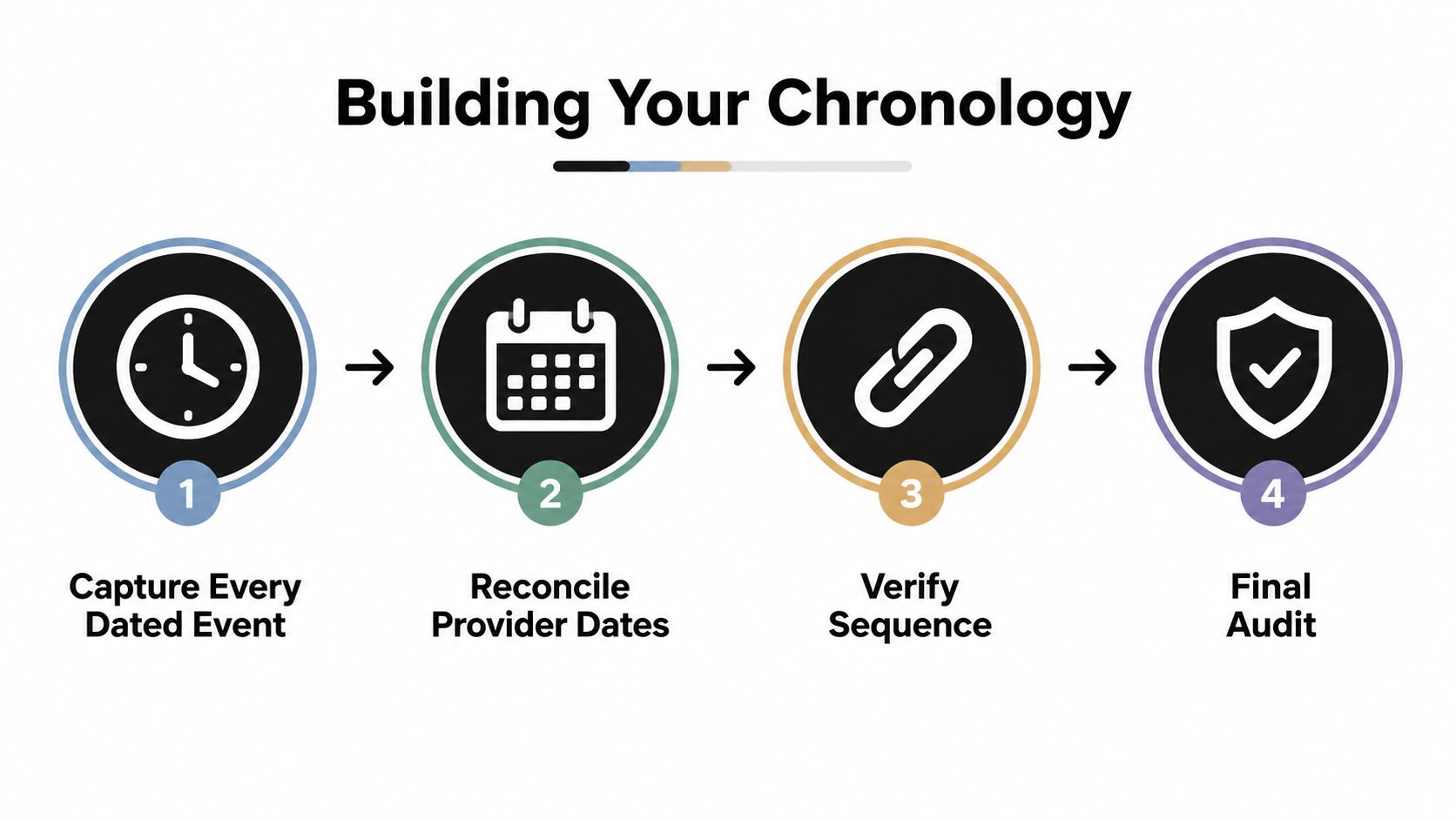
A chronology is more than a list of dates. It's the control layer that exposes missing records, duplicate entries, contradictory descriptions, and unexplained gaps before the insurer finds them.
Capture events before writing conclusions
Begin with an event grid. Record every dated encounter, communication, bill, photograph, estimate, payment, and decision without trying to argue the claim yet. Use the source document's date, not the date someone later described the event.
A practical chronology entry should include:
- Date and time, when available
- Event or service
- Provider, witness, carrier, or other source
- Document supporting the entry
- Injury, damage, treatment, payment, or decision described
- Open question or inconsistency
For medical files, list the emergency visit, diagnostic imaging, follow-up appointment, referral, procedure, therapy session, prescription, and discharge event separately. For property claims, list the discovery of damage, inspection, mitigation, estimate, supplemental finding, repair milestone, and payment. For auto claims, place the collision, report, inspection, estimate, repair, rental period, and related medical encounters on the same timeline when they belong to the same loss.
Reconcile names, facts, and sequence
After capturing events, compare the chronology against the source records. Reconcile provider names, diagnoses, treatments, locations, dates, signatures, and authorization details. Don't "fix" a discrepancy. Flag it, identify the stronger source, and explain the resolution in an audit note.
A 2024 systematic review of medical-record documentation errors found that, among 48 eligible studies, 47 reported incompleteness, 14 reported inaccuracy, and 8 reported inconsistency. It also identified illegibility, unsigned documents, and irrelevant content as reported error categories. The systematic review of medical-record documentation errors supports a chronology-first method because missing and conflicting information are routine record defects, not unusual exceptions.
Enforce completion at intake
Free-text instructions such as “obtain complete records” leave too much to chance. Use mandatory fields for claimant identity, incident date, provider, admission or initial evaluation, operative events, discharge, imaging, reconciliation, and authorization status.
A 2022 electronic medical record audit found the strongest documentation where workflows enforced required fields. It reported 98% documentation for allergies, 99% for inpatient review documentation, 81% for admission documentation workflow, and 88% for operation documentation workflow. Discharge workflow was 72%, while venous thromboembolism pathway workflow was 42%, medical reconciliations were below 50%, problems-list documentation was 65%, goals of care were 61%, and diagnostic imaging endorsement was 68%. The electronic medical record audit illustrates the operational point: mandatory checkpoints produce more complete records than an open text box.
Preserve the original file, record the date received, identify the sender or custodian, and note any conversion from paper to PDF or image. Keep chain-of-custody notes for photographs, videos, invoices, and exported portal records. Before filing, require a final sign-off for discharge summaries, imaging, bills, operative reports, and any record that resolves a disputed event.
A medical chronology template can provide the structure, but the discipline matters more than the particular format. The reviewer should be able to distinguish a documented fact, a reported symptom, an interpretation, and an unresolved issue.
Organizing and Filing Your Claim File for Faster Review
A well-built chronology can still lose value if the file is difficult to work with. Adjusters, attorneys, paralegals, and experts should be able to locate a provider, date, estimate, or communication without opening every attachment.
Build a predictable folder structure
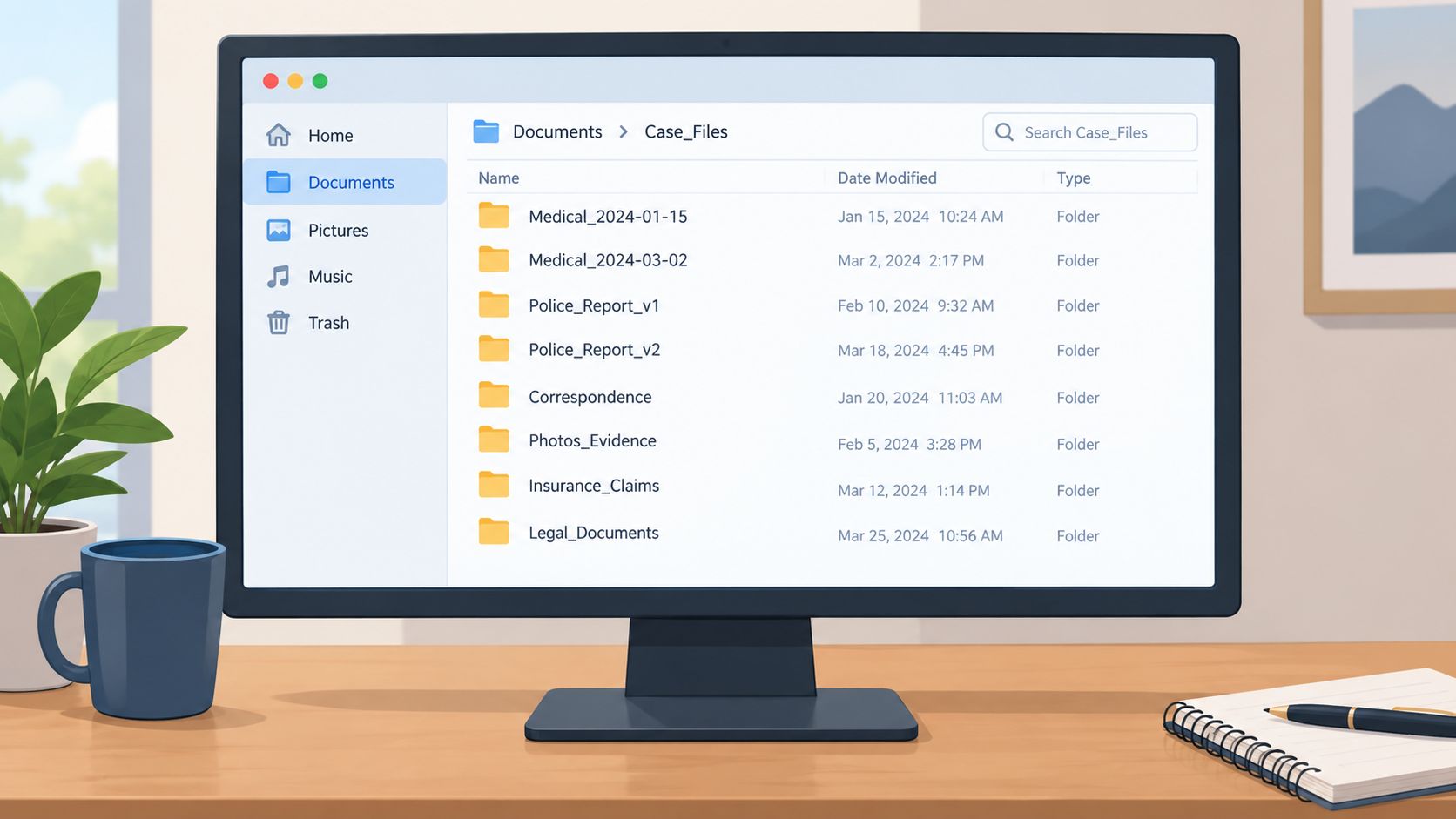
Use folders that reflect how the claim will be reviewed:
- 00 Intake and Coverage
- 01 Incident and Liability
- 02 Medical Records
- 03 Bills and Payments
- 04 Property or Vehicle Damage
- 05 Wage Loss and Other Damages
- 06 Correspondence
- 07 Chronology and Index
- 08 Submission and Responses
The exact labels can vary, but the order shouldn't change from case to case. A consistent structure helps new team members work without reconstructing your filing logic.
Name files for people, not software
A filename such as IMG_4821.pdf tells the reviewer nothing. Use a format such as 2026-04-18_EmergencyDept_DischargeSummary.pdf or 2026-04-20_Kitchen_CeilingWaterDamage_Initial.jpg. Put the date first, then the source or location, then the document type or subject.
Keep the original filename in an index if it carries evidentiary value. Don't overwrite a received document after editing it. Save a working copy, identify the editor, and record the revision date. For scans, check that pages are upright, text is searchable when appropriate, and attachments haven't been separated from the report that explains them.
Create a master index
The master index should function as a map. Include document ID, date, source, document type, relevant event, page range, and any issue requiring attention. For medical records, add provider, diagnosis, treatment, and bill references. For property and auto files, add location, item or component, damage description, estimate reference, and repair status.
The index should also show what's missing. A visible “requested, not received” entry is more useful than an apparently complete folder that hides a gap. Before submission, another team member should test the file by locating a selected date, provider, invoice, image, and communication from the index. If that exercise fails, the adjuster will likely experience the same friction.
Common Pitfalls That Delay or Deny Claims and How to Avoid Them
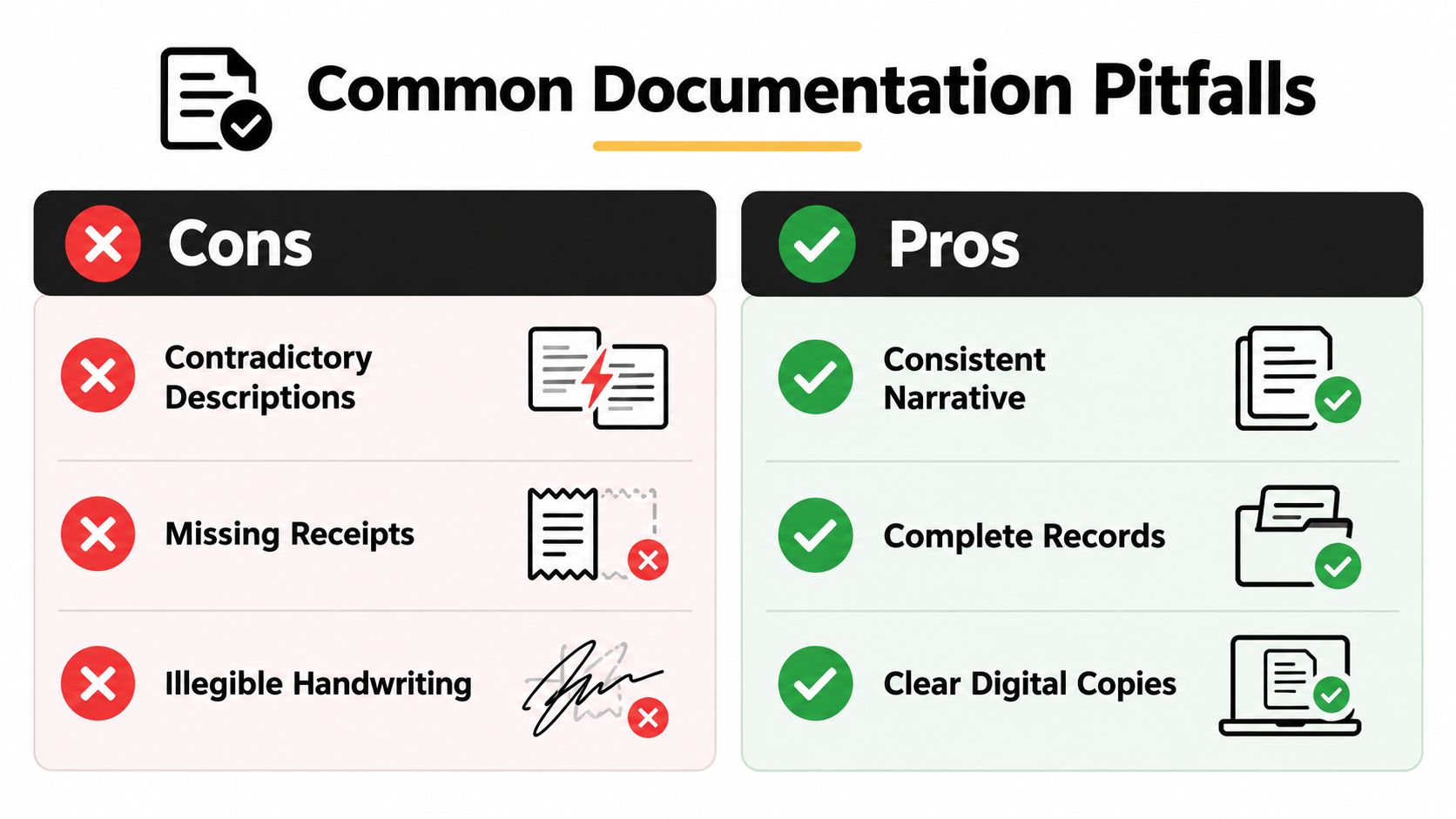
Many claimants assume that more documents create stronger proof. They don't. Contradictory, illegible, late, or unauthenticated documents can make a large submission harder to trust than a smaller file with a coherent explanation.
Contradictions need resolution, not concealment
Common delay triggers include incomplete forms, missing photographs, contradictory event descriptions, absent estimates or incident reports, illegible handwriting, and inconsistent dates or locations. This industry discussion of synthetic claims fraud and claim delays highlights why chronology matters when records come from multiple providers, dates, and formats.
Use a discrepancy log. State the conflicting entries, identify the source of each, explain which record is more reliable, and attach supporting material. If the claimant gave an imprecise date during an initial call but the incident report and contemporaneous medical record agree, explain that distinction rather than pretending the inconsistency doesn't exist.
Authenticity now belongs on the checklist
Images, invoices, and supporting records may be edited or generated. Recent reporting states that Admiral saw a 71% rise in fraud in 2025, partly tied to AI-manipulated evidence, while Verisk reported that 99% of insurers had encountered manipulated or AI-altered documentation and 76% said those submissions had become more complex in the prior year. The BBC report on AI-altered insurance evidence makes the practical issue clear: completeness no longer establishes authenticity.
Preserve original photographs and videos, retain the native files where possible, and avoid repeatedly exporting or messaging an image before submission. Record who captured the evidence, when it was captured, where it was stored, and whether any editing was performed. Review metadata where available, compare invoice text and formatting across related documents, and ask the issuing provider or contractor to verify questionable records.
For teams handling video evidence, AI Video Detector preservation tips offers useful guidance on preserving source material and documenting handling. The resource is relevant even when no one suspects fraud because a clean preservation record makes later authenticity questions easier to answer.
A reviewer should never have to choose between trusting an unexplained file and rejecting it as unreliable.
Gaps in care deserve their own explanation. A gap may reflect insurance authorization, transportation, provider availability, recovery, or a change in treatment. Don't leave the adjuster to infer the reason. Add a short factual note supported by correspondence, scheduling records, or a later provider statement, while keeping advocacy separate from the underlying documentation.
Smart Tips for Secure and Efficient Claim Submission
Speed helps only when it preserves accuracy. The safest submission workflow separates extraction, verification, review, and delivery. Automation can locate dates, diagnoses, providers, bills, and repeated references, but a person still needs to confirm that the extracted information matches the source record and belongs to the correct claim.
Use secure systems for protected health information. Confirm that your vendors provide appropriate privacy and security controls, limit access by role, maintain an audit trail, and support secure transfer and deletion policies. Don't place medical records in personal email, unsecured file-sharing links, or consumer applications that your firm hasn't approved.
Run the final verification
Before sending the file, check:
- Identity: The claimant name, date of birth, address, claim number, and policy information match across the submission.
- Chronology: Every material event has a date, source, and supporting document, with discrepancies explained.
- Medical completeness: Records include initial evaluation, imaging, procedures, treatment, discharge, follow-up, and relevant bills.
- Damage support: Estimates, invoices, photographs, ownership proof, repair records, and payment information correspond to the claimed loss.
- Authenticity: Original files, metadata where available, custodian information, and any edits are documented.
- Communication: The cover letter identifies the requested action and points the reviewer to the exact supporting documents.
- Submission record: Keep the final package, transmission confirmation, recipient, and response deadline in the file.
Ares is one example of a tool that can ingest medical records and case files, extract diagnoses, treatment timelines, provider details, and key dates, and produce organized medical summaries and demand drafts for review. It's designed for sensitive PHI with HIPAA-compliant and enterprise-oriented privacy controls, but the output still requires source verification before submission.
Workflow takeaway: Mandatory fields and sign-off checkpoints produce more dependable claim files than free-text narration alone.
The best process is repeatable. Intake the records, preserve originals, build the chronology, reconcile contradictions, index the file, run the authenticity check, obtain attorney or case-manager approval, and submit a focused package. That system reduces avoidable back-and-forth while giving the claim team a defensible explanation for every important entry.
If your firm needs a more reliable way to turn scattered medical records into verified chronologies, damage summaries, and claim-ready drafts, review how Ares supports structured case preparation. Upload your records securely, use the extracted timeline to identify gaps and inconsistencies, and have your team verify the final file before it reaches the insurer.