
A demand deadline is approaching. The file contains hospital records, therapy notes, billing statements, imaging reports, and correspondence from several providers, but nobody can say with confidence which records are missing. A paralegal is building a chronology by hand while an attorney waits for a usable narrative to draft the demand. The firm may own advanced software, yet the case still moves at the speed of the least organized handoff.
That gap is the practical domain of legal process improvement. For personal injury firms, the highest-value opportunity often isn't generic e-discovery or contract automation. It's the messy middle between record collection, medical chronology, injury analysis, and demand drafting. A better process turns scattered documents into verified, case-ready information without removing attorney judgment.
Law Firm Utilization and Automation in Practice
A personal injury file can look active while producing little usable work. Attorneys review records, paralegals chase providers, and demand drafts wait for a chronology that still has gaps. Adding another platform may increase activity without increasing throughput if ownership, naming rules, intake requirements, and approvals remain unclear.
Legal process improvement applies structure to that problem. Its foundation includes Lean and Six Sigma principles to legal work, adopted early by firms such as Seyfarth Shaw. An academic treatment links the discipline to removing non-value-added work and defects, lowering client cost, improving firm margins, and applying measurable quality standards, including the classic target of 3.4 defects per million opportunities (academic treatment of legal process improvement).
For PI teams, the useful application is narrower and more practical. Medical chronologies repeat recognizable fields. Demand letters repeat factual and damages components. Record requests move through recurring stages, even though the underlying injuries and legal judgments differ. Those patterns create opportunities to standardize collection, indexing, chronology preparation, and drafting without turning attorney judgment into a template.
Find the constraint before choosing the tool
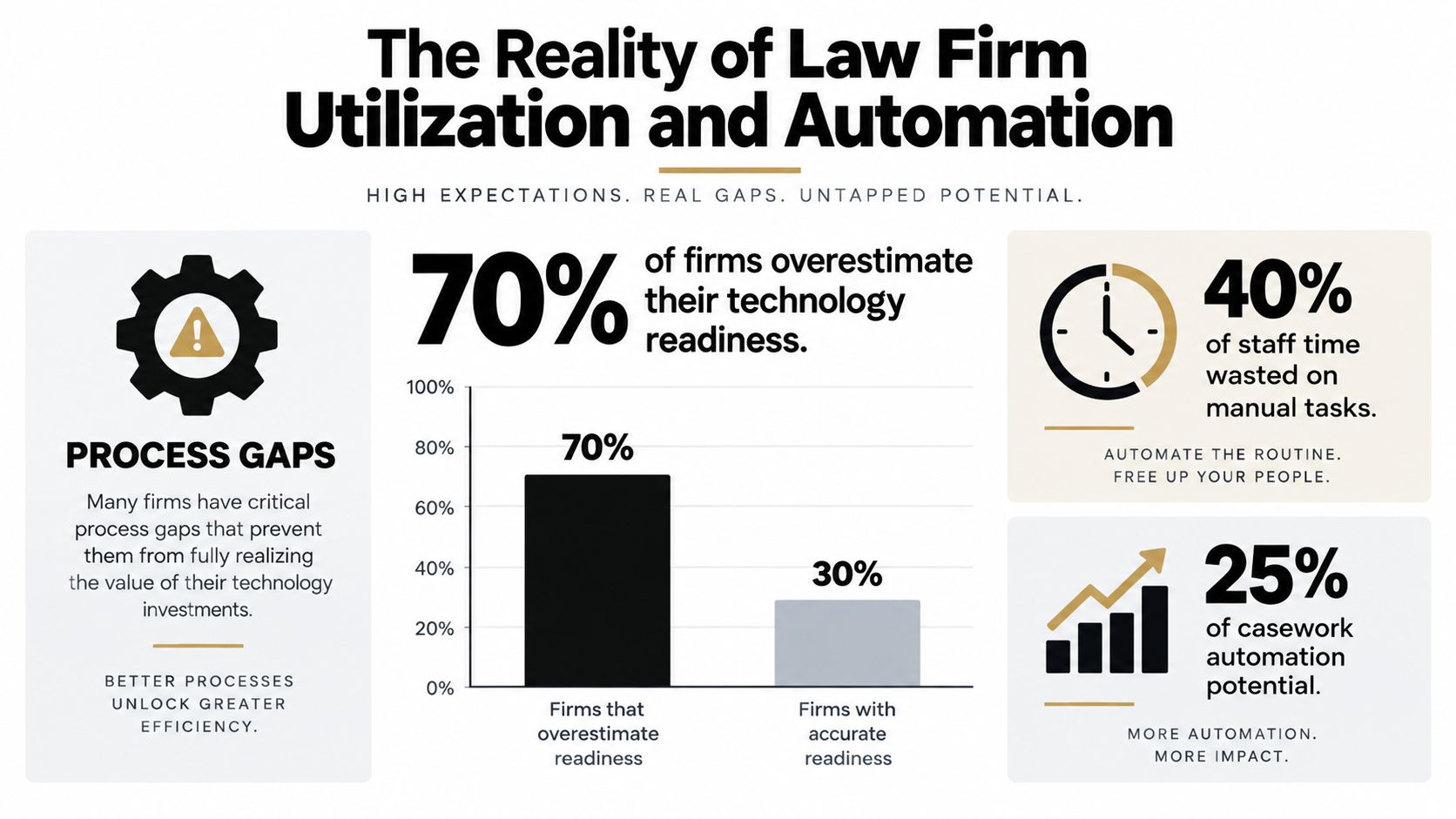
Clio's 2025 benchmark reports an average law-firm utilization rate of 38%, equal to 3.0 billable hours in an average 8-hour workday. It also reports an average realization rate of 88%, a collection rate of 93%, and median total lockup of 93 days (Clio's 2025 legal trends benchmarks). These broad benchmarks do not predict a particular PI firm's results, but they show how work can consume attorney capacity before it becomes collected revenue.
Another industry study found that 74% of respondents viewed automation of manual tasks, including workflow or task flow, as having the highest impact among efficiency technologies (legal automation efficiency study). The finding is a reason to examine repetitive work, not a reason to automate every step. In PI practice, the strongest candidates are often the handoffs that delay settlement readiness, such as record follow-up, file organization, chronology assembly, and first-pass demand drafting.
Classify the constraint before buying software:
- Tool deficit: The workflow and ownership are clear, but the team lacks a dependable way to complete a necessary task.
- Process deficit: Staff follow different rules, documents arrive through disconnected channels, or the next action has no owner.
- Governance deficit: The firm has a tool and a process, but lawyers review outputs inconsistently or staff can bypass the standard workflow.
Document the current state first. If dictation contributes to the bottleneck, how to choose lawyer dictation software can help evaluate workflow fit instead of features alone. For medical-record automation, why automation is required should be assessed against the firm's actual capacity constraint. The demonstration comes later.
Mapping the Personal Injury Case Lifecycle
Improvement starts with visibility. A managing partner may know that cases feel slow, but that description doesn't identify whether the delay begins at intake, medical authorization, provider follow-up, record indexing, chronology review, demand approval, or negotiation. A value-stream map makes the physical movement of work visible from the first client contact to settlement.
Map the work as it actually happens
Use a recently closed matter and a currently active matter. Don't map the process from a policy manual because the manual usually describes the intended workflow, not the one staff perform under pressure. Record each activity, the person responsible, the input required, the output created, the system used, and the next handoff.
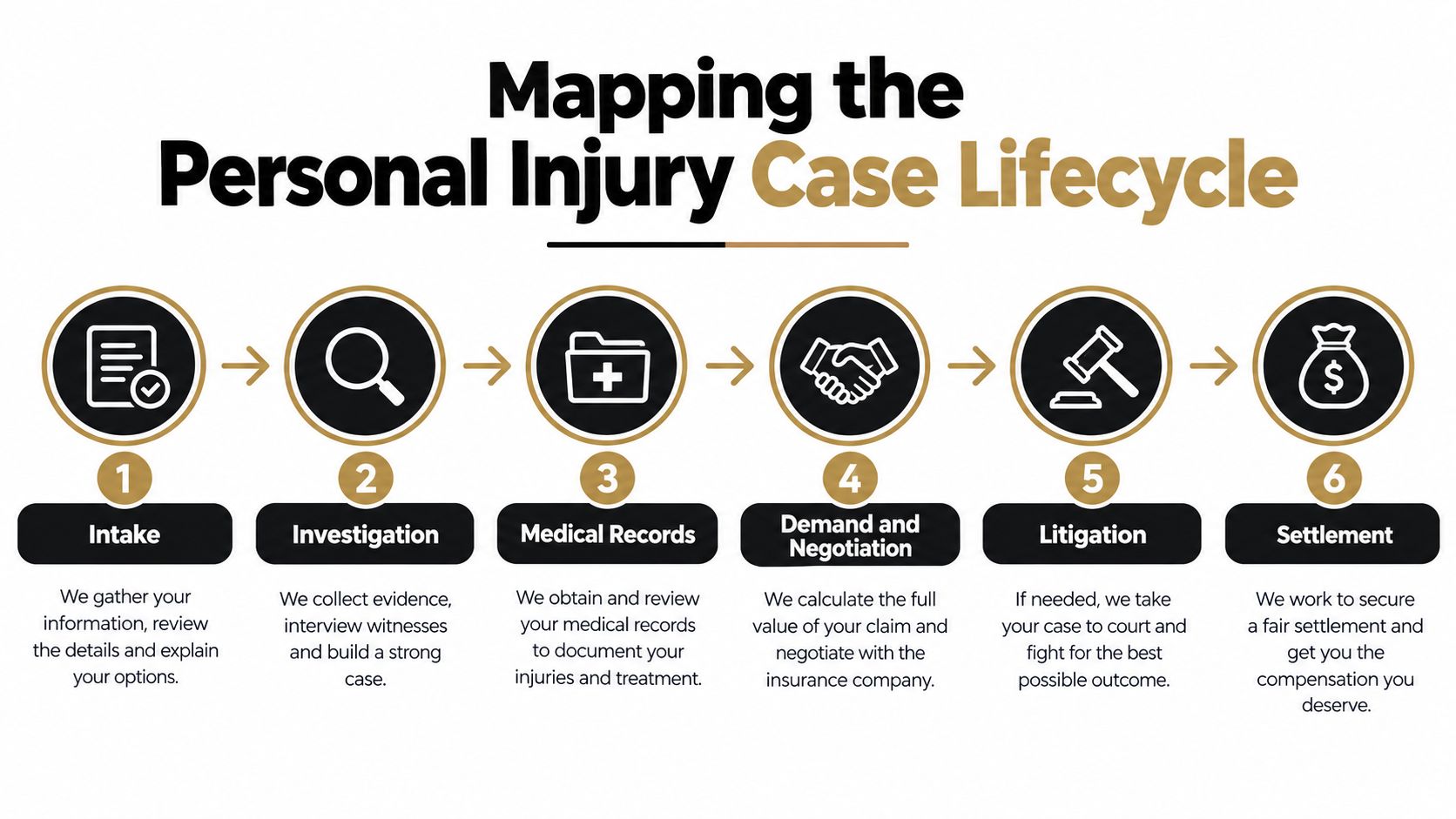
The PI lifecycle commonly includes:
- Intake: Capture the incident, parties, contact details, liability facts, treatment status, insurance information, and conflict-check requirements.
- Investigation: Preserve evidence, identify witnesses, request reports, assess liability, and clarify the client's immediate needs.
- Medical records: Obtain authorizations, send provider requests, monitor responses, index files, and reconcile records against known treatment.
- Demand and negotiation: Build the medical chronology, calculate or organize damages, draft the demand, obtain attorney approval, and communicate with the carrier.
- Litigation: Update the factual record, answer discovery, prepare witnesses, manage deadlines, and revise the case theory as evidence develops.
- Settlement: Confirm terms, resolve liens and outstanding balances, obtain approvals, distribute funds, and close the matter.
The important detail is not the label. It's the handoff condition. “Records requested” isn't a useful status if nobody knows which providers were contacted, when requests were sent, whether the request was complete, or who owns follow-up.
Find the stalled handoffs
Medical-record collection is a major source of delay. Independent PI-focused efficiency material estimates that records collection commonly takes 6–8 weeks, that initial requests are incomplete in 67% of cases, that cases average 4.3 providers, and that chronology creation can consume 12–15 hours per case (PI workflow efficiency analysis). Those figures should be treated as a benchmark for diagnosis, not as a prediction for every firm.
Build a handoff register with questions such as:
- Intake to case management: Does the paralegal receive a complete provider list and signed authorization, or must someone reconstruct the information?
- Records to review: Does the reviewer receive a searchable, consistently named file, or a folder of mixed PDFs and duplicate pages?
- Review to attorney: Does the chronology identify source pages and unresolved gaps, or does the attorney receive a general summary requiring another review?
- Attorney to drafting: Does the demand drafter have approved facts, damages information, and case themes, or must the narrative be rebuilt from the source files?
For each stall, classify the cause as waiting, rework, missing information, unclear ownership, or a necessary legal judgment. Automate only after separating those categories. A reminder can address waiting. A required intake field can prevent missing information. A lawyer still needs to decide whether a fact supports the claim.
Redesigning Medical Record Review and Drafting
The medical-record stage creates a distinctive operational problem. A file can contain all the right documents and still be unusable because dates are out of order, provider names vary, duplicate pages obscure the sequence, or a treatment gap has never been tested against the client's account.

A reliable redesign begins by separating extraction from legal interpretation. The system can identify dates, providers, diagnoses, procedures, medications, symptoms, imaging references, and billing entries. The reviewer then verifies those extracted facts against source pages and flags missing or contradictory information. The attorney decides how those facts affect causation, damages, credibility, negotiation posture, and litigation strategy.
Build a controlled document pipeline
The workflow should enforce a sequence rather than rely on individual habits:
- Collect: Store incoming records in a matter-controlled location with clear access permissions.
- Normalize: Apply consistent file names, provider labels, document categories, and date conventions.
- Extract: Produce structured events from the records, including treatment dates, diagnoses, symptoms, procedures, and relevant findings.
- Verify: Require source-page review for material facts and mark uncertainty instead of filling gaps.
- Reconcile: Compare the chronology with intake notes, client statements, bills, prior injuries, and provider lists.
- Draft: Use approved facts to prepare a demand narrative, then route the draft for attorney review.
An AI system can help, but PHI handling is essential. The firm should confirm how the vendor protects client information, what contractual safeguards apply, who can access files, how outputs are retained, and how the firm handles deletion, auditability, and human review. HIPAA compliance should be evaluated as part of vendor due diligence, not treated as a marketing checkbox.
A practical option for PI firms is Ares' medical record review service, which is designed to turn case files into organized medical overviews and demand-related output. Whatever platform a firm selects, it should be tested against difficult real-world files, including multiple providers, inconsistent dates, scanned documents, duplicate records, and records that reveal a gap rather than a clean treatment story.
The best output isn't a polished paragraph. It's a defensible working record. The chronology should let a lawyer move from an event to the underlying page, distinguish documented treatment from inference, and see where the file needs another request or client interview. Demand drafting should use that verified record, not obscure uncertainty beneath confident prose.
A useful review screen asks four questions:
- What happened, and on what documented date?
- Which provider or record supports the event?
- What changed in the client's symptoms, diagnosis, treatment, or function?
- What remains missing, inconsistent, or legally significant?
The attorney still owns the narrative. Automation should reduce sorting and reconstruction so counsel can spend more time testing the theory of the case.
The video below provides additional context for teams evaluating how structured legal workflows can support document-heavy case preparation.
Measuring Impact with Operational KPIs
A personal injury firm can lose throughput in the messy middle without seeing it in monthly revenue. Medical records wait for requests, chronologies return for factual corrections, and demands sit with attorneys because the file is not settlement-ready. Measuring those handoffs shows where workflow redesign produces a business result.
Legal AI research reports weekly time savings for legal professionals typically ranging from 6% to 20%, with about half of respondents also reporting revenue increases in that same band (legal AI adoption and efficiency research). These are broad survey findings, not a forecast for a PI team. The firm should establish its own record-review time, chronology rework, demand-drafting time, and readiness delays before comparing results.
Establish the baseline before deployment
Choose a defined sample of matters and document the current path from records request to approved demand. Capture elapsed time, active staff time, handoffs, missing-provider follow-ups, chronology corrections, attorney revision cycles, and the point at which the file is ready for negotiation. Keep cycle time separate from labor time. A matter may wait weeks while consuming little active work, or move quickly while using excessive attorney hours.
A practical KPI set keeps the dashboard tied to case throughput:
| KPI Category | Specific Metric | Target Outcome |
|---|---|---|
| Matter flow | Intake-to-record-request time | Complete requests move out promptly |
| Records | Request-to-complete-file cycle time | Fewer avoidable waits and follow-ups |
| Review capacity | Active review time per matter | Less manual sorting and reconstruction |
| Chronology quality | Source-verification exceptions and rework | Fewer unsupported or duplicated facts |
| Demand drafting | Complete chronology-to-approved-demand time | Faster movement from records to negotiation |
| Settlement readiness | Files awaiting missing information | Fewer stalled demands |
| Capacity | Administrative time recovered per attorney | More time available for legal judgment |
| Cash flow | Work-to-collection lockup | Less delay between completed work and payment |
Track realization, collection, and lockup as downstream measures. Operational speed matters only when completed work converts into resolution and collected funds. A PI firm can compare its baseline with later results, asking whether faster chronology approval and demand readiness shorten the period between work performed, settlement, and payment. This keeps the financial test connected to the specific workflow rather than repeating broad industry benchmarks.
Make the dashboard actionable
A dashboard should assign an owner and response to every metric. If request-to-complete-file time rises, the records coordinator checks provider follow-up, request completeness, and duplicate submissions. If chronology exceptions increase, the operations lead examines extraction rules and source-page review. If attorney revisions increase, the team separates factual corrections from strategic edits, since the remedies differ.
For a reporting structure that connects matter activity with capacity and management decisions, firms can use a legal operations dashboard and analytics framework. The purpose is limited and practical: make bottlenecks visible early enough for someone to correct them, then review whether the correction improves throughput without weakening source verification.
Overcoming Adoption Barriers and Governance Gaps
A medical-record workflow breaks down when staff can bypass it. An attorney keeps a personal chronology, a paralegal pastes extracted facts into a private document, and the manager measures output without changing the required process. The firm then maintains two systems: the approved workflow and the workaround that controls the file.
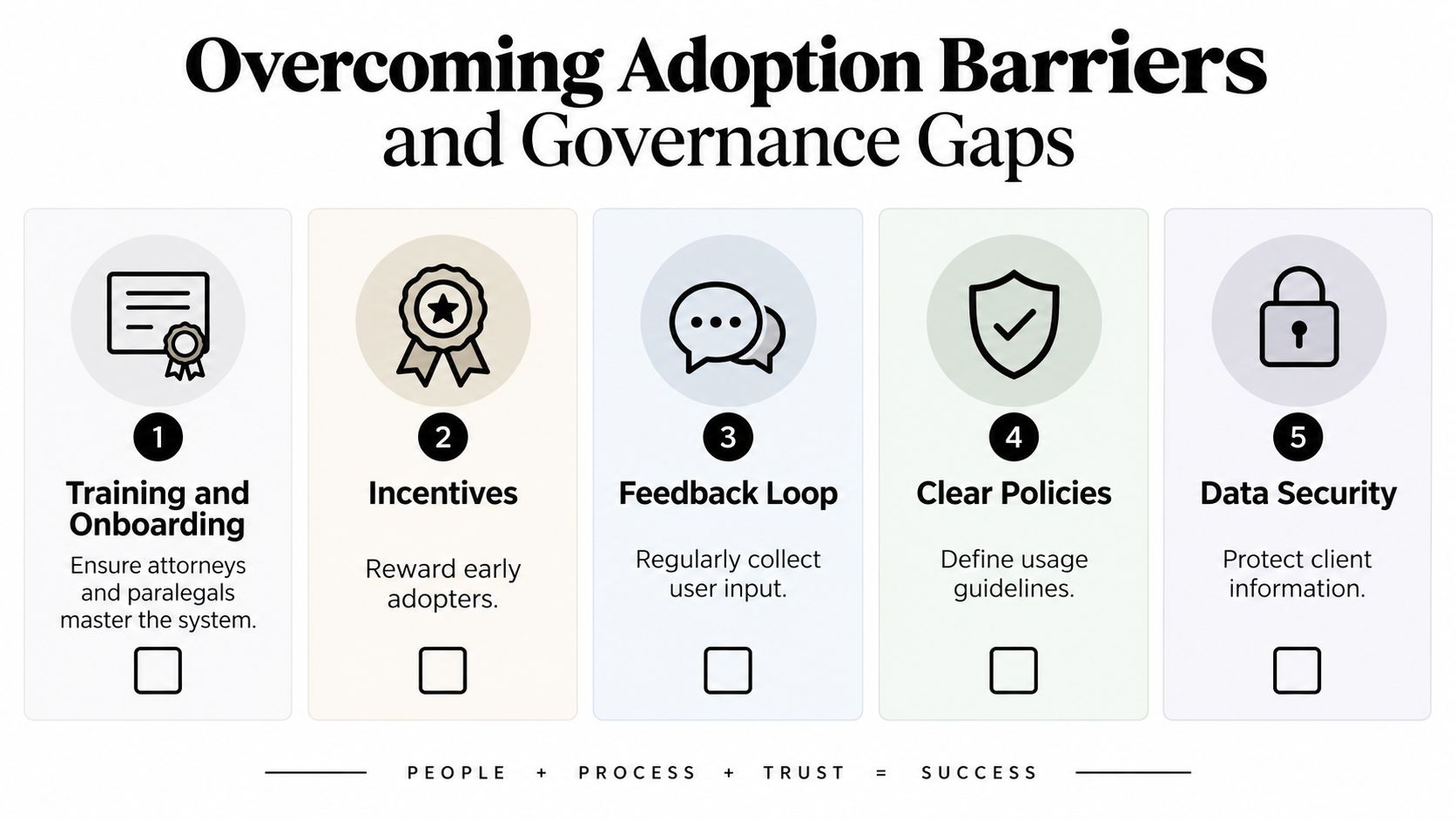
Adoption depends on clear ownership, usable rules, and review of accuracy and confidentiality. Governance should specify who may use the tool, which source pages must be checked, where approved chronologies and demand drafts belong, and what happens when an output is wrong. A shared policy file cannot answer those questions during a busy file.
Give people a usable standard
Training should follow the firm's personal injury workflow. Show how a new matter enters the system, how records are uploaded, how a missing provider is flagged, how a reviewer verifies a treatment date against its source page, and how an attorney approves a demand draft. A generic feature tour does not resolve the questions staff face when records arrive out of order or contain conflicting facts.
Set a standard operating procedure that defines:
- Required inputs: Provider names, authorizations, incident information, known prior injuries, and relevant client statements.
- Review duties: Which person checks dates, diagnoses, treatment gaps, billing entries, and source citations.
- Attorney controls: Which facts require legal approval before entering a demand or negotiation position.
- Exception handling: How the team records unclear records, conflicting dates, missing pages, and suspected extraction errors.
- Security controls: Who may upload, review, export, share, or delete sensitive matter information.
Start with a limited rollout, one accountable owner, and a short feedback cycle. Early users should report defects without creating unofficial rules. The operations lead decides whether feedback changes the standard process or calls for training.
For vendor review, a practical compliance guide for software offers context for assessing security and compliance requirements during implementation. The firm still needs its own vendor review, contract assessment, and confidentiality procedures.
Governance rule: No automated chronology or demand draft should become part of the case record without a named human reviewer.
Measure adoption through file behavior, not attendance. Check whether staff complete required intake fields, reviewers record source verification, attorneys approve outputs in the designated location, and exceptions receive a documented resolution. If duplicate entry causes avoidance, remove the extra step. If the rule is unclear, rewrite it. If medical facts are unreliable, inspect the original records and correct the extraction or review control.
Sustaining Continuous Improvement in Legal Ops
Legal process improvement isn't a software installation. It's a management discipline that continues after the launch meeting, the training session, and the first successful demand draft. The firm's workflow changes as case volume changes, provider behavior changes, staff roles change, and new AI capabilities enter the market.
Legal-operations guidance increasingly emphasizes KPIs, matter management, service-provider requirements, and regular benchmarking, while also asking legal teams to align operations with broader business strategy and prepare for GenAI integration (Legal Department Operations Index 2025). That combination creates a practical lesson for PI managing partners. Process improvement is a change-management and measurement problem before it's an AI problem.
Run a recurring improvement cycle
Assign an owner for the medical-record and demand workflow. Review the KPI dashboard on a recurring schedule, select one constraint, test one change, and compare the result with the baseline. Document what changed, what failed, and which standard operating procedure needs revision.
The review should ask:
- Where did matters wait?
- Which records required repeat requests?
- Which chronology facts required attorney correction?
- Which demand sections repeatedly came back for revision?
- Did the change improve throughput without weakening verification or confidentiality?
Standardization should come before expansion. A firm that can't consistently identify providers, verify source pages, and route approvals won't gain reliable value by adding more automation. Once the core workflow is stable, the firm can evaluate additional integrations and GenAI use cases against known controls instead of experimenting inside an undefined process.
The competitive advantage comes from institutional memory. Each closed matter should improve the next matter's intake, record request, chronology structure, and drafting checklist. That is how legal process improvement becomes durable, measurable, and useful to the lawyers handling the work.
Ares helps personal injury firms structure medical-record review and demand drafting by turning raw case files into organized, case-ready insights for human verification and attorney use. Visit Ares to evaluate how a repeatable document workflow can reduce manual reconstruction, surface treatment gaps, and move matters toward settlement readiness.