
If you work in personal injury law, you know the feeling: drowning in a sea of unstructured medical records. For years, the only way out was to assign paralegals to manually sift through every single page—a painstaking process that eats up hundreds of hours. This isn't just slow and expensive; it’s a minefield for human error, where one missed detail can derail an entire case.
This is where medical chronology software comes in. It’s a tool designed to pull firms out of that linear slog and give them a serious strategic advantage.
Moving Beyond Manual Medical Record Review
Let's be honest: the old way of building a case chronology is broken. A paralegal gets handed thousands of pages of physician's notes, lab results, and billing codes and is told to "make sense of it." They spend weeks, sometimes months, hunched over a spreadsheet, manually piecing together a timeline.
For a moderately complex case, this can easily eat up 80 hours of billable time. This isn't just a resource drain; it’s a huge risk. A single missed entry or a misinterpreted note can gut a demand letter or create an opening for the defense during negotiations.
This manual system simply can’t keep up. The amount of electronic health information is exploding, with the global market for these records projected to hit nearly $49 billion by the end of the decade. That means an even bigger flood of digital data is coming your way. You can learn more about tackling this in our guide on medical record review services.
Medical chronology software completely flips the script. Instead of a paralegal reading documents one by one, the platform ingests the entire case file at once. It uses AI to automatically find, pull out, and organize every key event into a clean, usable timeline.
Think of it like this: you're moving from a librarian who has to manually catalog every book one at a time to a powerful search engine that indexes the entire library in minutes. You stop searching for information and start asking questions to get immediate, source-verified answers.
This shift in approach delivers a few immediate, game-changing benefits:
- Massive Time Savings: What used to take a paralegal weeks of tedious work can now be done in just a few hours. This frees up your team to focus on strategy, client communication, and other high-value tasks.
- Pinpoint Accuracy: AI doesn’t get tired or distracted. It eliminates the risk of human error, ensuring that no critical detail gets lost in a mountain of paperwork.
- A True Strategic Edge: With a clear medical narrative from day one, your firm can spot treatment gaps faster, identify case strengths, and build rock-solid, evidence-backed arguments long before the defense even knows what's coming.
How Medical Chronology Software Actually Works
Think of a seasoned detective who doesn't just gather evidence, but instantly maps every clue onto a live timeline, revealing connections you'd otherwise miss. That's the best way to understand medical chronology software. It takes in thousands of pages of jumbled medical records—everything from a doctor's scribbled notes to complex lab reports—and uses a powerful set of tools to bring the story of your case into focus.
The magic starts the second you upload your files. The first step is Optical Character Recognition (OCR), which essentially acts as a universal translator. It turns static images of documents into text that a computer can actually read and search. This simple but critical step transforms a dead-end paper stack into a living, digital resource. Without OCR, none of the sophisticated analysis that follows could even happen.
From Text to Actionable Intelligence
Once the records are digitized, the real brainpower of the software takes over. A combination of Artificial Intelligence (AI) and Natural Language Processing (NLP) gets to work reading and, more importantly, understanding the context of the medical story. NLP is the key here; it deciphers the meaning behind the words, much like an experienced paralegal would.
This technology has been trained on mountains of medical documents, which allows it to:
- Pinpoint and pull out key facts like dates of service, provider names, and diagnoses.
- Recognize specific medical terms, including treatments, prescriptions, and ICD codes.
- Tell the difference between a patient's past medical history and a new diagnosis from a recent visit.
This intelligent extraction is what turns a chaotic, 3,000-page file into a clean, organized case summary. It’s not just searching for keywords; it’s genuinely comprehending the medical narrative. This is precisely why an AI paralegal can now knock out in minutes what used to take a human days of painstaking work. You can learn more about this shift in our guide to artificial intelligence for paralegals.
The Automated Chronology Building Process
After pulling out all that data, the software doesn't just spit it out in a massive list. It becomes the ultimate organizer. It meticulously arranges every piece of information into a logical, interactive timeline. It automatically gets rid of duplicate entries, standardizes medical terms (so "myocardial infarction" and "heart attack" are logged as the same event), and lines everything up in perfect chronological order.
The old way of doing things was a slow, linear slog: from a giant stack of papers, to a paralegal’s desk, and eventually to a static timeline document.
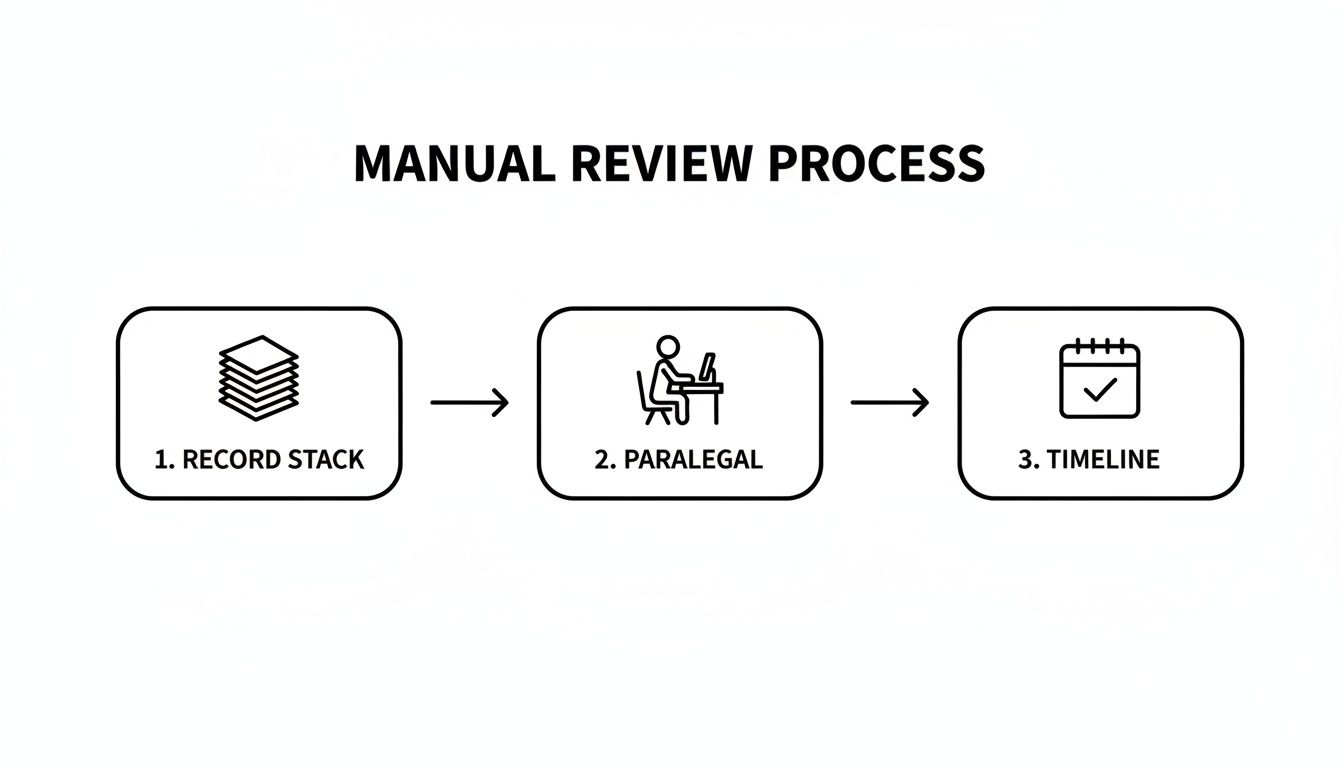
This process highlights just how manual and time-consuming the old method really is. Medical chronology software collapses all those steps, handling the extraction, organization, and timeline creation all at once, and in a tiny fraction of the time.
Instead of a flat, dead document, the software builds a living, searchable database of every medical event in the case. You stop hunting for individual facts and start actively exploring the narrative, asking questions like, "Show me every visit where back pain was mentioned," and getting immediate, source-linked answers.
Must-Have Features That Drive Case Value
Let’s be clear: not all medical chronology software is built the same. Some tools are little more than digital highlighters, while others are true strategic assets for your firm. The difference lies in the features. The best platforms don't just organize information—they help you uncover the story hidden within the medical records, a story that can dramatically increase your case's value.
Think of it like this. A basic tool might give you a list of ingredients. An advanced one, however, gives you the full recipe, pointing out exactly which ingredients are crucial and how they combine to create the final dish. These features are the difference between just managing a case and actively shaping its narrative for a better outcome.
Here are the non-negotiable features you should be looking for.
Automated Date and Event Extraction
The engine that drives everything is the software's ability to automatically pull out key data points from thousands of pages of dense medical records. This is where the magic really begins. Instead of a paralegal spending days manually reading and logging every single date of service, diagnosis, and treatment, the software does it in minutes.
The old way was a paralegal's nightmare. Imagine sifting through 3,000 pages of records, trying to manually hunt down every mention of a "lumbar disc herniation." It’s slow, tedious work that’s practically begging for human error.
With modern software, you can apply a simple filter and instantly see every instance of that diagnosis—who documented it, on what date, and in what context—all neatly organized and linked back to the original page. It's like flipping a switch to illuminate the entire room instead of searching for clues with a tiny flashlight.
This isn't just about moving faster; it's about being more thorough. An AI-powered tool doesn't get tired or miss that critical detail buried on page 2,847. It ensures you capture every single relevant event, giving your case a rock-solid foundation.
Intelligent Diagnosis and Treatment Mapping
A truly powerful platform goes way beyond a simple chronological list of events. It intelligently connects the dots for you, mapping the relationships between your client's diagnoses and the treatments they received. This feature makes it possible to show, not just tell, the story of your client's medical journey.
For example, the software can:
- Connect an injury to its entire course of care: It can visually link an initial ER visit for a broken femur to the subsequent surgery, the months of physical therapy, and the ongoing pain medication prescriptions.
- Track the progression of symptoms: You can easily highlight how a client's reported pain levels changed over time in response to different treatments, providing powerful evidence of their suffering.
- Organize by provider: Instantly pull up all treatments administered by a specific orthopedic surgeon or physical therapist, simplifying how you analyze their role in the client's recovery.
This is absolutely critical for proving causation. You can build a clear, logical argument—backed by visual evidence from the records themselves—that the treatments were a direct result of the injuries from the incident.
Automated Medical Gap Analysis
One of the oldest tricks in the defense attorney's playbook is to find a gap in your client's treatment history. A two-month period with no doctor visits can be twisted to suggest your client was fine, potentially gutting the value of your claim. Manually spotting these gaps across years of records is incredibly difficult and time-consuming.
This is where automated gap analysis becomes a case-saver. It constantly scans the timeline and flags periods of inactivity, letting you get ahead of the defense.
Here’s a quick look at how this changes your workflow.
Manual Review vs Medical Chronology Software
| Task | Manual Process (The Old Way) | With Medical Chronology Software (The New Way) |
|---|---|---|
| Finding Gaps | Manually comparing dates in a spreadsheet, a process prone to error and taking hours. | The software automatically flags any period longer than a specified duration (e.g., 30 days) with no medical activity. |
| Investigating Gaps | Requires manually searching records before and after the gap for any explanation. | Click on the flagged gap to instantly review the appointments immediately preceding and following it to understand the context. |
| Strategic Response | Reactive; you often discover the gap when the defense points it out, forcing you to scramble for an explanation. | Proactive; you identify and address potential weaknesses in your case narrative long before they can be used against you. |
By instantly flagging these periods, the software gives you a chance to talk to your client. You can find out why there was a gap. Maybe they were waiting on an insurance approval, or perhaps they simply couldn't get an appointment. This proactive approach turns a potential weakness into a well-explained part of the story, disarming the defense before they even get a chance to attack.
From Piles of Paper to a Clear Narrative
Theory is one thing, but seeing medical chronology software in action is where you really grasp its power. Let's walk through a typical workflow to see how this plays out in a real-world personal injury case.
Imagine your firm just signed a client injured in a multi-car pile-up. The initial case file is a digital mess—over 2,500 pages of records from the ER, two orthopedic specialists, a physical therapy clinic, and a pain management doctor. The documents are jumbled, full of duplicates, and mix everything from MRI reports to billing codes.

Handled the old way, a paralegal is staring down at least 40-60 hours of mind-numbing work just to get a basic timeline on paper. With a platform like Ares, that entire process gets flipped on its head.
Step 1: Ingestion and Initial Processing
It all starts with a simple drag-and-drop. The paralegal uploads the entire chaotic folder of medical records into the system. In minutes, the software kicks into gear, tackling several critical jobs at once.
First, its Optical Character Recognition (OCR) engine converts every page—even scanned documents with handwritten notes—into searchable text. At the same time, it hunts down and flags duplicate documents, instantly cleaning up the file before a human ever has to lay eyes on it. This step alone shaves hours off the clock.
Step 2: Automated Data Extraction and Timeline Creation
With the records prepped, the AI core gets to work. It meticulously reads through all 2,500 pages, pulling out the key pieces of the puzzle.
- Dates of Service: Every single appointment, procedure, and prescription is captured.
- Providers: It logs every doctor, hospital, and clinic involved in the client’s care.
- Diagnoses: All documented injuries are identified, from a "cervical sprain" to a "lumbar disc herniation."
- Treatments: The platform notes every procedure, physical therapy session, and medication prescribed.
This isn't just a list. The software instantly organizes all this data into an interactive, chronological timeline. What used to take a paralegal weeks to build in a spreadsheet now materializes on-screen in a clean, filterable format, where every single entry is hyperlinked directly to its source page.
This is the fundamental shift: the paralegal's role evolves from data entry clerk to strategic analyst. They're no longer digging for facts—they're verifying and interpreting a fully assembled story.
Step 3: Uncovering the Case-Winning Details
Now, with a dynamic timeline at their fingertips, your team can explore the case narrative in ways that were simply impossible before. They can use filters to get answers to critical questions in seconds.
For instance, the paralegal can:
- Pinpoint the Initial ER Visit: One click filters for the date of the accident, instantly pulling up the complete emergency room record, initial diagnoses, and treatment plan.
- Track the Full Course of Physical Therapy: By filtering for the physical therapy provider, they can see every session, map the client's reported pain scores over time, and demonstrate progress—or a frustrating lack of it.
- Isolate Records from a Specific Specialist: Need to see everything from the orthopedic surgeon before a deposition? A quick provider filter gathers all their notes, reports, and prescriptions in one place.
Even better, the software's automated gap analysis flags a six-week period where the client had no treatment. Instead of being blindsided by this in discovery, the paralegal can ask the client about it right away. They learn the gap was caused by a delay in insurance authorization—a fact that completely dismantles a common defense argument.
This narrative-driven workflow, powered by medical chronology software, transforms a mountain of disorganized documents into a clear, compelling, and defensible case story in a fraction of the time.
Calculating the ROI for Your Law Firm
When you're looking at any new technology, the first question is always the same: what's the bottom line? Is medical chronology software a smart investment or just another subscription draining your budget? The real answer is found in its Return on Investment (ROI), and it goes way beyond just cutting a few costs.
The ROI you get from this kind of software isn't just one number. It's a mix of direct savings and powerful strategic gains that can fundamentally change how your firm operates. The best way to understand its full value is to break it down into two parts: hard ROI and soft ROI.
Hard ROI: The Direct Cost Savings
Hard ROI is the stuff you can easily track on a spreadsheet—the tangible money your firm saves. This comes from slashing the time spent on manual, tedious work that eats into your payroll and operational budget.
Here’s where you’ll see the immediate financial wins:
- Fewer Paralegal Hours Burned: Manually sifting through records for a moderately complex personal injury case can easily take 40-60 hours of a paralegal's time. At their blended rate, that’s a huge expense. The right software can cut that review time by over 70%, freeing up your team to focus on billable work that actually requires their legal expertise, not just data entry.
- Reduced Outsourcing Bills: Many firms farm out medical reviews to third-party services. This isn't just expensive; it adds another communication bottleneck. Bringing this process in-house with dedicated software gives you more control and completely eliminates those recurring vendor fees, case after case.
Soft ROI: The Strategic Advantages
Soft ROI is where things get really interesting. These are the strategic benefits that don't show up as a line item on a profit and loss statement but directly lead to bigger settlements and a more efficient, powerful practice. This is where a tool like Ares really proves its worth.
Think of it this way: hard ROI is about saving money on the work you're already doing. Soft ROI is about empowering your team to achieve results that were simply out of reach before because of time and resource limits.
These strategic advantages are game-changers:
- Crafting Bulletproof Demand Letters: Imagine building a demand letter where every single point is backed by a perfectly organized, source-cited chronology. You can negotiate with total confidence because the proof is right at your fingertips.
- Finding Hidden Case Value: Automated analysis often catches patterns a human reviewer, no matter how diligent, might miss. It could be a subtle but persistent symptom that points to a much more severe injury, potentially adding significant value to a claim.
- Improving Team Morale: Let’s be honest, no one enjoys spending weeks buried in repetitive record review. Taking that soul-crushing task off your paralegals' plates leads to much higher job satisfaction and less turnover. They get to focus on engaging, high-impact work where their skills truly shine.
The shift toward electronic health records, pushed by government policies, has made these tools more of a necessity than a luxury. It’s no surprise that North America has accounted for roughly 42-43% of related medical software revenue recently, a trend driven by the need for smarter digital workflows. You can dig deeper into this trend in the latest medical software market analysis.
When you add it all up, the investment in medical chronology software often pays for itself within the first few settled cases. It’s a clear financial and strategic win.
Integrating Software While Ensuring Security and Compliance
Bringing any new technology into your firm, especially one that handles sensitive client data, requires total confidence. When it comes to medical chronology software, this isn't just a preference—it's a non-negotiable requirement. The platform you choose has to make your firm better, not more complicated, all while upholding the strictest standards for data protection.
Think of it this way: you wouldn't hire a paralegal without checking their references and seeing if they fit your team's dynamic. It's the same with software. You need to vet its security protocols and ensure it plays well with the systems you already use every day. For a personal injury firm, that boils down to two critical things: ironclad security and seamless integration.
The Bedrock of Trust: HIPAA Compliance
Personal injury law is built on Protected Health Information (PHI). This puts your firm squarely under the microscope of the Health Insurance Portability and Accountability Act (HIPAA). A violation isn’t just a slap on the wrist; it can lead to crippling financial penalties and, worse, a shattered reputation that’s nearly impossible to rebuild.
This means your medical chronology software can't just be "HIPAA-friendly"—it has to be fundamentally built for HIPAA compliance. This is more than a marketing bullet point. The vendor absolutely must be willing to sign a Business Associate Agreement (BAA), which is a legally binding contract that holds them accountable for protecting your clients' PHI.
A platform that won't sign a BAA is an immediate deal-breaker. It’s like hiring a contractor who refuses to show you their insurance—a massive red flag that signals they aren't serious about their responsibilities, leaving you to shoulder all the risk.
When you're bringing new tools into your practice, it's vital to stay on top of the regulations. For a deeper dive, this guide on how to ensure HIPAA compliance in legal practices is an excellent resource. You can also explore our own detailed breakdown of HIPAA-compliant document management to get a better handle on these obligations.

Look for a platform like Ares that provides security measures you can trust:
- End-to-End Encryption: Your data should be unreadable to anyone without authorization, both when it's being uploaded (in transit) and when it's sitting on a server (at rest).
- Secure Cloud Hosting: Top-tier vendors use enterprise-grade cloud platforms, which provide far more sophisticated security monitoring than most firms could manage with on-site servers.
- Access Controls: You need the ability to set specific permissions, ensuring only the right people on your team can see or edit certain case files. This is key to minimizing internal risks.
Seamless Integration with Your Case Management System
A powerful tool that doesn’t talk to your other systems isn't powerful at all—it's just a headache. It creates information silos, forces your team into mind-numbing double data entry, and completely throws off your established workflow. A well-designed medical chronology tool should feel like a natural extension of your firm's existing setup.
The goal is a single, unified ecosystem where information flows without friction. Look for software that offers direct integrations with the case management systems you already depend on, like Clio, Filevine, or PracticePanther. This kind of connectivity means your organized medical timelines and summaries can be pushed right back into the main case file, keeping everything neat and centralized.
When a platform integrates smoothly, it becomes part of the solution, not another problem to manage. It lets your team tap into powerful AI analysis without ever leaving the familiar environment of your case management software. That's how you make the entire process efficient, secure, and fully compliant.
Common Questions About Medical Chronology Software
Bringing any new piece of legal tech into the firm always raises a few good questions. It's only natural. When it comes to medical chronology software, firms rightfully want to know about the learning curve, data security, and what the software can really do. Getting clear answers to these common concerns is the first step toward making a smart decision for your practice.
Most legal teams are genuinely surprised by how quickly they can get up and running. Modern platforms are built to be intuitive, a far cry from the clunky, complicated legal software of the past. The whole point is to make your team more productive right away, not get them bogged down in weeks of training.
How Long Does It Take to Get My Team Running?
Honestly, it's faster than you'd think. A typical personal injury firm can have its paralegals and attorneys feeling confident with the core features after just a few days of hands-on training. We've seen many firms process their first full case in less than a week.
This quick adoption happens because the best software handles the most tedious, complex parts of the process for you. Your team’s role changes from mind-numbing data entry to strategic review, which is a much more natural and valuable way for legal professionals to spend their time.
The goal is to amplify your team's legal expertise, not turn them into software gurus. The tech should simply be a tool that helps them find those crucial, case-winning details faster, without a massive technical learning curve.
Is My Client Data Secure in the Cloud?
This is probably the most important question of all, and the answer needs to be a firm, unequivocal "yes." Any reputable vendor in this space builds their platform on a foundation of serious, enterprise-grade security. This means end-to-end encryption for all data—whether it's being uploaded or just sitting on a server—and secure hosting on trusted platforms like AWS or Azure.
Here's the non-negotiable part: any legitimate medical chronology software provider must be HIPAA compliant and ready to sign a Business Associate Agreement (BAA). This is a legal contract that obligates them to protect your client's Protected Health Information (PHI) to the full extent of the law. Frankly, this level of security is often far more robust than what a single firm can manage with its own in-house servers.
Can the Software Handle Handwritten Notes?
Yes, and this is a major dividing line between basic tools and advanced platforms. The best systems use sophisticated OCR and AI models that have been specifically trained on medical documents. That includes those notoriously messy handwritten doctor's notes and even low-quality faxes or scans.
Now, is the extraction going to be 100% perfect on every single page? Of course not. But a top-tier platform can accurately pull data from the vast majority of medical records you'll throw at it, dramatically cutting down the amount of time you spend on manual review and corrections.
Will This Integrate with My Case Management System?
For a new tool to be truly useful, it has to play nice with your existing setup. Leading software solutions are designed with this in mind. They offer direct integrations with popular case management systems, which allows case information to flow seamlessly between the platforms.
This is huge. It breaks down the data silos that frustrate so many firms and gets rid of the need to enter the same information in two different places. It ensures the software becomes a natural extension of your workflow, not another complication.
Ready to eliminate hundreds of hours of manual work and build stronger cases? Ares provides the AI-powered platform to turn chaotic medical records into clear, actionable insights. Discover how Ares can transform your firm's efficiency.