
A medical chronology template is your secret weapon for turning a mountain of disorganized medical records into a clear, compelling timeline of your client's care. For any personal injury firm, this isn't just about summarizing records; it's about building the narrative that proves causation, justifies damages, and wins your case.
Why Your Case Depends on a Strong Medical Chronology
Let's be blunt: a messy, unorganized stack of medical records can kill an otherwise solid personal injury case. If you hand a confusing puzzle to an adjuster, mediator, or jury, they simply won't have the patience to solve it. A well-crafted medical chronology isn't just another document in the file—it's the narrative backbone of your entire argument.
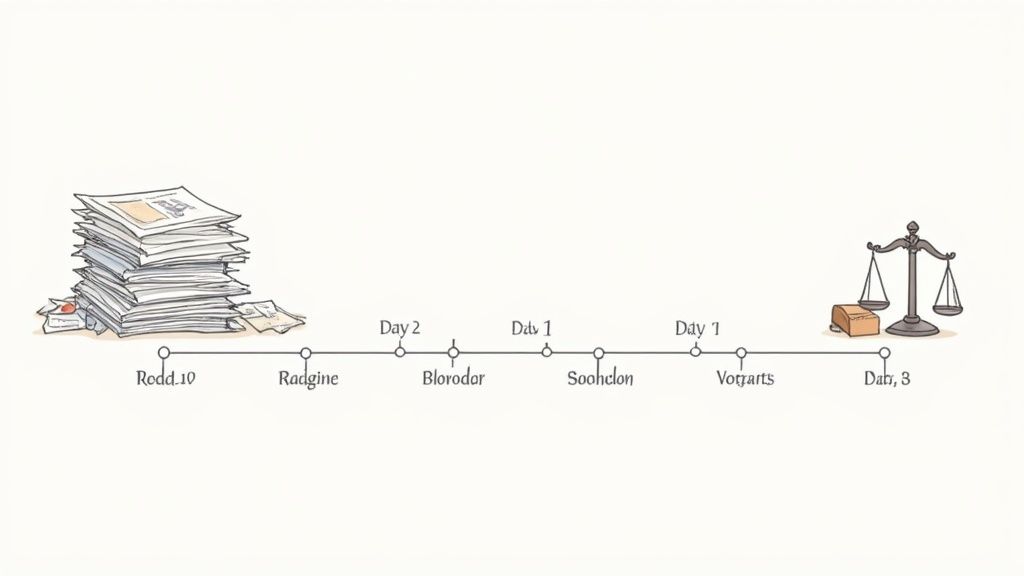
Wrangling those records into a coherent timeline gives you a massive strategic advantage. It’s how you distill hundreds, sometimes thousands, of pages of dense medical jargon into a story that is clear, concise, and persuasive. This is your primary tool for turning complex medical data into a story that wins.
Uncovering the Story Within the Records
At its core, every personal injury case is about connecting an event—the accident—to a series of consequences. A medical chronology is what forges that connection with undeniable clarity. By methodically organizing every doctor's visit, diagnosis, prescription, and procedure, you create a powerful, undeniable timeline of cause and effect.
This structured overview accomplishes several critical things for your case:
- Demonstrates Causation: It visually links the initial injury to all subsequent medical treatments, making it much harder for the defense to claim a condition was pre-existing or unrelated.
- Quantifies Damages: The timeline acts as a running ledger of every medical expense, procedure, and therapy session, providing a rock-solid foundation for your damages calculation.
- Reveals Case Weaknesses: It quickly flags potential problems you need to get ahead of, like gaps in treatment, inconsistencies in your client's reporting, or pre-existing conditions.
A strong chronology doesn't just list dates; it tells the story of the client's pain, suffering, and recovery journey. It's the most effective way to communicate the human impact of an injury to an insurance adjuster or jury.
Gaining Leverage in Settlement Negotiations
When you walk into a negotiation and present a meticulously organized medical chronology, you're sending an unmistakable message to the insurance adjuster: you're prepared, you know the facts cold, and you're ready for trial. This level of organization almost always leads to more serious and substantial settlement offers because the evidence is laid out so logically.
Adjusters are paid to find holes in your argument, and a disorganized file is an open invitation. On the other hand, a clear, well-documented timeline built from a solid medical chronology template shuts down ambiguity. It forces them to deal with the facts of the case head-on. That preparation is precisely the leverage you need to negotiate from a position of strength, often settling cases faster and for significantly more.
Laying the Foundation: What Your Medical Chronology Template Must Include
A powerful medical chronology is only as good as the information you feed it. Simply listing dates and providers is a decent start, but for a personal injury case, you need more strategic depth. When you move beyond the basics, your chronology transforms from a simple log into a compelling narrative that tells your client's story and fortifies your arguments.
Think of your medical chronology template as the blueprint for your case. It’s designed to methodically capture every medical event, diagnosis, and treatment in the order they happened, which makes managing mountains of records infinitely easier. A well-built framework from the outset ensures no critical detail gets lost in the shuffle. If you're looking for more background, you can find a solid overview of how these templates connect to evidence verification in this guide on medical chronology tools at inquery.ai.
Now, let's break down what actually goes into one of these templates.
The Non-Negotiable Core Fields
Every chronology, no matter how complex the case, needs a solid foundation. These are the absolute must-have columns that form the backbone of your client’s medical timeline. Get these right, and you'll have the who, what, when, and where of their journey nailed down.
- Date of Service (DOS): This is your anchor. The exact date the medical service happened is the primary field you'll sort by, establishing the entire structure of the timeline.
- Provider Name and Type: Who provided the care? Be specific here. "Hospital" isn't enough; "St. Jude’s Emergency Department" or "Dr. Smith, Orthopedic Surgeon" provides necessary clarity.
- Record Type: What kind of document did this entry come from? Was it an "Office Visit Note," "ER Report," "Surgical Report," or "Physical Therapy Notes"? This small detail adds critical context.
- Summary of Event: This is a concise, objective description of the visit. Stick to the key facts: patient complaints, diagnoses rendered, treatments administered, and any future plans or referrals.
This basic set of fields tells the core story. But to build a truly formidable case, you need to add layers that speak directly to your legal strategy.
Advanced Fields That Win Cases
This is where your template evolves from a mere summary into a strategic weapon. These next fields are designed to anticipate the questions that will come up in demand letters, depositions, and trial preparation. Adding them from the beginning saves you countless hours of scrambling later by putting crucial information right at your fingertips.
A simple spreadsheet in a program like Excel or Google Sheets can easily handle these extra columns, making all your data sortable, searchable, and ready for action.
A great medical chronology does more than just report the facts from the records; it actively organizes them in a way that highlights the strengths of your case and exposes the weaknesses of the defense's potential arguments.
For instance, a field for Bates numbers is non-negotiable. It creates a direct, verifiable link between your summary and the source document, making your work defensible.
Below is a breakdown of the fields that separate a basic chronology from a professional, case-winning one.
Anatomy of an Effective Medical Chronology Template
This table outlines the essential and advanced fields that create a comprehensive and defensible medical chronology for personal injury cases.
| Field Name | What It Captures and Why It Matters | Real-World Example |
|---|---|---|
| Date of Service | The exact date of the medical encounter. It’s the primary sorting key for the entire timeline. | 01/15/2024 |
| Provider Name/Type | Identifies the specific doctor, facility, or therapist. Precision is key for credibility. | Dr. Susan Jones, MD (Neurologist) |
| Record Type | The nature of the source document (e.g., MRI report, PT notes). This provides immediate context. | "Initial Consultation Note" |
| Summary of Event | An objective summary of the visit, diagnosis, and treatment plan. Keep it factual and concise. | "Patient reports 8/10 neck pain post-MVA. Dx: Cervical Strain. Prescribed Flexeril, advised PT." |
| Bates Number | The unique page identifier from discovery. This makes every entry instantly verifiable and trial-ready. | PLAINTIFF_000247 |
| Source Document Link | A direct hyperlink to the specific page in the PDF. A massive time-saver for team review. | [Link to page 247 of PDF] |
| CPT/ICD Codes | CPT codes for procedures and ICD codes for diagnoses. Essential for verifying billing and medical necessity. | ICD-10: S13.4 (Cervical Sprain) |
| Medical Expenses | The cost of the service. Columns for "Billed," "Paid," and "Out-of-Pocket" build your damages model. | Billed: $350.00 |
| Strategic Notes | Your internal analysis. This is where you connect the facts to your legal strategy. | "Key entry: Dr. notes pain is 'directly attributable to the collision.'" |
By incorporating these fields, you're not just logging data—you're actively building your argument with every line item.
The Power of a "Notes" Column
Of all the advanced fields, the most strategically valuable might be a simple, dedicated column for your team’s internal notes and analysis. This is where your template stops being a static record and becomes a living document for case strategy.
Use this space to:
- Flag Inconsistencies: Note any contradictions between what your client told you and what the provider wrote down.
- Highlight Key Quotes: Pull out verbatim language from a provider that proves causation, like, "Patient's persistent headaches are a direct result of the MVA."
- Identify Red Flags: Mark potential problems for your case—things like gaps in treatment, mentions of pre-existing injuries, or notes about the client not following doctor's orders.
When you thoughtfully construct your medical chronology template with these essential and advanced fields, you create a powerful, centralized hub for your case. This proactive approach ensures every relevant detail is captured, organized, and ready to be deployed to win the best possible outcome for your client.
From Piles of Paper to a Powerful Timeline
You've designed the perfect medical chronology template. Now comes the real work: transforming that mountain of raw medical records into a clear, compelling timeline that tells your client's story. This is where meticulous attention to detail pays off, turning a chaotic file into an asset that can win your case. It’s a process that demands a systematic approach, starting long before you even think about entering that first date.
The absolute first step is making sure you have the complete universe of documents. Trying to build a chronology from an incomplete set of records is like solving a puzzle with half the pieces missing—you're guaranteed to create gaps and draw the wrong conclusions. Before you do anything else, confirm you have every record from every single provider, from the initial ER visit right through to the most recent physical therapy session.
Getting this initial collection right is critical. Send out your record requests early and follow up relentlessly. Once the documents start rolling in, your next job is to get them organized. A messy digital folder is just as useless as a chaotic stack of papers. For some practical strategies on taming this initial flood of information, our guide on how to organize medical records lays out a workflow that can save you a ton of time and headaches.
Systematically Reviewing and Pulling Key Data
With your records gathered and neatly organized, the real extraction process begins. This isn't just casual reading; it's a strategic hunt for the legally significant events that form the backbone of your case. You need to work through the documents one by one, always in strict chronological order based on the date of service.
As you review each document, keep your medical chronology template open in another window. When you spot a key event—a new diagnosis, a specific prescription, a referral to a specialist, or a surgical procedure—you'll create a new row in your template. Each entry has to be a concise, objective summary of what happened.
The goal is to connect every event to its source, as this visual representation shows.

This process creates an unbreakable chain of evidence, linking every single data point back to a specific provider and source document.
Writing Summaries That Are Clear, Objective, and Effective
The quality of your summaries can make or break your chronology. An entry needs to be brief, yet comprehensive enough that a partner or paralegal can instantly grasp the event's importance without having to pull the original record. The name of the game is clarity and objectivity.
Whatever you do, don't inject your own analysis or legal arguments into the summary column. That’s what the "Strategic Notes" or "Attorney Comments" column is for. The summary itself must stick strictly to the facts as they are presented in the record.
Here are a few tips I've learned for writing summaries that actually work:
- Use Action-Oriented Language: Get straight to the point. Start with what happened, like "Patient diagnosed with..." or "Dr. Smith prescribed..."
- Include Key Details: Always capture specifics like pain levels ("reports 8/10 neck pain"), objective findings from the exam, and the provider's stated plan.
- Standardize Abbreviations: To keep things consistent across the firm, agree on a standard set of abbreviations (MVA for motor vehicle accident, PT for physical therapy, etc.).
A great summary strikes the perfect balance between brevity and detail. It must accurately reflect the source record while being immediately understandable to anyone on your legal team, no matter their medical expertise.
For instance, a weak summary might just say: "Patient saw doctor for neck." That's not very helpful. A much better, more useful summary would be: "Patient reports persistent 8/10 neck pain with radiation into the left shoulder. Dr. Evans diagnosed cervical strain (S13.4) and recommended an MRI to rule out disc herniation." The second version gives you a diagnosis, a pain level, and a clear action plan, making it infinitely more valuable to the case.
Handling Common Challenges and Discrepancies
Let's be honest—medical records are rarely perfect. As you start populating your template, you're going to run into challenges that require some careful handling and clear notation. Anticipating these issues will help you maintain the integrity of your timeline.
A classic problem is illegible handwriting. When you come across notes you simply can't decipher, don't guess. The right move is to make an entry for that date of service and, in the summary, write "Physician's notes illegible." This flags the issue for follow-up, which could mean requesting a typed transcription from the provider or earmarking it as a topic for a deposition.
Another frequent headache is conflicting dates or information. You might see a procedure listed in a report on a Tuesday, but the billing records show it happened on a Wednesday. When this occurs, create an entry for each conflicting date and use your "Strategic Notes" column to document the discrepancy. For example: "Note: ER report lists DOS as 1/15/24, but hospital bill lists 1/16/24. Need to verify correct date." Flagging this proactively prevents major confusion later on.
Finally, you have to be vigilant for missing records. If a primary care physician’s note mentions a referral to a specialist, but you don't have any records from that specialist, that's a huge red flag. Your chronology is the perfect tool for making these omissions glaringly obvious. Highlight these gaps directly in the template so your team knows to immediately request the missing documentation. A complete medical chronology isn't just a summary of what you have; it's also a map of what you still need to find.
Formatting Your Chronology for Maximum Impact
You can spend weeks compiling the perfect medical chronology, but if it lands on an adjuster’s desk as a dense wall of text, you’ve lost before you’ve even started. The real goal isn't just to list dates and treatments; it’s to tell a clear, compelling story. Good formatting is what turns that raw data into a persuasive tool that walks adjusters, mediators, and eventually a jury, through your client's ordeal.
Think of it as the visual layer of your argument. A few simple tweaks can immediately spotlight the most critical parts of your client's journey, making your key points impossible to miss.
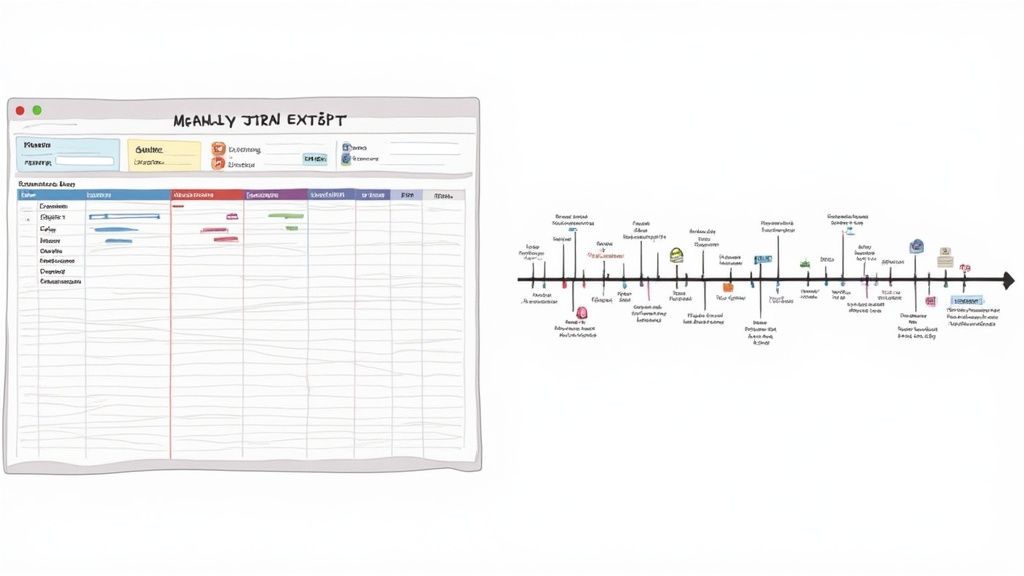
A well-designed medical chronology template gives you the flexibility to build these visual cues right into your workflow.
Strategic Use of Color and Visual Cues
One of the easiest ways to bring a chronology to life is with color. The human brain processes visual information an incredible 60,000 times faster than plain text, a fact you should absolutely use to your advantage. Assigning colors to different types of information lets anyone see crucial patterns at a glance.
For your internal team, a simple color key can be a game-changer:
- Provider Type: Make orthopedic entries blue, physical therapy green, and neurological consults purple. This instantly shows the breadth of care your client needed.
- Key Events: Highlight major events like surgeries in red to signal their gravity. A life-altering diagnosis could be flagged in yellow.
- Billing Issues: Use orange to flag questionable billing codes or payment discrepancies that need a closer look from your paralegal.
This kind of visual shorthand makes the story jump off the page, helping your team spot connections and build the case narrative much more quickly.
The Two Faces of a Chronology
In my experience, a single, one-size-fits-all chronology just doesn't work. Different audiences need different things. That's why I strongly advocate for maintaining two distinct versions: a comprehensive internal spreadsheet and a clean, high-level visual timeline for external use.
The detailed spreadsheet is your war room document—packed with every note, code, and observation. The visual timeline is your courtroom exhibit—it tells a simplified, powerful story designed for maximum impact.
While the granular spreadsheet is your foundation, a visual timeline is often far more persuasive in demand letters or at mediation. If you want to get better at boiling down dense records into compelling summaries, our guide on crafting a medical record summary offers some great tips that go hand-in-hand with this process. A simplified timeline focuses the narrative on those pivotal moments, making the client's journey both understandable and memorable.
Choosing Your Format: Spreadsheet vs. Visual Timeline
The right format depends entirely on your objective and who you're trying to convince. A spreadsheet that works wonders for internal strategy sessions will fall flat in front of a jury. Here’s a quick breakdown of when to use each.
| Use Case | Spreadsheet Format (e.g., Excel) | Visual Timeline Format (e.g., Graphic) |
|---|---|---|
| Internal Case Review | Ideal. Allows your team to sort, filter, and analyze every data point, including internal notes and Bates numbers. | Less effective. Lacks the granular detail and searchability needed for deep strategic analysis. |
| Demand Letters | Supportive. Can be included as an appendix, but a visual timeline is often better for the main body. | Highly Effective. A clean graphic showing the progression from accident to surgery to ongoing therapy is incredibly persuasive. |
| Mediation Presentations | Ineffective. Too dense and overwhelming for a presentation format. | Ideal. A simplified timeline is perfect for a slide deck, guiding the mediator through the key events of the case. |
| Trial Exhibits | Rarely used. Juries find spreadsheets confusing and boring. | Excellent. A large, clear timeline can be a powerful demonstrative aid, helping the jury follow the story of your client's suffering. |
Ultimately, a thoughtfully formatted chronology does much more than just list facts—it shapes the narrative. By using simple visual techniques and tailoring your presentation to the audience, you ensure the story hidden in those medical records comes through loud and clear.
How AI Is Modernizing Medical Chronology Creation
Let’s be honest: nobody enjoys sifting through thousands of pages of dense medical records. It’s a painstaking, manual process that has bogged down personal injury firms for decades. Thankfully, that entire workflow is being completely upended by AI-powered tools that handle the grunt work, letting your team get straight to building the case.
These intelligent systems are built to read and comprehend unstructured data, from a doctor's scribbled notes to a convoluted surgical report. They can automatically pinpoint and pull the critical information needed for your medical chronology template, doing it with a level of speed and precision that’s hard to match.
The Magic of Natural Language Processing
So, how does it actually work? The technology behind this shift is Natural Language Processing (NLP), a field of AI that teaches computers to understand human language. For a law firm, this means an AI can tear through a massive PDF of medical records and instantly pull out the essential facts.
What does it look for?
- Dates of Service: The AI flags every appointment, procedure, and prescription refill.
- Diagnoses: It recognizes and extracts specific diagnostic terms and ICD codes.
- Treatments: The system logs every detail on surgeries, medications, and physical therapy regimens.
- Providers: It automatically catalogs the names of every doctor, specialist, and facility involved.
This isn't just a minor improvement. The automated extraction can slash review time from days—or even weeks—down to a matter of hours. The result is a pre-populated, organized chronology delivered with an accuracy that’s tough to sustain manually, especially when fatigue kicks in.
More Than Just a Time-Saver
The immediate benefit is obviously the massive amount of time saved, but the strategic advantages go much deeper. By structuring the case data almost instantly, these platforms help your team spot critical details that might have otherwise been buried.
You can quickly flag treatment gaps the defense will inevitably try to exploit. Or, you can pinpoint the exact moment a pre-existing condition was clearly aggravated by the incident in question.
By automating the initial data extraction, AI allows paralegals and attorneys to immediately jump to the most important part of their job: analyzing the facts and building a winning legal argument.
When you think about the evolution of this process, tools that incorporate AI Voice Charting are another leap forward. This technology can further cut down on manual entry by allowing for hands-free documentation, making the whole process even faster and more accurate.
The Irreplaceable Human Element
As powerful as these tools are, it’s vital to remember that AI is here to assist legal experts, not replace them. An algorithm can pull data, but it can't understand the nuances of a case or build a compelling narrative. The final chronology must always be reviewed and verified by a human.
An experienced paralegal or attorney provides the context, strategic insight, and critical thinking that software simply can't replicate.
The ideal workflow, then, is a partnership. The AI does the heavy lifting—the tedious data extraction—and presents a nearly complete chronology. From there, your team steps in to review the entries, add strategic notes, and ensure the final story is 100% accurate, defensible, and ready for whatever comes next. This approach gives you the best of both worlds: incredible speed backed by human-verified precision.
Navigating HIPAA and Evidentiary Rules
Working with medical records means you're not just handling case details; you're handling someone's most private information. This is where the legal and ethical lines get very bright and very clear. Every single move you make with a medical chronology—from creating it to storing it—is governed by the Health Insurance Portability and Accountability Act (HIPAA).
A slip-up isn't just a mistake; it's a potential breach that can bring serious legal consequences.
All the Protected Health Information (PHI) in your chronology, whether it's a diagnosis or just a provider's name, needs to be locked down. This means your firm must store this data on secure, encrypted servers, with access strictly limited to those who need to see it. If you're not confident in your setup, it’s worth reviewing your framework for HIPAA-compliant document management to ensure it's built into your daily workflow.
Building a Chronology That Holds Up in Court
Beyond privacy, your chronology has to be bulletproof under legal scrutiny. Its power as a piece of evidence hinges completely on its accuracy and how well you can prove it. Every entry must be a direct reflection of the source medical record, stated objectively, without any of your own spin.
This is exactly why columns for things like Bates numbers aren't just "nice to have"—they're essential. They create a clear, undeniable trail from your summary right back to the original page. Without that direct link, your chronology is just a summary of claims that opposing counsel can—and will—tear apart.
Your goal is to build a chronology so meticulously sourced and objectively written that it's accepted as a reliable record of events. Anything less, and you've just handed the other side a reason to question your entire case.
Keeping Communication Secure
When it's time to share the chronology with experts, co-counsel, or others, you have to do it securely. Hitting "send" on a standard email can instantly trigger a data breach. It's critical to use compliant methods, which often involves understanding the nuances of HIPAA email disclaimers and secure email platforms.
Good medical chronology templates are designed with this reality in mind. They provide the structure to capture all the necessary clinical data in a way that respects privacy regulations. Integrating these secure practices isn't optional; it's the only way to protect your client, your firm, and the integrity of your evidence.
Clearing Up Common Medical Chronology Questions
Even with the best template in hand, you're bound to run into some tricky situations when building a medical chronology. Let's tackle some of the questions I hear most often from legal teams. Getting these right can make all the difference in the strength of your case.
Do I Really Need to Include Every Single Visit?
This is probably the number one question I get. Someone sees a client's visit for a sinus infection a year before the accident and wants to leave it out. My advice? Don't.
You absolutely should include every single medical encounter, even if it seems completely unrelated. A quick visit for the flu or a routine check-up might feel like noise, but leaving it out creates a gap. And gaps are where the defense loves to build their arguments, suggesting your client's pain stems from some mysterious, undocumented event. A complete timeline shuts that down from the start.
How Should We Handle Pre-Existing Conditions?
It's tempting to want to downplay or even omit a pre-existing condition, but that's a huge mistake. Trying to hide something is a surefire way to kill your credibility with opposing counsel, a mediator, or a jury.
The best approach is to face it head-on. Document the pre-existing condition clearly within the chronology.
Don't think of it as a weakness; frame it as the baseline. Your goal is to use the chronology to demonstrate, with clear medical evidence, how the accident aggravated or exacerbated that underlying issue. This puts you in control of the story.
By being transparent, you build trust and show that your case is grounded in facts, not a curated version of them.
What’s the Right Level of Detail for Summaries?
Finding the sweet spot for detail in your summaries is crucial. You want enough information to be useful, but not so much that it becomes a novel. The key is to stick to objective brevity.
Your summary for each entry should be a concise recap of the most important clinical facts. Focus on capturing these four things:
- The client's specific complaints (subjective)
- The provider's key examination findings (objective)
- The official diagnosis given (assessment)
- The recommended course of action (plan)
Crucially, keep your own legal analysis out of the summary column. That's what a "Notes" or "Attorney Comments" section is for. The chronology itself must remain a purely factual, objective document. This makes it a powerful, defensible foundation for your legal arguments, not the argument itself.
At Ares, we eliminate the hours of manual record review and drafting. Our AI platform transforms disorganized medical files into clear, case-ready chronologies and demand letter drafts in minutes, helping you settle faster and for more. See how much time you can save.