
The usual advice is to obtain the medical records, put them in date order, and write the injury narrative. That skips the most important question: Do the records support the story you're about to tell? A neatly sorted file can still omit the referring physician, confuse a signature date with a treatment date, or turn an undocumented interval into an accusation of noncompliance.
Treat medical history records as evidence to audit, not a finished history to summarize. Before drafting a demand, establish what each source proves, preserve where each fact came from, and disclose what you couldn't obtain.
What a Medical History Record Actually Contains
A medical history isn't one document. It's a collection of sources created by different people for different purposes, and no single source answers every litigation question. A discharge summary describes the hospital course; it doesn't replace the operative report, nursing observations, or outside follow-up records.
The useful question isn't whether a document mentions the injury. It's what the document can establish and what requires corroboration.
Medical record types and what each one proves
| Record type | What it documents | What attorneys check |
|---|---|---|
| Provider visit notes | Complaints, exam findings, assessment and plan | Symptom onset and consistency across visits |
| Emergency department records | Triage, imaging ordered and discharge instructions | Arrival time against the injury date |
| Hospital records | Admission, operative reports, nursing notes and discharge summaries | Length of stay, procedures and discharge restrictions |
| Imaging reports | Radiologist findings from X-ray, CT and MRI | Findings matched to documented complaints |
| Laboratory results | Test values, reference ranges and collection dates | Dates against the clinical timeline |
| Pharmacy and medication history | Prescriptions, fills and dosing changes | Fill gaps and medications taken before the injury |
| Referral and specialist records | Consultations, therapy and surgical evaluation | Referral delays and specialist opinions |
| Billing and encounter data | Dates of service, codes and charges | Dates that match the clinical notes |
| Pre-injury history | Prior conditions and earlier treatment | New findings versus pre-existing conditions |
Read these sources according to their limits. A pharmacy fill establishes dispensing, not that the claimant took every dose. A billing code helps locate an encounter, but it isn't a substitute for the clinician's assessment. A radiologist's finding needs clinical context before counsel attributes symptoms to it.
Practical rule: Request the underlying document whenever a summary describes an event material to causation, treatment, or damages.
Pre-injury records deserve particular attention. Without a baseline, counsel may mistake an earlier complaint for a new symptom or concede that a changed condition was unchanged. Compare body region, symptom severity, functional restrictions, and treatment, rather than relying on a shared diagnostic label.
Request every applicable source in the table, not just the latest treating provider's notes. Narrow the request by relevant dates and issues where appropriate, but don't narrow it merely because another provider's records are easier to retrieve.
Why Mixed Records Are Imperfect Evidence
A record's appearance depends on when and where someone created it. An older clinic chart may contain handwriting and fax headers, while a recent hospital export may mix structured fields, dictated reports, scanned outside records, and repeated medication lists. Searchable text doesn't make those sources equivalent.
Separate adoption from completeness
The following table draws on the federal office-based physician EHR adoption statistics and non-federal acute-care hospital EHR adoption statistics; the measures differ, so the columns describe separate adoption trends rather than interchangeable capabilities.
Electronic record adoption from 2008 to 2024
| Year | Office physicians using any EHR | Hospitals with a basic EHR |
|---|---|---|
| 2008 | 42% | About 9% |
| 2012 | 72% | 44% |
| 2018 | Not specified in the cited summary | 98% |
| 2024 | 95% | Basic-EHR figure not specified in the cited summary |
Don't substitute certified-system adoption for basic-system adoption to fill an empty cell. That same discipline applies to case review: related fields aren't necessarily equivalent facts.
Sort the collection by format and era before extracting substance. Check whether scanned pages are legible, whether optical character recognition missed handwriting, and whether an imported document retains its original author and date. Keep the original files intact while working from a searchable copy.
A typed note can contain text imported from an earlier encounter. A faxed report may display a transmission date more prominently than its clinical date. An export may repeat a single outside report under several visits. Without checking those features, a reviewer can manufacture apparent repetition or delay.
Read the narrative as a partial account
In a study comparing clinical notes with audio recordings of 105 patient encounters, 90% of notes contained at least one documentation error, and omissions accounted for 71.5% of detected errors. Those findings concern the encounters studied, not an error rate that should be assigned to every litigation file.
The practical lesson is narrower and useful: silence in a note isn't automatically evidence of absence. A visit may focus on the immediate clinical problem without recording every symptom, work limitation, or conversation relevant to a later claim.
Say a physician's assessment addresses neck pain, while a therapy evaluation records difficulty driving and sleeping. The physician's silence doesn't establish that those limitations didn't exist. Equally, the later therapy account doesn't establish that the physician heard those complaints earlier.
Preserve both propositions without improving either one. Distinguish the claimant's reported history, the clinician's observed findings, and the clinician's opinion. Don't convert a patient's attribution of pain to a collision into an independent medical causation opinion.
A note is a clinical snapshot, not a recording of everything that happened.
Reconcile narrative notes with imaging, referrals, medication administration, and encounter metadata. When they disagree, quote the material wording and identify the disagreement instead of selecting the version most favorable to the claim.
The distinction matters because medical records are legal documents whose wording may be tested against other evidence. Automated extraction works best as a way to locate contradictions and unsupported transitions for review. It shouldn't resolve ambiguous language or transform an incomplete account into a definitive conclusion.
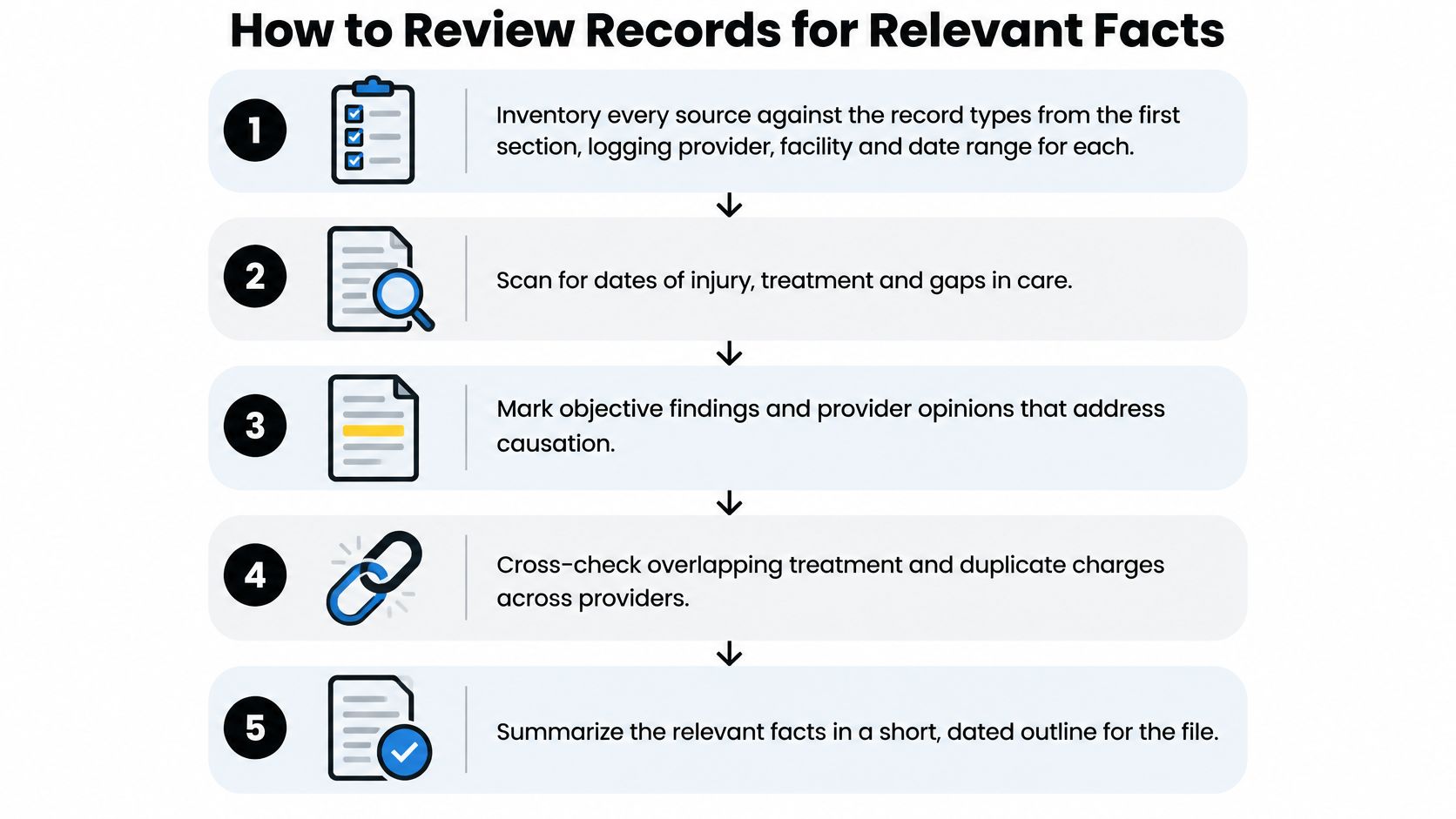
How to Review Records for Relevant Facts
Start with a source register, not a narrative draft. A spreadsheet works if the team uses consistent fields and stable document identifiers; a case-review platform can support the same discipline.
The United States Core Data for Interoperability organizes exchangeable health information into classes such as clinical notes, medications, laboratory results, encounters, imaging, and provenance, including author information. It's a U.S. interoperability baseline, not a universal litigation format, but its separation of content from provenance is a useful design model.
Use a source-first routine
Inventory every source. Log provider, facility, document type, and covered date range against the record categories. Record the scope of each production so an office-chart response isn't mistaken for a complete institutional response.
Separate formats and eras. Identify scanned paper, typed narrative, and structured results before searching. Verify important language on the page image rather than trusting optical character recognition alone.
Keep event and documentation dates separate. Record when the care occurred and when the author entered or signed the note. A later signature must not become the diagnosis date.
Extract the relevant clinical facts. Capture symptoms, diagnoses, treatments, and providers while preserving material wording. Keep the author or facility beside each entry, and distinguish reported symptoms from observed findings.
Attach the encounter and source page. Give each extracted item a document identifier and page reference. Another reviewer should be able to reach the supporting passage without repeating your search.
Label inference explicitly. If a treatment plan suggests a diagnosis that the clinician never states, mark that connection as inferred. Don't promote an interpretation into a documented fact merely because it seems clinically plausible.
Build the chronology after verification. Sort the checked entries by event date and retain unresolved conflicts. Where the date remains uncertain, show the uncertainty rather than forcing an exact position.
Normalize without rewriting the evidence
Normalize provider names and date formats so the same person or encounter doesn't appear under several identities. Keep the original text available beside the normalized field, especially for disputed diagnoses and causation language.
Keyword searches can locate terms, but they won't reliably explain whether a diagnosis was suspected, ruled out, historical, or current. Read the surrounding assessment and plan before assigning significance. The finished chronology should expose those distinctions, not erase them for readability.
Gaps, Contradictions and Missing Providers
A completeness audit sits between receiving records and trusting the timeline. Classify the defect before deciding what to request, because a missing page requires a different response from conflicting accounts of the same encounter.
Gap types, how they appear and how to check them
| Gap type | How it appears | How to check |
|---|---|---|
| Missing document | A visit is referenced but no note is in the set | Request the referenced encounter from the provider |
| Missing fact | A note omits a symptom or treatment documented elsewhere | Cross-check against imaging, pharmacy and therapy notes |
| Treatment gap | Several weeks with no visits or medication fills | Confirm referral delay, insurance barrier or care elsewhere |
| Inconsistent date | The same visit is dated differently across sources | Compare event date with billing and documentation date |
| Conflicting description | Notes describe the same injury differently | Quote both and identify which is contemporaneous |
| Unexplained negative | A negative finding appears without supporting detail | Determine whether the finding was assessed or merely undocumented |
| Duplicate encounter | The same visit appears repeatedly | Consolidate the timeline entry and keep all source references |
In a nationally representative 2025 survey of 1,800 UK adults reported by the Patient Experience Library, 23% reported inaccuracies or missing information in their medical records. That finding illustrates why file size isn't a reliable measure of evidential completeness.
Ask questions that change the next action
Which providers are absent? Compare referral names, copied recipients, imaging facilities, pharmacy histories, and the claimant's account against the source register. A specialist's reference to prior treatment is a retrieval lead, not proof that the underlying records are already present.
What does the negative entry establish? An explicit denial of numbness differs from a note that never discusses sensation. Preserve that difference, and check whether the examination addressed the relevant finding.
What explains the interval without treatment? Ask about referral processing, coverage problems, scheduling, self-directed care, and treatment elsewhere. Record the claimant's explanation as their account until supporting material confirms it; don't label the interval noncompliance by default.
Use a dedicated incomplete medical records review to assign each unresolved item an owner, next action, and status. Keep missing documents, missing facts, and inconsistent facts in separate categories.
The output is a completeness log, not a promise that every uncertainty will disappear. Counsel needs to know which issues can be resolved through retrieval, which require a provider's clarification, and which must remain disclosed limitations before negotiation.
Requesting Records You Do Not Yet Have
In 2024, 85.6% of U.S. adults were offered online access to their medical records, according to Healthy People 2030. An offer of access doesn't establish that a claimant's download contains every relevant source.
The OECD's report covering 17 countries found that, on average, only 18% of patients knew they could access their records online through primary care. Don't assume the claimant understands the difference between a portal view, a downloaded summary, and the records held by outside facilities.
Request the source, not just the available export
- Define the production. Request the full designated record set from each relevant provider, specifying the patient, date range, and needed categories. Use a medical record request letter that identifies attachments and authorizations clearly.
- Include outside custodians. Send separate requests to pharmacies, imaging centers, and other facilities identified in the file. Specify whether you need imaging reports, image files, or both.
- Track every response. Log the request date, recipient, scope, follow-up, and material received. Compare the response against the request before closing the task.
- Resolve delivery obstacles. Check identity details, authorization scope, and the correct records department when a transfer stalls. Ask whether a response means no responsive records exist or that the current custodian can't locate them.
Firms with persistent retrieval backlogs may choose to hire legal virtual assistants through Virtual Legal Assistants for request tracking and follow-up. Keep clinical interpretation, authorization decisions, and judgments about evidentiary sufficiency with the responsible legal team.
Unavailable is a status, not a fact to conceal.
For an unavailable source, record the custodian, requested scope, search efforts, response, and effect on the case analysis. State whether the source remains pending, reportedly no longer exists, or couldn't be located. Those outcomes aren't interchangeable.
A Worked Timeline From Three Providers
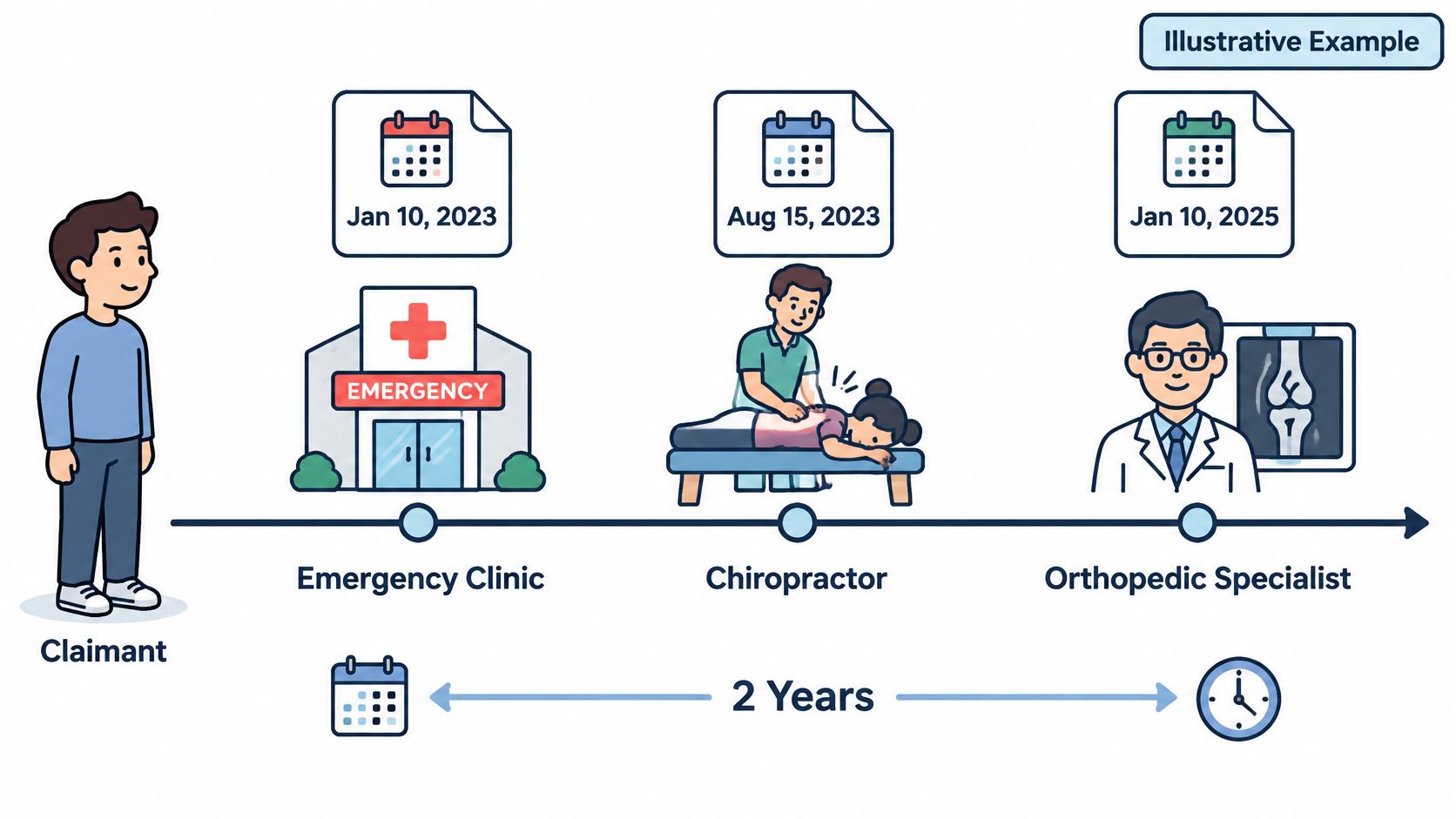
Consider an illustrative, hypothetical file, not a case result. The review covers a two-year history for a claimant in a rear-end collision, but the produced post-collision records come from urgent care, physical therapy, and an orthopedic surgeon.
The task is to describe what those sources establish without inventing the missing connections.
Urgent care establishes the initial documented complaint
The urgent care note records neck pain on the collision date. The reviewer marks the complaint documented, identifies the encounter date, and records the note's entry or signature date separately.
The source field points to the urgent care document and supporting page. The summary says that the claimant reported neck pain following the collision, unless the clinician supplied a stronger causation opinion. It doesn't convert that report into an independent conclusion about mechanism or permanent injury.
Therapy identifies a missing link
At the hypothetical intake in week three, the therapist records a referral from a clinician whose chart isn't in the production. The intake documents that the therapist recorded the referral; it doesn't supply the referring clinician's examination or reasoning.
The reviewer retains the therapy encounter date, documentation date, and page reference. The underlying referral pathway is labeled inferred pending verification, and the absent referral and office note become retrieval tasks in the completeness log.
This distinction prevents the timeline from implying continuous documented physician care merely because therapy followed urgent care.
The surgeon points to unavailable imaging
At the hypothetical consultation in month four, the surgeon discusses an earlier imaging study that isn't in the file. The chronology can accurately summarize the surgeon's description, attributed to the surgeon, but it can't present the missing radiologist's report as independently reviewed.
The reviewer opens a missing-document entry, records the actual request date when the request is sent, and identifies the imaging custodian if known. The consultation keeps its own event date, documentation date, and source reference.
| Entry | Evidentiary status | Outstanding action |
|---|---|---|
| Urgent care neck complaint | Documented in the visit note | Verify any material examination findings |
| Therapy referral history | Documented report, underlying link unverified | Obtain referral and referring clinician's chart |
| Surgeon's imaging discussion | Documented specialist account | Obtain original imaging report and relevant images |
The result isn't a perfectly smooth narrative. It's a usable timeline that separates documented symptoms, attributed accounts, and inferred treatment links, with outstanding sources visible before counsel drafts the demand.
Confirm the Chronology Before You Demand
Proceed when every material timeline entry has a source-page citation and every unavailable source is disclosed in the completeness log. Hold the demand when an unexplained treatment gap or missing relevant pre-injury source could materially change causation, damages, or the account of recovery.
Disclosure alone doesn't cure a critical evidentiary hole. Counsel must decide whether the available evidence supports the proposed position, whether further retrieval is proportionate, and whether an outstanding item requires a narrower assertion.
Make the decision explicit
- Go. The material propositions are supported, limitations are identified, and unresolved items don't undermine the demand's central account.
- Hold. A missing source could change the claimed baseline, explain a disputed interval, or contradict a material treatment assertion.
For teams using Ares, our Medical Summaries turn records into organized chronologies, billing ledgers, and treatment timelines, while Red Flags identify missing records, treatment gaps, and inconsistencies. Use those outputs to support the attorney's decision, not replace it.
Protect the working file as carefully as the original production. Apply role-based access and HIPAA-compliant handling of protected health information throughout review and sharing. Ares is HIPAA compliant, with role-based access controls and detailed audit logging.
Run an open case through the completeness log this week. Count the unresolved material entries, assign responsibility for each, and make a documented go-or-hold decision before drafting the demand.
Our Medical Summaries organize medical history records into chronologies and treatment timelines, and our Red Flags help identify gaps and inconsistencies requiring review. Visit Ares to see how those outputs can support a source-checkable chronology and a more deliberate demand-preparation process.