A successful medical record review hinges on what you do before you ever read a single page. It's all about a methodical process for requesting, organizing, and analyzing your client's health information. This isn't just about collecting documents; it’s about building the unshakable foundation for your case.
Building Your Foundation for Efficient Record Review
The initial intake and organization phase is, without a doubt, the most critical part of the process. Any mistakes here will snowball into massive headaches down the road. You need to move beyond simply gathering files and establish a standardized protocol for requesting every necessary document—from the initial EMT run sheet to those obscure physical therapy notes.
Part of this foundation is understanding the different formats you'll encounter. Many of your most crucial pieces of evidence, like MRIs and CT scans, come in specialized digital formats. Getting familiar with the basics of these, such as the DICOM standard, is a good first step. Resources like What Is DICOM: Your Guide to Medical Imaging offer a great primer on what to expect with these important files.
Creating a Bulletproof Intake Process
A haphazard intake process is a recipe for disaster. It leads directly to missing records, frantic follow-ups, and wasted time. The solution is to ask targeted, probing questions that uncover a client's complete medical journey, not just the obvious stops.
Don't just ask, "Where did you get treated?" Dig deeper.
- Emergency Services: "Which ambulance service responded? Which ER did they take you to?"
- Follow-Up Care: "Did the hospital refer you to any specialists? Have you seen a physical therapist, chiropractor, or acupuncturist since the incident?"
- Diagnostic Imaging: "Where did you get your X-rays or MRIs? Often, that’s a different facility from the hospital or doctor's office."
- Prior History: "Have you ever injured this part of your body before, even if it seemed minor at the time?"
This level of detail from the very beginning ensures your initial record requests are as comprehensive as possible. You're trying to build a complete map of the client's medical journey right from the start.
This workflow is simple but powerful. It's about systematically requesting documents, organizing them logically, and ensuring strict compliance at every turn.
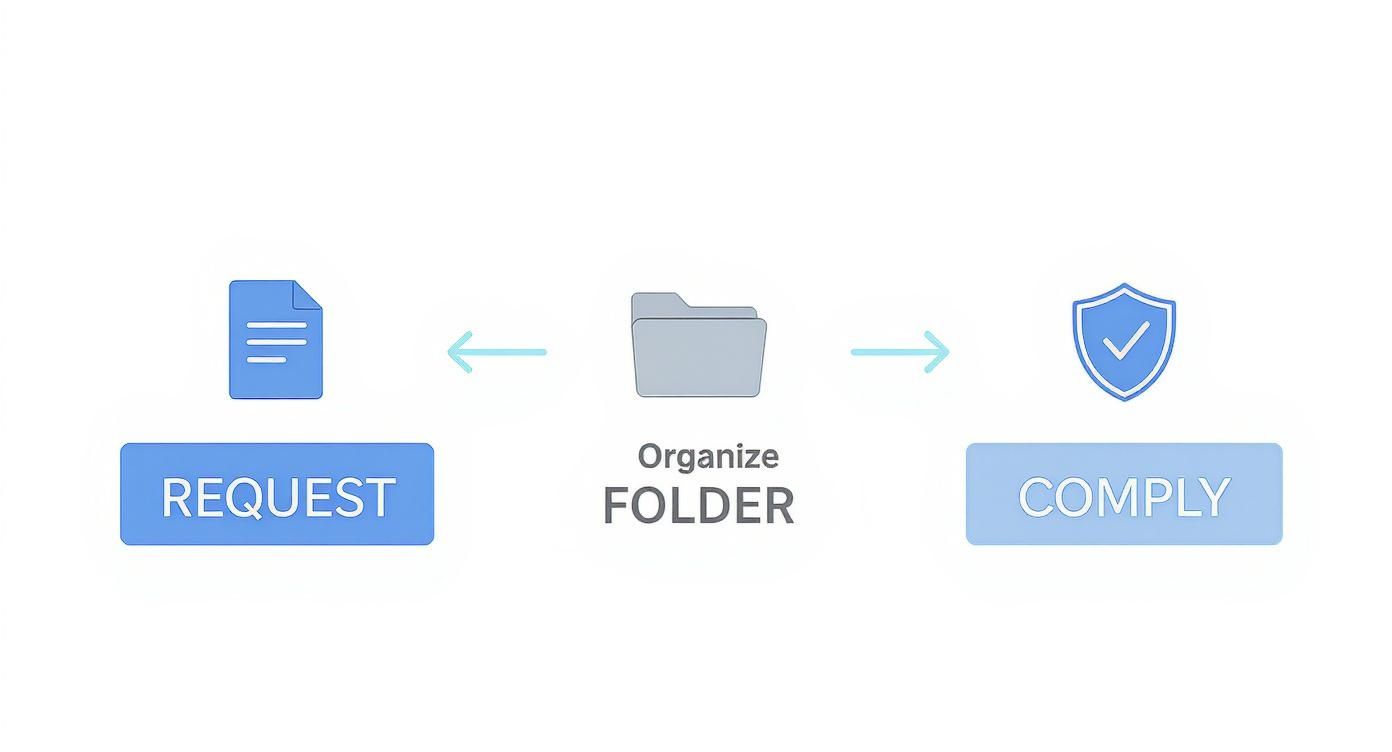
Mastering these three pillars—request, organize, comply—is how you prevent downstream chaos and set your team up for a much smoother, more effective review.
To truly nail this process, a checklist is indispensable. It removes guesswork and ensures every team member follows the same rigorous protocol for every single case.
Essential Components of a Record Intake Checklist
| Checklist Item | Purpose | Key Action |
|---|---|---|
| Signed HIPAA Authorization | To legally request and receive Protected Health Information (PHI). | Verify the form is fully completed, signed, dated, and covers all relevant provider types. |
| Comprehensive Provider List | To identify every source of medical records. | Interview the client using probing questions about all care received, including ancillary services. |
| Imaging & Diagnostic Facilities | To obtain crucial visual evidence like X-rays and MRIs. | Ask specifically where diagnostic tests were performed, as these are often separate facilities. |
| Pre- and Post-Incident History | To establish a baseline and understand the full scope of damages. | Inquire about relevant prior injuries and all treatment sought since the incident date. |
| Pharmacy Records | To track pain medication, treatment protocols, and compliance. | Request a full prescription history from the client's primary pharmacy for the relevant time period. |
| Billing & Insurance Records | To document medical expenses and treatment dates. | Request itemized bills and Explanation of Benefits (EOBs) to corroborate treatment records. |
This checklist isn't just about ticking boxes; it's about creating a repeatable, defensible process that guarantees you have the complete picture before you start your analysis.
Digital Organization and Compliance
As records pour in, you can either create order or let chaos take over. A consistent digital filing system is absolutely non-negotiable.
A logical folder structure is your best friend. Something as simple as organizing by provider and then chronologically by date of service can make information retrieval incredibly intuitive. For a deeper dive, our guide on https://areslegal.ai/blog/how-to-organize-medical-records offers more advanced strategies.
A standardized naming convention is your best defense against disorganization. A simple format like "[Date YYYY-MM-DD] - [Provider Name] - [Document Type]" can transform a messy folder into a searchable, chronological case file.
Finally, and most importantly, compliance is paramount. You are handling extremely sensitive Protected Health Information (PHI), and that demands strict adherence to security protocols. The American Bar Association has made it clear that attorneys should follow HIPAA guidelines when handling medical records. This means using secure portals for file transfers, controlling access, and ensuring every member of your team understands their ethical and legal obligations. It’s a core component of building a case that can withstand scrutiny.
Turning a Mountain of Records Into a Cohesive Case Narrative
When boxes of medical records land on your desk—or, more likely, a dozen different password-protected digital files—the real work begins. The instinct is to just start sorting by date, but that’s a rookie mistake. A straight chronological sort often buries the most potent evidence deep within routine check-up notes.
A much smarter approach is to triage the files first. Think like an ER doctor: find and stabilize the most critical elements before dealing with the rest. Your goal is to isolate the handful of records that tell 80% of the story. A small, powerful stack of these key documents gives you a working theory of the case in a fraction of the time.

Find the Pillars of the Case First
Before you start building the walls, you need to find the foundational pillars. In any medical file, certain documents just carry more weight. They provide a clearer, faster, and more objective picture of what happened to your client.
Focus your initial pass on pulling these specific records:
- Operative Reports: These are gold. They give you a play-by-play of a surgery, straight from the surgeon. You get the findings, the exact procedures performed, and, crucially, any complications that arose.
- Diagnostic Imaging Reports: Don't just look at the images; read the radiologist's interpretation. An MRI, CT scan, or X-ray report is objective proof of an injury, often pinpointing the precise nature and severity of the damage.
- Emergency Department Records: This is ground zero. These records capture the immediate aftermath of the incident—the client’s first complaints, the initial physical exam, and the working diagnosis.
- Specialist Consultations: What did the neurologist, the orthopedic surgeon, or the pain management doctor have to say? Their reports provide expert opinions on the injury, causation, and what the future holds for your client (prognosis).
By pulling these documents out first, you can quickly sketch out the core facts of your case. This lets you develop a preliminary case theory and spot potential red flags long before you've waded through every last page of physical therapy notes.
Building a Story, Not Just a Timeline
Once you have your high-impact documents, it's time to weave them into a narrative. This is where you build a proper medical chronology, which is so much more than a list of dates. A great chronology tells the compelling story of your client's journey from the moment of injury through every single medical intervention.
A medical chronology transforms a chaotic pile of records into a strategic tool. It’s not just about what happened and when, but about connecting the dots to demonstrate causation, damages, and the full impact of the injury on your client's life.
This process means meticulously pulling key data from every relevant record and arranging it to tell a logical story. The goal is a clear, easy-to-follow narrative that anyone—a partner, an expert witness, or even opposing counsel—can grasp instantly. For a deeper dive into this essential skill, see our complete guide to building a medical record chronology.
Weaving the Narrative Threads Together
As you build the chronology, you're not just a data entry clerk. You're an analyst. You’re pulling different threads from hundreds of pages and weaving them together to show a pattern. You’re looking for pivotal moments, inconsistencies, and the clear progression of an injury.
Take a personal injury case involving a back injury from a car crash. A simple timeline just lists doctor's appointments. A powerful chronology, on the other hand, builds a narrative.
Here’s how that looks in practice:
- The Incident: Start with the ER visit right after the accident. Note the chief complaint: "severe lower back pain." Pull the direct quote from the physician's note: "Tenderness over the L4-L5 vertebrae."
- The Progression: A few days later, the client sees their primary care physician. You add that entry, highlighting that the notes now say, "Pain radiating down the left leg." This isn't just another visit; it's evidence of worsening symptoms.
- The Diagnosis: Two weeks later, you slot in the MRI report. The formal diagnosis—"herniated disc at L4-L5"—becomes a critical anchor point in your story.
- The Treatment: From there, you chronologically layer in the orthopedic consult, the pain medication prescriptions, the months of physical therapy, and finally, the recommendation for epidural steroid injections.
By structuring the information this way, you’ve created a clear, compelling narrative of cause and effect. It’s no longer a jumble of records; it’s a story that shows an initial injury that worsened, was definitively diagnosed, and required increasingly invasive medical care. This narrative structure is what allows you to build a powerful, evidence-based argument for damages.
Uncovering Evidence and Spotting Case Weaknesses
Once you have a detailed chronology, the real detective work begins. You're no longer just an organizer of facts; you're an analyst, poring over the narrative to find the golden nuggets that prove your case and, just as importantly, spotting the landmines opposing counsel will try to detonate. It’s all about reading between the lines of every physician's note, lab result, and intake form.
This is where a truly meticulous medical record review for attorneys pays dividends. You aren't just verifying dates on a timeline. You're digging for the subtle connections that lock down causation, illustrate the full scope of damages, and expose fatal flaws in your argument before they become a problem at deposition or trial.

Proving Causation and Identifying Red Flags
In most personal injury claims, the biggest hurdle is drawing a clear, unbroken line from the incident to the injury. Your chronology is the roadmap, but your job now is to highlight the direct route and anticipate every argument the defense will make about detours or alternate destinations.
This means you have to actively hunt for any mention of intervening events or alternative causes. A seemingly innocent physician's note about a "weekend fall" a month after the accident can instantly muddy the waters if you don't find it and address it head-on.
Keep a sharp eye out for these common red flags that can complicate a case:
- Undocumented Complaints: Your client swears their shoulder pain began the moment of impact, but the first three medical records from the ER and their primary care doctor don't mention a shoulder at all. That’s a gap that demands an explanation.
- Conflicting Provider Reports: One urgent care doctor diagnoses a minor sprain, but an orthopedist a few weeks later identifies a significant ligament tear. You need to understand why the diagnoses differ to frame the narrative correctly.
- Gaps in Treatment: A three-month break in physical therapy is a gift to the defense. They'll argue your client must have recovered. You need to know the why behind that gap—was it an insurance authorization delay, a family emergency, or something else you can explain?
- Pre-existing Conditions: The records show a history of lower back pain. Your task is to find the medical evidence that differentiates the old, chronic ache from the new, acute injury caused by the defendant's negligence.
Finding these issues isn't a sign that you have a bad case. On the contrary, it's the mark of a thorough review. Uncovering them early gives you the time to build a strategy around them, prepare your client for tough questions, and gather the evidence needed to neutralize the defense's attack.
Building Your Master Provider and Treatment List
While you're deep in the analytical phase, it's crucial to build a separate, consolidated reference sheet: a master list of every single provider, diagnosis, and significant treatment. This isn't another narrative; it’s a factual index that will become one of your most-used tools for the rest of the case.
Think of this master list as your case's command center. It gives you an at-a-glance view of every medical professional involved, every official diagnosis rendered, and every procedure performed, saving you from having to dig back through thousands of pages.
This centralized list is invaluable for countless litigation tasks. When you need to consult with an expert, you can send them a clean, organized summary of all treating physicians. During deposition prep, you can quickly pull up every diagnosis and treatment date to ensure your client's testimony is perfectly consistent with the written record.
Structure your master list for clarity and speed. A simple table is often the most effective format:
| Provider Name & Specialty | Key Dates of Service | Diagnoses | Major Treatments/Procedures |
|---|---|---|---|
| Dr. Susan Jones (Orthopedics) | 2023-04-15 to 2023-09-20 | Cervical Strain; Herniated Disc C5-C6 | Physical Therapy Referral; Epidural Injection |
| Mercy Hospital ER | 2023-03-01 | Concussion; Whiplash Associated Disorder | CT Scan (Negative); Pain Medication |
| Crestview Imaging | 2023-04-10 | N/A | Cervical Spine MRI |
| PT Solutions | 2023-05-01 to 2023-08-15 | Cervicalgia | Manual Therapy; Therapeutic Exercise |
Building this document as you conduct your initial review is far more efficient than scrambling to create it months down the line. It ensures every critical data point is captured and organized from the start, making your damage calculations, expert preparations, and overall case management exponentially more precise.
Drafting Medical Summaries That Win Negotiations
After all the analysis, it's time to translate your findings into a document that actually moves the case forward. This isn't just a list of medical facts; it's about building a powerful narrative that proves liability and damages. A strong medical summary tells your client's story with irrefutable evidence, and it becomes the foundation of your demand letter and negotiation strategy.
The sheer volume of records we're dealing with today makes this skill absolutely critical. To give you some perspective, in California's workers' compensation system alone, evaluators had to sift through over 50 million pages of medical records in 2023. That number alone shows why sending a sharp, persuasive summary is infinitely better than dumping a mountain of raw files on an adjuster's desk.
And remember, your summary needs to be tailored to its audience. The version you prepare for a medical expert will look quite different from the one you send to an insurance adjuster. But the goal is always the same: make the core facts of the case impossible to ignore.
The Anatomy of a Demand-Ready Summary
When you're drafting a summary for a demand package, clarity is king. It has to walk the reader through the client's entire medical journey, leaving zero doubt about the link between the incident and the injuries. Think of it as the highlight reel of your medical record review, edited for maximum impact.
To be truly effective, your summary needs to hit a few key points:
- A Clear Injury Narrative: Start with a brief, factual overview of what happened and the immediate medical response. This sets the scene.
- Key Treatments and Interventions: Detail the most important medical care the client has received. I'm talking about surgeries, key specialist consults, significant therapies, and major diagnostic findings.
- Resulting Impairments: This is where you connect the dots. Clearly describe the client's current condition and any lasting limitations on their life, quoting directly from physician notes when you can.
- Projected Future Medical Needs: If the records support it, outline the recommendations for future care—things like anticipated surgeries, ongoing physical therapy, or pain management. This is absolutely essential for calculating future damages.
Structuring your summary around these pillars creates a logical, compelling argument for your valuation of the claim.
Writing for Maximum Persuasion
The way you write this summary is just as important as the facts inside it. You want to stay objective and fact-based, of course, but it still needs to tell a human story. This is your chance to turn dry medical data into a powerful advocacy tool.
Focus on making it credible and easy to understand. I always try to avoid overly technical jargon. If you have to use a specific medical term, explain what it means in plain English. For instance, instead of just writing "L4-L5 herniation," say something like "a herniated disc at the L4-L5 level in the lower back, which caused severe nerve pain radiating down the client's leg." That small tweak makes the injury instantly real to a non-medical reader.
Your goal is to lead the reader to an inescapable conclusion. Every fact, diagnosis, and treatment described should build upon the last, creating an unbroken chain of evidence that logically supports your valuation of the claim.
Finally, a pro tip: integrate your source references right into the text. Citing the specific provider and date for each key fact (e.g., "Dr. Smith, Orthopedic Consult, 05/15/2023") lends an incredible amount of weight to your summary. It tells the adjuster that you've done your homework and every single claim you're making is backed by documentation. For a deeper dive into the different kinds of summaries and how to use them, check out our in-depth guide to the medical record summary. This approach turns a simple document into one of your most powerful negotiation assets.
Integrating Technology for Smarter Case Preparation
https://www.youtube.com/embed/kPfIzM6HYpc
In today's world of massive, sprawling electronic health records, the old-school approach to medical record review is simply breaking down. For even a moderately complex personal injury case, a legal team can find themselves buried under thousands of pages. Expecting paralegals and attorneys to manually read, sort, and connect every dot is no longer just inefficient—it's a serious competitive disadvantage.
The only way to keep up is to bring in the right technology. Modern software, especially tools built with artificial intelligence, can completely reshape how your firm prepares a case. These platforms are designed to handle the heavy lifting that used to eat up countless billable hours, freeing up your team to focus on what they do best: legal strategy and analysis.
Shifting From Manual Drudgery to Automated Insight
What if you could upload a client's records and get back a detailed medical chronology just moments later? That's not a far-off dream; it's what today's legal tech can do. These tools are trained to read and understand complex medical jargon, pulling out the most crucial data points with a high degree of accuracy.
They can instantly grab and organize key information, like:
- Key Diagnoses: Pulling every official diagnosis from physician notes, consults, and reports.
- Medications and Dosages: Building a complete list of all prescribed medications relevant to the case.
- Treatment Timelines: Mapping out every physical therapy session, surgical procedure, and specialist visit.
- Provider Lists: Compiling a master list of every doctor, clinic, and hospital involved.
This kind of automation gets your team out of the data entry business for good. You can automate data entry with AI and let the software handle the initial organization, allowing your legal professionals to dive straight into the analytical work that wins cases.
Radically Accelerating Your Case Workflow
The biggest and most immediate impact of this technology is the dramatic reduction in turnaround time. The traditional process—shipping boxes of records, manual sorting, and a page-by-page slog—creates a massive bottleneck that stalls case progress.
The old-school manual medical record review workflow often takes 60-90 days, sometimes even longer. This painfully slow process delays settlements, frustrates clients, and ties up your firm's most valuable resources.
In contrast, modern AI-powered platforms can deliver the same, if not better, results in a tiny fraction of that time. This isn't just a small improvement; it's a fundamental change to the entire workflow. The speed advantage is undeniable, with some platforms now hitting 10-12 day turnaround times for a complete medical record review. That’s a massive 5-8x speed improvement over outdated manual methods.
Here's a clearer picture of how the two approaches stack up.
Manual vs AI-Powered Medical Record Review
The difference between the old way and the new way is stark. While manual review has been the standard for decades, AI-powered solutions offer significant advantages in speed, consistency, and the ability to uncover insights that might otherwise be missed.
| Feature | Manual Review Process | AI-Powered Review Process |
|---|---|---|
| Speed | Extremely slow, often taking 60-90 days or more. Heavily dependent on the reviewer's availability and speed. | Exceptionally fast, with turnarounds as quick as 10-12 days. The system processes documents 24/7. |
| Accuracy | Prone to human error, typos, and missed details due to fatigue or oversight. Consistency can vary between reviewers. | Highly accurate and consistent. The AI applies the same rules to every document, every time, reducing subjective errors. |
| Cost | High labor costs, driven by the many hours of paralegal and attorney time required for review and data entry. | Significantly lower operational costs. Frees up expensive human resources for high-value strategic work. |
| Scalability | Difficult to scale. A sudden influx of large cases creates immediate bottlenecks and delays across the firm. | Easily scalable. The system can handle a massive volume of documents without a proportional increase in time or resources. |
| Data Extraction | A tedious, one-by-one process of identifying and transcribing key dates, diagnoses, and treatments. | Automated extraction of key data points, instantly populating chronologies, provider lists, and summaries. |
Ultimately, while the human element remains critical for strategy, AI provides the leverage needed to process information at a scale and speed that is simply impossible to achieve manually.
Choosing the Right Tools and Validating the Output
Jumping into new technology requires a smart approach. Not all "AI" tools are the same, and it’s crucial to build a workflow that pairs automated efficiency with essential human oversight. When looking at different software, focus on platforms built specifically for the unique needs of personal injury and medical malpractice litigation.
Once you have a tool, the final piece of the puzzle is establishing a solid quality control process. Think of the AI as a brilliant, incredibly fast paralegal—it does the groundwork, but an experienced attorney still needs to provide the final sign-off.
Your validation workflow should include these checkpoints:
- Spot-Check Key Entries: Have a paralegal or nurse consultant compare a handful of key entries in the AI-generated chronology against the source documents to confirm accuracy.
- Review the Narrative Flow: An attorney needs to read the summary to make sure it tells a clear, compelling story that aligns with the core facts of the case.
- Hunt for Gaps: Use the structured, organized timeline to quickly spot what's missing. A three-month gap in physical therapy treatment will be glaringly obvious in an AI-generated timeline.
By combining powerful technology with skilled human review, your firm can reach a new level of efficiency and accuracy in your medical record review for attorneys, helping you build stronger cases and secure better outcomes for your clients.
Answering Your Questions About Medical Record Review
Even with a well-oiled process, wrestling with a mountain of medical records brings up questions for even the most seasoned legal teams. It's a constant balancing act—digging through huge volumes of data, staying compliant, and somehow building a rock-solid case narrative. Let's tackle some of the most common questions we see from firms in the trenches.

What Are the Most Common Mistakes to Avoid?
One of the biggest, and frankly most damaging, mistakes we see is failing to get a complete set of records right from the start. You end up with a fragmented picture of the case, and that can completely torpedo your strategy. You simply cannot build a winning case on a client's memory or a partial document dump.
Another critical error is not having a secure, HIPAA-compliant system for all this sensitive information. Mishandling Protected Health Information (PHI) is more than just a procedural slip-up; it exposes your firm to serious legal and ethical risks that can sink a case and tarnish your reputation.
Finally, diving into a complex medical record review for attorneys without the right medical background is a recipe for disaster. If you can't decipher a physician's shorthand or understand the implications of a diagnostic test, you’re flying blind. You’ll miss case-defining details, misjudge causation, and walk right into traps that opposing counsel will be more than happy to spring.
How Should We Handle Missing Records or Gaps?
When you discover a gap in the medical timeline, the key is to have a clear protocol, not to panic. The very first thing to do is meticulously document what's missing. Cross-reference every document you have to confirm the record isn't just buried somewhere or misfiled.
Once you’ve confirmed it’s missing, send a certified follow-up request to the provider. Be incredibly specific about the exact records and date ranges you need. If that formal request doesn't get a response, a subpoena might be your next logical step to compel their release.
Gaps in the record aren't always a setback. Strategically, they can become powerful leverage in litigation. A missing record can imply sloppy bookkeeping or, in some cases, even suggest an intentional alteration. This can help you build a narrative of negligence or a breach in the standard of care.
The trick is to address these gaps proactively during discovery. When you bring them to light on your own terms, you control the story. If you wait for opposing counsel to find them, you're immediately on the defensive.
When Is It Smart to Outsource Medical Record Review?
Bringing in outside help for medical record review is a smart, strategic move in a few key situations. If your firm lacks deep in-house medical expertise—especially for complex cases like medical malpractice where the standard of care is everything—outsourcing is a must.
It also makes perfect sense when your team is drowning in paper. In mass tort or catastrophic injury cases, the sheer volume of documents can grind your internal workflow to a halt. It pulls attorneys and paralegals away from the high-value legal work they should be focused on.
Ultimately, outsourcing gives you a powerful trifecta of benefits:
- Expertise: You get an objective, expert-level analysis from professionals like legal nurse consultants who live and breathe this stuff.
- Speed: Specialized services can turn around professional summaries and chronologies far faster than an in-house team juggling a full caseload.
- Cost-Effectiveness: It's often much more economical to pay for a dedicated service than to burn expensive attorney and paralegal hours on this incredibly labor-intensive task.
Ready to transform your case preparation? Ares provides an AI-powered platform that automates your medical record review, turning thousands of pages into case-ready insights in minutes. Eliminate tedious manual work and build stronger cases faster. Discover how much time you can save.