Think of a medical record review service as the expert team that takes a mountain of disorganized medical files and turns it into a clear, concise roadmap for your case. It’s a modern alternative to the old-school, manual slog of sifting through thousands of pages, page by painful page. For a busy personal-injury firm, this kind of service is designed to do one thing: give your paralegals back their time, speed up your cases, and pinpoint the make-or-break details that win claims.
The Hidden Costs of Manual Medical Record Review
Picture a paralegal, buried under stacks of paper, spending weeks just trying to piece together a client's medical history. It’s a scene played out in personal injury firms everywhere, and it's a massive bottleneck. This traditional approach isn't just slow—it's a quiet killer of efficiency and profitability.
The Problem with the Old Way
The manual review process is riddled with problems that drag down your cases. Every hour a sharp paralegal spends on mind-numbing administrative work is an hour they can't spend on strategy, client communication, or drafting demands. The costs add up fast.
- Inflated Operational Costs: Paying skilled staff for weeks of what is essentially data entry and organization eats into your profit margins on every single case.
- High Risk of Human Error: Let's be honest, even the best paralegal can miss a critical note buried on page 947 of a dense hospital record. A single oversight can weaken a claim or even torpedo a settlement.
- Delayed Case Settlements: When it takes a month just to get through the records, the entire case stalls. That means delayed cash flow for the firm and a longer wait for your client to get the compensation they need.
The traditional review process is a classic low-value, high-risk activity. It burns through valuable time on a task that technology now does faster and more accurately, freeing up your legal talent to focus on what really matters: strategy and advocacy.
The Shift Toward Modern Solutions
It's no surprise that law firms are looking for a better way. This need for smarter solutions is part of a much bigger trend in how we handle sensitive health information. The global market for medical records retrieval was valued at USD 1.1 billion and is expected to hit USD 2.8 billion by 2034, largely because industries like the legal field are demanding it. You can explore more data on this market growth to see just how quickly things are changing.
A modern, tech-forward medical record review service is the answer. These platforms, especially those powered by AI, can take a multi-week headache and solve it in a matter of hours. They automatically pull out the crucial data—injury timelines, treatment details, billing codes—and hand you a clean, organized summary that your team can use immediately. It's about building a stronger case, faster.
Turning a Mountain of Paper into a Winning Case Strategy
Anyone who's managed a personal injury case knows the feeling. You're handed a stack of medical records—a chaotic mix of handwritten notes, lab results, physician summaries, and billing codes. It’s a classic case of unstructured data, and your job is to find the story hidden within that chaos.
This is where an AI-powered medical record review service steps in. Think of it less like a piece of software and more like a team of super-powered paralegals who can read, understand, and connect every detail in minutes. It doesn't just digitize files; it extracts the critical intelligence you need to build your case.
The old way of doing things—manual review—is a well-known bottleneck. It’s a slow, expensive, and frustrating process that’s ripe for human error.
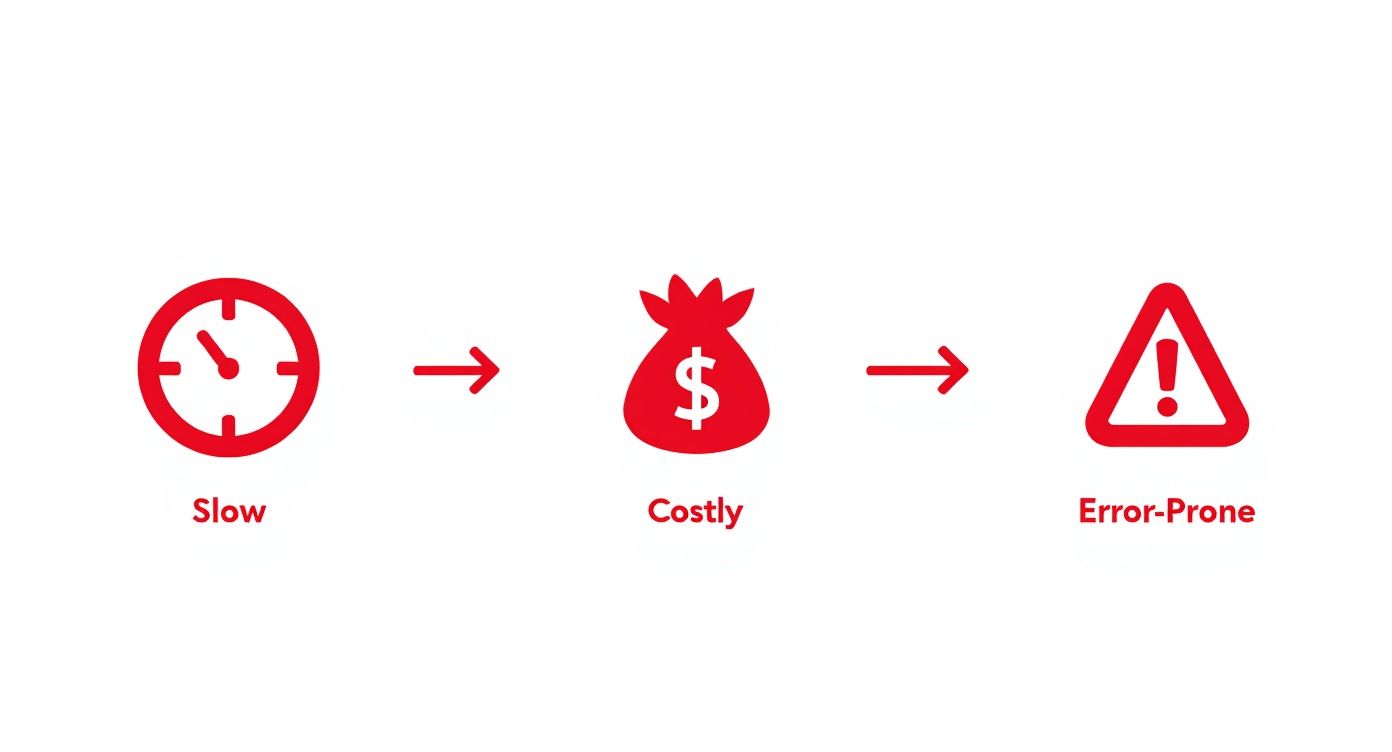
As you can see, the traditional path is a straight line from wasted time to wasted money, often ending with costly mistakes that can undermine an otherwise solid claim.
First Step: From Scanned Pages to Searchable Text
The whole process kicks off with a technology called Optical Character Recognition (OCR). In simple terms, OCR is the digital bridge that turns scanned paper documents or fuzzy PDFs into clean, machine-readable text. It’s the foundational step that makes every single word searchable.
Without OCR, your team is stuck reading line by line. With it, the AI has the raw material it needs to start its real work.
The Brain of the Operation: Natural Language Processing
Once the records are text, Natural Language Processing (NLP) takes over. This is the real "brain" behind the service. NLP is a sophisticated type of AI that goes beyond just reading words; it understands context, intent, and relationships, much like an experienced paralegal or nurse reviewer.
These NLP models are trained on immense libraries of medical literature, so they know the difference between a diagnosis and a differential diagnosis. They recognize complex terminology and common abbreviations right out of the box.
For example, an NLP-driven system can instantly tell that "HTN" in a doctor's note means hypertension. It can also connect a medication prescribed on page 50 to the specific condition it treats, which was mentioned on page 5. This level of contextual understanding is impossible to achieve with a simple keyword search.
This is the same kind of technology that powers other advanced medical tools. You can see a similar application in action with AI for Medical Transcription, where AI has to understand the nuances of spoken medical language.
Finding the Needle in the Haystack with Machine Learning
The final, most powerful layer is machine learning (ML). This is where the AI becomes a true expert analyst. By training on millions of anonymized medical records from previous cases, the ML models learn to spot patterns and flag information that has real legal significance.
This is how an AI-powered medical record review service can pinpoint a crucial detail buried in a 500-page file that even a dedicated human reviewer might miss after hours of work.
What Machine Learning Uncovers:
- Injury Timelines: The AI automatically builds a clear, chronological sequence of events, from the moment of injury through every follow-up and therapy session.
- Treatment Protocols: It identifies every procedure, prescription, and therapy, making it easy to see if the care provided aligns with the injuries claimed.
- Billing Discrepancies: The system flags potential overcharges or inconsistencies between the services documented in clinical notes and what shows up on the bill.
- Undiagnosed Symptoms: It can highlight recurring patient complaints noted by physicians that never resulted in a formal diagnosis, pointing to potential gaps in care or unaddressed injuries.
Ultimately, this intelligent, multi-layered process takes an overwhelming pile of documents and transforms it into a structured, searchable, and actionable asset. Your team can stop digging for facts and start building a winning strategy from day one. To learn more about how this works in practice, check out our guide on AI for personal injury lawyers for more applications.
Let's face it, bringing new technology into your firm isn't just about looking modern. It's a business decision that needs to deliver a clear, measurable return. When it comes to a medical record review service for a personal injury practice, we're not talking about an expense—we're talking about a powerful profit-driver.
The return on investment here goes way beyond just saving a few hours. It’s about calculating the real value of reclaimed time, faster case timelines, and, most importantly, uncovering those crucial details that can dramatically increase settlement values. By automating one of the most tedious parts of case prep, you fundamentally change your firm's financial engine.
This isn't a new concept, either. The healthcare industry has been on this path for years. The global market for electronic health records hit USD 33.43 billion and is expected to climb to USD 43.36 billion by 2030. This growth is fueled by the exact same need for efficiency that’s pushing smart law firms toward automation. You can read more about these EHR market trends and see the clear parallels.
Shifting from Overhead to High-Value Work
The most immediate and obvious return comes from reallocating your team's most valuable asset: their time. Every hour a paralegal or attorney spends manually digging through medical records is an hour you're paying an expert salary for administrative busywork. It just doesn't make sense.
An automated service completely flips that script. When you shrink the review process from weeks down to a matter of hours, you're not just saving time—you're freeing up your best people to focus on the work that actually generates revenue.
High-Value Activities Unlocked by Automation:
- Crafting Better Demand Letters: Armed with a perfectly organized chronology and summary, your team can build a much stronger, fact-based narrative from day one.
- Focusing on Case Strategy: Instead of just searching for information, they can spend their energy identifying case weaknesses, planning discovery, and getting ready for depositions.
- Improving Client Relationships: More time in the day means better communication with clients. That leads directly to happier clients, more referrals, and a rock-solid reputation.
This isn't about replacing your staff; it's about making them more powerful. The service handles the grunt work, allowing your team to operate at their highest level and focus on the strategic thinking that actually wins cases.
The real ROI isn't just in the hours saved, but in the quality and strategic value of the work your team can produce with those reclaimed hours. It transforms your payroll from a fixed cost into a dynamic engine for growth.
Accelerating Cash Flow and Increasing Case Capacity
Here's a benefit that often gets overlooked: the massive impact on your firm's cash flow. We all know that manual reviews are a notorious bottleneck. They can hold up a settlement for weeks, sometimes months. And every single day a case is stalled is a day your firm is waiting to get paid.
By speeding up that initial review, you get the entire case lifecycle moving faster. Demand letters go out sooner, negotiations kick off earlier, and you reach a settlement that much more quickly. This has a direct, positive effect on your firm's financial health by improving liquidity and making your revenue more predictable.
Better yet, this new efficiency means your firm can actually take on more cases without having to hire more people. Think about it: if each case suddenly requires 10-15 fewer administrative hours, your existing team can comfortably manage a larger caseload. That directly boosts your firm's total revenue without increasing your overhead. That kind of scalability is how a firm builds sustainable, long-term growth.
To really put this in perspective, let’s look at a side-by-side comparison. The table below breaks down the typical financial impact when a personal injury firm moves from a traditional manual process to an AI-powered service.
Manual vs AI-Powered Medical Record Review ROI
| Metric | Traditional Manual Review | AI-Powered Review Service |
|---|---|---|
| Average Review Time Per Case | 20-30 hours | 2-4 hours |
| Associated Labor Cost | $1,000 - $1,500 (at $50/hr paralegal rate) | $100 - $200 (at $50/hr paralegal rate) |
| Time to Draft Demand Letter | 2-3 weeks (post-records receipt) | 3-5 days (post-records receipt) |
| Case Capacity Per Team Member | 15-20 active cases | 25-30 active cases |
| Key Detail Discovery Rate | Relies on human attention; prone to fatigue and error | 95%+ accuracy; spots patterns humans might miss |
| Settlement Value Impact | Baseline value based on obvious injuries | Potential 10-20% increase from uncovered details |
The numbers speak for themselves. The gains aren't just marginal; they represent a fundamental shift in how a firm can operate, turning a time-consuming cost center into a source of strategic advantage and increased profitability.
Uncovering Hidden Value in Medical Records
Finally, an AI-powered medical record review service often pays for itself many times over simply by finding what a human reviewer might have missed. Let's be honest, after staring at hundreds of pages, anyone's eyes can glaze over. But a machine learning algorithm, trained on millions of records, doesn't get tired. It's exceptionally good at spotting subtle patterns, inconsistencies, and crucial details buried deep in the file.
For example, the AI can instantly flag things like:
- A billing code for a procedure that was never mentioned in the physician's notes, pointing to a potential overcharge or unrecorded treatment.
- A recurring complaint of pain noted in nursing logs that was never formally diagnosed, suggesting an unaddressed injury.
- Contradictory information between different provider records that could be used to undermine the defense's arguments.
Discoveries like these give you incredible leverage. They directly strengthen your negotiating position and can significantly increase the final settlement you secure for your client. It’s like having an expert auditor on every single case, making sure that no dollar is ever left on the table. This consistent ability to find hidden value provides a direct, quantifiable, and often substantial return on your investment.
Mastering HIPAA Compliance and Client Data Security
https://www.youtube.com/embed/zTHuvSCs3mQ
When your firm handles medical records, you’re not just managing case files—you’re a custodian of your clients' most personal information. Protecting this data isn’t just good practice; it's a legal and ethical mandate. For any personal injury firm, navigating the fine points of the Health Insurance Portability and Accountability Act (HIPAA) is simply non-negotiable.
That responsibility doesn't stop at your office door. It extends directly to any partner you bring into your workflow, especially a medical record review service. The moment a third party touches, stores, or analyzes a client's medical file, they are handling Protected Health Information (PHI). This means both your firm and your vendor are on the hook for HIPAA compliance.
The Business Associate Agreement: Your Critical Shield
Any legitimate service provider that handles PHI must be ready and willing to sign a Business Associate Agreement (BAA). Think of this as a legally binding contract that clearly defines the vendor's duty to protect patient data according to strict HIPAA standards.
A BAA is your firm's first and most important line of defense. It legally requires the vendor to uphold the same rigorous data security standards expected of healthcare providers. If a potential partner even hesitates to sign one, that’s a massive red flag. Walk away.
Core Security Standards for Any Medical Record Review Service
Beyond the BAA, you need to be sure a potential partner has the technical muscle to back up their promises. Modern data security isn't just about a strong password; it's about layered, robust defenses.
A great way to start is by using a practical HIPAA risk assessment template to benchmark your own processes and scrutinize those of any vendor you’re considering.
Here are the absolute must-haves for any top-tier service:
- End-to-End Encryption: Data must be scrambled and unreadable both in transit (as it’s being uploaded) and at rest (while stored on their servers). This ensures that even if a breach occurs, the information itself remains useless to unauthorized parties.
- SOC 2 Certification: This is the gold standard. It’s an intense, third-party audit confirming a service provider’s controls for security, availability, confidentiality, and privacy. Achieving SOC 2 compliance shows a serious, enterprise-level commitment to security.
- Secure Cloud Infrastructure: Look for services built on trusted platforms like Amazon Web Services (AWS) or Microsoft Azure. These cloud giants offer security features far more advanced and resilient than anything a typical law firm could build or maintain on its own.
Choosing a vendor is an act of trust. You are entrusting them with your client's privacy and your firm's reputation. Due diligence isn't just about features and pricing; it's about confirming their security architecture is built to withstand modern threats.
Asking the Right Questions to Protect Your Firm
When you vet a medical record review service, you need to put on your auditor hat. Don't be timid about digging into the nitty-gritty of their security protocols. We cover this in-depth in our guide to HIPAA-compliant document management.
Start your evaluation by asking these direct questions to any provider:
- Do you sign a Business Associate Agreement? (The only acceptable answer is "yes.")
- Can you provide a copy of your SOC 2 Type II report?
- How is our data kept separate from your other clients' data?
- What is your protocol for notifying us of a data breach?
- Where is our data physically stored, and what security measures are in place at those data centers?
The clarity and confidence of their answers will speak volumes. A partner who truly prioritizes security will welcome your questions and have direct, transparent answers ready.
Weaving a Review Service into Your Firm’s Workflow

Bringing a new tool into the fold shouldn't feel like a radical overhaul. The key to successfully adopting a medical record review service is a smart, measured approach that builds confidence and proves its worth right out of the gate.
The best way to start? A pilot project. Forget a firm-wide mandate that puts everyone on edge. Instead, pick one or two of your more tech-forward paralegals and have them test the service on a single, moderately complex case. This creates a low-stakes sandbox where they can learn the platform, see the time savings for themselves, and create a genuine success story to share.
A Phased Rollout Strategy
A step-by-step implementation is your best friend here. It minimizes disruption and makes sure your team feels supported, not overwhelmed. Rushing things is a recipe for resistance, but a phased approach builds momentum by showing people the benefits in a real, tangible way.
- Pick the Right Pilot Case: Find a new case with a decent volume of medical records—enough to be a real test, but not so much that it feels like a high-stakes gamble.
- Focus on Initial Training: Your service provider should help get your pilot team up to speed. These folks will become your internal champions, the go-to people who can answer questions and help their colleagues down the line.
- Measure Everything: Seriously, document it all. Track the hours spent on review and compare it directly to your firm's manual baseline. When you can show leadership the concrete hours saved and critical facts uncovered, you’ve got a powerful case for moving forward.
- Expand Gradually: Once the pilot is a success, roll the service out to a small team or a specific practice area. Apply what you learned from the pilot to fine-tune the workflow before going firm-wide.
Connecting with Your Existing Systems
For this to truly work, the new service has to play nice with your current case management software. Modern platforms are built for this. They use APIs—think of them as digital handshakes—to automatically transfer data between systems.
This link is crucial because it kills double data entry. The organized summaries and timelines from the medical record review service pop up right inside the case files your team already lives in every day. To get the most out of this, it helps to understand the fundamentals of effective case management for law firms.
The smartest way to frame this change is to present the new tool not as a replacement, but as a powerful assistant. It’s there to handle the tedious, repetitive work, freeing up your legal staff to focus on strategy, analysis, and advocacy—the high-value work that actually wins cases.
This perspective is central to navigating the human side of implementing new technology.
Driving Adoption by Empowering Your Team
Change can feel daunting, but it’s how progress happens. Just look at the healthcare industry’s own tech journey. Back in 2008, only 9% of U.S. hospitals used Electronic Health Records (EHRs). By 2021, that number had skyrocketed to an incredible 96%. This shift completely reshaped how an entire industry operated.
The same principle applies to your firm. When you position a medical record review service as a tool that enhances your team’s skills—not one that threatens their roles—you get buy-in. Once paralegals realize it eliminates the most grueling parts of their job, they won't just accept it; they'll champion it. That’s how you ensure a smooth and profitable integration.
The Ultimate Checklist for Choosing Your Medical Record Review Partner
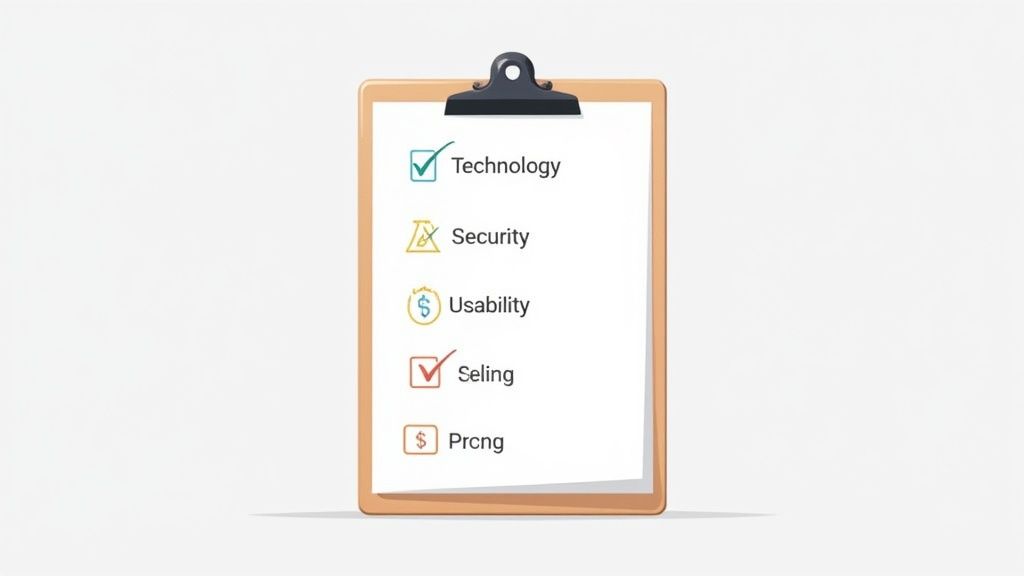
Picking the right partner for medical record review is one of the most important decisions you'll make for your firm's efficiency. Let's be honest, not all services are built the same. The gap between a great platform and a mediocre one can directly impact your case outcomes, billable hours, and even your sanity.
To help you cut through the marketing noise, you need a solid framework. This checklist breaks down the evaluation process into the four areas that truly matter. Use it to ask the right questions and spot the difference between a vendor and a true partner.
Technology and Accuracy
At the end of the day, the core of any service is the quality of its analysis. A platform that misinterprets key medical data or, even worse, misses it entirely, is a liability. It's time to look under the hood.
What’s the AI brain behind the operation? You need to ask if they use generic AI models or specialized large language models (LLMs) that have been specifically trained on medical and legal documents. A standard AI simply won't grasp the nuances of a physician's shorthand or its direct relevance to your personal injury claim.
Can it read everything? Case files are messy. You're dealing with everything from pristine EHR printouts to handwritten doctor's notes and blurry faxes. Confirm their Optical Character Recognition (OCR) is tough enough to accurately digitize it all.
How good is it, really? Ask for their accuracy rates. A reputable provider will be upfront about their performance metrics and should have a human-in-the-loop review process to catch and correct any AI errors.
Security and Compliance
When you hand over Protected Health Information (PHI), you're handing over a massive responsibility. A data breach doesn't just damage your firm's reputation; it can bring on staggering legal and financial penalties. Security isn't just a feature—it’s the foundation.
Choosing a vendor is an act of trust. You are entrusting them with your client's privacy and your firm's reputation. Due diligence on security is non-negotiable and protects both your clients and your practice from significant risk.
Are they fully HIPAA compliant? The provider must be willing to sign a Business Associate Agreement (BAA) without any hesitation. This is the legal cornerstone of your relationship. If they balk, walk away.
Do they have a SOC 2 report? A SOC 2 Type II certification is the gold standard. It’s an independent, third-party audit that proves their security controls have been tested and verified over time.
What does their data security look like? Find out if they use enterprise-grade cloud platforms like AWS or Azure. You should also ask about their data encryption protocols, both for information that's being transferred and for data that's stored on their servers.
Platform Usability
The most powerful technology in the world is useless if your team hates using it. The platform needs to feel like a natural extension of your workflow, not another frustrating system they have to fight with.
Is it actually easy to use? Don't just take their word for it—get a live demo or a trial. See for yourself if your paralegals can upload documents, navigate the summaries, and pull reports without needing a week of training. The goal here is to reduce friction, not create it.
Does it play well with your other software? Check if the service integrates with your existing case management system. A platform that syncs automatically saves countless hours and eliminates the risk of human error from manual data entry.
Pricing and Support
Finally, the business side of the deal has to make sense for your firm. You're looking for a long-term relationship, and that requires transparent pricing and reliable support.
Is the pricing model clear and predictable? You need to know exactly how you’ll be billed. Is it per page, per case, or a flat subscription? Steer clear of any vendor with vague or complicated fee structures that make it impossible to budget.
What happens when you need help? Find out what their support looks like. Ask about response times, and see if they offer a dedicated account manager and real onboarding to get your team up and running. The right partner is invested in your success from day one.
Frequently Asked Questions
Even when the benefits are clear, bringing a new service into your firm's workflow always raises a few practical questions. Let's tackle some of the most common ones we hear from personal injury firms looking at AI-powered medical record review.
How Much Time Can We Realistically Save Per Case?
This is the big question, and while it definitely varies with the complexity of the case, the numbers are pretty consistent. Firms using these services regularly report cutting out 10 to 15 hours of manual review and summary work for a standard case. When you're dealing with a file that has thousands of pages, those savings can be astronomical.
Think about what that really means. It’s not just about saving time; it’s about reallocating it. Your paralegals can stop digging through records and immediately start drafting demand letters or preparing for discovery. You’re essentially converting administrative dead time into strategic, forward-moving action.
Is an AI Service a Replacement for Our Paralegals?
Not a chance. In fact, it's the exact opposite. An AI-powered medical record service is a force multiplier for your team, not a substitute. It’s best to think of it as the world’s most efficient assistant, one that handles the mind-numbing task of initial data extraction with incredible speed and accuracy.
Your paralegals’ legal expertise is more crucial than ever. They take the AI-generated summaries and apply their critical thinking to find the strategic angles and connect the medical facts to the legal arguments. The technology finds the "what," so your team can focus entirely on the "so what?" and how to win the case.
The real goal here is to free up your most skilled people from the administrative grind. It lets them operate at the highest level, applying their training to a perfectly organized set of facts from the very beginning.
What If the Medical Records Are Handwritten or Poor Quality?
A completely fair and common question. After all, medical records are rarely pristine. The best services use sophisticated Optical Character Recognition (OCR) that has been specifically trained on the messy reality of medical documents—that means it’s built to decipher different handwriting, make sense of blurry scans, and even read those grainy faxed pages.
No technology is perfect, of course, but the accuracy is surprisingly high. More importantly, leading platforms don't just rely on the AI. They almost always have a human-in-the-loop review process to verify the AI's work, catching any errors and ensuring the final summary you get is something you can build a case on.
How Does the Service Handle All the Different Types of Medical Records?
A solid platform is built to handle the entire mix of documentation that lands on your desk. It can ingest, understand, and organize information from dozens of different sources into a single, easy-to-read timeline. This includes everything from:
- Hospital admission and discharge summaries
- SOAP notes from physicians and nurses
- Complex diagnostic imaging and lab reports
- Full prescription histories
- Itemized billing records and CPT codes
The AI is smart enough to know the difference between these documents. It can connect a diagnosis from a doctor’s note to a prescription filled a week later and a billing code from the hospital, weaving together a complete story that would otherwise take a paralegal weeks to piece together manually.
Ready to get rid of the single biggest bottleneck in your case prep? See how Ares Legal can change your medical record review from a burden into a strategic advantage, giving your team back hundreds of hours.