Medical records retrieval service for PI cases: faster settlements
For any personal injury firm, the story of a case is written in the medical records. But getting those records? That’s often a story of frustration, delays, and administrative headaches. This is where a medical records retrieval service comes in—not just as a vendor, but as a strategic partner that fundamentally changes how you build your cases.
What Is a Medical Records Retrieval Service?
Think of your paralegal trying to navigate a maze of healthcare providers without a map. That's the reality of manual record retrieval. It’s a grind of endless phone calls, confusing provider portals, and follow-ups that go nowhere. Every day spent chasing down a record is a day your case is stalled, pushing back settlements and draining your firm’s resources.
A medical records retrieval service is your expert guide through that maze. It’s a dedicated partner that takes on the entire administrative burden of hunting down and gathering every piece of medical evidence your case needs. This isn't just about sending faxes; it’s a focused, systematic operation built to solve the exact problems that bog down personal injury firms every single day.
From Administrative Burden to Strategic Asset
Instead of your team spending valuable hours on hold or trying to figure out yet another provider's unique request form, a retrieval service manages the whole process from start to finish. This frees up your skilled legal staff to do what they do best: building case strategy, negotiating with adjusters, and communicating with clients.
This shift from an in-house chore to an outsourced specialty is why the global medical records retrieval market recently hit a $1.1 billion valuation. Legal teams are recognizing that they need faster, more reliable access to records. The old way—waiting 60-90 days—is a massive bottleneck. Modern, tech-enabled services are crushing that timeline, often getting complete records in just 10-12 days. That's a 5-8x speed increase that lets firms move cases forward at a pace that was once unthinkable.
This infographic shows just how dramatic that time savings can be.
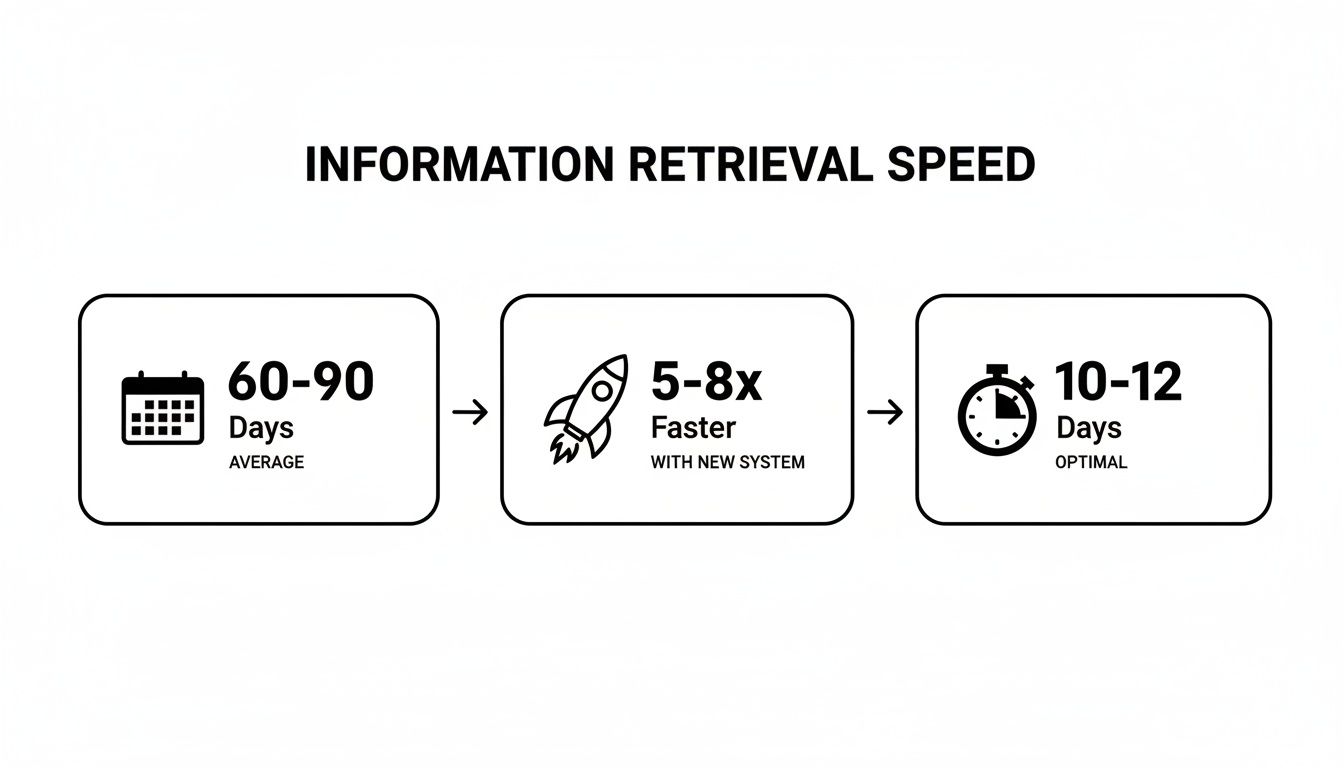
When you compress a months-long waiting game into a couple of weeks, you fundamentally accelerate your entire case cycle and improve your firm's cash flow.
To truly understand the difference, let’s break down the old way versus the new way.
Manual Retrieval vs. Modern Service: A Breakdown
| Metric | Traditional Manual Process | Modern Retrieval Service |
|---|---|---|
| Provider Contact | Manual calls, faxes, portal navigation for each provider. | Automated requests through established provider networks. |
| Follow-Up | Relies on staff memory, calendar reminders; often inconsistent. | Systematic, automated follow-ups ensure no request falls through. |
| Turnaround Time | 60-90 days on average, with frequent outliers. | 10-12 days on average, with real-time status tracking. |
| Accuracy | High risk of missing records, wrong date ranges, or incomplete files. | QA checks ensure all requested documents are present and correct. |
| Staff Focus | Paralegals and legal assistants spend hours on administrative tasks. | Legal staff are free to focus on high-value legal work. |
| HIPAA Compliance | Burden falls entirely on the firm; risk of mishandling PHI. | Handled by a specialized, compliant partner with secure systems. |
As the table shows, it's not just a minor improvement—it's a complete operational overhaul.
Transforming Data into a Powerful Narrative
Ultimately, a modern service does more than just collect paper (or PDFs). It helps you turn a chaotic pile of medical data into a clear, compelling narrative you can take to the negotiating table. By eliminating the administrative overload and frustrating delays, it gives your firm a serious competitive edge.
By outsourcing retrieval, law firms are not just offloading an administrative task; they are investing in a system that delivers speed, accuracy, and completeness—the three pillars of a strong personal injury case.
Of course, getting the records is only the first step. Once they’re in your hands, the real work of analysis begins. A great partner can help with that, too. To learn more about what comes next, check out our guide on choosing a medical record review service.
The True Cost of In-House Record Retrieval
Many law firms automatically assume that keeping medical record retrieval in-house is the smart, budget-friendly choice. You’re already paying your staff, so why add an outside service to the payroll? But this view misses the bigger picture—the hidden costs that silently chip away at your firm’s most critical assets: time, money, and focus.

The real expense of DIY record retrieval never shows up on a balance sheet. It’s measured in the countless hours your best paralegals spend on hold with a provider’s office, wrestling with clunky request portals, or chasing down faxes that never seem to arrive. This isn’t just lost time; it’s an opportunity cost. Every minute they spend on administrative busywork is a minute they could have spent on high-value legal tasks that actually move cases forward.
The Ripple Effect of Administrative Delays
Think about a typical personal injury case. Your paralegal, who is already stretched thin, needs records from three different providers: a hospital, a physical therapist, and a specialist. Sounds simple enough, right? But each provider has its own set of rules, its own fee schedule, and its own timeline.
Suddenly, that straightforward task explodes into a time-consuming mess:
- Provider A (Hospital): Insists on a specific, notarized authorization form and a pre-payment check mailed to a P.O. box.
- Provider B (Therapist): Forces you to use a glitchy third-party online portal that crashes every other time you log in.
- Provider C (Specialist): Still operates on a fax-only system and has a two-week backlog just to look at new requests.
Your paralegal can easily burn a quarter of their week just trying to get one set of records. The constant follow-up calls, troubleshooting portal errors, and correcting provider mistakes create a massive bottleneck. This isn’t just inefficient—it’s a major drag on your firm's entire operation.
The true cost of manual retrieval is not just the time spent on the task itself, but the cascading delays it introduces into the entire case lifecycle. Every week spent waiting for a record is another week a demand letter can't be drafted and another week a settlement is postponed.
Quantifying the Hidden Financial Drain
Let’s put some real numbers to those delays. All that time your team sinks into manual retrieval directly hits your firm's bottom line. Instead of pushing cases toward resolution, your staff is trapped in a cycle of low-value administrative headaches.
This creates a few compounding problems:
- Stalled Case Timelines: Cases that should be progressing are stuck in limbo, waiting for the paperwork to arrive. This drags out the time from intake to settlement, creating a serious cash flow problem.
- Delayed Client Compensation: When cases drag on, your clients have to wait longer for the compensation they desperately need. This can damage client relationships and tarnish your firm's reputation.
- Reduced Firm Capacity: With your best people bogged down by clerical work, they have less time to support the strategic legal work that actually generates revenue. This caps your firm’s ability to take on new cases and grow.
In the end, that "free" in-house process is often one of the most expensive drains on your practice. It forces your legal experts to double as administrative coordinators, pulling them away from what they do best: winning cases for your clients. Partnering with a dedicated medical records retrieval service removes this bottleneck, turning a major cost center into a smooth, predictable part of your workflow.
How AI Is Taking Case Preparation to the Next Level
Getting the medical records is just step one. A traditional retrieval service solves the logistical headache, but the real breakthrough is what you can do with those documents once they arrive. The future isn't just about getting records faster; it’s about pulling intelligence from them instantly. This is where Artificial Intelligence (AI) turns a simple administrative task into a core strategic advantage.

Think of it this way. A standard retrieval service is like an efficient courier dropping a thousand-page, sealed book on your desk. You got the book quickly, sure, but you still have to read every single page to find the critical plot points.
An AI-powered platform, on the other hand, is like having an expert researcher who not only delivers that book but also hands you a perfect summary, highlighting every key character, event, and timeline. That's the fundamental shift AI brings to personal injury law—it moves beyond fetching documents to actively preparing your case.
From Raw Data to Structured Intelligence
AI-driven platforms are built to do the heavy lifting that once ate up hundreds of paralegal hours. Instead of your team manually digging through dense medical charts, the technology uses sophisticated algorithms to read, understand, and organize the information for you.
Within minutes of the records being available, the AI can pinpoint and pull out the most critical details with incredible accuracy. This process transforms a mountain of unstructured, messy data into a clean, organized, and actionable medical chronology.
This automated extraction includes:
- Treatment Timelines: Instantly mapping out every single doctor's visit, procedure, and therapy session in perfect chronological order.
- Injury Diagnoses: Identifying and listing all official diagnoses, often complete with the relevant ICD codes.
- Key Providers: Creating a straightforward list of every hospital, clinic, and specialist involved in your client's care.
- Symptom Mentions: Flagging every time a specific symptom or complaint is mentioned across all documents.
This immediate organization gives your attorneys a 30,000-foot view of the case, allowing them to grasp the complete medical story almost instantly.
AI doesn't just make the process faster; it makes it smarter. By structuring complex medical data, it empowers your firm to build a stronger, more evidence-backed demand letter from the very beginning.
This kind of automation isn't limited to just data extraction, either. To see how similar technology is being applied, you can explore AI support applications like supportgpt.
Building a Stronger Demand Letter, Faster
With a structured medical summary ready to go, your team can jump straight into crafting a compelling demand letter. The AI has already done the foundational work of connecting injuries to treatments and laying out a clear timeline of events. This gives you a massive advantage in negotiations.
Let’s look at a common scenario: a client has records from the ER, an orthopedist, and a physical therapist.
- Without AI: A paralegal spends days cross-referencing dates, trying to decipher a doctor's handwriting, and manually building a timeline. It’s easy to miss a subtle note in the ER report that directly links the client's back pain to the accident.
- With AI: The platform ingests all three record sets and produces a unified chronology in minutes. It flags that critical ER note, highlights the orthopedic surgeon’s diagnosis of a herniated disc, and links it to the subsequent physical therapy, creating an unbroken chain of causation.
This level of detail and speed allows your firm to draft a more accurate and persuasive demand letter in a fraction of the time. You can negotiate from a position of strength, armed with a clear, evidence-based narrative. The potential here is massive; to learn more, you can read about specific applications of AI for personal injury lawyers.
By automating the most time-consuming parts of case prep, an AI-powered medical records retrieval service gives your firm a repeatable process for hitting better outcomes and settling cases faster.
Navigating HIPAA and Protecting Client Data
When it comes to personal injury law, protecting your client's data isn't just a box to check—it’s a cornerstone of your practice. The moment you hire a medical records retrieval service, you're handing over the keys to some of your client's most sensitive Protected Health Information (PHI). One wrong move can spiral into a disaster, bringing with it massive fines, a damaged reputation, and a complete loss of client trust. That's why a vendor's security posture should be at the very top of your list.
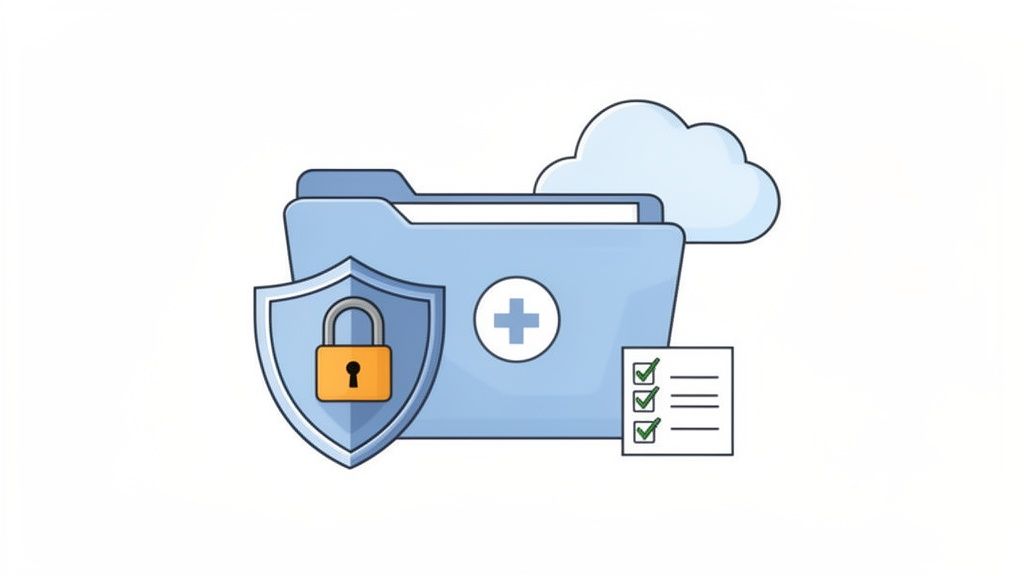
Think of it as a digital chain of custody for your case files. You wouldn't leave physical evidence sitting out in the open, and the same principle applies here. You need to know that those electronic records are locked down at every point in their journey—from the provider’s office all the way to your firm’s system. A good partner doesn't just bolt on security as an afterthought; they build their entire workflow around it.
The Bedrock of Compliance: HIPAA and BAAs
The Health Insurance Portability and Accountability Act (HIPAA) is the law of the land for protecting patient health information. Any third-party vendor handling PHI for your firm is legally considered a "Business Associate." This isn't just a title; it means they are legally bound to follow the same strict privacy and security rules you are. To get the full picture, you can review a detailed HIPAA compliance guide for healthcare providers.
This legal relationship is cemented with a Business Associate Agreement (BAA), a non-negotiable contract that clearly defines who is responsible for what when it comes to safeguarding PHI.
A vendor who drags their feet on signing a BAA—or worse, offers up a flimsy, generic template—is a massive red flag. A solid BAA is a sign that they take their legal duties as seriously as you take yours.
Never, ever work with a retrieval service without an ironclad BAA in place. It's your firm's primary legal shield and the clearest signal of a vendor’s commitment to doing things right.
Essential Security Credentials to Verify
Beyond the BAA, you need to see tangible proof of a vendor’s security chops. These aren't just technical buzzwords; they're verifiable standards that show a company has put in the work to shield your data from real-world threats.
Here's what you should be looking for:
- End-to-End Encryption: This is non-negotiable. It means client data is scrambled and unreadable from the second it leaves the provider until it’s safely in your hands. This protects information both while it's moving across the internet and when it's sitting in storage.
- SOC 2 Compliance: A Service Organization Control (SOC) 2 report is a big deal. It’s an independent audit confirming a vendor handles customer data according to five key principles: security, availability, processing integrity, confidentiality, and privacy. Think of it as the gold standard for enterprise-grade security.
- Secure Access Controls: The platform must let you control who sees what. You should be able to set user permissions so that only authorized team members can access specific case files, which helps prevent both internal and external breaches.
- Comprehensive Audit Trails: A detailed log that tracks every single action—who accessed a record, what they did, and when they did it—is crucial. It provides accountability and is your first line of defense if you ever need to investigate a security incident.
A vendor worth their salt will be completely transparent about their security protocols and welcome your questions. You can learn more about how these principles work in practice by exploring what goes into HIPAA-compliant document management systems. Ultimately, the right partner won't just tell you they’re secure; they’ll show you.
How to Choose the Right Retrieval Partner
Choosing a medical records retrieval service isn’t just about finding the cheapest option. Think of it as hiring a critical member of your team—one that can either supercharge your firm's engine or grind its gears to a halt. The right partner helps you close cases faster and more profitably. The wrong one just creates new headaches, leaving you stuck in the same old cycle of delays.
To make the right call, you have to look past the slick marketing and evaluate how a partner will hold up under the pressure of real casework. This means digging deep into their technology, their process, and their support to see if they truly align with your firm’s goals.
Go Beyond the Sales Pitch
Every vendor on the planet will promise you speed and accuracy. Talk is cheap. The only way to know for sure is to see their platform in action with your own cases.
The single best way to vet a potential partner is to run a small pilot program. Give them 7–14 of your active cases and see what happens. This gives you hard data, not just sales talk, and lets you measure what really counts:
- Turnaround Times: How long does it actually take to get a complete set of records in hand?
- Accuracy: Are the records correct? Are there missing pages or wrong date ranges?
- Responsiveness: What happens when a provider goes dark or there's an issue with an authorization? How does their team react?
A pilot program quickly reveals a vendor's true colors. A partner who proactively communicates when things go wrong is infinitely more valuable than one who only calls when the sun is shining.
Evaluate the Entire Workflow, Not Just Retrieval
A modern retrieval service should do a lot more than just dump a 500-page PDF in your inbox. The real value is in what happens after the records show up. The best platforms are built to support your entire case preparation workflow, from the initial request all the way to a draft demand letter.
The goal isn't just to get documents faster; it's to get to a settlement-ready case faster. A vendor that only solves one piece of the puzzle still leaves your team buried in weeks of manual review and summarization.
When you're looking at a service, ask yourself a simple question: Does this tool actually reduce my team's workload, or does it just shift the bottleneck to a different part of the process? The most advanced AI-powered platforms deliver organized, searchable chronologies that make manual data entry obsolete, freeing up your paralegals for the work that truly matters.
Your Vendor Evaluation Checklist
Coming into a demo with the right questions is half the battle. This checklist will help you cut through the noise and compare potential partners on the criteria that will have the biggest impact on your firm.
Vendor Evaluation Checklist
| Evaluation Criteria | Key Questions to Ask | Importance (High/Medium/Low) |
|---|---|---|
| Technology & Automation | Does the platform use AI to automatically extract key data like diagnoses, providers, and treatment dates? | High |
| Integration | Can the service integrate with our existing case management software to avoid duplicate data entry? | High |
| HIPAA & Security | Can you provide documentation of your SOC 2 compliance and a copy of your standard Business Associate Agreement (BAA)? | High |
| Turnaround Time | What are your average retrieval times, and do you offer guarantees or SLAs for urgent requests? | High |
| Support & Reliability | What does your customer support process look like when a provider is unresponsive or a record is incomplete? | Medium |
| Pricing Model | Is your pricing a flat fee per request, or are there variable provider costs? How are these costs communicated? | Medium |
Taking this kind of structured approach ensures you find a medical records retrieval service that acts as a strategic asset, not just another vendor. When you focus on the total workflow impact, real-world performance, and airtight security, you can confidently choose a partner that will help your firm grow, improve efficiency, and get better results for your clients.
Best Practices for a Smooth System Rollout
Bringing a new medical records retrieval service into your firm should feel like adding a turbocharger, not replacing the engine while you're driving. A great rollout isn't just about technology; it's about people and process. Without a smart implementation plan that gets your whole team on board, even the most powerful platform will just sit in the garage.
The work starts long before you go live. You have to build a case for the change internally. Show everyone, from partners to paralegals, what’s in it for them. It’s about demonstrating how this new tool eliminates the soul-crushing administrative grind, freeing them up to practice law and build stronger cases. Getting that initial buy-in is everything.
A big-bang, firm-wide launch can be chaotic. A much safer bet is a phased rollout. Start small. Pick a pilot team of your most tech-forward staff or apply the new system to a specific type of case first. This lets you iron out the wrinkles in a controlled environment. This small group becomes your team of internal experts, and their success stories create the momentum you need for a firm-wide adoption.
Training and Protocol Development
Good training isn't a one-hour webinar showing off software features. It has to be grounded in the day-to-day reality of each role. Your case managers need to see exactly how this tool fits into their workflow, and attorneys need to understand how to access the final, organized records. The best sessions are hands-on, using anonymized files from real cases.
Once people get the hang of it, you need to lock in the new process with clear, documented protocols. Think of it as your firm’s new playbook for handling medical records. It should spell out:
- Starting a Request: Who kicks off a retrieval order? What information do they need to have ready?
- Checking on Progress: How do we track open requests? Who is responsible for monitoring the dashboard?
- Handling Delivered Records: What’s the procedure when records arrive? How are they named, saved, and linked to the case file in our practice management software?
Clear rules prevent confusion and ensure your team is using the new service the right way from the very beginning.
Measuring Success with Clear KPIs
You can’t just feel more efficient; you have to prove it. To understand the real value of your investment in a medical records retrieval service, you need to track its impact with hard numbers. Forget vague goals like “improving workflow.” Get specific with Key Performance Indicators (KPIs).
A well-chosen platform should deliver measurable wins. By tracking the right KPIs, you can move beyond gut feelings and use concrete data to show exactly how the system is paying for itself.
Here are the essential metrics to watch:
- Average Retrieval Time: How much faster are you getting records now compared to your old manual process?
- Staff Hours Saved: Calculate the time your team is no longer spending on phone calls, faxes, and follow-ups.
- Case Cycle Velocity: Are you sending demand letters out sooner? Measure the time from intake to demand to see the impact on your case pipeline.
By focusing on a structured rollout, practical training, and data-driven results, you can turn a new software subscription into a core strategic asset for your firm.
Frequently Asked Questions
It's natural to have questions when you're thinking about changing a process as fundamental as how you handle medical records. Here are some of the most common ones we hear from personal injury firms, along with straightforward answers.
How Much Time Can Our PI Firm Realistically Save?
The time savings are substantial. Firms that switch to an AI-powered service often cut out more than 10 hours of administrative work per case.
Think about the traditional chase for records, which can easily drag on for 60-90 days. A modern platform crushes that timeline down to just 10-12 days. This isn't just about getting files faster; it's about settling cases sooner and freeing up your team to focus on higher-value legal work instead of follow-up calls and faxes.
Is It Truly Secure to Use a Third-Party Retrieval Platform?
Absolutely—as long as you choose the right partner. Reputable, HIPAA-compliant vendors build their entire business on trust and security. They use features like end-to-end encryption and tightly controlled access to safeguard your clients' most sensitive information.
Choosing a retrieval partner is a security decision. Always insist on signing a formal Business Associate Agreement (BAA) and verify their security certifications, like SOC 2 compliance, before entrusting them with any client information.
Doing this homework is crucial. It protects your clients, and it protects your firm's reputation.
How Does This Service Help Create a Better Demand Letter?
This is where the real magic happens. A great service doesn't just dump a 1,000-page PDF on your desk. It organizes the chaos. Using AI, it extracts the crucial details—diagnoses, treatments, providers, and dates—and arranges them into a clean, chronological summary.
Your team can see the entire medical narrative in minutes, not days. This organized intelligence provides the rock-solid factual foundation for a more persuasive, accurate, and evidence-driven demand letter. You're starting negotiations from a position of strength.
Can These Services Get Records from Any Healthcare Provider?
Yes, a full-service platform is built to do just that. They are experts at navigating the entire healthcare system, from massive hospital networks and their complex EHR portals to small specialty clinics, chiropractors, and local pharmacies that might still rely on paper.
The top vendors have refined their processes for dealing with every kind of provider. This means you can count on getting a complete, gap-free medical history for every single case.
Ready to eliminate administrative bottlenecks and accelerate your case settlements? Ares provides an AI-powered platform that automates medical record review and demand letter drafting, turning chaotic case files into clear, actionable insights in minutes. Discover how to save over 10 hours per case by visiting https://areslegal.ai.