For any personal injury firm, medical records are the lifeblood of a case. But getting your hands on them often feels like an uphill administrative battle. This is where medical records retrieval services come in—they are specialized partners that handle the entire process of requesting, tracking, and organizing this critical health information for you.
Think of it as transforming a chaotic, manual scavenger hunt into a smooth, predictable workflow. The end goal? To save your law firm a massive amount of time, money, and headaches.
Why Outsourcing Medical Records Retrieval Is a Smart Move
In a personal injury practice, gathering a client's medical records isn't just another box to check. It's the absolute foundation of a strong case. Every single diagnosis, treatment note, and prescription helps build the story of your client's injury and proves their damages.
But when you handle this in-house, the process is notoriously clunky and full of frustrating roadblocks.
Imagine you're trying to build a complex engine, but the parts are spread across fifty different warehouses, and each one has its own weird ordering process, different business hours, and unpredictable shipping times. That's a pretty good picture of what manual retrieval feels like. Your paralegals and legal assistants spend hour after hour hunting down provider information, sending requests by fax (yes, still fax!), making endless follow-up calls, and juggling invoices. This isn't just a time-suck; it's a serious drain on your firm's most valuable resources.
The Real Price of Doing It Yourself
The bottlenecks in manual retrieval create a ripple effect that slows down the entire firm. When records are delayed, cases stall. When requests have errors, you end up with incomplete evidence. All that time spent chasing down paperwork is time your best people can't spend on high-value legal work.
This directly impacts your firm's performance in a few key ways:
- Case Timelines: Just waiting on records can easily add weeks, or even months, to a case, pushing back settlements and resolutions for your clients.
- Settlement Values: A disorganized or incomplete medical file weakens your negotiating position, which can lead to lower settlement offers from the other side.
- Firm Profitability: The labor costs tied to these non-billable administrative tasks cut directly into your firm's bottom line.
A dedicated medical records retrieval service acts as your expert partner, taking over the entire lifecycle of a request. Instead of a box of scattered parts, you get a perfectly assembled, case-ready file delivered right to you.
This is exactly why professional medical records retrieval services offer such a powerful strategic advantage. By offloading this specialized function, firms can get cases moving faster and free up their legal teams to focus on what they do best: building a winning strategy and fighting for their clients. Honestly, rethinking this one process might be one of the most impactful changes a PI firm can make to boost both efficiency and outcomes.
What Does the Retrieval Workflow Actually Look Like?
Getting medical records from a provider's office into your case file isn't as simple as just asking for them. It’s a multi-stage marathon that can be riddled with frustrating delays and clerical errors if you don't know the course. Let's walk through what the end-to-end process really involves.
The entire journey is built on a bedrock of legal compliance and painstaking verification, starting with the single most important document: the HIPAA authorization form. Without a valid, properly executed form signed by your client, no provider will release a single page of Protected Health Information (PHI). This isn't just a formality; a simple mistake like a missing date, an illegible signature, or incorrect provider information will get the request kicked back immediately, sending your team back to square one.
Phase 1: Kicking Things Off with Authorizations and Provider Verification
Once you have a solid authorization, the real detective work begins. You have to identify every single place your client received care. It's rarely just one hospital. More often, it’s a scattered web of primary care doctors, specialists, imaging centers, physical therapists, and pharmacies.
Your team has to find the right records custodian at each location. Sending a request to the wrong department is an incredibly common—and costly—mistake that can add weeks, or even months, to your timeline.
After you've identified the right people, you have to submit the request, and every provider seems to have their own preferred method:
- Online Portals: Large hospital systems often force you to use their own clunky online portals, each with its own unique login and submission quirks.
- Fax and Mail: Believe it or not, a huge number of smaller practices and older facilities still operate on fax or snail mail, which introduces a whole new level of uncertainty. Did they get it? Who knows.
- Third-Party Services: To complicate things further, some providers outsource their records management entirely. Now you’re dealing with yet another company and its unique process.
This flowchart shows the stark difference between a typical manual retrieval process and one managed by a dedicated service.
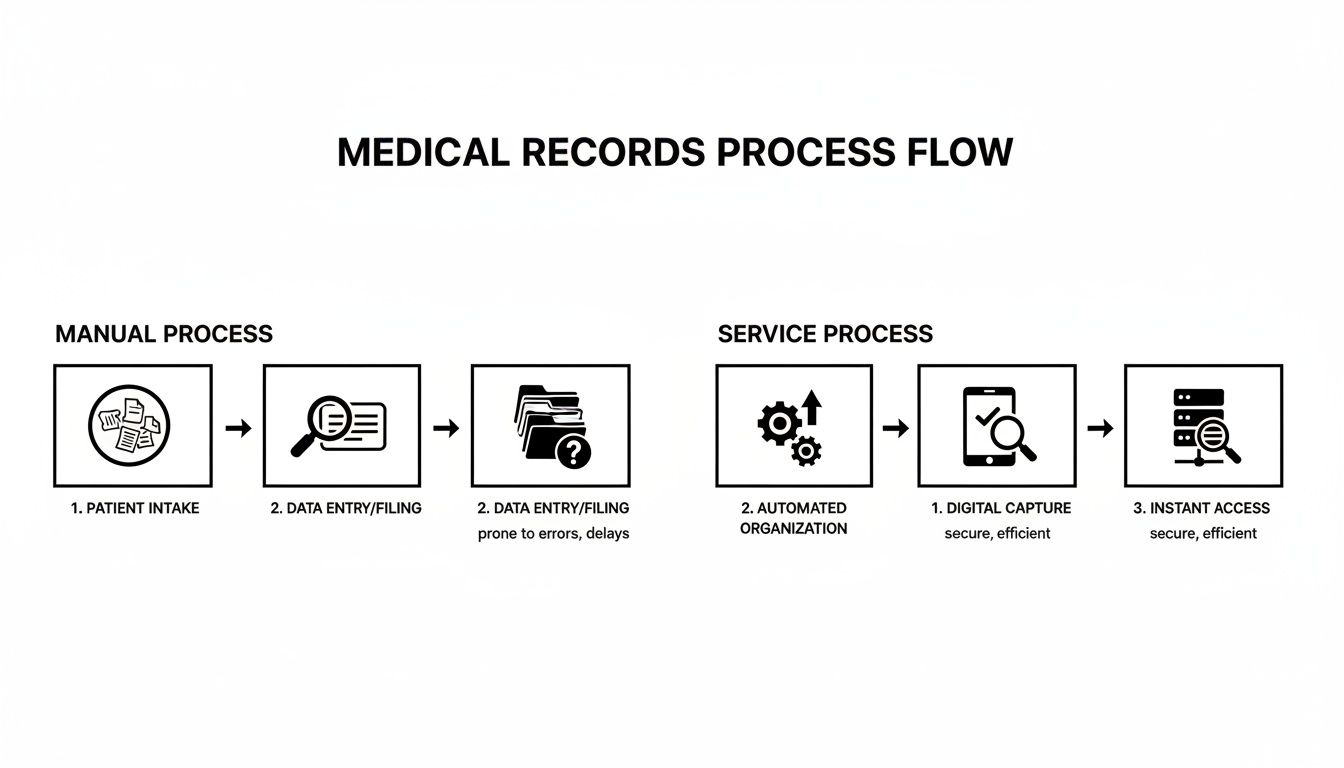
As you can see, a structured service takes all that chaotic, multi-channel communication and funnels it into a single, predictable system you can actually track.
Phase 2: The Art of the Follow-Up and Settling Invoices
Just sending the request is only the start. Without persistent, professional follow-up, your request will likely end up at the bottom of a very tall pile in a busy records department. This is where most in-house efforts burn the most time and money.
The success of medical records retrieval often hinges on the quality of the follow-up. It's an active, persistent process of communication, not a passive "send and forget" task.
This means systematically tracking every single request and making regular contact—often daily—to confirm it was received, check its status, and troubleshoot any holdups. On top of that, providers charge for their time and materials. These invoices have to be paid promptly, or they won't release the files. A professional service handles all these financial transactions, paying the providers directly and giving your firm a single, consolidated bill.
Phase 3: Quality Control and Secure Delivery
When the records finally arrive, you can’t just assume they’re correct. The last step is a rigorous quality control check. The documents have to be compared against the original request to make sure nothing is missing. Are all the date ranges covered? Is everything legible? Are there corrupted digital files or missing pages?
Finding these mistakes early is crucial. If an error is spotted, the retrieval service goes back to the provider to get it fixed—a task that would otherwise eat up your paralegals' valuable time.
Only after passing this quality check are the records organized, digitized, and securely delivered to your firm. This complete, end-to-end management turns a chaotic and frustrating process into a reliable, predictable workflow, giving your legal team the complete and accurate information they need to build a winning case.
Navigating HIPAA Compliance in Records Retrieval
When it comes to retrieving medical records, compliance with the Health Insurance Portability and Accountability Act (HIPAA) isn't just a box to check—it's the foundation of the entire process. For personal injury firms, the moment you handle a client's medical information, you become a "business associate" under HIPAA. This designation means you share the legal responsibility for protecting that data just as rigorously as the healthcare provider does.
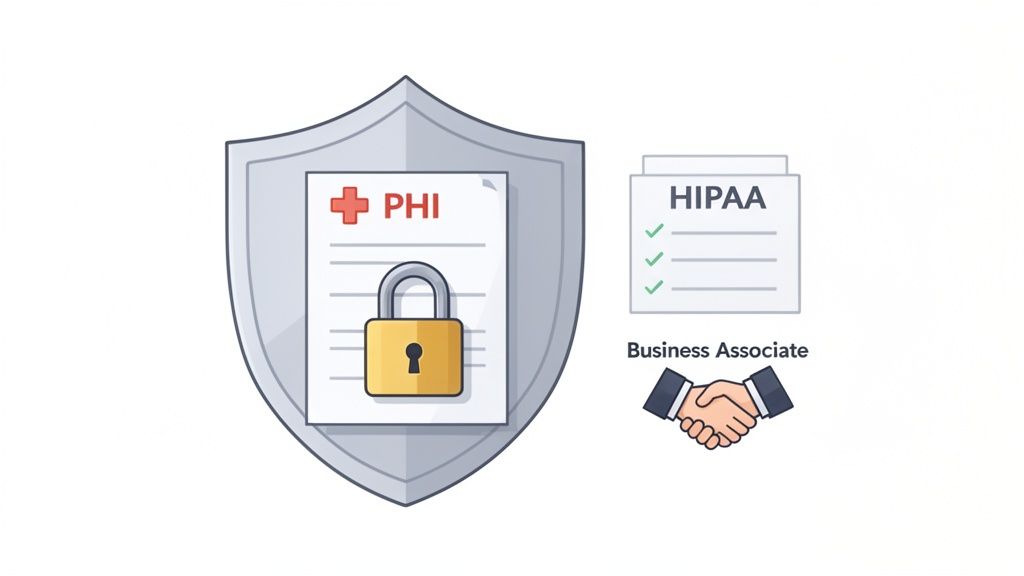
Getting this wrong goes far beyond the risk of fines. A compliance slip-up can torpedo a client’s case and inflict serious damage on your firm's reputation. HIPAA exists to protect Protected Health Information (PHI)—any piece of data that could identify a patient, from their name and address to the specifics of their diagnosis.
The Anatomy of a Valid Authorization
Every single records request hinges on a signed HIPAA authorization form from your client. You have to understand that providers examine these forms with a fine-toothed comb. Any mistake, no matter how small, will get the request kicked back, grinding your case momentum to a halt.
For an authorization to be valid, it absolutely must include these key elements:
- A specific description of the PHI to be released.
- The name of the person or firm authorized to request the records (that's you).
- The name of the person or firm the records can be disclosed to.
- An expiration date or a specific event that triggers expiration.
- The client's signature and the date it was signed.
If even one of these components is missing, the form is worthless. This is precisely where in-house, manual processes so often fail—the devil is truly in the details.
"Proper summarization of medical documents preserves patient privacy and data integrity. The American Bar Association advises attorneys to consistently follow HIPAA regulations on the safekeeping, sharing, and enforcement requirements for health care providers and others who handle PHI."
This really drives home the legal and ethical tightrope your firm walks. The stakes are incredibly high, with civil penalties potentially soaring over $2 million per violation and the threat of criminal charges for willful neglect. For a more detailed look at the regulations, this HIPAA Compliance Faxing Healthcare Guide is a fantastic resource.
De-Risking Your Firm with Professional Services
This is where professional medical records retrieval services and modern AI platforms become an essential safeguard. Their systems are built with compliance as the central pillar, effectively wrapping your firm's retrieval workflow in a layer of expert protection.
These partners manage the entire chain of custody to meet strict legal standards. They do everything from pre-flighting authorization forms for accuracy to delivering documents through secure, encrypted portals. To get a better handle on managing these files securely, check out our guide on HIPAA-compliant document management.
At the end of the day, working with a compliant retrieval partner is a smart risk management move. It offloads the complex and high-stakes burden of HIPAA to specialists, freeing up your team to focus on winning the case, confident that your client’s sensitive data is in safe hands.
Comparing Retrieval Models: In-House vs. Outsourced vs. AI
Deciding how to get your hands on medical records isn't just an administrative choice—it’s a strategic one that shapes your firm's entire workflow. The right approach can unlock efficiency and growth, while the wrong one can bog your team down in a sea of paperwork and follow-up calls.
Essentially, you have three paths you can take: keep it all in-house, hand it off to a traditional vendor, or embrace a modern AI-powered platform. Each has its own distinct pros and cons, and understanding them is the first step toward building a more effective practice.
The In-House Approach: Control at a Cost
Handling retrieval internally means your team manages everything. You have complete control, from drafting the initial requests to chasing down providers and paying invoices. On the surface, this level of oversight can feel like the safest bet.
But that control comes with a hefty price tag, paid in your team’s most valuable resource: time. Paralegals and legal assistants can easily sink hundreds of non-billable hours every month into the frustrating cycle of phone calls, faxes, and portal logins. This isn't just an overhead expense; it's a massive distraction that pulls your best people away from the high-value work that actually moves cases forward.
Even with physical records, managing the paper trail is a job in itself. While solutions like advanced mobile shelving for medical records can help keep things organized, the core problem remains. As your firm grows, the operational bottlenecks of an in-house system almost always start to outweigh the benefits of direct control.
Traditional Outsourcing: Offloading the Legwork
For years, the go-to solution for firms drowning in retrieval work has been to outsource to a traditional vendor. This model is straightforward: you pay another company to take the administrative headache off your plate. They handle the follow-ups and paperwork, freeing up your team to focus on legal strategy.
This is a clear improvement over the in-house grind, but it often trades one set of problems for another. Communication can feel like a black box, with slow responses and unclear status updates. Pricing can also be a frustration, with confusing per-page fees and hidden costs that make it nearly impossible to budget accurately.
The real value of a traditional vendor is labor arbitrage—they do the manual work so you don't have to. It's a helpful service, but it doesn't fundamentally make the retrieval process any faster or smarter.
And their job is usually done the moment the records land on your desk. Your team is still left facing a mountain of documents, with the monumental task of sifting through thousands of pages to piece together the case narrative.
The AI Platform: A True Evolutionary Leap
The third option is where things get interesting. An AI-powered platform takes the best of both worlds—offloading the workload like a traditional vendor but layering on the speed, intelligence, and analytical power of modern technology.
This is more than just a medical records retrieval service; it's a complete workflow solution. An AI platform automates the entire request and follow-up process, slashing turnaround times. But the real game-changer is what happens after the records arrive. The AI engine reads, digests, and organizes the entire medical history in a matter of minutes.
Suddenly, a chaotic stack of documents is transformed into structured, case-ready intelligence. The system can instantly generate:
- Medical Chronologies: A clean, easy-to-read timeline of every appointment, diagnosis, and procedure.
- Key Data Extraction: Pinpointing critical information like providers, treatment dates, and billable expenses without manual review.
- Actionable Summaries: High-level overviews that give attorneys a firm grasp of the case facts in a fraction of the time.
The industry is clearly moving in this direction. The retrieval market is projected to grow from $1.1 billion to $2.8 billion by 2034, and a telling 47.40% of law firms already rely on external vendors to escape the inefficiency of in-house processes. You can find more details on these trends and PI case statistics over at GetCodesHealth.com.
For a personal injury firm, this is a massive strategic advantage. An AI platform like Ares doesn't just get you records faster; it accelerates your entire case development cycle, empowering you to build stronger arguments and manage a larger caseload without burning out your team.
Comparison of Medical Records Retrieval Models
To make the differences even clearer, here's a side-by-side look at how the three models stack up across the attributes that matter most to a busy law firm.
| Attribute | In-House Team | Traditional Vendor | AI-Powered Platform |
|---|---|---|---|
| Control | Maximum control over the entire process | Limited visibility; reliant on vendor updates | Full transparency with real-time dashboards |
| Speed | Slow; dependent on staff bandwidth | Moderately slow; subject to vendor delays | Fastest; accelerated by automation |
| Cost | High overhead (staff salaries, non-billable hours) | Predictable but can have hidden per-page fees | Transparent subscription or flat-rate pricing |
| Staff Burden | Very high; diverts staff from core legal work | Low; workload is fully offloaded | Very low; eliminates manual follow-up and review |
| Scalability | Poor; struggles as caseload grows | Good; can handle volume but may slow down | Excellent; built to scale with your firm's growth |
| Post-Retrieval | All manual review and analysis is on your team | Delivers raw documents; no analysis provided | Automates review, summarization, and chronologies |
| Technology | Manual processes (phone, fax, portals) | Primarily manual labor with basic tech | Advanced AI, automation, and data analytics |
Ultimately, choosing the right model comes down to your firm's specific goals. While in-house offers control and traditional vendors offer convenience, an AI platform provides a comprehensive solution that addresses both the retrieval and the review, setting your firm up for a more efficient and profitable future.
How to Choose the Right Retrieval Service for Your Firm
Picking the right partner for medical records retrieval is a huge decision, one that directly impacts your firm's efficiency, security, and bottom line. This isn't just about finding the cheapest vendor; it's about making a strategic investment that fits your workflow and helps you grow. To make a smart choice, you need to look past the sales pitch and evaluate what really matters.
Think of it like hiring a key employee. You wouldn't bring on a new paralegal without checking their references and really understanding their capabilities. You should apply that same level of diligence when choosing a retrieval service. Your checklist needs to focus on tangible proof of performance, ironclad security, and reliable support.
Evaluating Turnaround Time and Technology
The first question on every lawyer's mind is, "How fast can you get me the records?" Speed is obviously critical, but don't settle for a vague answer. You need to dig for specifics.
- Ask for Turnaround Guarantees: What are their average and maximum delivery times? Do they have service-level agreements (SLAs) that put those guarantees in writing?
- Assess the Platform’s Usability: Always ask for a live demo. Is the dashboard intuitive? Can you track the status of your requests in real-time, or are you just sending them into a black hole?
- Check for Integration Capabilities: Find out if their platform can connect with your existing case management software. A smooth integration eliminates the soul-crushing manual data entry that wastes so many billable hours.
A modern, easy-to-use platform with transparent reporting is a great sign you're dealing with an efficient and reliable partner.
Verifying Security and Pricing Transparency
In our line of work, where data privacy is everything, security is non-negotiable. We're dealing with a massive digital healthcare ecosystem—the Electronic Health Records (EHR) market is expected to reach $45.55 billion by 2035. And with 96% of non-federal hospitals already on EHR systems, your retrieval partner absolutely must be equipped to handle digital records securely. You can discover more insights about the EHR market and its growth on towardshealthcare.com.
A vendor’s HIPAA compliance is your firm’s compliance. Don't take their word for it—demand proof. Ask to see their certifications, security audit reports (like SOC 2), and detailed data protection protocols.
Just as important is getting a straight answer on cost. Far too many traditional vendors hide their fees in confusing, per-page pricing models that make budgeting a nightmare.
- Demand a Transparent Pricing Structure: Get a clear, itemized breakdown of all potential fees. Are there separate charges for follow-ups, provider fees, or digital delivery?
- Inquire About Hidden Costs: Ask point-blank about cancellation fees, rush charges, or extra costs for tracking down records from hard-to-reach providers. A reputable service will be completely upfront.
Assessing Support and Scope of Services
Finally, don't forget the human element and the full range of services they offer. When a request inevitably hits a roadblock, you need to know an expert team has your back and is ready to solve the problem.
Put their customer support to the test while you're still vetting them. How quickly and completely do they answer your questions? If they're slow to respond now, imagine how it will be when you're a client with an urgent deadline.
Also, look beyond basic retrieval. What other value can they bring to the table? The best partners do more than just fetch documents; they actually improve your workflow. For instance, some advanced AI platforms can automatically organize and summarize records the moment they arrive. If you're serious about optimizing your process after the records are in hand, a partner who offers a quality medical record review service can give you a massive strategic advantage, turning mountains of raw data into the case intelligence you need to win.
Using AI to Speed Up Case Review and Strategy
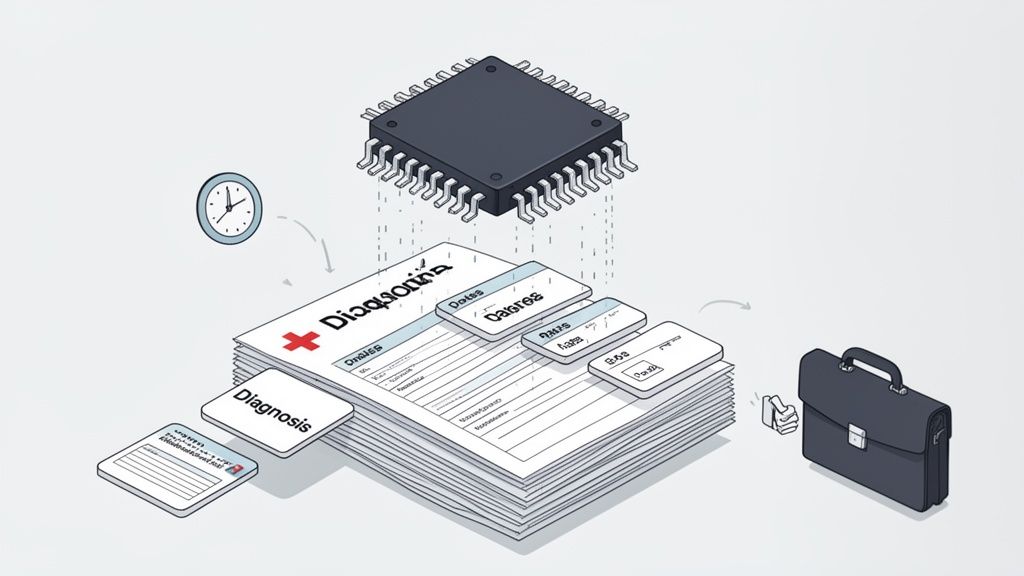
Getting that complete stack of medical records is a huge step, but let's be honest—it's just the starting line. The real grind begins now. That's the painstaking, page-by-page manual review of hundreds, sometimes thousands, of documents to find the handful of facts that will make or break your case. This is precisely where modern AI platforms offer a serious competitive edge, going far beyond just fetching documents to delivering genuine case intelligence.
Imagine this: instead of your best paralegal spending days locked in a room, reading every single line, an AI engine ingests the entire medical file in minutes. It automatically pulls out and neatly organizes all the critical data points, no matter how scattered they are across different EMR formats and provider notes. This isn't just a minor tweak to your workflow; it's a fundamental shift from having the documents to instantly understanding what’s inside them.
From Raw Data to Actionable Insights
The magic of AI is its ability to create order from chaos. Think of it like being handed a giant, messy box of receipts and having a tool that instantly turns it into a perfectly balanced, itemized spreadsheet. A sophisticated AI platform does the same for medical records, automatically finding and sorting the details that matter most for a personal injury claim.
This automated process can immediately pinpoint things like:
- Diagnoses and Conditions: Every single ICD code and official diagnosis is flagged and categorized.
- Treatment Timelines: A clean, chronological list of every appointment, procedure, and therapy session is created.
- Key Providers: The system identifies all involved physicians, specialists, and facilities.
- Medical Expenses: It extracts billable items and costs to help you build out the damages.
This structured data becomes the solid foundation for your entire case. For PI attorneys, the payoff is immediate and significant.
By transforming raw records into organized, searchable data, AI doesn't just save time—it deepens an attorney's grasp of the case facts, exposing strengths and weaknesses that might otherwise remain buried in the paperwork.
Accelerating Case Preparation and Strategy
Ultimately, the real win here is how much faster your entire workflow becomes. When you have structured medical data ready to go, you can generate core case documents that used to take days of manual labor. For personal injury firms, learning more about how AI can supercharge your practice is essential for staying competitive.
For instance, an AI platform can produce a detailed medical chronology in moments. This clean, event-by-event timeline gives you a clear narrative of your client's journey from injury through recovery—the very story you need to build a compelling argument.
Even better, you can use that organized data to create a strong first draft of a demand letter. The AI assembles all the key facts—diagnoses, treatments, providers, and dates—into a coherent summary that forms the backbone of your settlement package. Your team can jump from review to drafting in a fraction of the time, putting you in a stronger negotiating position from day one. This kind of efficiency means your firm can handle more cases without burning out your staff.
Your Top Questions About Medical Records Retrieval, Answered
Making a switch in how your firm handles medical records brings up a lot of questions. It’s a big decision. Let’s tackle some of the most common things PI attorneys and paralegals ask when they're considering a professional retrieval service.
What’s the Real Cost of Medical Records Retrieval?
There really is no simple "average" cost, because the price tag completely depends on the service model. Many traditional vendors still charge by the page, a model that can get wildly expensive and unpredictable, especially for clients with long and complicated medical histories. And that's before you even factor in the provider fees, which can run anywhere from a few bucks to hundreds of dollars for a single request.
This is where newer AI platforms have really changed the game. They usually offer a flat-rate or subscription fee, which makes budgeting a whole lot easier. You get predictable costs, and these services often bundle the retrieval with powerful analysis tools, so you’re getting more value and avoiding the surprise invoices that are so common with older pricing methods.
How Long Does It Actually Take to Get Records?
Honestly, the timeline can be all over the map, stretching from a couple of weeks to, in some painful cases, several months. Delays are the norm, not the exception, and they happen for a few key reasons.
- Slow Provider Response: Big hospitals are swamped and smaller clinics are often short-staffed. Processing your request is rarely their top priority.
- Simple Clerical Errors: One tiny mistake on a HIPAA authorization form—a missed signature or an incorrect date—and the provider will reject it outright. You’re back to square one.
- The Follow-Up Grind: An in-house team juggling multiple cases just doesn't have the time to make the constant phone calls and send the persistent emails needed to push a request through the system.
Modern platforms cut this waiting time down dramatically. They automate the initial request to ensure it’s perfect, then keep up the pressure with automated follow-ups, which frees up your team and gets records in hand much faster.
If Our Vendor Has a HIPAA Breach, Are We on the Hook?
Yes. One hundred percent. Under HIPAA rules, a retrieval service is considered your "business associate." This creates a legal partnership where both you and your vendor are responsible for safeguarding your client’s protected health information (PHI). If they have a data breach, your firm isn’t immune—you can face serious penalties and legal trouble right alongside them.
This is precisely why vetting a partner's security and compliance isn't just a box to check. It's a critical risk management step to protect your clients, your reputation, and your firm's bottom line.
How Is an AI Platform Different from a Standard Retrieval Service?
This is the most important question to ask, because the difference is huge. A standard, old-school retrieval vendor has one job: go get the documents. They do the manual legwork of sending requests and collecting records, then drop a massive, unorganized PDF on your server. Their job ends right when your most tedious work—reviewing everything—begins.
An AI-powered platform, on the other hand, handles the entire process from start to finish. It doesn’t just retrieve the documents more efficiently; it reads, understands, and organizes the information inside them. It turns a mountain of raw medical data into something you can actually use, like a clean medical chronology or even a first draft of a demand letter. It saves an incredible amount of time for your paralegals and attorneys.
Ready to stop chasing paperwork and start building stronger cases faster? See how Ares uses AI to automate medical record review and accelerate your entire workflow. Learn more and get started at https://areslegal.ai.