
Six weeks before mediation, a plaintiff's paralegal receives a medical-records request from defense counsel. The client has gaps in treatment, the defense is likely to use them against causation and damages, and the production deadline now competes with the mediation brief. The request looks routine until someone asks the questions that matter: Was the subpoena properly issued? Was the patient given the notice required by state law? Does the authorization cover the requested records? Are psychotherapy notes, substance-use treatment records, or other specially protected material sitting inside the production set?
A medical records subpoena is an evidence pipeline, not a formality. The reliable approach treats it as a HIPAA-and-state-law compliance workflow, with deliberate scope control, documented service, response triage, objection handling, and human review before protected health information leaves the file.
Why Medical Records Subpoenas Trip Up Even Experienced PI Teams
Personal-injury cases often turn on chronology. The records must show what happened before the incident, what changed afterward, which providers treated the claimed injuries, and whether the treatment supports the damages theory. A request that arrives late, reaches the wrong custodian, or produces an unfiltered electronic health record can create problems at precisely the point when counsel needs dependable evidence.
The federal baseline is more nuanced than many intake checklists suggest. The HIPAA Privacy Rule framework established in 2000 distinguishes a court order from a subpoena issued by an attorney or court clerk. Under HHS guidance on court orders and subpoenas, a covered provider or health plan may disclose subpoenaed protected health information only when the applicable notification requirements are satisfied. A judge-signed order is not treated the same way as an attorney-issued demand.
Practical rule: Never treat a subpoena as self-executing. Confirm authority, notice, scope, and the provider's disclosure basis before production.
State law adds another layer. Arizona, for example, requires a subpoena seeking medical or payment records to be served on the provider and all parties at least 10 days before the production date, and it permits production only when specified authorization, court-order, investigative, regulatory, or statutory conditions are present, as set out in Arizona Revised Statutes § 12-2294.01. Maryland uses a different structure, requiring certified-mail notice to the patient at least 30 days before disclosure and allowing release only after the objection process is complete or a court authorizes disclosure.
The workflow therefore has two sides. Issuing counsel must draft narrowly, attach valid supporting documents, and prove service. Receiving counsel or the custodian must validate the request, identify protected categories, and choose among compliant production, objection, or court protection.
The stakes aren't limited to delay. Improper disclosure can create privacy and liability exposure, while an invalid response can leave the case without usable records. The most reliable teams use automation for classification and review, then preserve attorney checkpoints for sensitive material and legal judgment.
Anatomy of a Compliant Medical Records Subpoena Draft
A sound subpoena begins with identification. The caption should match the personal-injury action, include the court and case number, and identify the named records custodian with enough precision that the provider knows which department must respond. The command should request production from that custodian, not vaguely from an institution with multiple facilities and separate record systems.
Scope is the drafting decision that controls nearly everything afterward. Tie the request to the incident date, the claimed injury, and a defensible treatment window. Name providers and facilities when known. Identify categories such as histories and physicals, diagnostic imaging, laboratory results, operative reports, discharge summaries, itemized billing, and payment records. Exclude unrelated treatment, genetic information, and mental-health material unless the case and applicable law justify a separate request.
Psychotherapy notes require special care. HHS treats them as separate from the rest of the medical record, and they generally require patient authorization even when other medical records may be disclosed. A request for “all medical records” doesn't automatically reach those notes. The subpoena should state the exclusion expressly and identify any separate authorization or court process required for a specific request.
The authorization should appear as a separate exhibit, not buried in the subpoena text. Review the patient's signature, the information covered, the recipient, the purpose, the expiration date or event, and the required disclosure statements. If the subpoena relies on patient notice or a qualified protective order instead, preserve the documents proving that basis.
Production instructions should also answer practical questions. Request searchable electronic files when available, itemized billing ledgers rather than summary balances, and a custodian declaration suitable for the governing evidence rules, such as Evidence Code 1158 or Federal Rule of Evidence 902(11), where applicable. Include a clear production deadline and a contact line for objections or accommodation requests.
For a broader explanation of how HIPAA requirements interact with subpoena practice, see this HIPAA and subpoenas guide.
Required elements of a medical records subpoena
| Element | Purpose | Common pitfall |
|---|---|---|
| Case caption and court information | Identifies the litigation and issuing authority | Mismatched case numbers or incomplete court details |
| Named custodian and provider | Directs the request to the responsible record holder | Addressing a general corporate office without a records contact |
| Narrow records description | Limits production to relevant material | Using “any and all records” without dates or categories |
| HIPAA authorization or disclosure basis | Establishes permission or a compliant subpoena pathway | Treating an attorney-issued subpoena as equivalent to a court order |
| Psychotherapy-note carve-out | Prevents automatic inclusion of specially protected notes | Assuming the ordinary chart includes every mental-health record |
| Format and authentication instructions | Makes the production usable and admissible | Receiving image files without billing detail or custodian certification |
| Deadline and objection contact | Creates a workable response process | Setting a date without accounting for statutory notice periods |
The drafting trade-off is straightforward. A broad request may seem safer because it captures more files, but it also invites objections, delays review, and increases the risk of overproduction. A targeted request gives counsel a cleaner record set and a stronger answer when the custodian or opposing party challenges relevance.
Serving the Subpoena and Meeting State-Law Notice Windows
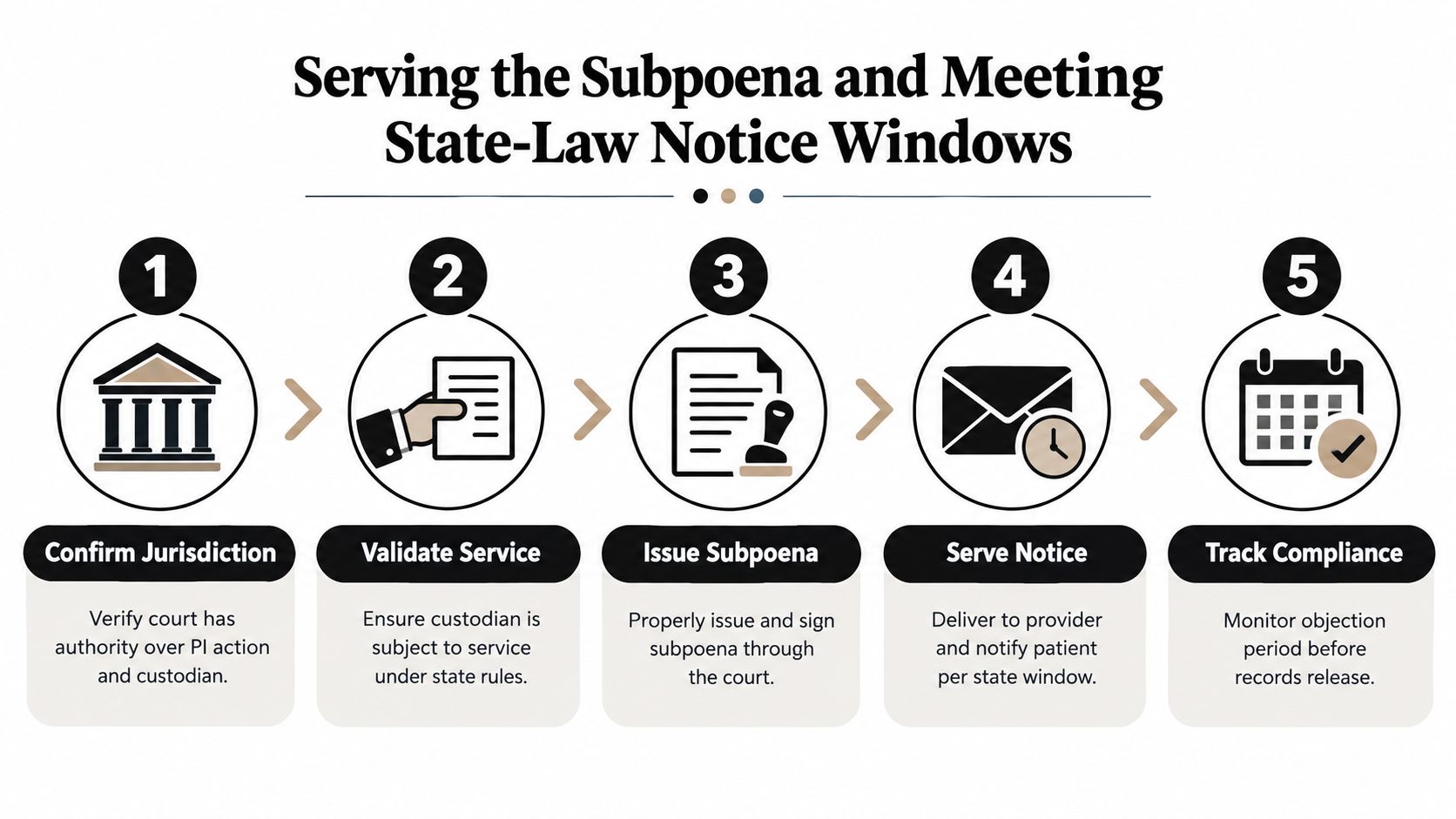
Service starts with jurisdiction, not delivery. Confirm that the court has authority over the action and that the records custodian is subject to service under the applicable state rule, long-arm provision, or business-records procedure. Electronic delivery may be operationally convenient, but it doesn't replace the service method required by the governing jurisdiction.
The provider's records custodian must receive the subpoena through the authorized channel. The patient whose records are sought and the parties entitled to notice must also be served as required. In a PI case, that commonly includes the plaintiff and opposing counsel. If an insurer or other interested entity has a legally relevant role, check whether local procedure requires notice to that entity as well. Failure to serve the patient is a common route to a motion to quash because the patient may lose the opportunity to object before disclosure.
State deadlines can change the entire schedule. Arizona requires service on the provider and all parties at least 10 days before the production date, subject to the statutory conditions described above. Maryland requires certified-mail notice to the patient at least 30 days before disclosure, with release delayed until the objection period has passed, disputes are resolved, or a court authorizes production. Those rules demonstrate why counsel must check the governing state statute rather than rely on a generic office template.
Service records belong in the case file
Send the subpoena, authorization, patient notice, and any protective-order papers together when the procedure requires them. Keep the signed original or court-issued copy, affidavit of service, certified-mail receipt, delivery confirmation, and any electronic-service consent. A production dispute often turns less on what counsel intended than on what counsel can prove.
Use the medical records retrieval process as an operational reference, but verify the controlling state rule for the particular action. Serve early enough to absorb a protective-order motion, a custodian clarification request, or a corrected service event before depositions and mediation preparation close.
A useful calendar entry should identify every event separately: provider service, patient notice, objection deadline, production date, follow-up date, and motion deadline. Combining them into one “subpoena due” reminder is how a technically valid request becomes operationally late.
How to Triage and Respond to an Incoming Medical Records Subpoena
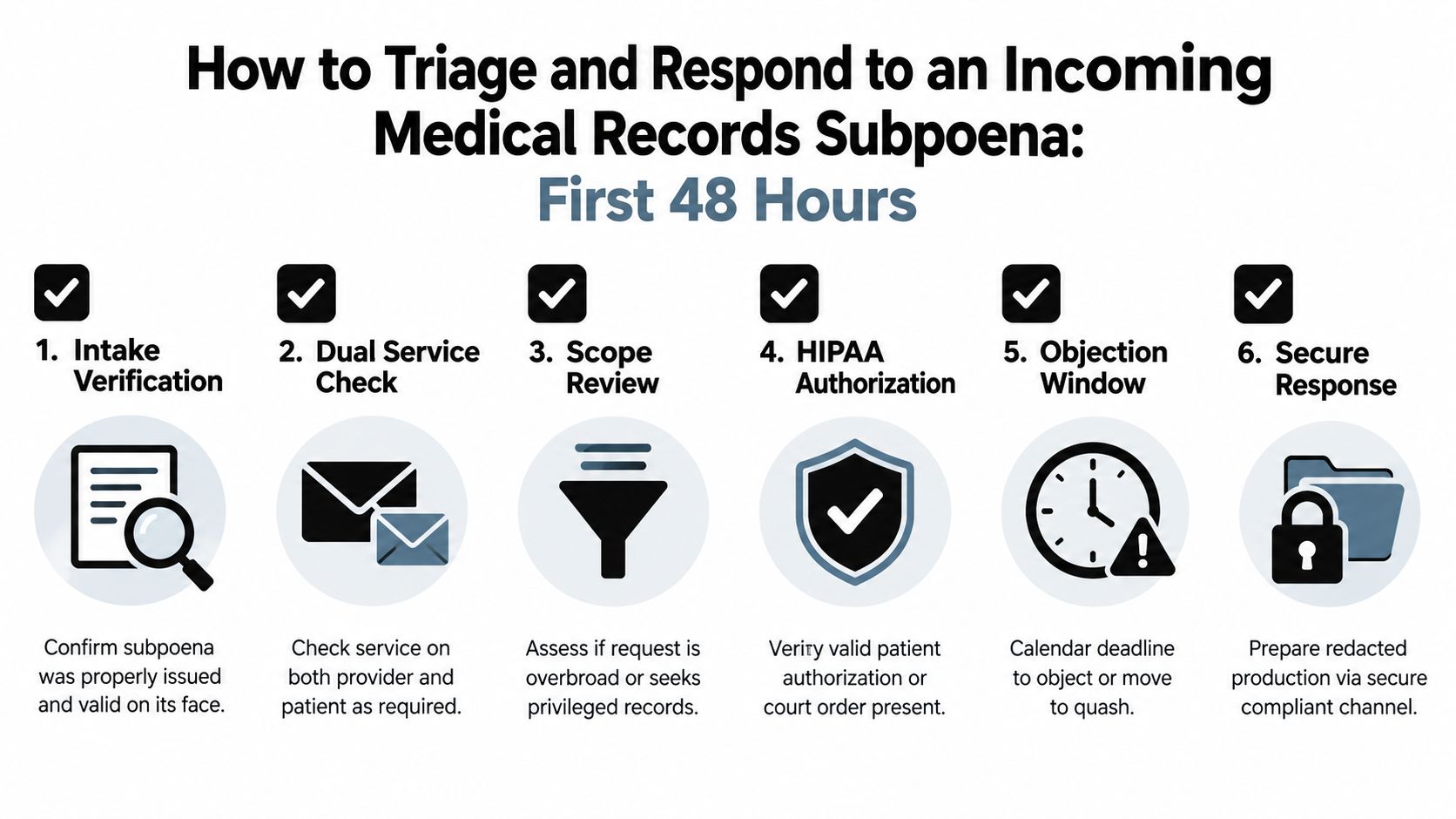
The first review period isn't clerical. It determines whether the office can produce, must object, or needs court protection. Start by preserving the request exactly as received, logging the date and method of service, and assigning one attorney responsible for the decision.
Review the subpoena on its face. Confirm the issuing court, case number, signatory, named custodian, requested categories, compliance date, and service documents. Then verify service on the provider and patient, because a request that skips required notice may not support disclosure even when the records appear plainly relevant.
The attached authorization deserves its own review. Check that it identifies the information and recipient, carries the patient's signature, and includes an expiration date or event. If the request relies on a court order, confirm that the order authorizes the disclosure sought. If it relies on patient notice, locate the notice and proof of delivery.
Three response tracks
A narrow, properly supported request may proceed to production with appropriate redactions. The records team should still compare the files received with the subpoena categories and preserve the original production, not just the edited copy.
An objection is appropriate when the request is invalid, overbroad, irrelevant, or missing the disclosure basis. Flag language such as “all medical records,” “any condition,” “entire lifetime,” “including psychotherapy notes,” or “all records from every provider” for attorney review before any file leaves the office.
A protective-order motion may be the right response when the records are relevant but sensitive, or when the parties need limits on use, access, storage, and post-litigation handling. Don't use a motion to avoid a scope conversation that counsel can resolve through a targeted amendment. Do use one when disclosure risk remains after negotiation.
Records involving substance-use treatment may be governed by 42 CFR Part 2, which can impose protections beyond ordinary chart handling. Mental-health records, HIV-related information, and minor-patient records also warrant a category-specific review rather than an assumption that the ordinary authorization resolves everything.
The secure response should include a written decision log. Record what was reviewed, what was withheld or redacted, why the response path was selected, who approved it, and how the production was transmitted. That log becomes important if the requesting party later claims noncompliance or if a provider questions the release.
Common Objections and Motions to Quash in PI Cases
The strongest objection is usually the one tied to a specific defect and a practical remedy. “Privacy” by itself is rarely enough. Counsel should identify the missing authorization, deficient notice, irrelevant date range, protected category, or concrete burden that makes the request improper.
A HIPAA objection should state that the subpoena doesn't establish a permissible disclosure pathway because the required notification or other assurance is absent. Support it with the subpoena, the service record, the missing notice, and a declaration from the custodian or responsible representative explaining why the provider cannot release the material.
Relevance and overbreadth objections should connect the request to the pleadings. If the plaintiff claims a specific body part and a defined incident, a request for unrelated specialties or treatment from an unbounded period needs an explanation. Ask the court to quash or limit the subpoena to providers, dates, and record categories tied to the claimed injury.
Drafting point: A proposed narrowing often persuades more effectively than a blanket refusal. Identify the records that can be produced and the language that should be removed.
Objections that require category-specific proof
| Objection | Legal basis | Supporting evidence |
|---|---|---|
| Defective authorization or notice | HIPAA disclosure requirements and applicable state procedure | Unsigned or expired authorization, missing notice, defective service affidavit |
| Irrelevance or overbreadth | Rule 26 or the applicable state discovery rule | Pleadings, medical chronology, unrelated provider list, excessive date range |
| Psychotherapy notes | HIPAA's separate protection for psychotherapy notes | Provider declaration identifying the notes and the absence of specific authorization |
| Substance-use treatment records | 42 CFR Part 2 and related protections | Facility identity, record category, consent or court-order status |
| Undue burden | Applicable subpoena procedure and custodian burden standards | Custodian affidavit, volume description, system limitations, proposed alternative |
| Confidentiality risk | HIPAA, state privacy law, or protective-order principles | Sensitive category identification and proposed access or use restrictions |
A motion to quash should attach the subpoena and enough evidence for the court to understand the defect without reconstructing the file. For a burden argument, a custodian declaration should explain the actual work required and propose a reasonable alternative, such as narrowing the dates or accepting a specified electronic format.
Negotiate first when the issue is scope, formatting, or a reasonable redaction protocol. Brief when the requesting party insists on protected categories, refuses to correct defective notice, or demands records that bear no plausible relationship to the claims. A short stipulated protective order may solve a genuine confidentiality concern faster than a contested motion, but it shouldn't be used to paper over an invalid subpoena.
Building a Repeatable Records Workflow That Stays Compliant
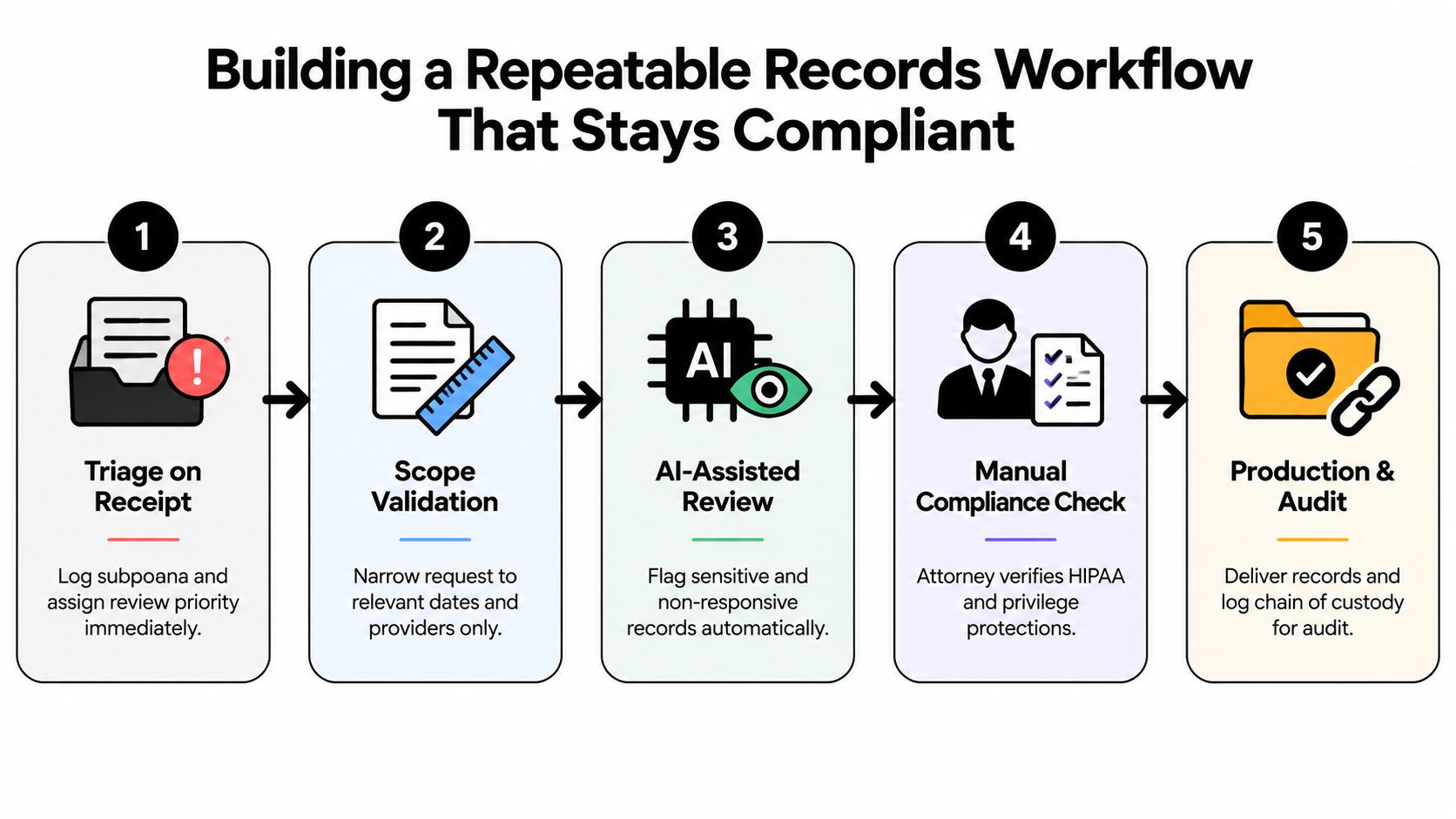
A repeatable workflow separates mechanical review from legal judgment. The intake system should capture the subpoena, related authorization or order, service proof, deadlines, custodian details, and responsible attorney in one matter record. That prevents the common failure where a production team sees the request but not the notice defect attached to it.
Where automation helps
Software can classify requests by issuing authority, extract dates and provider names, identify duplicate files, and flag likely sensitive categories. AI-assisted review can also organize histories, imaging reports, operative notes, billing records, and chronology for attorney examination. Those functions reduce repetitive sorting, but they don't decide whether a psychotherapy note may be disclosed or whether a state notice period has been satisfied.
A practical pipeline looks like this:
- Triage on receipt: Log the request, preserve the originals, and calendar every response and objection deadline.
- Scope validation: Compare the demand with the pleadings, claimed injury, providers, dates, and requested categories.
- Authorization review: Confirm the signature, covered information, recipient, purpose, expiration, and disclosure basis.
- AI-assisted extraction: Identify responsive records, duplicates, date gaps, sensitive terms, and potential nonresponsive material.
- Attorney checkpoint: Review psychotherapy notes, Part 2 records, HIV-related information, minor-patient material, and privilege issues manually.
- Redaction and privilege logging: Remove nonresponsive or protected material, record the reason, and preserve the unredacted source securely.
- Production and audit: Deliver through a secure channel, maintain chain-of-custody details, and record the final approval.
Ares is one option for the review stage. Its platform processes medical records into structured information such as dates, diagnoses, treatments, providers, and symptom chronology, which can help a PI team identify relevant material and treatment gaps before attorney review. Firms should pair any AI output with a documented human checkpoint, especially where disclosure restrictions turn on context rather than keywords.
The firm should maintain version tracking for the subpoena, amended requests, authorizations, protective orders, redaction sets, and final production. Audit logs should show who accessed the files, who approved release, what was produced, and how it was transmitted. Useful internal measures include missed deadlines, corrected service events, rejected requests, unresolved objections, redaction reversals, and the time between intake and attorney approval. The point isn't to create a vanity dashboard. It's to prove that the process works and expose the point where it fails.
For document controls that support this model, review HIPAA-compliant document management for legal teams.
Tactical Takeaways and a Field-Tested Subpoena Checklist
The safest subpoena is narrower than the universe of records. Request the treatment connected to the claimed injury, identify the providers and date range, exclude psychotherapy notes unless separately authorized, and specify the format and authentication materials you need. Narrow drafting reduces review burden and gives opposing counsel fewer credible grounds to argue that the request is a privacy fishing expedition.
Treat service proof as evidence, not office administration. Keep separate records for provider service, patient notice, party service, delivery confirmation, and any consent to electronic service. Calendar the state-law objection window and the production date independently. If a provider objects, record the objection, assign ownership, and calendar the response or motion rather than leaving the matter in an email thread.
Recurring mistakes deserve a desk-level warning:
- Overbroad dates: A lifetime request rarely helps the attorney review the claimed injury and often creates a stronger relevance objection.
- Missing authorization details: A signed page isn't enough if the form lacks the required information or expiration language.
- Incomplete service proof: Counsel may believe notice occurred, but the file must show when, how, and to whom it was delivered.
- Unreviewed sensitive records: Psychotherapy notes and Part 2 records need category-specific handling before production.
- Late follow-up: A subpoena served near mediation leaves little room for a protective-order motion, corrected service, or supplemental production.
- Unlogged redactions: The team should be able to explain every withheld category without searching across disconnected systems.
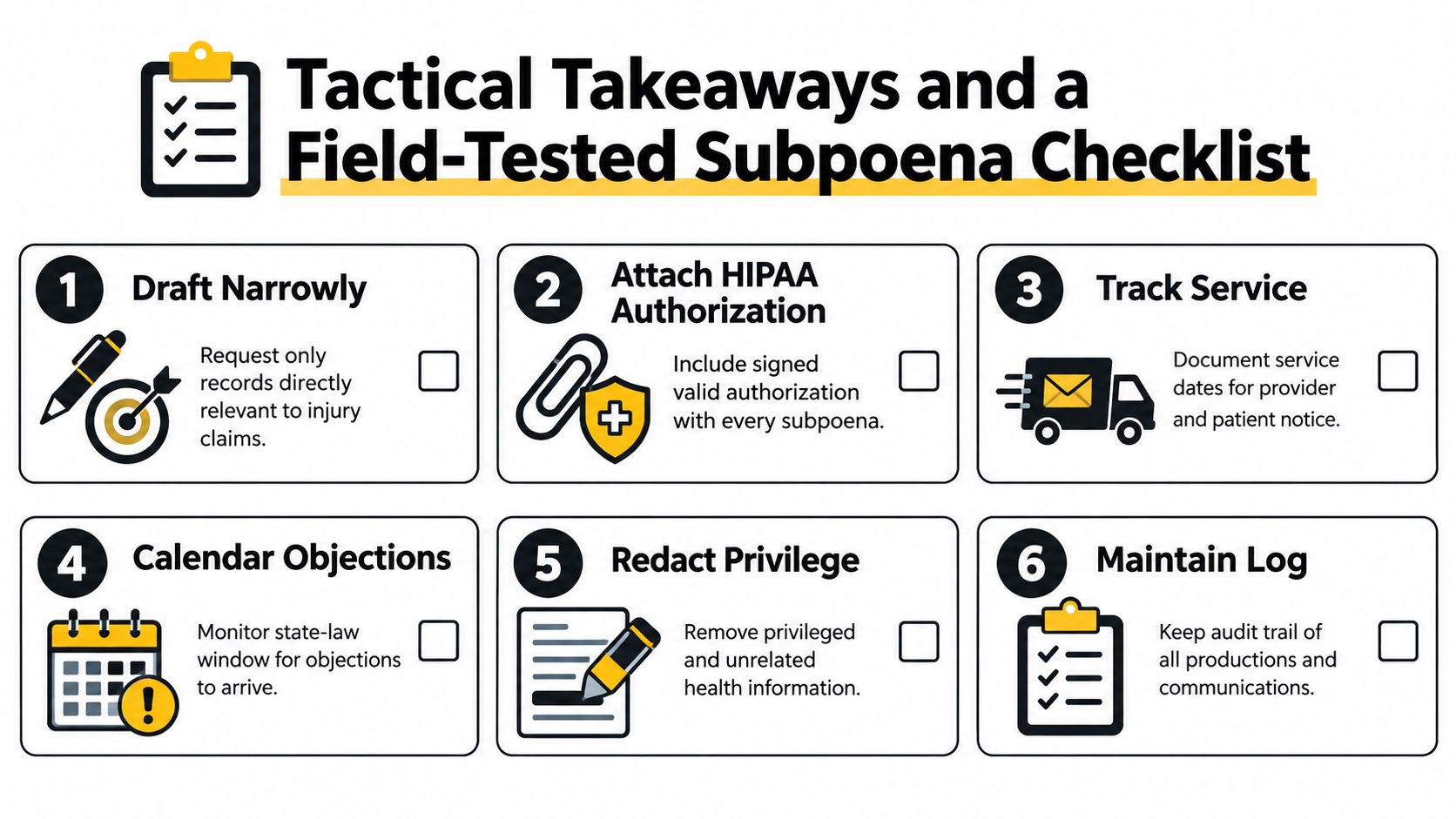
Desk checklist
- Pre-draft scoping: Tie the request to the injury, providers, dates, and relevant record categories.
- Draft review: Confirm caption, custodian, authority, deadline, format, authentication request, exclusions, and objection contact.
- Authorization or notice: Attach the valid authorization or establish the patient-notice or protective-order pathway.
- Service mechanics: Serve every required recipient and retain affidavits, receipts, and delivery records.
- Response triage: Verify validity, scope, sensitive categories, and the applicable production or objection track.
- Post-production control: Redact, Bates-label, authenticate, transmit securely, and preserve the audit trail.
Ares helps PI firms organize medical records, extract case-ready chronology, and support structured review of subpoena productions in a HIPAA-compliant environment. If your team is losing time to scattered records, treatment gaps, or manual chronology work, visit Ares to evaluate how the platform could fit into your subpoena and medical-record review workflow.