
At its core, medical records summarization is about taking a mountain of a patient's medical history—every visit, test, and treatment—and distilling it into a clear, usable summary. For a personal injury firm, this isn't just administrative work; it's the foundation of a strong case. This is precisely where modern AI is changing the game.
The Hidden Bottleneck in Every Personal Injury Case

If you work in a personal injury firm, you know the feeling. A new case lands, and with it comes an avalanche of medical records. We’re talking about everything from the first EMT report and ER notes to months of specialist visits, physical therapy logs, and complex imaging results.
For paralegals and attorneys, digging through this pile is like searching for a needle in a haystack—a haystack that seems to grow bigger with every new document request. It's a grueling, manual slog that quietly brings case progress to a crawl.
Worse yet, this process is riddled with risk. A single missed detail, like a pre-existing condition buried in a doctor's notes or a slight inconsistency in a pain report, can seriously undermine a claim's value or even sink the entire case.
The True Cost of Manual Review
The slowdown from manual review isn't just an annoyance; it hits the firm directly in the wallet. All those hours spent poring over documents are hours that can't be billed, yet they chew up a huge chunk of your team's day.
This has real, tangible costs that hurt the firm's bottom line by:
- Dragging out case timelines: The longer it takes to piece together the medical narrative, the longer it takes to get a demand letter out the door and start negotiating.
- Capping your caseload: When your best people are buried in paperwork, they simply can't take on more cases. This puts a hard limit on the firm's growth potential.
- Driving up operational costs: The labor expense of manual review is a major, and often hidden, drain on your resources.
Manual medical record review forces highly skilled legal professionals to spend their days acting like data entry clerks. It’s an inefficient use of talent that creates a drag on firm productivity and profitability, preventing teams from focusing on high-value legal strategy.
Breaking the Bottleneck with Technology
This is where AI-driven medical records summarization changes everything. Instead of being a roadblock, it becomes a launchpad. By automating the grunt work of finding and organizing key medical facts, firms can finally break free from this chronic bottleneck.
AI has been shown to cut documentation time by more than 50%, with some platforms boosting record review efficiency by as much as 65%. This isn't just about moving faster; it's a fundamental shift in how work gets done.
This kind of technological leap is a key part of broader legal workflow automation, allowing firms to operate with more speed, accuracy, and strategic focus. The result? A faster path to settlement, a higher caseload capacity, and a serious competitive edge.
Understanding Medical Records Summarization
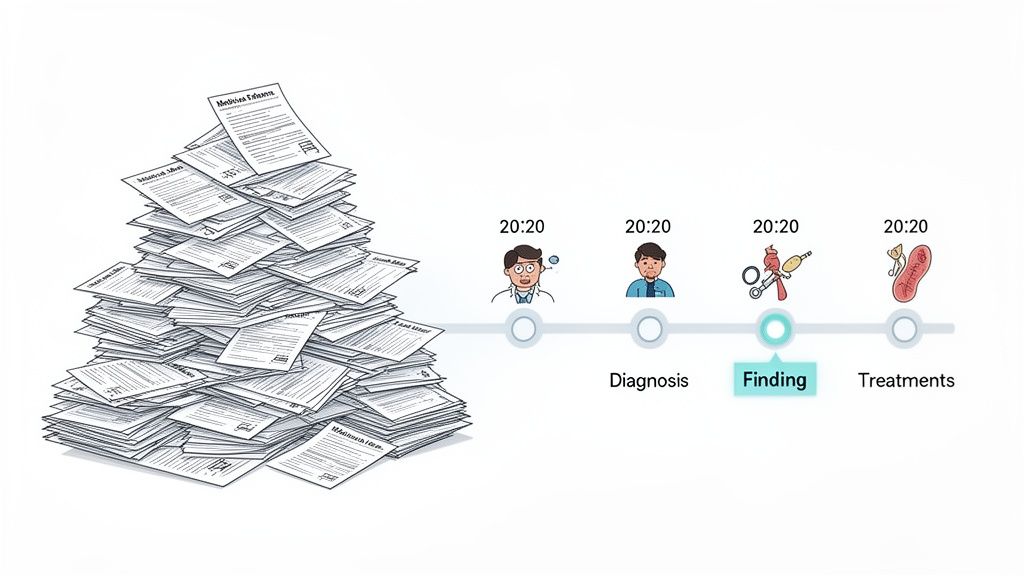
Let's be clear: true medical records summarization isn't just a clerical task. It’s a core legal strategy. It’s the art of taking a chaotic mess of clinical data and forging it into a clear, chronological, and legally potent narrative.
Think of it as being a translator. You're converting dense medical jargon into a compelling story that an adjuster, opposing counsel, or jury can actually follow and understand. This isn't about copy-pasting notes; it’s about strategic extraction. A skilled paralegal or a sophisticated AI has to dig through potentially thousands of pages to find the specific details that build the case, connecting the dots between an incident and the injuries that followed.
And the scale of this challenge is just staggering. U.S. hospitals are exchanging over 1.2 billion clinical documents annually, a number that has skyrocketed with the shift to electronic health records. For any legal team, trying to manage this flood of information manually is nearly impossible. This is where AI summarization becomes essential for finding meaningful insights. You can learn more about this data explosion on topflightapps.com.
The Anatomy of a Powerful Summary
A truly effective summary does more than just list what happened. It builds a defensible argument, piece by piece. It meticulously isolates and organizes the most critical parts of a client’s medical journey, turning a mountain of disorganized files into a real strategic asset.
A well-crafted summary is the backbone of any successful personal injury claim. It absolutely must include several key elements:
- Key Dates and Chronology: This establishes a clean, easy-to-follow timeline from the date of the injury through every major medical event.
- Diagnoses and Prognoses: It highlights the official medical diagnoses and, just as importantly, the doctor's expert opinion on future medical needs and limitations.
- Treatment Timelines: This section details every procedure, medication, and therapy session, linking them directly back to the injuries from the incident.
- Critical Inconsistencies: A great summary also flags any conflicting information or gaps in the record—the exact kinds of things the defense will try to exploit.
This organized information is the raw material you need to build a winning case.
From Summary to Settlement Strength
A meticulous summary isn't just an internal document; it's a tool that directly shapes the outcome of a case. It gives your legal team a major advantage at every step, from the first client meeting all the way to final settlement talks.
The impact is felt across your entire practice.
A strong medical summary is the cornerstone of a persuasive demand letter. It presents the facts in an undeniable, organized fashion, demonstrating to the insurance adjuster that you have a comprehensive grasp of the case and are prepared to prove every element of your client's damages.
This level of preparation allows you to negotiate with confidence and authority. For example, when you're drafting that demand letter, the summary gives you a ready-made narrative of damages, all backed by hard evidence. When prepping for a deposition, it serves as a roadmap for questioning medical experts and the plaintiff, making sure no key detail is missed.
Ultimately, by uncovering crucial details—like a previously overlooked note that directly links a specific treatment to the accident—a detailed summary can dramatically increase a claim's value. It provides the concrete evidence needed to justify a higher settlement and builds a stronger, more defensible case right from the start.
How AI Changes the Game in Medical Record Review
To really get what AI brings to the table for personal injury law, don't think of it as one single piece of software. It’s more like hiring a hyper-efficient, specialized team that works 24/7.
The first member of this team is Optical Character Recognition (OCR). Think of OCR as a digital transcriber. It takes all those scanned documents, messy handwritten notes, and clunky PDFs and turns them into clean, machine-readable text. Suddenly, all that locked-away information becomes searchable and usable.
Next up is Natural Language Processing (NLP). If OCR is the transcriber, NLP is the brilliant paralegal who can read, comprehend, and connect the dots across thousands of pages in mere seconds. This technology understands complex medical jargon, figures out the context of a doctor's note, and sees the relationships between a diagnosis, a specific treatment, and the provider who ordered it. NLP is the real engine behind powerful medical record summarization.
This AI-driven workflow takes over tasks that used to eat up hundreds of paralegal hours. It’s incredibly good at pulling out structured data—things like dates of service, provider names, and billing codes—with almost perfect accuracy. But where it really shines is in making sense of the unstructured stuff, like a doctor’s narrative notes. It can spot a sentence about causation or an inconsistency between two reports that a human reviewer, tired after hours of reading, might easily miss.
Putting AI to Work in Your Firm
AI doesn’t just read the records; it actively organizes the information into a powerful strategic asset. Because it processes the entire medical file in one go, it can instantly flag critical details that are often buried deep within the file and easy to overlook during a manual review.
Here's what that looks like in practice:
- Building a Chronological Timeline: The AI instantly sorts every single entry by date. You get a crystal-clear, easy-to-follow timeline of your client's entire medical journey without lifting a finger.
- Spotting Missing Records: By analyzing treatment patterns and referral notes, the system is smart enough to identify gaps. It might flag that a referenced specialist’s report or a specific lab result is missing from the file.
- Extracting Key Facts: You can train the platform to find and highlight the exact information you need for a personal injury case—mentions of pain levels, notes on loss of mobility, or a doctor's recommendation for future surgery.
This depth of analysis, done in minutes instead of days, lets your legal team jump from data collection straight into case strategy. It completely changes the workflow, moving your team away from tedious administrative tasks and toward high-value legal work.
The insights you get are immediate and actionable. For example, an AI tool can instantly link a physical therapy note from month three back to the initial ER diagnosis, making your causation argument that much stronger. To get a sense of how these systems turn a flood of information into something useful, it’s interesting to look at the strategies behind winning Google’s AI summaries. It’s a similar concept: distilling massive amounts of data into concise, valuable insights.
Manual Review vs AI-Powered Summarization
When you put the old way of doing things side-by-side with an AI-assisted approach, the difference is night and day. This isn't just an incremental improvement; it's a fundamental shift in how personal injury firms can operate, giving them a real edge in efficiency, accuracy, and strategy.
| Task | Manual Process (The Old Way) | AI-Powered Process (The New Way) |
|---|---|---|
| Speed | Takes days or weeks to review a large file, creating a major case bottleneck. | Summarizes thousands of pages in minutes, accelerating the entire case lifecycle. |
| Accuracy | Prone to human error, fatigue, and missed details buried deep in the records. | Eliminates oversight by systematically analyzing every word, ensuring high consistency. |
| Insight | Focuses on finding known facts, often missing subtle connections across documents. | Uncovers hidden patterns, flags inconsistencies, and identifies strategic opportunities. |
| Cost | High labor costs tied to non-billable, administrative paralegal hours. | Reduces operational overhead and frees up staff for strategic, billable tasks. |
This shift in technology isn’t about replacing legal experts—it's about empowering them. Our guide on how AI benefits personal injury lawyers dives deeper into this partnership. By handing off the heavy lifting of medical record summarization to AI, firms can finally free up their most valuable resource—their team's expertise—to focus on what they do best: building stronger cases and winning better outcomes for their clients.
Implementing AI Summarization Securely and Effectively
Bringing any new technology into your firm, especially one that handles sensitive client data, needs to be done thoughtfully. For personal injury firms looking at AI for medical record summarization, the big questions always revolve around security, compliance, and how a new tool will actually fit into the way you already work.
The good news is that modern AI platforms are built from the ground up to address these concerns. The goal isn't to force a new, awkward process on your team. It’s to give your experts a powerful assistant, creating a system where technology does the heavy lifting while your legal professionals provide the critical strategic oversight.
The Foundation of Trust: Data Security and HIPAA
When you're dealing with Protected Health Information (PHI), there is absolutely zero room for error. Security isn't just another feature on a list—it's the bedrock of the entire system. Any AI vendor you consider has to prove they have a rock-solid commitment to data protection, and that starts with HIPAA compliance.
This is more than just a logo on a website. Real compliance means a layered security strategy designed to protect client data at every single step.
- End-to-End Encryption: All data must be encrypted, whether it's being uploaded, analyzed by the AI, or sitting in storage. This makes the information unreadable and useless even in the highly unlikely event of a breach.
- Strict Access Controls: The platform must let you decide who on your team can see which case files. This ensures sensitive information is kept on a strict need-to-know basis.
- A Signed Business Associate Agreement (BAA): This is completely non-negotiable. A BAA is a legal contract that holds the vendor to the same strict HIPAA standards your firm follows, making them a true partner in protecting PHI.
Choosing a vendor without a BAA is a massive compliance risk. Think of it as your insurance policy—it ensures your technology partner is legally and financially on the hook for keeping your client's most private data safe.
The workflow of a secure AI platform is surprisingly straightforward, which is exactly how it should be.
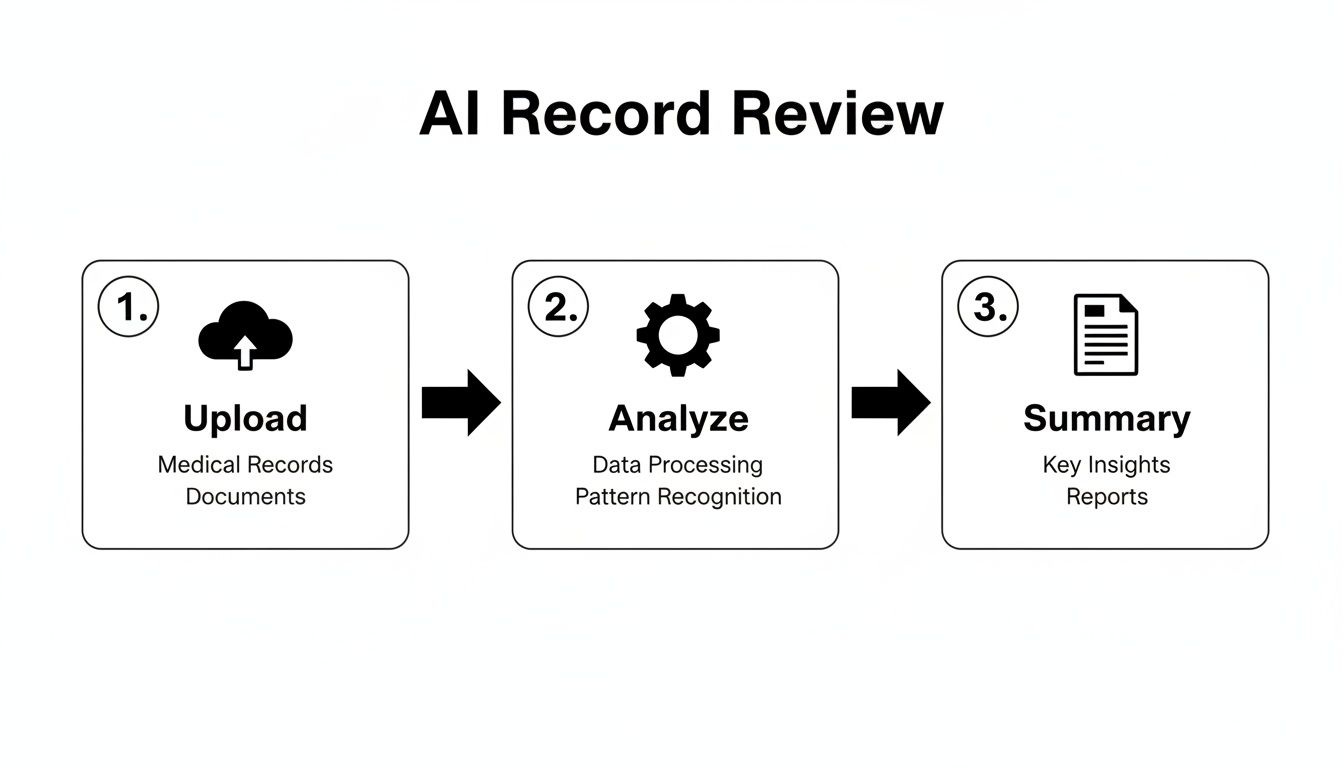
As you can see, a secure upload kicks off the automated AI analysis, which then produces a structured summary. The whole process is designed to minimize manual data handling and the risks that come with it.
Best Practices for a Smooth Rollout
Once you've confirmed a vendor's security credentials, the focus shifts to bringing the tool into your firm effectively. A successful rollout is just as much about your people and processes as it is about the software itself. For a solid framework, organizations can look to the principles found in guides about Mastering GRC Cyber Security.
Here’s a practical roadmap for getting an AI summarization tool up and running in your firm:
- Start with a Pilot Project: Don't try to change everything overnight. Pick a couple of recent or moderately complex cases and run them through the AI platform first. This gives your team a low-stakes way to get comfortable with the tool and see the results for themselves.
- Establish Clear Protocols: Figure out exactly where the AI fits. For example, you might create a new standard operating procedure: whenever medical records come in for a new case, the first step is always to upload them to the platform. You can see what a comprehensive medical record review service entails to help shape your protocol.
- Train for the "Human-in-the-Loop" Model: This is key. Make it clear that the AI is an assistant, not a replacement. Train your paralegals and case managers on how to review the AI's summary, double-check critical facts, and add their own strategic notes. Their legal expertise is what transforms an accurate summary into a case-winning tool.
- Create a Feedback Loop: Ask your team for honest feedback. What’s working? Where are the hang-ups? This ongoing conversation helps you get the most out of the tool and fine-tune it to fit how your firm operates best.
By starting with a secure foundation and following a smart implementation plan, you can bring AI for medical records summarization into your practice with confidence. This approach doesn't just make your firm more efficient; it does so while upholding the highest standards of client data protection and quality of work.
Calculating the True ROI of Automated Summarization

When we talk about bringing AI into a law firm for medical records summarization, the conversation often starts with "saving time." But that’s just scratching the surface. For firm owners and managing partners, the real return on investment (ROI) is a powerful mix of expanding your firm's capacity, cutting down on operational friction, and ultimately, improving case outcomes. It’s a strategic move that hits your bottom line and sets you up for growth.
To really grasp the value, you have to look past the simple efficiency metrics. This isn't about doing the same old work a little bit faster; it’s about fundamentally changing what your firm is capable of accomplishing.
Boosting Caseload Capacity Without Increasing Headcount
Let's get right to it: the most immediate and tangible benefit you'll see is a massive boost in your team's capacity. Manually reviewing medical records is a well-known bottleneck, putting a firm ceiling on the number of cases your team can handle well.
Once your paralegals and case managers are no longer bogged down for weeks sifting through records, they can apply their skills to tasks that actually move cases forward. This means you can take on more clients—and more revenue—without the heavy cost of hiring more people.
Here’s a quick, real-world breakdown:
- The Old Way: A skilled paralegal sinks 20 hours into reviewing the records for a single complex personal injury case.
- The New Way: An AI platform produces a draft summary in minutes. That same paralegal now spends just 2 hours verifying the key points, adding strategic context, and getting it ready for the attorney.
That's 18 hours saved on just one case. If your firm handles 10 complex cases a month, you've just unlocked 180 hours of high-level staff time. That's essentially the output of a new full-time employee, but without the salary, benefits, and overhead. This reclaimed time is pure ROI you can put directly toward growing your firm.
Shortening Case Cycles and Accelerating Cash Flow
In the world of personal injury law, time is quite literally money. A delay at the start of a case—like the initial record review—creates a domino effect, pushing back everything from drafting the demand letter to starting negotiations and receiving payment.
By compressing the review timeline from weeks down to a matter of hours, AI summarization acts as an accelerant for your entire case pipeline. You get demand letters out faster, you start talking settlement sooner, and you get paid more quickly.
This isn't just about convenience. It directly improves your firm's cash flow and lowers the carrying costs of having cases drag on. Shaving even a few weeks off the cycle from intake to settlement can make a huge difference to your firm's financial stability.
Enhancing Settlement Values Through Stronger Evidence
This benefit is tougher to plug into a spreadsheet, but it might be the most valuable of all. An AI doesn't get tired, it doesn't skim, and it won't miss a critical detail buried on page 947 of a hospital chart. These systems are built to methodically connect the dots across thousands of pages, flagging inconsistencies and uncovering patterns a human reviewer might easily overlook after hours of reading.
This gives your attorneys a much stronger, evidence-based foundation to build their arguments. Think about walking into a negotiation with a perfect timeline of your client's pain complaints, a clear link between a seemingly minor injury and a major later complication, or evidence of a diagnosis that was missed early on. That level of detail strengthens your leverage, frequently leading to higher settlement offers and better results for your clients.
Answering Your Key Questions About AI Summarization
Even when the benefits are clear, bringing a new tool into a critical process like medical records summarization is bound to raise a few questions. For any legal professional, the concerns usually boil down to three things: accuracy, security, and how much of a headache it will be to get started.
Let’s tackle those head-on.
How Accurate Is AI Medical Records Summarization?
When it comes to pulling objective data—think dates, provider names, diagnoses, and treatments—modern AI tools are incredibly accurate. They're built for consistency, catching details across thousands of pages and eliminating the simple human errors that creep in during manual review.
But the best approach isn't to just "set it and forget it." The gold standard is what we call a “human-in-the-loop” model. The AI does the heavy lifting, organizing a complex medical history into a clean timeline and extracting the core facts. Then, a skilled paralegal or attorney reviews that output, adding the strategic context and legal nuance that only a human can.
This combination gives you the best of both worlds: the raw speed of automation paired with expert-level quality control.
Is My Client Data Secure on an AI Platform?
It is, but only if you choose a reputable, compliance-focused platform. Top-tier solutions are designed with security at their core and must be fully HIPAA compliant.
This isn't just a marketing claim; it involves specific, non-negotiable safeguards:
- End-to-End Data Encryption: Your data is shielded from the moment you upload it, while it’s being processed, and as it rests in storage.
- Strict Access Controls: You decide exactly who on your team can see which case files. It puts you in complete control.
- Business Associate Agreement (BAA): This is a critical legal contract. It ensures your vendor is legally bound to protect client data according to federal law.
A BAA is your guarantee that your technology partner is just as responsible for safeguarding Protected Health Information (PHI) as you are. Never partner with a vendor that won’t sign one.
How Difficult Is It to Integrate an AI Tool?
The good news is that modern AI platforms are built to be anything but difficult. As cloud-based tools, they don't require your IT team to install complex software on every computer in the firm.
The workflow is designed to be second nature. You securely upload the records, the AI gets to work, and you get a structured summary ready for review and export. The learning curve is intentionally short, so your team can start working more efficiently almost immediately, without needing weeks of training.
Ready to eliminate the bottlenecks in your case workflow? Ares provides an AI-powered platform designed for personal injury firms to turn thousands of pages of medical records into clear, actionable summaries in minutes. Strengthen your demand letters and settle cases faster by visiting the Ares Legal AI website to see how it works.