A personal injury lawsuit is a marathon, not a sprint. From start to finish, you can generally expect the process to take anywhere from 1.5 to 2 years. While some simpler cases might wrap up in a few months, most follow a well-trodden path from the accident and initial medical care all the way through investigation, negotiation, and sometimes, a trial.
Knowing these stages isn't just for trivia; it gives you a clear roadmap for the journey ahead.
Why Understanding the Case Timeline Matters
Trying to navigate a personal injury claim without a map can feel overwhelming. Every phase has its own rhythm, its own set of hurdles, and its own timeline. When you know what’s coming, you can dramatically cut down on the stress and uncertainty.
Think of the case timeline less as a rigid schedule and more as a strategic framework. It informs every decision, from the best time to collect a key piece of evidence to the right moment to push for a settlement. This guide will walk you through the entire journey, breaking down the essential milestones so you can see how all the pieces fit together to build a powerful claim.
The Three Core Phases of a Claim
When you boil it down, every personal injury case moves through three fundamental stages:
- The Incident & Immediate Care
- Investigation & Case Building
- Resolution (Settlement or Trial)
This visual breaks down how a case typically flows through these major phases.
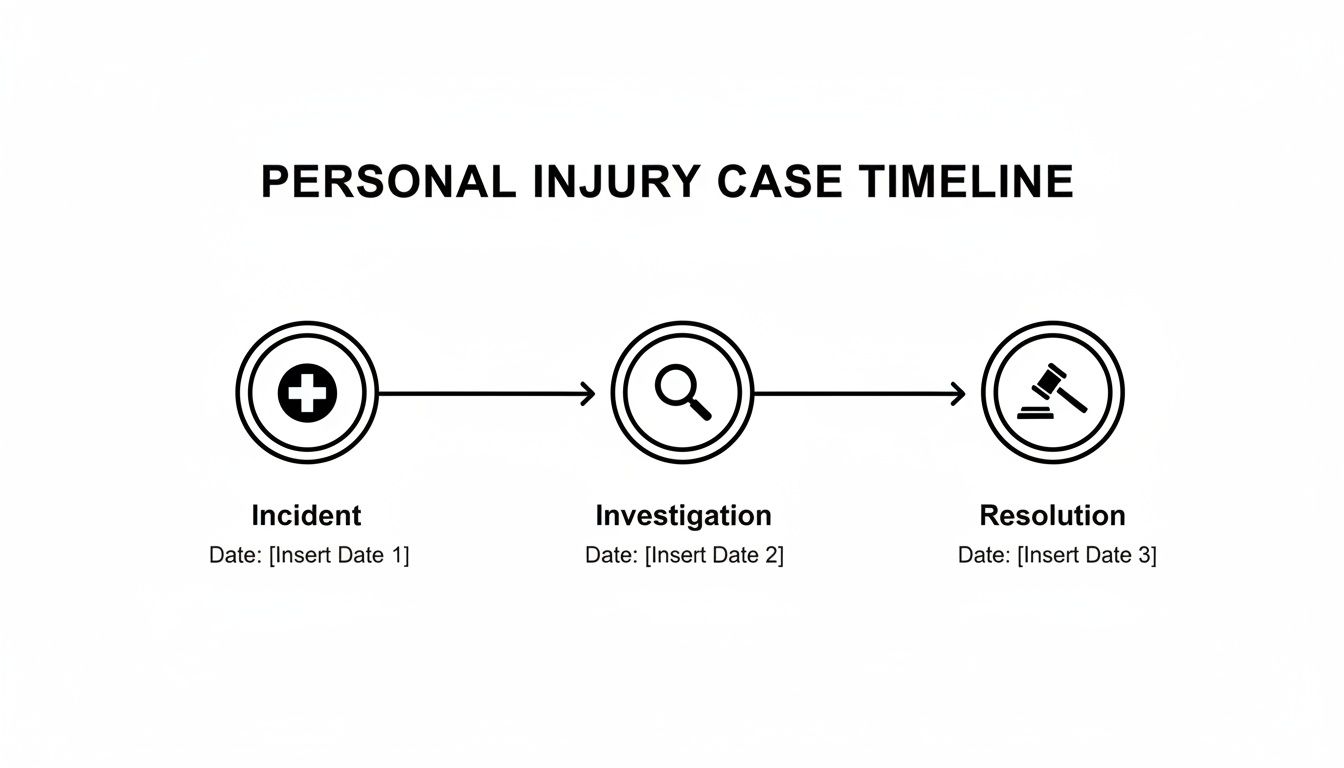
As you can see, the process is logical. Each step builds on the last, moving the case closer to a final resolution.
The table below provides a clearer picture of what happens in each stage and how long you can realistically expect it to take.
Key Stages and Estimated Durations in a PI Case
This table summarizes the main phases of a personal injury case and provides a realistic timeframe for each, helping to manage expectations from the outset.
| Stage | Description | Typical Duration |
|---|---|---|
| Incident & Care | The accident occurs, followed by immediate medical attention and ongoing treatment for injuries. | Weeks to Months |
| Investigation | Your legal team gathers evidence, collects records, and builds the foundation of your claim. | 3-9 Months |
| Negotiation | A demand package is sent to the insurance company, leading to back-and-forth settlement discussions. | 3-6 Months |
| Litigation | If a settlement isn't reached, a lawsuit is filed, and the case proceeds through discovery and to trial. | 1-2+ Years |
These timeframes are just estimates, of course. A case's complexity, the severity of the injuries, and the insurer's willingness to negotiate can all impact the final timeline.
Preparing for the Legal Journey
At the start, you'll be faced with a lot of paperwork, from your attorney’s retainer agreement to medical release forms. As you dive in, it’s helpful to understand the rules that govern official documents, especially the legally binding nature of electronic signatures. Knowing this ensures every action you take is secure and legally sound from day one.
A well-documented timeline is more than just a sequence of events; it's a narrative that demonstrates cause and effect. It connects the negligence of one party to the tangible damages suffered by another, forming the bedrock of a successful claim.
With this roadmap in mind, you're better prepared for the detailed steps to come. The rest of this guide will dig deeper into each phase, offering practical advice on what to do right after an accident, how evidence is gathered, and what really happens during negotiations.
Critical First Steps in the Aftermath of an Injury
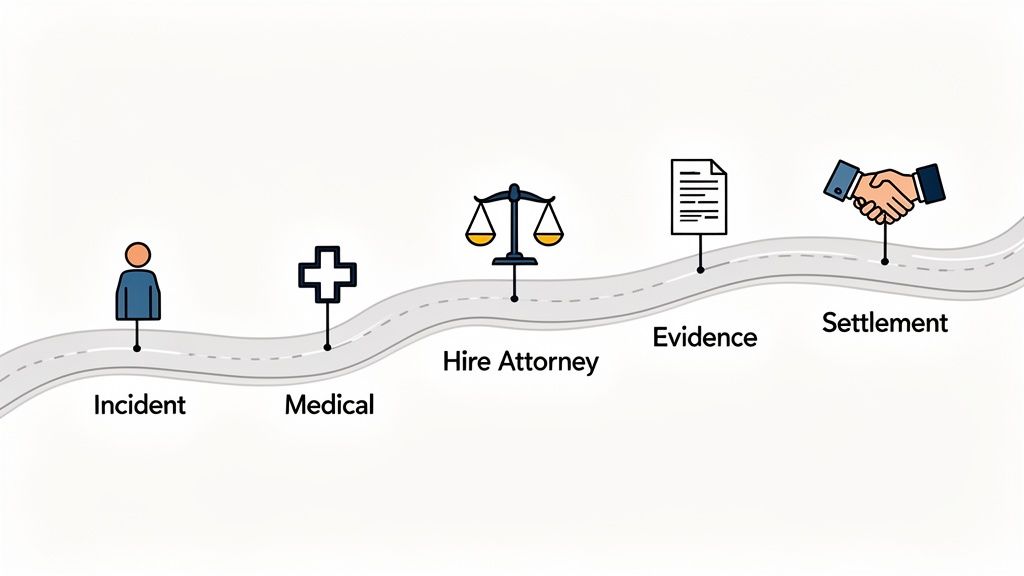
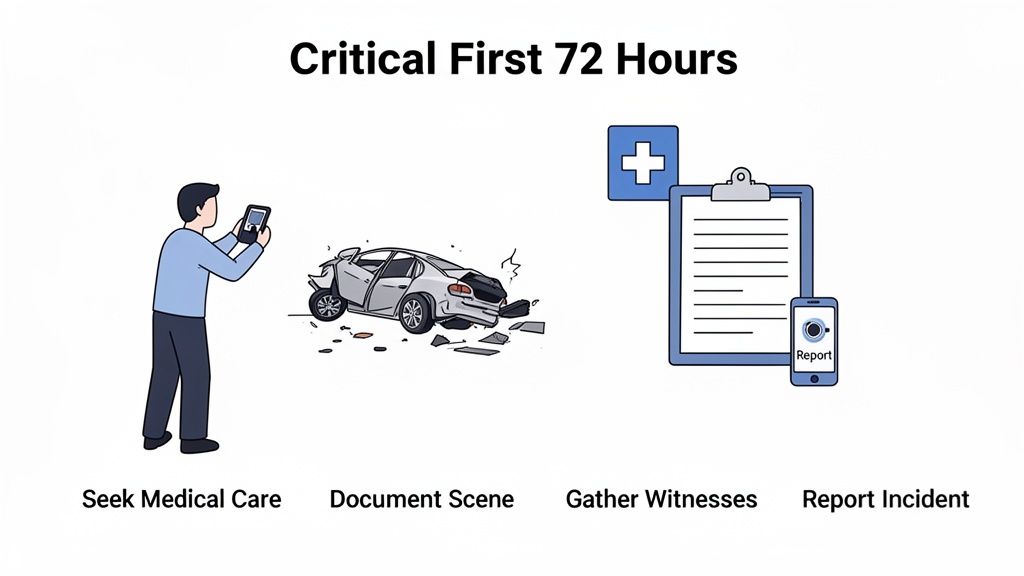
The first 72 hours after an injury are, without a doubt, the most pivotal moments in a personal injury case. The decisions made in this brief window lay the foundation for everything that follows. Get it right, and you build a strong case; get it wrong, and you could be fighting an uphill battle from the start.
While your health is always the number one priority, the steps you take to document what happened are a very close second. Think of it like this: your actions in these initial days write the first chapter of your case's story. They create the evidence and the narrative that will be referenced for months, or even years, to come.
Seek Immediate Medical Attention
First things first: get to a doctor. This is non-negotiable, both for your recovery and for the health of your claim. A visit to the ER, an urgent care center, or even your family physician creates a crucial piece of evidence.
That medical report becomes the first official entry on your case timeline. It's the anchor, connecting your injuries directly to the date and time of the incident. If you wait, you’re handing the insurance company a ready-made argument—they’ll suggest your injuries happened later or weren't serious enough for immediate care.
A documented medical evaluation is the cornerstone of a personal injury claim. It transforms a personal account of pain into a verifiable fact that an insurance adjuster cannot easily dismiss or dispute.
And it doesn't stop there. Make sure you follow through on all medical advice, from physical therapy to follow-up appointments. Any gaps in your treatment can be spun by the other side as proof that you weren't really hurt that badly.
Document and Report the Incident
While the events are still fresh in your mind, it's time to gather evidence. Memories fade, witnesses move away, and physical evidence gets cleaned up or disappears. You have a very small window to capture the facts.
Your on-the-scene checklist should look something like this:
- Photographs and Videos: Get shots from every angle. Document property damage, your injuries, and anything that might have contributed to the incident, like a wet floor or a broken step.
- Witness Information: Collect names, phone numbers, and emails from anyone who saw what happened. An independent account of the events is incredibly powerful.
- Official Reports: Always create an official record. After a car wreck, that means a police report. For a slip and fall at a business, it means notifying the manager and making sure they file an incident report.
Keeping this information organized from day one will save you massive headaches down the road. For more on this, check out our practical guide on how to organize medical records.
Avoid Speaking with Insurance Adjusters
It won't be long before you get a call from the other party's insurance adjuster. It’s vital to remember their job isn't to help you—it's to protect their company's bottom line by paying out as little as possible.
These adjusters are skilled at asking leading questions to get you to say something that undermines your claim. Your best move is to politely refuse to give a recorded statement or go into detail about your injuries before you've consulted an attorney. A simple, "I'm not ready to discuss this at the moment," is all you need to say. Anything you tell them can be used against you, so don't give them the ammunition.
Building Your Case: The Long Road of Investigation and Treatment
Once the immediate shock of an incident wears off, your personal injury case settles into its longest and most important phase. This is where patience truly becomes a virtue. Think of it as two critical storylines running at the same time: your personal journey toward healing and your legal team’s methodical investigation.
The whole point of this stage in the personal injury case timeline is to be thorough, not fast. While you’re focused on getting better, your attorney’s team is in the trenches, turning a mountain of scattered documents and facts into a story that can’t be ignored. Everything done here is about building leverage for when it's time to talk numbers.
The Foundation: Your Medical Treatment
Your most important job during this phase is simple but non-negotiable: follow your doctor's orders. Consistent medical treatment is the engine of your case. It’s not just about your physical recovery; it creates a rock-solid, chronological record of your injuries and how they've upended your life.
This leads us to a crucial term you'll hear often: Maximum Medical Improvement (MMI). MMI is the point where your doctor says your condition is as good as it’s going to get. It doesn't mean you're 100% back to normal, but it establishes a clear picture of your long-term prognosis and future medical needs.
Reaching MMI is a major milestone. It’s the green light for your legal team, signaling that the full, true cost of your injuries—both what you've already been through and what you'll face in the future—can finally be calculated.
Trying to settle a case before you hit MMI is a huge mistake. You could drastically underestimate what your future care will cost, leaving you to pay for it yourself down the road. Patience here is about making sure every single consequence of your injury is on the table before a settlement is ever discussed.
Putting the Puzzle Together
While you’re on the path to MMI, your legal team is doing some heavy lifting. The investigation process is a lot like putting together a 1,000-piece jigsaw puzzle without the picture on the box. Your attorney has to find every single piece and figure out exactly how it fits into the big picture of who’s at fault and what your damages are.
This deep-dive investigation involves:
- Hunting Down All Medical Records: This means getting every note, bill, and report from every single provider you've seen—your family doctor, specialists, physical therapists, you name it.
- Getting Official Reports: The team will secure copies of the police report, any workplace incident reports, or other official documents.
- Following Up with Witnesses: Those quick statements taken at the scene? Now's the time for more detailed interviews to lock down testimony.
- Bringing in the Experts: For more complex cases, an attorney might hire an accident reconstructionist, a medical expert, or an economist to add serious weight to your claim.
- Tracking Every Penny: Every lost pay stub, every receipt for a prescription, and every medical bill is gathered, organized, and accounted for.
The level of detail required is immense. The goal is to build a fortress of evidence so strong that an insurance adjuster has nowhere to go.
Why Does This Stage Take So Long?
Clients often ask why this part of the personal injury case timeline seems to drag on forever. The truth is, building a powerful case takes time. It’s a methodical, step-by-step process that can easily last from several months to more than a year.
The clock is often set by the severity of your injuries. In the personal injury world, a straightforward case might take around 12 to 18 months to settle. But for something like a serious back injury, you could be looking at 27 to 36 months. For traumatic brain injuries (TBI), that can stretch to 33 to 48 months or even longer. You can get a closer look at what influences these timelines in this deep-dive on settlement data.
Several factors can stretch this timeline out:
- Your Recovery Time: It simply takes as long as it takes to reach MMI.
- Bureaucratic Delays: Medical offices can sometimes take weeks, if not months, to send over records.
- Liability Fights: If the other side is denying they did anything wrong, the investigation gets much more involved.
- Opposing Party Dragging Their Feet: Delays from the defendant or their insurance company can also slow things down.
At the end of the day, this phase isn't a race. It’s about building a case that can withstand pressure. By patiently finishing your treatment and letting your legal team do a thorough investigation, you’re setting yourself up for success in the most critical part of the journey: the demand and negotiation.
The Art of the Demand and Negotiation
Once you’ve reached what we call Maximum Medical Improvement (MMI), the whole dynamic of your case shifts. The quiet, behind-the-scenes work of building your case is over. Now, it’s time to go on the offensive. This is the moment where all those months of gathering records and piecing together the facts come together into one, powerful story aimed at getting you a fair settlement.
The first major move in this new phase is sending the demand letter. Don't let the name fool you; this is far more than a simple request for money. It's a meticulously crafted argument, a narrative that lays out your entire case from start to finish. Your legal team takes every shred of evidence—medical bills, expert reports, photos, you name it—and weaves it into a compelling package.
Crafting a Powerful Demand Letter
Think of the demand letter as the opening argument in a trial you hope to avoid. It’s your lawyer’s first official shot at showing the insurance adjuster the full weight of your claim.
A truly effective demand letter must nail three things:
- A Clear Liability Argument: It has to spell out exactly why the other party is at fault, using police reports, witness accounts, and relevant statutes to back it up.
- A Detailed Injury Summary: This section walks the adjuster through your medical journey—every diagnosis, every procedure, and the long-term prognosis, all supported by the medical records we’ve gathered.
- A Full Accounting of Damages: We have to calculate and justify every single dollar we’re asking for. This includes the hard numbers like medical bills and lost income, as well as the non-economic damages like pain and suffering.
This document isn’t just a list of facts; it’s about turning those facts into a human story of how this incident turned your life upside down. To get into the nitty-gritty of this crucial step, you can check out our detailed guide on writing a demand letter for personal injury.
A meticulously crafted demand letter backed by a clear, chronological timeline doesn't just ask for a settlement—it demonstrates why that settlement is the only logical and just outcome. It forces the adjuster to confront the undeniable facts of the case.
The Strategic Back-and-Forth of Negotiation
Once the demand is sent, the negotiation dance begins. This is a strategic back-and-forth that can take anywhere from a few weeks to several months, really depending on how complex the case is and what kind of tactics the insurance company decides to use. Remember, insurance adjusters are skilled negotiators; their job is to pay out as little as possible.
You can almost always expect their first response to be a lowball offer. They’ll question how bad your injuries really were or suggest that some of your medical treatment wasn't necessary. This is where your attorney earns their keep, pushing back against every argument with the mountain of evidence we’ve collected. That detailed case timeline becomes a shield, deflecting every attempt to chip away at the value of your claim.
Negotiation is where the rubber meets the road—it's the ultimate test of how well your case was built. When an adjuster questions a specific treatment, a well-organized file lets your attorney instantly pull up the doctor's report or the corresponding bill to shut down the argument. This keeps the pressure on and inches the settlement number closer to where it should be. This is precisely why the earlier investigation phase is so fundamental to the entire personal injury case timeline. Your power at the negotiating table is directly proportional to the quality of the evidence you've gathered.
It's also worth noting that these negotiations are happening in an increasingly busy legal arena. Personal injury filings in US federal courts recently jumped by 30% to 9,406, often fueled by large-scale mass tort cases. This activity is part of a massive $61.3 billion industry, a number that reflects the sheer volume of the 39.5 million Americans who need medical care for injuries each year. This is the competitive, high-stakes environment where your case will be fought and, hopefully, won.
When Negotiations Stall, Litigation Begins
It’s a frustrating moment when good-faith negotiations with the insurance company hit a wall. It can feel like you've reached a dead end, but really, it's the start of a new, more structured phase in the personal injury case timeline: litigation.
Filing a lawsuit doesn’t mean you’re automatically headed for a dramatic courtroom showdown. Far from it. Think of it as a strategic move designed to apply pressure and show the other side you mean business. It’s the step that often forces them to finally make a fair offer.
Kicking Off the Lawsuit
The shift from negotiation to litigation starts the moment your attorney files a formal complaint (or petition) with the court. This is the document that officially gets the ball rolling. It lays out the facts of what happened, explains why the other party—the defendant—is legally on the hook for your injuries, and details the damages you’re seeking.
Once the complaint is filed, it has to be legally "served" on the defendant. From that point, they have a set amount of time, usually about 30 days, to file an official answer. Their response is their chance to admit or deny your claims and lay out their own legal defenses. Once that happens, the battle lines are drawn, and you move into the next critical stage.
The Discovery Process: A Strategic Chess Match
Discovery is almost always the longest and most pivotal part of the litigation process. If the initial investigation was your team gathering its own evidence, discovery is where both sides are forced to lay their cards on the table. It’s a bit like a strategic chess match, where each side uses specific legal tools to find out what the other knows and to poke holes in their case.
The key moves in this game include:
- Interrogatories: These are written questions that the opposing party must answer under oath. They’re great for locking down specific facts, dates, and official positions.
- Requests for Production: This is exactly what it sounds like. Each side can demand the other to hand over relevant documents—think maintenance logs after a slip-and-fall or a truck driver’s logbooks after a crash.
- Depositions: This is where things get serious. It’s sworn testimony given outside of court, where attorneys get to question witnesses, experts, and the parties involved. Everything is recorded word-for-word by a court reporter.
This is where the case is often won or lost. A powerful deposition can completely dismantle the defendant's story, while a single document uncovered through a request can prove negligence without a doubt. As these proceedings increasingly happen online, knowing the best practices for securing virtual depositions with end-to-end encryption is crucial to protect sensitive case details.
Why Almost Every Case Still Settles Before Trial
The thought of a trial is intimidating for most people, but here’s the reality: the vast majority of personal injury cases never make it in front of a jury.
The entire litigation and discovery process is designed to expose the true strengths and weaknesses of each side. As more evidence comes to light, the risk of losing at trial becomes very real, pushing both parties back to the negotiating table.
Settlement timelines vary widely. A straightforward car accident case, which accounts for about 52% of all claims, might take 18-24 months to resolve once a lawsuit is filed. A complex medical malpractice claim, on the other hand, can easily stretch beyond 36 months.
Even with those differences, a staggering 91% of cases settle before trial. Often, it’s because the discovery process uncovered disorganized records or a critical weakness that killed one side's leverage. You can learn more about personal injury statistics to see these trends for yourself.
In the end, most courts will require the parties to attend mediation or a settlement conference before they’ll even schedule a trial date. With all the evidence finally out in the open, these final negotiations are far more grounded in reality and often lead to a resolution that avoids the time, expense, and sheer uncertainty of a jury verdict.
How AI Is Reshaping the Case Timeline
The traditional personal injury timeline has always been bogged down by one massive bottleneck: manual document review. For every single case, legal teams have to wade through hundreds, if not thousands, of pages of dense medical records. It’s a painstaking process to identify every injury, treatment, and provider, often taking weeks and grinding case momentum to a halt before settlement talks can even begin.
This administrative burden is a serious drag on a case's progress. Imagine trying to assemble a car engine by hand, one tiny screw at a time. It’s slow, tedious, and leaves plenty of room for error—all of which directly hurts your firm’s capacity and makes your client wait even longer for justice.
A Faster Path to Resolution
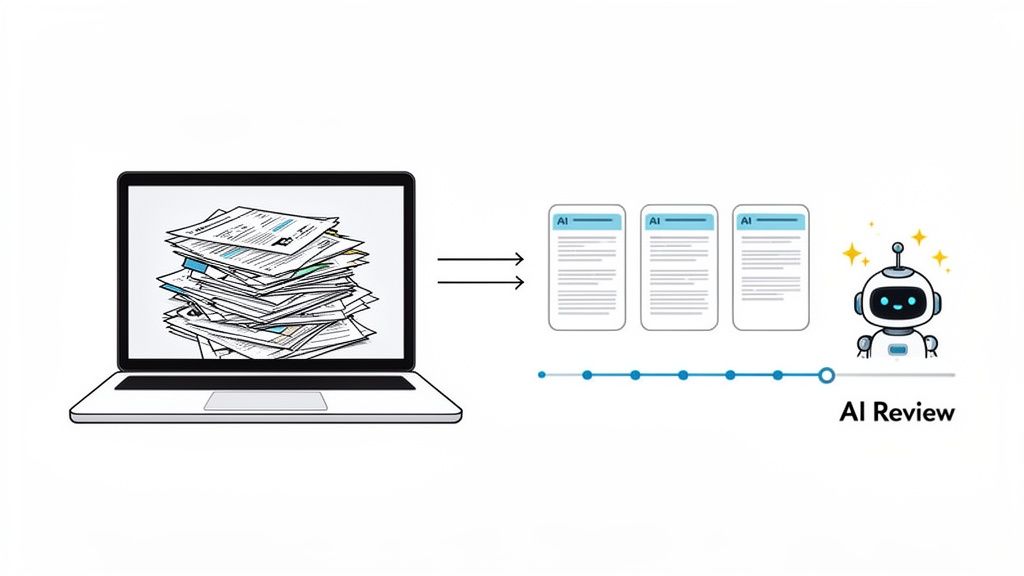
Thankfully, modern legal tech offers a powerful way out of this chronic delay. AI-powered platforms are changing the game by automating the most time-consuming parts of preparing a case. Instead of a paralegal spending days buried in records, AI can analyze the entire medical file in minutes.
This technology doesn't just scan documents; it actually understands them. It pulls out the critical data points that become the backbone of any strong personal injury claim.
- Key Dates: It instantly flags dates of service, specific treatments, and the first mention of symptoms.
- Medical Providers: It builds a complete list of every doctor, hospital, and therapist involved in the client's care.
- Diagnoses and Treatments: It creates a clean summary of all medical conditions and the procedures performed.
- Chronological Summaries: It takes a chaotic pile of records and organizes them into a clear, usable narrative.
By automating this foundational work, your team can skip weeks of manual labor. This lets you move from collecting evidence to drafting the demand letter with incredible speed, effectively shortening the entire personal injury case timeline.
From Manual Slog to Strategic Advantage
Making the switch from manual review to automated analysis completely changes how a firm operates. The right platform can give you a structured, high-level overview of a case’s medical history almost instantly.
This visual shows how a platform like Ares can distill complex medical histories into an organized, easy-to-scan format. The key insight here is speed and clarity; attorneys can grasp the core facts of a case in minutes, not days.
This isn't about replacing legal expertise; it's about amplifying it.
By handling the administrative heavy lifting, AI frees up legal professionals to focus on high-value tasks—crafting compelling legal arguments, developing case strategy, and negotiating from a position of strength.
This kind of technological support helps firms build stronger cases faster, putting them in a much better position to secure favorable settlements for their clients. For a closer look, you can explore more on how this is being applied in our complete guide to AI for personal injury lawyers. Ultimately, automation allows firms to not only manage their current caseload more efficiently but also to take on more cases without letting quality slip, leading to better outcomes for more clients.
Frequently Asked Questions
Working through a personal injury claim naturally brings up a lot of questions. Below, I’ll tackle some of the most common ones that both clients and legal teams ask, offering straight answers to demystify the process.
How Long Will My Case Take to Settle?
This is easily the number one question, but the honest answer is: it depends. Every case is unique. Still, we can look at some typical timeframes to give you a rough idea.
- Minor Injuries & Clear Fault: These cases tend to move the fastest, often settling in as little as 3 to 6 months.
- Moderate Injuries or Disputed Facts: When things are a bit more complicated, the timeline usually stretches to between 6 and 12 months.
- Severe Injuries or Complex Liability: For the most serious cases, you can expect the process to take anywhere from 1 to 2 years, and sometimes even longer.
Keep in mind, these are just averages. A difficult insurance adjuster or a snag in getting all the medical records can easily add months to the process. Rushing to a settlement usually means leaving money on the table, so patience is key.
The single biggest factor influencing your personal injury case timeline is the severity of your injuries and the time it takes to reach Maximum Medical Improvement (MMI). A case should not settle until the full extent of your damages is known.
What Is the Difference Between a Claim and a Lawsuit?
It’s easy to use these terms interchangeably, but in the legal world, they mean very different things. Knowing the difference helps you understand exactly where you are in the process.
A claim is the initial, pre-litigation demand for payment sent to the at-fault party's insurance company. Most personal injury matters are resolved at this stage. A lawsuit, on the other hand, doesn't start until a formal complaint is filed in court. This is what officially kicks off the litigation process.
Why Do So Few Cases Go to Trial?
You see dramatic courtroom showdowns on TV all the time, but that's not how it usually works in the real world. In fact, a huge majority of cases—over 95%—settle long before they ever see the inside of a courtroom.
There are a few solid reasons why everyone prefers to avoid a trial:
- Cost: Trials are incredibly expensive. Between court costs, expert witness fees, and the sheer number of attorney hours required, the price tag gets steep for both sides.
- Risk: Juries are unpredictable. No matter how strong your case feels, there's always a chance you could lose and walk away with nothing. A settlement offers certainty.
- Time: Filing a lawsuit and going all the way to trial can tack on another one to two years (or more) to your case's timeline.
Once both sides have gone through the discovery process, they usually have a very clear picture of the evidence. This clarity is often all it takes to bring them to the negotiating table to find a fair middle ground.
Ready to speed up your case prep and get to settlement sooner? Ares takes the grind out of medical record review, turning stacks of documents into a clear, strategic summary in minutes. Stop the bottlenecks, write more powerful demand letters, and free up your team to focus on what matters most. See how it works at https://areslegal.ai.