A well-crafted demand letter is the cornerstone of a successful personal injury claim, setting the stage for negotiation and demonstrating the strength of your case. A generic template simply won't suffice; adjusters can spot boilerplate language from a mile away. To command attention and secure a top-dollar settlement, your demand must be a compelling narrative backed by irrefutable evidence.
This guide moves beyond theory, providing a curated collection of personal injury demand letter examples, each dissected to reveal the specific strategies that compel insurers to act. We will break down what makes each example effective, from structuring a motor vehicle accident claim to documenting a complex Traumatic Brain Injury (TBI) case.
You will learn how to:
- Present facts in a clear, chronological narrative.
- Quantify both economic and non-economic damages persuasively.
- Leverage critical evidence to build an undeniable case for liability.
To truly master the art of maximizing your personal injury settlement, understanding how to craft a compelling demand letter is paramount. For this, a comprehensive guide to writing effective insurance demand letters offers invaluable insights. These examples show how to build a demand that not only tells your client's story but also forces the adjuster's hand. Discover how to transform standard practice into a strategic advantage, ensuring your demands are taken seriously from the moment they are received.
1. Motor Vehicle Accident (MVA) Demand Letter with Property Damage Integration
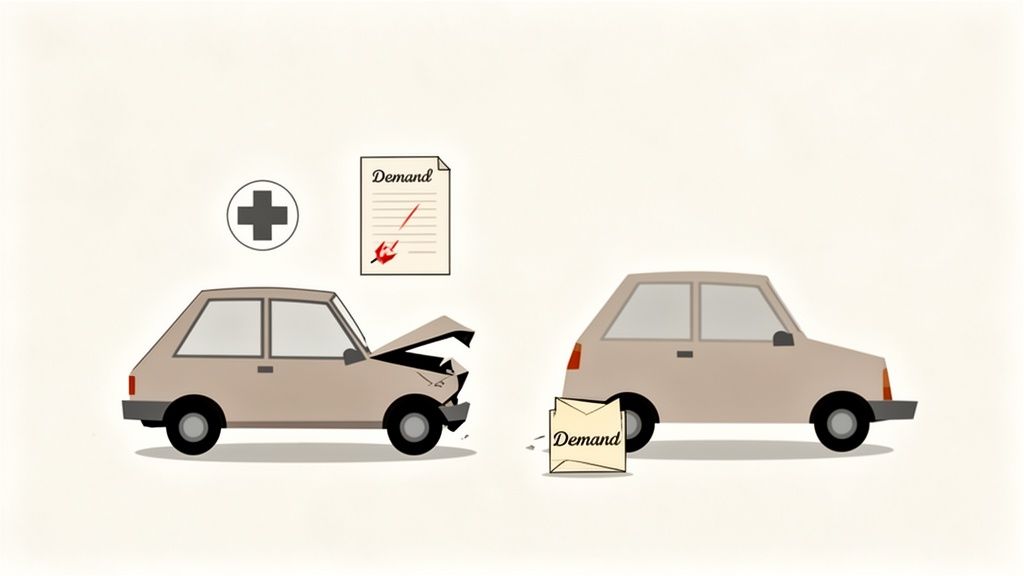
Integrating property damage details into a personal injury demand letter is a powerful strategic move, particularly in motor vehicle accident (MVA) cases. This approach uses the tangible, objective evidence of vehicle damage to create a compelling narrative that directly supports the severity of the claimant's physical injuries. By front-loading the demand with clear documentation of the collision's force, you establish a strong foundation of credibility before even detailing the medical treatment.
This method transforms a standard demand into a cohesive story. Instead of presenting two separate claims (property and injury), it links them, showing a clear cause-and-effect relationship that is difficult for insurance adjusters to dispute. The logic is simple: significant vehicle damage illustrates a violent impact, making soft-tissue, orthopedic, or spinal injuries a foreseeable and believable consequence. This is one of the most effective personal injury demand letter examples for cases where liability is clear but injury severity might be questioned.
Strategic Application and Real-World Examples
The core strategy is to use the property damage figures and photos as an anchor for the entire claim. This establishes the mechanism of injury in a visually and financially concrete way.
- Rear-End Collision: In a case involving a significant rear-end impact, the demand letter led with the $8,000 in vehicle repair costs and photos of the crumpled rear bumper. This evidence immediately framed the subsequent discussion of the client's whiplash and cervical strain, correlating the violent, rearward force with the diagnosed injuries. This resulted in a $47,000 settlement.
- T-Bone Intersection Accident: For a T-bone collision, the demand highlighted $12,000 in property damage to the driver's side door. This objective data made the client's hip and shoulder injuries entirely plausible, justifying the $6,000 in medical specials and ultimately securing a $65,000 settlement.
Actionable Tips for Implementation
To effectively integrate property damage, focus on clear, chronological storytelling supported by visual evidence.
- Structure the Narrative: Begin the demand with the property damage section. Present the repair estimate, final invoice, and compelling photographs of the damaged vehicle before delving into the personal injury details.
- Create Visual Correlation: Place a high-quality photo of the vehicle damage next to a summary of the initial medical diagnosis or the first MRI results. This visual pairing creates an immediate and powerful link for the adjuster.
- Automate Chronology: Use tools like Ares to extract accident dates, repair timelines, and all medical appointment dates. This creates an airtight, verifiable timeline that shows a consistent narrative of damage and treatment from day one.
- Reference the Police Report: Explicitly cite the officer's description of vehicle damage from the police report to add an authoritative, third-party validation of the impact's severity.
By weaving property damage into the fabric of your personal injury demand, you build a more persuasive and logically sound argument. For a deeper dive into structuring these documents, you can learn more about writing a compelling personal injury demand letter.
2. Slip and Fall / Premises Liability Demand Letter with Hazard Documentation
A premises liability demand letter requires a fundamentally different approach than a standard MVA claim. The central focus shifts from the singular moment of impact to a detailed narrative proving the property owner's negligence. Success hinges on meticulously documenting the hazardous condition and, more importantly, establishing that the defendant had notice of the danger and failed to take reasonable steps to remedy it. This strategy is about building an undeniable case for foreseeability and breach of duty.
This method transforms the demand from a simple recitation of injuries into a compelling argument about corporate or individual irresponsibility. By leading with concrete evidence of the hazard-like maintenance logs, prior incident reports, or photographic proof of a long-standing defect-you frame the claimant's fall not as an unfortunate accident, but as an inevitable outcome of the defendant's negligence. This makes it one of the most crucial personal injury demand letter examples for shifting blame squarely onto the property owner.
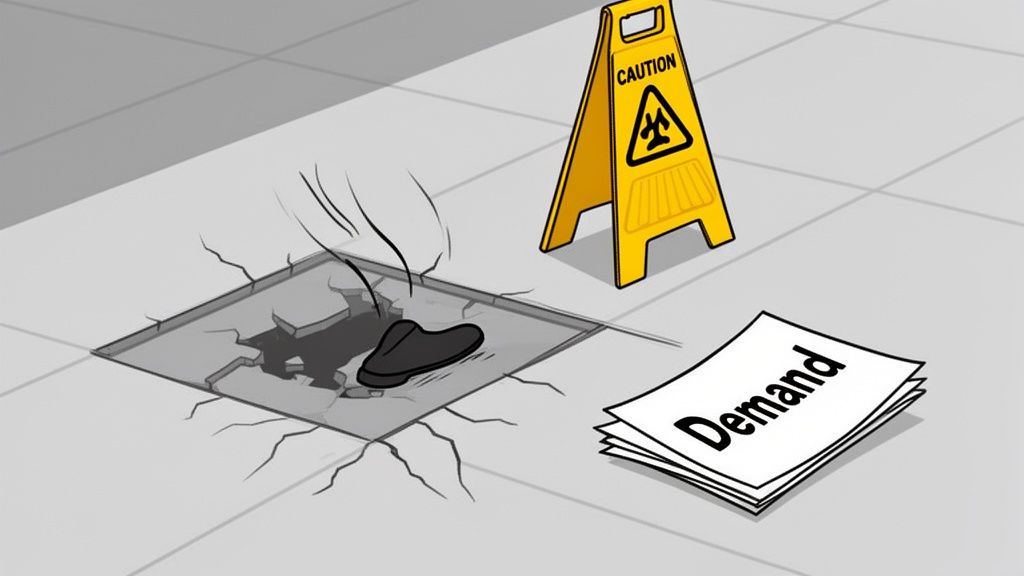
Strategic Application and Real-World Examples
The core strategy is to prove the defendant knew or should have known about the dangerous condition. This is achieved by front-loading the demand with evidence that establishes a pattern of negligence or a clear breach of safety standards.
- Restaurant Slip-and-Fall: The demand letter opened by citing maintenance logs that documented three similar slip-and-fall incidents in the same high-traffic area within the previous year. This evidence of prior notice made the client’s fall on a wet floor a foreseeable event, leading to a swift $52,000 settlement.
- Grocery Store Fall: In a case involving a fall caused by a broken floor tile, the demand included security footage showing the tile had been damaged for several days, with multiple employees walking past it. This visual proof of constructive notice, combined with $15,000 in medical bills for a fractured wrist, secured an $89,000 settlement.
- Apartment Complex Staircase Injury: The demand letter highlighted specific building code violations related to stairwell maintenance and attached prior written complaints from other tenants about the same broken step. This documentation of actual notice and regulatory non-compliance resulted in a $67,000 settlement for the client's resulting knee injury.
Actionable Tips for Implementation
To build a powerful premises liability demand, you must create an airtight narrative that demonstrates the defendant's awareness and inaction.
- Lead with Proof of Notice: Begin the demand by presenting the evidence of the hazard and the defendant's knowledge. This includes photographs of the defect, incident reports from prior events, maintenance logs, or citations for building code violations.
- Document the Hazard Visually: Include clear photographs of the specific hazard that caused the fall, taken as close to the time of the incident as possible. Juxtapose these images with the client's initial medical diagnosis to create a direct visual link between the dangerous condition and the injury.
- Establish a Negligence Timeline: Use discovery to obtain and organize all maintenance records, employee statements, and prior incident reports. This creates a timeline that can expose patterns of neglect and prove the defendant had ample opportunity to address the danger.
- Cite Regulatory Violations: Explicitly reference any applicable building codes, OSHA standards, or other local safety regulations that the property owner violated. This adds an authoritative, third-party validation of their negligence and strengthens the breach of duty argument.
3. Workplace Injury / Workers' Compensation Subrogation Demand Letter
Crafting a demand letter for a workplace injury caused by a negligent third party involves a delicate but crucial balance. The primary goal is to establish the third party's liability while simultaneously acknowledging and incorporating the workers' compensation carrier's subrogation rights. This approach requires meticulously separating the damages covered by workers' comp from the additional damages sought, such as pain and suffering and full wage loss, which are not covered by the statutory benefits.
This type of letter serves a dual purpose: it pursues a recovery for the injured employee beyond what workers' compensation provides and respects the carrier's legal right to be reimbursed for the benefits it has paid. The strategy hinges on presenting a unified front that clearly delineates the workers' comp lien while building an undeniable case for the third party's fault. This transforms the letter into one of the more complex but essential personal injury demand letter examples, perfect for cases where multiple layers of liability and damages are in play.
Strategic Application and Real-World Examples
The core strategy is to use the workers' compensation payment ledger as the undeniable foundation of medical specials and initial wage loss, then build upon it to claim additional damages from the third-party tortfeasor. This method provides the adjuster with a clear, pre-verified accounting of a significant portion of the economic damages.
- Manufacturing Equipment Defect: An employee suffered a partial hand amputation due to a defective safety guard on a piece of machinery. The workers' comp carrier paid $180,000 in medical and indemnity benefits. The demand letter to the manufacturer led with this established lien, then detailed the non-economic damages of permanent disfigurement and loss of earning capacity. This resulted in an additional recovery of $220,000 for the employee.
- Contractor Negligence on Job Site: A subcontractor's negligence created an unsafe condition, causing an employee to suffer a spinal injury. Workers' compensation paid $95,000 in benefits. The demand to the general contractor's insurer used the comp ledger to establish the initial damages, ultimately securing a third-party settlement of $150,000, which satisfied the lien and provided significant additional compensation to the injured worker.
Actionable Tips for Implementation
To execute this strategy, you must be transparent about the workers' comp lien while aggressively pursuing all available third-party damages.
- Obtain the Complete WC File: Secure the entire workers' compensation claim file, including the complete payment ledger (P&I or "Payment and Indemnity" report). This document is non-negotiable as it establishes the precise lien amount and your damages floor.
- Incorporate Official Reports: If an OSHA investigation occurred, include the full report and any citations issued to the third party. This serves as powerful, unbiased evidence of a breached safety standard and strengthens your liability argument.
- Calculate the Wage Loss Gap: Clearly calculate and present the difference between the partial wage replacement provided by workers' comp (often two-thirds of the average weekly wage) and the employee's actual, full wage loss. This is a key component of the third-party claim.
- Coordinate with the WC Carrier: Open a line of communication with the workers' compensation carrier's subrogation department or counsel. Aligning your demand with their interests can prevent future disputes and streamline negotiations with the third-party adjuster.
4. Medical Malpractice Demand Letter with Expert Affidavits and Deviation Documentation
A medical malpractice demand letter operates on a much higher level of complexity than a standard personal injury claim. This document is not merely a request for compensation; it's a meticulously constructed argument that must prove a healthcare provider breached the accepted standard of care, and that this breach directly caused the patient’s injuries. Including expert affidavits and clear documentation of the deviation from accepted medical standards is non-negotiable and forms the backbone of the entire claim.
This approach transforms the demand from a simple narrative into a quasi-legal brief. It presents a robust, evidence-based case that anticipates and preemptively counters the defense's arguments. By articulating the precise points of failure in the medical treatment, supported by an authoritative expert opinion, the demand forces the insurer to confront the merits of the case head-on. This makes it one of the most powerful personal injury demand letter examples for high-stakes cases where professional negligence is the central issue.
Strategic Application and Real-World Examples
The core strategy is to present an irrefutable, expert-backed narrative of medical negligence. The demand must clearly contrast the care the patient received with the care they should have received according to established medical protocols.
- Surgical Error: In a case involving a retained surgical sponge, the demand letter led with an expert affidavit from a board-certified surgeon. The affidavit established the breach of the standard of care (failing to perform a correct sponge count) and directly linked it to the client's subsequent life-threatening infection and need for additional surgeries, resulting in a $1.2M settlement.
- Misdiagnosis of Cancer: A demand for a delayed cancer diagnosis case was built around a detailed causation analysis from an oncologist. The expert’s report outlined how the primary physician’s failure to investigate clear symptoms deviated from the standard of care, allowing the cancer to progress to a more advanced, less treatable stage. This expert-driven argument secured an $890,000 settlement.
- Medication Error: For a hospital-based medication error that caused organ damage, the demand included an expert report from a clinical pharmacologist. The report documented the breach in protocol, confirming the wrong dosage was administered and causing the injury. This clear evidence of deviation supported a $567,000 settlement.
Actionable Tips for Implementation
To build a compelling medical malpractice demand, you must combine a clear narrative with unimpeachable expert testimony and meticulously organized records.
- Retain an Expert Early: Engage a qualified medical expert at the outset of the case. Their initial review is crucial for identifying the specific deviations from the standard of care and validating the claim's strength before you even draft the demand.
- Document Pre- and Post-Malpractice Health: Use baseline medical records to establish the client’s health status before the negligent act. Contrast this with post-malpractice records to create a stark and undeniable picture of the harm caused.
- Create a Deviation Timeline: Organize medical records chronologically to highlight the specific decision points where the provider’s actions diverged from the standard of care. Clearly show the cause-and-effect relationship between the deviation and the subsequent injury.
- Contrast Actual vs. Standard Care: Use a side-by-side comparison or a clear narrative structure to show what treatment was provided versus what an expert confirms should have been provided. This simplifies the complex medical facts for the adjuster.
Successfully litigating these cases often comes down to evidence management. For a comprehensive guide, you can learn more about how to organize medical records for a claim.
5. Traumatic Brain Injury (TBI) Demand Letter with Neuropsychological Testing and Life Impact Documentation
Crafting a demand letter for a Traumatic Brain Injury (TBI) requires a specialized approach that goes far beyond cataloging medical bills. The strategy is to build a detailed narrative around the "invisible" injuries, using objective data from neuropsychological testing and poignant life impact documentation. This method translates complex cognitive and behavioral changes into a clear, compelling, and high-value claim that insurers cannot easily dismiss.
This type of demand letter is essential for TBI cases because the most significant damages are often not physical but functional. It connects sophisticated medical evidence, like imaging and cognitive testing, with real-world consequences documented by family, friends, and employers. By demonstrating a direct line from the injury to diminished work capacity, strained relationships, and a reduced quality of life, this approach substantiates the massive non-economic damages inherent in TBI claims. It is one of the most critical personal injury demand letter examples for demonstrating long-term, life-altering harm.
Strategic Application and Real-World Examples
The core strategy is to use neuropsychological testing as the objective anchor for the subjective, yet devastating, life-impact evidence. This data-driven approach validates the client's reported struggles with concrete scientific findings.
- Moderate TBI from MVA: A client suffered a moderate TBI in a collision. The demand letter prominently featured neuropsychological testing results showing a 30% reduction in processing speed and working memory. This data was paired with a vocational expert’s report detailing why these specific deficits made it impossible to continue their career as an accountant. A life care plan projected ongoing therapy costs, leading to a $780,000 settlement.
- Fall-Related TBI: Following a fall, a client exhibited significant behavioral changes. The demand included statements from family and employers documenting increased irritability and memory loss. These anecdotal records were substantiated by a neuropsychological evaluation, which gave clinical weight to the observations. The claim also included vocational rehabilitation records proving an inability to return to their prior profession, securing a $625,000 settlement.
Actionable Tips for Implementation
To build a powerful TBI demand, you must meticulously document cognitive deficits and link them directly to functional impairments and future needs.
- Obtain a Complete Neuropsych Battery: Insist on a full neuropsychological testing battery. A single test is insufficient to capture the scope of TBI deficits. Focus on test results that quantify specific cognitive losses in processing speed, memory, attention, and executive function. As cases evolve, understanding options like telehealth neuropsychological testing can be crucial for ongoing assessments.
- Document and Explain Cognitive Deficits: Use a vocational expert's report to connect specific cognitive deficits to the inability to perform prior job duties. For example, show how a measured loss in executive function directly impacts a manager's ability to plan and organize.
- Gather Lay Witness Statements: Collect detailed statements from family, friends, and co-workers that document personality changes, memory problems, and mood swings. These third-party accounts provide powerful, relatable evidence of the TBI's impact.
- Create a Comprehensive Symptom Timeline: Use a tool like Ares to organize imaging studies with radiology reports, neuropsychological test dates, and treatment records. This creates a clear, chronological narrative of the injury, its diagnosis, and the persistent deficits over time.
6. Product Liability Demand Letter (Defective Product Causing Injury) with Design/Manufacturing Defect Analysis
A product liability demand letter requires a fundamentally different approach than a standard negligence claim. It shifts the focus from a single act of carelessness to a systematic failure in a product's design, manufacturing, or marketing. This type of demand letter is an evidence-heavy document, built on a foundation of expert analysis, regulatory history, and meticulous documentation of the product's failure. It aims to prove that the product was unreasonably dangerous and directly caused the claimant's injuries, holding corporate entities accountable.
This method transforms the claim into a technical and legal argument against a corporate defendant. Instead of simply detailing an accident, it presents a compelling case file demonstrating that the product was defective when it left the manufacturer's control. The goal is to establish strict liability or negligence by showing the company knew or should have known about the defect. This makes it one of the most complex but potentially high-value personal injury demand letter examples, often used in cases with catastrophic injuries and significant insurance coverage.
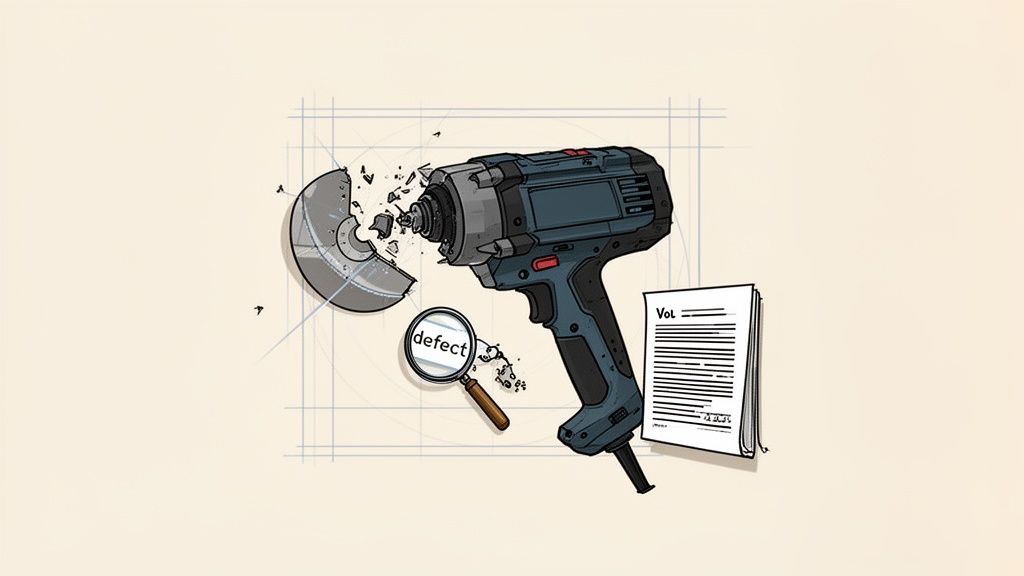
Strategic Application and Real-World Examples
The core strategy is to front-load the demand with indisputable expert and regulatory evidence, leaving the adjuster little room to question the product's role in the injury. This establishes corporate accountability from the outset.
- Defective Power Tool: A case involving a defective power tool led to a finger amputation. The demand letter prominently featured an expert engineering report that documented a manufacturing defect in the safety guard. It was further supported by evidence of prior similar incidents found in the CPSC database, proving the manufacturer had notice. This comprehensive approach led to a $425,000 settlement.
- Airbag Deployment Failure: After a vehicle's airbag failed to deploy, an expert analysis revealed a critical design defect in the sensor system. The demand letter integrated this report with documentation of regulatory complaints filed with the NHTSA. The irrefutable link between the design flaw and the client's severe facial injuries secured a $680,000 settlement.
Actionable Tips for Implementation
To build a powerful product liability demand, you must meticulously gather and present technical, regulatory, and medical evidence in a cohesive narrative.
- Lead with Expert Analysis: Begin the demand by summarizing the findings of a qualified product engineering expert. Clearly state whether it is a design, manufacturing, or warning defect and quote key conclusions from their report.
- Document Corporate Knowledge: Research and include evidence of prior incidents from sources like the CPSC, FDA, and lawsuit databases. Showing a pattern of failures or prior complaints demonstrates the manufacturer’s knowledge of the defect.
- Preserve and Photograph Evidence: Immediately secure the defective product. Take high-quality, detailed photographs of the product, its serial numbers, and the specific point of failure before sending it to an expert for inspection.
- Connect Injury to Defect: Use medical records and expert medical opinions to draw a clear, direct line of causation from the specific product failure to the resulting injuries. For example, show how a specific mechanical failure caused a precise orthopedic injury.
7. Assault / Battery / Intentional Tort Demand Letter with Witness Statements and Criminal Context
Crafting a demand letter for an intentional tort, such as assault or battery, requires a different strategic approach than a standard negligence claim. Instead of proving carelessness, the focus shifts to documenting clear intent and leveraging criminal proceedings to substantiate the civil claim. This method involves weaving together police reports, witness statements, and evidence from the criminal case to create an undeniable narrative of wrongdoing that leaves little room for the defendant to dispute liability.
The power of this approach lies in its use of official, third-party documentation to corroborate the plaintiff's account. A pending criminal charge or a detailed police report provides immediate credibility and shifts the dynamic, making the demand less about what happened and more about how much the resulting damages are worth. This is one of the most compelling personal injury demand letter examples for cases where the defendant's actions were deliberate, as it uses the state's own evidence to anchor the civil liability claim.
Strategic Application and Real-World Examples
The core strategy is to front-load the demand with evidence from the criminal context, establishing the defendant's malicious intent before detailing the victim's injuries. This frames the claim as a response to a documented crime, not just an unfortunate incident.
- Workplace Assault: A supervisor assaulted an employee, leading to pending criminal charges. The demand letter led with excerpts from the police report and two corroborating witness statements. This immediately established liability for both the supervisor and the employer (under respondeat superior), leading to a pre-litigation settlement of $165,000.
- Bar Fight with Inadequate Security: A patron was attacked, and the police report documented the assault and noted multiple witnesses. The demand letter highlighted the bar's failure to provide adequate security, attaching witness affidavits. This dual-pronged approach secured a $234,000 settlement by establishing liability against both the assailant and the negligent business.
Actionable Tips for Implementation
To build an effective intentional tort demand, focus on creating an airtight case file that seamlessly integrates criminal evidence with civil damages.
- Lead with Official Reports: Begin the demand by summarizing the incident directly from the police report. Quote the officer's observations and reference the criminal charges filed against the defendant to establish an authoritative foundation.
- Incorporate Witness Statements: Attach signed and dated witness statements as exhibits. In the body of the letter, use block quotes for powerful excerpts from these statements that corroborate the assault and the severity of the attack.
- Document Injuries Visually and Medically: Use time-stamped photos of visible injuries taken immediately after the incident and during the healing process. Pair these with medical records from the emergency room and any subsequent treatment to connect the documented act with the physical harm.
- Leverage Prior Communications: If available, include evidence of prior threats from the defendant, such as text messages, emails, or social media posts. This demonstrates a pattern of intent and escalation that strengthens the claim for punitive damages.
- Quantify All Damages: Meticulously calculate economic damages like medical bills and lost wages. For non-economic damages, it is crucial to present a well-reasoned argument, and you can discover more about how to calculate pain and suffering damages.
7-Case Personal Injury Demand Letter Comparison
| Demand Letter Type | Implementation Complexity | Resource Requirements | Expected Outcomes | Ideal Use Cases | Key Advantages |
|---|---|---|---|---|---|
| Motor Vehicle Accident (MVA) Demand Letter with Property Damage Integration | Low–Medium | Vehicle photos, repair estimates, medical records, lost-wage docs, insurance policy analysis | Moderate settlements tied to medical specials and repair costs; efficient adjuster processing | Auto collisions where vehicle damage corroborates injury severity | Property damage provides objective causation evidence; standardized format adjusters expect |
| Slip and Fall / Premises Liability Demand Letter with Hazard Documentation | Medium | Hazard photos/measurements, maintenance logs, prior-incident reports, security footage, medical causation records | Variable outcomes; stronger recoveries when notice/violation proven | Falls on commercial/residential premises with documentary notice or pattern of incidents | Owner records and regulatory violations create strong proof of notice and breach |
| Workplace Injury / Workers' Compensation Subrogation Demand Letter | Medium–High | Complete workers' comp file, OSHA/accident reports, employer records, medical records, lien documentation | Recoveries can be significant but reduced by subrogation liens and statutory limits | Third-party negligence causing workplace injury where comp benefits paid | Clear work-related causation; workers' comp carrier has incentive to pursue subrogation |
| Medical Malpractice Demand Letter with Expert Affidavits and Deviation Documentation | High | Retained medical experts, full multi-provider medical chronology, expert affidavits, causation analysis | Potentially high settlements but high defense scrutiny and litigation risk | Cases alleging deviation from accepted medical standards with serious harm | Expert affidavits provide credible standard-of-care analysis and substantiate claims |
| Traumatic Brain Injury (TBI) Demand Letter with Neuropsychological Testing and Life Impact Documentation | High | Neuropsych testing, advanced imaging, neurology/rehab records, vocational/life-care plans, family/employer statements | Substantial settlements when long-term cognitive/functional impairment is demonstrated | Significant head injuries with measurable cognitive, behavioral, or vocational impact | Objective testing and imaging document deficits; strong persuasive narrative about life impact |
| Product Liability Demand Letter (Defective Product Causing Injury) with Design/Manufacturing Defect Analysis | High | Physical product preservation, engineering experts, regulatory records, prior-incident data, medical records | Often high settlements due to corporate defendants and objective defect proof | Injuries caused by defective products (design, manufacturing, failure to warn) | Engineering reports and regulatory violations provide objective defect and manufacturer-knowledge evidence |
| Assault / Battery / Intentional Tort Demand Letter with Witness Statements and Criminal Context | Medium–High | Police reports, witness statements, injury photos, criminal charging documents, mental-health records | Variable recoveries; stronger when criminal findings and witnesses corroborate intent | Intentional acts (assault, battery, domestic violence) with criminal or witness corroboration | Criminal charges and witness accounts help establish intent and strengthen liability claims |
Turning Examples into Action: Automating Your Path to a Stronger Demand
Throughout this article, we have dissected seven distinct personal injury demand letter examples, each showcasing a strategic approach tailored to its unique circumstances. From the detailed hazard documentation in a premises liability case to the complex expert analysis required for a medical malpractice claim, a clear pattern emerges. The most compelling demands are not merely requests for compensation; they are powerful, evidence-backed arguments that leave little room for dispute.
These examples demonstrate that an effective demand letter is a masterclass in strategic storytelling. It meticulously establishes liability, quantifies damages with precision, and anticipates and neutralizes potential defenses before the adjuster can even raise them. The common thread is the transformation of raw data, medical records, witness statements, and expert reports into a cohesive, persuasive narrative. This is where the true work lies and where modern law firms find their competitive advantage.
Key Takeaways for Crafting High-Impact Demands
Mastering the art of the demand letter requires more than just a template. It requires a commitment to a few core principles illustrated across all the examples we reviewed:
- Evidence is the Foundation: Every claim, from lost wages to future medical needs, must be substantiated with clear, organized documentation. The TBI example, with its reliance on neuropsychological testing, and the product liability example, with its defect analysis, underscore this critical point.
- Narrative is the Framework: Facts alone are not enough. You must weave them into a compelling story that highlights the defendant's negligence and illustrates the profound human cost of the injuries. This narrative structure is what makes your client's pain, suffering, and loss tangible to the adjuster.
- Specificity Drives Value: Vague assertions are easily dismissed. A powerful demand letter quantifies every possible loss. The MVA example's integration of property damage and the wrongful death claim's detailed economic loss calculations are prime illustrations of how specificity anchors your demand in reality and justifies its value.
From Manual Effort to Automated Excellence
The challenge has never been understanding what makes a great demand letter. The challenge has always been the sheer volume of manual work required to produce one. Manually sifting through thousands of pages of medical records, collating bills, and structuring a chronology is an immense administrative burden. This process is not only time-consuming but also prone to human error, where a single missed detail could significantly undervalue a claim.
This is precisely the bottleneck that legal technology is designed to eliminate. By leveraging AI-powered tools, you can automate the most laborious parts of demand letter preparation. Imagine transforming a chaotic pile of medical records into a structured, case-ready summary and a first-draft demand letter in a matter of minutes, not days.
This technological shift allows your team to move from data entry to strategic analysis. It frees up your attorneys and paralegals to focus on what truly matters: refining legal arguments, strengthening the narrative, and preparing for negotiation. By automating the foundational work, you can ensure that every single demand leaving your office meets the high standards set by the personal injury demand letter examples in this guide. This consistency and efficiency directly translate into better, faster outcomes for your clients and improved profitability for your firm.
Ready to stop manually drafting and start strategically negotiating? Discover how Ares uses AI to instantly review medical records and draft comprehensive demand letters, empowering you to build stronger cases and secure better settlements. See how top PI firms are leveraging our technology at Ares.