Record Retrieval Service: record retrieval service for faster PI case outcomes
For any personal injury firm, the administrative grind of chasing down medical records is a familiar—and costly—headache. It's the unglamorous but absolutely essential work that can bring a case to a screeching halt.
What Is a Record Retrieval Service Anyway?
Imagine your best paralegal spending half their day on hold with a hospital, re-faxing the same authorization form for the third time, or trying to track down a single missing page from a 500-page file. That’s the reality for many firms. Every minute they spend on that administrative treadmill is a minute they can't dedicate to legal strategy, client communication, or drafting a powerful demand letter.
This is exactly the problem a record retrieval service is built to solve. Think of it less as a simple courier and more as a specialized extension of your own team, one that’s an expert in navigating the maze of medical records departments. Instead of your staff juggling dozens of individual requests, the service takes the entire process off your plate.
The Core Function of a Retrieval Service
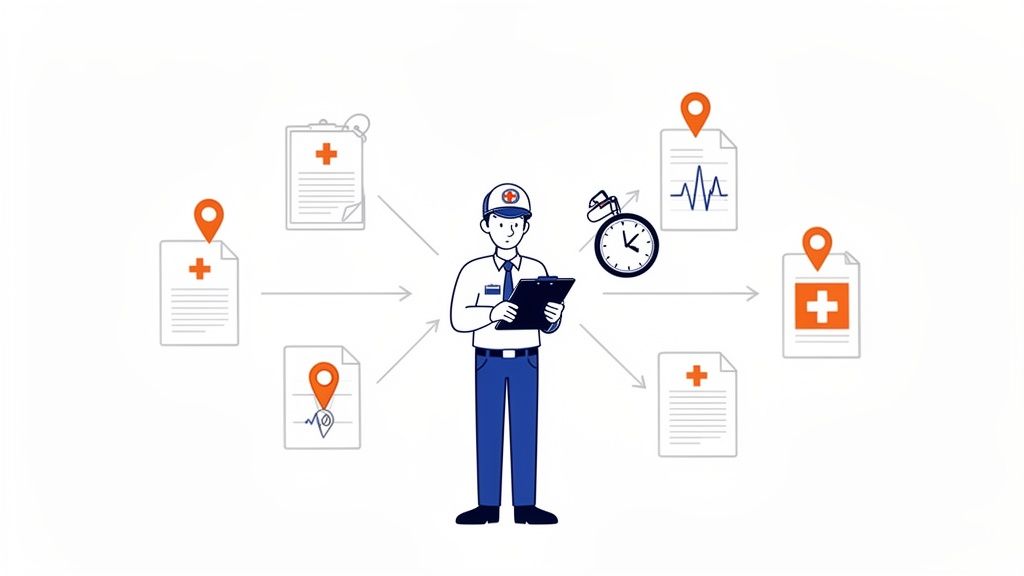
At its heart, a retrieval service tackles one of the biggest time-sinks in personal injury law: the manual, error-prone process of gathering evidence. By systemizing and managing this function, they help your firm run more efficiently. Their main job boils down to a few key responsibilities:
- Request Initiation: They draft and send properly formatted, HIPAA-compliant requests to every hospital, clinic, and specialist involved in your client's care.
- Persistent Follow-Up: This is huge. They are the ones making the phone calls and sending the emails, persistently checking in with providers to ensure your requests don’t fall to the bottom of the pile.
- Cost Management: They handle all the provider invoices and processing fees, consolidating everything into a single, easy-to-manage bill for your firm.
- Document Organization: Once the records arrive, they need to be sorted and put in order. To learn more about tackling this yourself, check out our guide on how to organize medical records.
A professional retrieval service does more than just fetch documents; it introduces predictability and speed into a historically unpredictable process, directly impacting case velocity and firm profitability.
Building a strong case hinges on having all the right evidence, and that starts with efficient record retrieval. It's a critical piece of the puzzle, just as important as knowing how to choose a personal injury attorney in the first place.
So, let's break down the three paths you can take to handle this vital function.
Uncovering the True Cost of In-House Record Retrieval
It’s easy to think that handling record retrieval in-house gives you more control and saves money. After all, your team knows the case inside and out, so why would you trust a core part of the discovery process to anyone else? This logic makes sense on the surface, but it often masks the significant hidden costs that are quietly eating away at your firm’s most critical resources: time, money, and focus.
The real expense isn't just a paralegal's salary. It’s the crushing weight of all the non-billable, administrative tasks that pull your best people away from what they do best—building strong cases. Every minute spent on hold with a hospital, chasing down a missing page, or wrestling with a finicky provider portal is a minute they’re not drafting a demand letter, prepping for a deposition, or communicating with a client. This is a massive, often unmeasured, operational drag.
A Day in the Life of Chasing Paperwork
To really get it, you have to walk through the process. Let's say a paralegal needs to get a set of medical records. It starts with drafting and sending a HIPAA-compliant request, which might take 15-30 minutes if they have all the provider’s contact details right at their fingertips. But that's just the first step.
The real time-suck is the follow-up. This isn't a one-and-done task; it's a relentless cycle of weekly calls to check the status, emails that go unanswered, and resubmitting forms that were mysteriously "never received." Then, when the records finally land on their desk, they might be incomplete, for the wrong date of service, or completely illegible. This kicks off a whole new round of calls and corrections. This chase easily eats up hours of your team's time for a single request, and it multiplies across your entire caseload.
The true cost of in-house retrieval isn't found on a spreadsheet. It's measured in the opportunity cost of delayed demand letters, stalled negotiations, and the compounding frustration of your most valuable legal staff.
This inefficiency does more than just hurt morale. It puts a hard ceiling on your firm's capacity for growth. When your team is buried in administrative quicksand, they simply can't handle more cases, which directly limits your revenue.
Quantifying the Hidden Expenses
When you start to attach real numbers to these activities, the financial drain becomes painfully obvious. We're not just talking about staff time; we're talking about hard costs and the immense opportunity cost that comes from a sluggish case timeline. While bringing in a professional record retrieval service might seem like adding a line item to your budget, a head-to-head comparison usually proves it's a strategic cost-saving move.
To put this in perspective, let’s break down the real costs tied to just one record request managed by your team.
The True Cost Breakdown of One In-House Record Request
The table below quantifies the direct and indirect costs associated with a single medical record request handled internally by a personal injury firm.
| Cost Component | Estimated Time / Expense | Impact on Firm |
|---|---|---|
| Paralegal Time (Request Prep) | 30 minutes | Diverts a skilled legal professional from strategic case work. |
| Follow-Up Communication | 2-4 hours (calls, emails) | Creates a huge non-billable administrative burden. |
| Correcting Provider Errors | 1-2 hours | Delays the entire case timeline and forces time-consuming rework. |
| Postage and Supplies | $5 - $15 | Adds up to a consistent, recurring overhead cost. |
| Provider Fees | $25 - $100+ | Creates unpredictable expenses that are tough to budget for. |
| Opportunity Cost | Weeks of delay | A 1-2 month delay stalls settlement, directly impacting cash flow. |
As you can see, the hours pile up fast. A paralegal earning $35 per hour could easily spend $100-$200 worth of their time on a single request—and that’s before you even pay the provider’s invoice. For a firm juggling dozens of cases, this adds up to tens of thousands of dollars every year in lost productivity and delayed revenue.
This forces a critical question: is chasing paperwork really the best use of your firm's expert legal talent?
Comparing the Three Record Retrieval Models
Choosing how your firm handles medical records isn't just an administrative task—it's a strategic decision that directly impacts your efficiency, case velocity, and ultimately, your bottom line. Most personal injury firms fall into one of three camps for record retrieval, and each model comes with its own distinct set of benefits and headaches.
To figure out what’s best for your practice, you need to weigh the trade-offs between keeping the work in-house, outsourcing to a traditional vendor, or adopting a modern, AI-powered platform. The right record retrieval service is the one that fits your firm's size, caseload, and ambitions for growth.
The In-House Control Model
The DIY approach puts your team in complete control. Your paralegals and legal assistants manage every single step, from drafting the initial requests and HIPAA authorizations to chasing down providers on the phone and paying invoices. The big upside here is total control and firsthand knowledge of every case.
But as we’ve seen, that control comes at a steep price. The administrative burden is massive, pulling your most skilled people away from high-value legal work. It’s also a nightmare to scale. A sudden spike in cases can completely swamp your team, creating bottlenecks that stall the entire litigation timeline. This model really only works for very small firms with a light, predictable caseload.
This flowchart breaks down the initial decision-making process for firms trying to figure out their retrieval strategy.
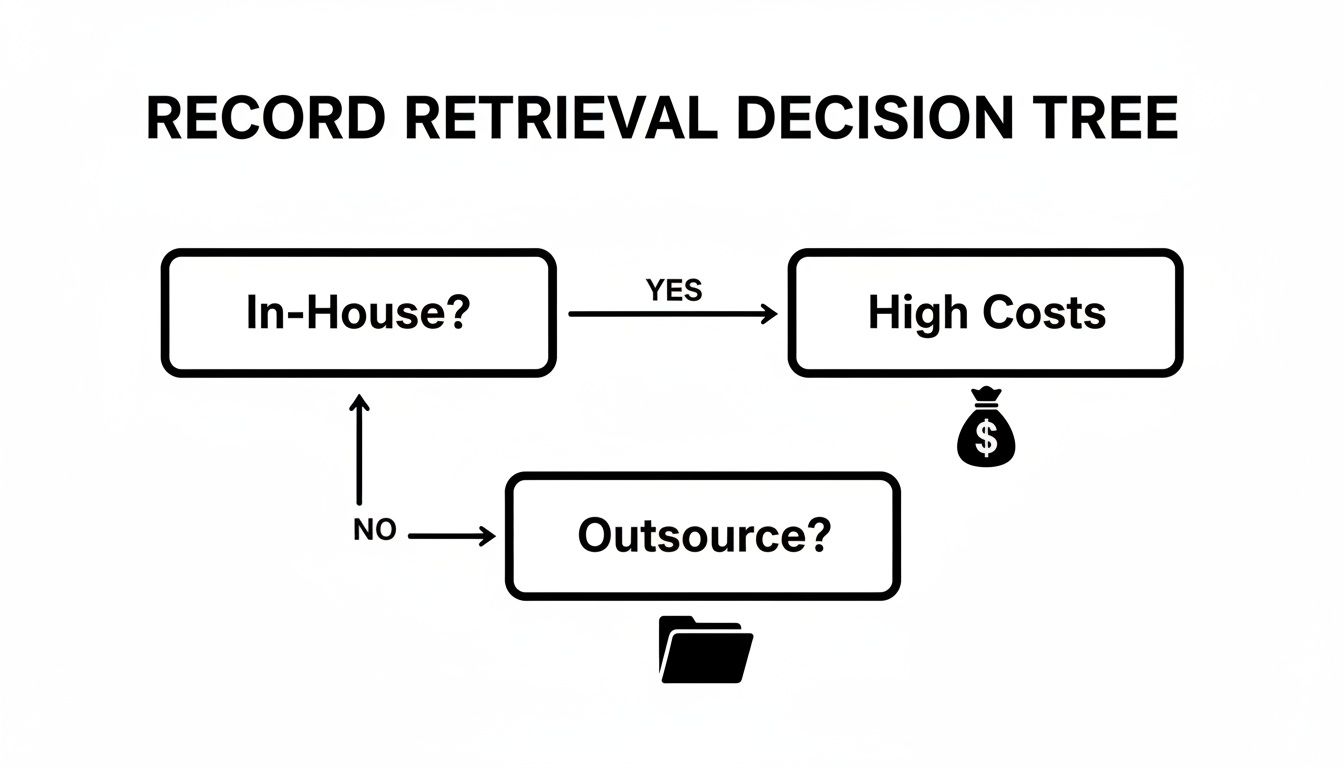
As the visual suggests, the hidden costs of keeping retrieval in-house often become too high, pushing firms to look at outsourcing as a more sustainable path forward.
The Traditional Outsourcing Path
For decades, the standard answer to the in-house grind has been traditional outsourcing. You hand off the entire process to a third-party vendor, and poof—your team is freed from the endless cycle of follow-up calls. It’s an immediate way to lift a huge administrative weight, letting your staff get back to focusing on case strategy.
The catch? This model often swaps one problem for another: a frustrating lack of transparency and speed. Once you send a request to a traditional vendor, it can feel like it vanished into a black hole. Communication is often sluggish, status updates are rare, and you have virtually no insight into where your records are. You can end up with the same delays you were trying to fix, only now you have less control over them.
While traditional outsourcing solves the problem of administrative workload, it often replaces it with issues of slow turnarounds and a complete lack of real-time visibility, leaving firms feeling powerless.
The Modern AI-Powered Platform
A new model has emerged that offers the best of both worlds: the control you get from an in-house team combined with the efficiency of outsourcing. AI-powered platforms automate the most grueling parts of the retrieval process—like the relentless follow-ups and status checks—while giving you a real-time dashboard to track every request.
This tech-forward approach brings some major advantages:
- Real-Time Transparency: You can see the exact status of every request at any time, which means no more guessing games.
- Enhanced Speed: Smart automation ensures no request falls through the cracks, dramatically shortening turnaround times.
- Data Security: These platforms are built from the ground up with HIPAA compliance and enterprise-grade security as a top priority.
The move towards technology-driven solutions is fundamentally changing the industry. The global medical records retrieval market was valued at around $1.1 billion and is expected to reach $2.8 billion by 2034, with outsourcing and AI adoption being the primary drivers.
This model gives firms the relief of outsourcing without forcing them to give up the visibility and control they need to manage their cases effectively. Of course, once the records arrive, the next step is digging into them. For more on that, you might find our guide on choosing a medical record review service helpful.
To put it all into perspective, the table below gives you a direct, side-by-side look at how these three models stack up across the key metrics that matter most to a PI firm.
Comparison of Record Retrieval Models
The right model can feel like a game-changer for your firm's operations. This table breaks down the core differences between handling retrieval in-house, using a traditional service, and adopting a modern AI platform.
| Feature | In-House Team | Traditional Outsourced Service | AI-Powered Platform |
|---|---|---|---|
| Speed & Turnaround | Slow; entirely dependent on staff bandwidth. | Inconsistent; often slow with little recourse. | Fast; optimized by automated follow-ups. |
| Cost Efficiency | Very high hidden costs in staff time. | Predictable, but can be high for slow service. | High ROI due to speed and staff time saved. |
| Transparency | High; your team sees everything. | Low; often a "black box" process. | High; real-time tracking dashboards. |
| Scalability | Poor; struggles with growing caseloads. | Good; can handle high volumes. | Excellent; scales instantly with demand. |
| Data Security | Variable; dependent on internal protocols. | Generally secure, but relies on vendor. | Highest; built with HIPAA compliance. |
| Staff Focus | Low; focused on administrative tasks. | High; staff can focus on legal work. | Highest; staff empowered by technology. |
In the end, the choice depends on your firm’s goals. The best record retrieval service is the one that frees up your team to do what they do best: fight for the best possible outcomes for your clients.
How Modern Technology Powers Faster Retrieval
Anyone who’s been in personal injury law for a while knows the drill: the endless cycle of faxes, phone calls, and manual follow-ups just to get a client's medical records. It’s a notorious bottleneck, slowing down cases and frustrating everyone involved. But today’s record retrieval service operates on a completely different level, using technology to build a faster, more transparent, and far more reliable system.
This isn’t about adding bells and whistles. It's about using smart, practical tools to solve the real-world headaches that plague every firm. The two game-changers here are cloud-based platforms and artificial intelligence. They work together to transform the chaotic paper chase into a predictable process that gives your firm a real edge.
The Power of the Cloud: Centralized and Secure Access
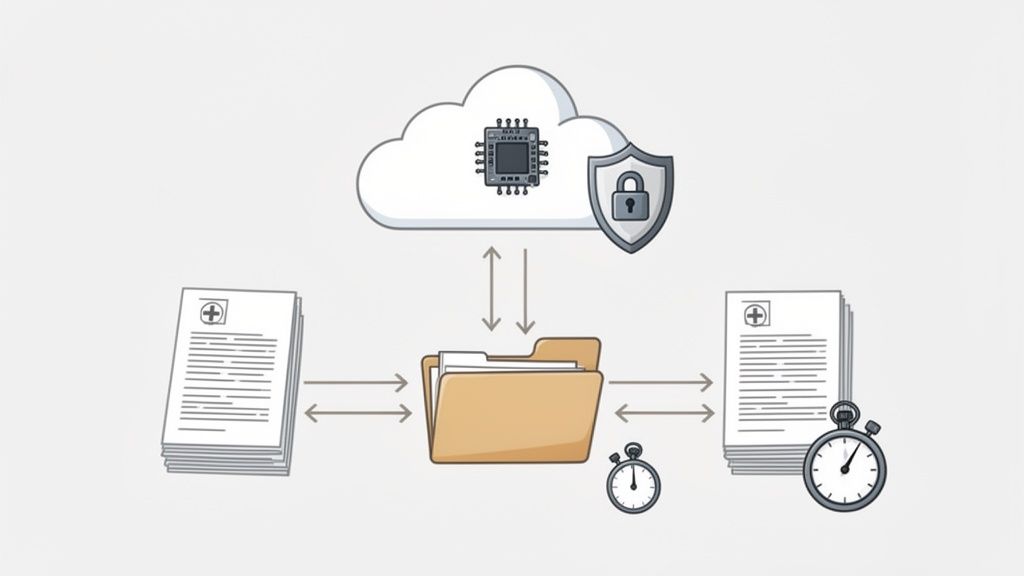
Imagine a secure, central hub for every record request your firm makes. That's what a cloud platform delivers. Instead of vital documents being buried in email chains, saved on a single paralegal's desktop, or stuck in a filing cabinet, everything is organized in one place. Your entire team gets instant, secure access to case files from anywhere, at any time.
There’s a reason cloud-based systems have become the standard. With major improvements in security, firms can now scale their operations confidently. This tech-driven approach has enabled professional providers to hit an average turnaround time of just 15 days—a massive 50% improvement over the 30-day minimum regulatory requirement.
Of course, security is paramount. These platforms are built from the ground up with HIPAA compliance in mind. They aren't just tacking on security features; it's part of their DNA. This includes:
- End-to-End Encryption: Your client's sensitive data is protected whether it's being sent or stored.
- Secure User Portals: You control exactly who sees what, ensuring only authorized team members can access specific case files.
- Detailed Audit Trails: Every single action—every view, download, or edit—is logged, giving you a complete history for accountability.
A cloud-based record retrieval service transforms document management from a liability into a secure, organized, and accessible asset for your entire firm.
AI as the Ultimate Administrative Assistant
If the cloud is the command center, then artificial intelligence (AI) is the tireless engine driving the whole operation. Think of it as the best administrative assistant you’ve ever had—one that handles all the repetitive, time-sucking tasks of the retrieval process so your team can focus on what they do best: building the case.
The latest developments in document artificial intelligence are making a huge impact on both speed and accuracy. In a modern workflow, AI is quietly working behind the scenes to draft and send out initial requests, making sure every required authorization and piece of information is included from the start.
But where AI truly shines is in the follow-up. It never gets tired or forgets. AI can send automated reminders to providers, escalate requests that are dragging on too long, and even flag a custodian who has gone completely silent. Once the records finally arrive, AI tools can even perform an initial quality check to ensure the files are complete and legible before a human ever lays eyes on them. This catches problems early and cuts out weeks of potential delays. You can learn more about its role in our guide on https://areslegal.ai/blog/ai-for-personal-injury-lawyers.
By automating these tedious but critical steps, a modern record retrieval service doesn’t just get records faster. It brings a new level of precision and reliability to the process that a manual approach could never achieve, letting your firm build stronger cases on a foundation of solid, timely evidence.
Choosing the Right Record Retrieval Partner
Picking a vendor to handle your clients’ Protected Health Information (PHI) is one of the most consequential decisions you'll make. The right partner becomes a true extension of your firm, an invisible engine that accelerates your case timelines and lets your team focus on winning. The wrong one, however, creates new headaches, compliance nightmares, and a whole lot of frustration.
To get past the slick sales pitch, you have to dig deep. You need a structured way to evaluate their technology, security, and real-world performance. It’s all about asking the right questions to see how they really operate and if they meet your firm’s standards for both efficiency and client care.
First Things First: Security and Compliance
Before you even think about speed or features, the conversation has to start and end with security. Handling medical records is a massive responsibility, and any partner you consider must have an ironclad commitment to protecting that data. HIPAA compliance isn't just a feature on a list; it's the foundation of their entire business.
When you're vetting a service, don't be shy about pressing for specifics on their security infrastructure. Key questions should include:
- Data Encryption: Is every single document encrypted from end-to-end, both when it's being sent and when it's sitting on a server?
- Access Controls: How do you lock down files? I need to know that only authorized people can see specific case records.
- Audit Trails: Can you show me a detailed log of every single action taken on a file, from who opened it to when it was downloaded?
- Business Associate Agreement (BAA): Are you prepared to sign a robust BAA that clearly defines your responsibilities under HIPAA?
If you get a vague or hesitant answer to any of these, it’s a major red flag. A partner you can trust will be completely transparent—and even proud—of their security measures.
Next Up: Evaluating How They Actually Work
Once you’ve established that they can be trusted with your data, it's time to talk performance. A vendor's workflow has a direct impact on your firm’s efficiency. You're not looking for a simple courier service; you need an active manager who can tackle the inevitable roadblocks, like a medical provider who just won't respond.
A great record retrieval partner doesn't just process requests; they solve problems. Their real value is in how well they chase down delays and deliver complete, accurate records without your team having to constantly follow up.
To figure out how good they really are, ask about their processes and hard numbers.
- Handling Unresponsive Providers: What's your protocol when a clinic ignores your request or says they never got it? A top-tier partner will have an automated, multi-step follow-up system already in place.
- Average Turnaround Times: Show me the data. What are your average retrieval times, and can you break that down by provider type, like big hospitals versus small private practices? You want a partner who obsesses over this metric.
- Quality Control: How do you double-check that the records you receive are complete, legible, and for the right patient and dates of service? This simple step can save your paralegals countless hours of fixing mistakes.
Finally: Technology and Integration
The last piece of the puzzle is figuring out how this service will fit into the technology your firm already uses. The whole point is to eliminate manual work, not just shift it around. That's why a seamless integration with your existing case management software (CMS) is non-negotiable.
A modern record retrieval service should feel like a central command center, not another isolated app. Make sure they offer a direct, reliable integration with your firm's primary software. This is critical because it means status updates, retrieved documents, and even invoices get automatically pushed into the right case file. Your team gets a single source of truth, and you eliminate the soul-crushing administrative work of downloading and re-uploading files.
How to Measure the ROI of Your Retrieval Process
Thinking of a record retrieval service as just another line-item expense is a mistake. It's a strategic investment, one that should pay for itself through real, measurable gains in your firm’s efficiency and profitability.
But to make the case for switching from your current in-house or outsourced model, you need more than a gut feeling. You need to prove the value by connecting the dots between a smarter workflow and your firm's bottom line. It all comes down to tracking the right numbers and telling a story that makes financial sense.
Key Metrics for Quantifying Your Return
To build a solid business case, you have to focus on the metrics that managing partners truly care about: saved time and faster revenue. These are the numbers that speak directly to your firm's operational health and its capacity for growth.
Get started by tracking these essential data points:
- Reduction in Paralegal Administrative Hours: This is your most direct and immediate financial win. Figure out how many hours your team sinks into non-billable grunt work each month—endless phone tag with providers, fixing request errors, chasing down invoices. When you offload that burden, a skilled paralegal can reclaim dozens of hours to focus on high-value legal work.
- Decrease in Average Record Turnaround Time: Start the clock from the moment a request goes out to the second you have complete, accurate records in hand. Trimming weeks or even months from this timeline isn't just a nice-to-have; it's a powerful accelerant for your entire case lifecycle.
- Increase in Case Velocity: This metric looks at how fast a case moves from intake to settlement. Getting records sooner means you can draft and fire off demand letters earlier, kickstarting negotiations and shrinking the entire settlement cycle.
The most powerful ROI calculation connects faster retrieval to faster settlements. If you can close a $100,000 case two months earlier, you’ve just made a significant improvement to your firm’s cash flow and stability.
Calculating the Financial Impact
Once you have the data, the math is straightforward. To calculate the direct savings from giving your staff their time back, try this simple formula:
(Avg. Paralegal Hourly Rate) x (Admin Hours Saved Per Month) x 12 = Annual Savings
Let’s run a quick example. If you save just 20 hours per month for a paralegal who makes $35/hour, you’re pocketing $700 a month. That adds up to $8,400 a year from just one team member. That figure alone can often cover the cost of a professional service.
But the real impact runs deeper. Think about the revenue side of the equation. If faster retrieval gives your team the capacity to settle just 5% more cases annually, the boost to your top line can be enormous. A modern record retrieval partner helps you scale your caseload without having to scale your headcount.
The Overlooked Qualitative Benefits
Beyond the hard numbers, don't forget the benefits you can feel. These are the improvements that cut down on burnout, lift team morale, and ultimately produce better results for your clients.
- Improved Team Morale: When you free your legal experts from the soul-crushing admin work, they can finally focus on the intellectually challenging legal strategy they were hired to do.
- Stronger Case Building: Getting a complete, well-organized set of evidence sooner gives your attorneys more time to craft a winning narrative and poke holes in the opposition's arguments.
- Enhanced Client Satisfaction: Nothing makes clients happier than progress. Faster case movement and clear communication lead to satisfied clients who become your firm's best source of referrals.
Common Questions About Record Retrieval Services
When you're thinking about changing how your firm handles medical records, a lot of practical questions come up. It's smart to dig into the details of compliance, speed, and how a new service will fit with your current setup. Let's walk through the most common questions we hear from personal injury firms to give you a clearer picture.
How Is HIPAA Compliance Guaranteed?
Any reputable service makes data security its absolute top priority. This isn't just about checking a box; it's about building a fortress around your client's most sensitive information. They do this with layers of protection, like end-to-end encryption on every document and secure client portals that keep prying eyes out.
They should also provide a comprehensive Business Associate Agreement (BAA), which is a legal contract binding them to protect client data just as stringently as you do. Behind the scenes, they use strict internal access controls and keep detailed audit trails, so every single action—from request to download—is logged. This creates a transparent, accountable process for handling Protected Health Information (PHI) from start to finish.
What Is a Realistic Turnaround Time?
While you can't control how quickly a specific hospital administrator responds, a professional service can dramatically shorten the typical 30- to 60-day waiting game. In many cases, they can cut that time in half. How? Two main reasons: they have established relationships with providers, and their follow-up process is relentless and often automated.
The real game-changer is turning the unpredictable waiting period into a managed, accelerated process. With real-time status updates, your team always knows exactly where a request stands, no more guessing games.
Can It Integrate with My Case Management Software?
Yes, and it should. The best platforms are designed to connect smoothly with the legal tech you’re already using, like Filevine or Litify. This connection is critical because it gets rid of the soul-crushing task of downloading, renaming, and re-uploading documents. Instead, records and status updates sync automatically, appearing right where they belong inside your case files.
How Are These Services Priced?
Most services charge a fee for each request they handle, plus any direct costs passed on from the medical facility itself. But that initial fee is only part of the equation. The real return on your investment comes from freeing up your team from hours of administrative work and, more importantly, from settling cases weeks or even months faster. When you look at it that way, a professional record retrieval service isn't just a cost—it's a strategic move that pays for itself.
Ready to eliminate administrative bottlenecks and accelerate your case timelines? Ares provides an AI-powered platform that transforms record review and demand letter drafting, saving firms over 10 hours per case. Discover how to settle cases faster with Ares.