

For personal injury firms, the efficiency and precision of medical record retrieval directly influence case velocity and outcomes. Cumbersome, manual processes consume valuable paralegal hours, stall the creation of demand packages, and can ultimately diminish settlement values. The challenge lies in navigating the complex market of record retrieval solutions, which spans from comprehensive third-party services to sophisticated SaaS platforms. Making the wrong choice can lead to operational friction, while the right one can become a significant competitive advantage.
This guide is designed to provide clarity and direction. We will dissect the primary categories of retrieval strategies available today: traditional in-house processes, full-service third-party providers, and modern software-driven platforms that often incorporate AI for intelligent document review. Understanding the fundamental differences between these models is the first step toward optimizing your firm's workflow. For a broader understanding of various approaches to gathering information and how they contribute to strategic insights, it's useful to explore different research data collection methods.
Our objective is to equip your team with a clear framework for making an informed decision. Following this introduction, we offer a detailed analysis of 12 leading solutions, complete with direct links, screenshots, and practical insights tailored to the unique demands of personal injury litigation. We evaluate each option based on critical criteria such as HIPAA compliance, retrieval speed, accuracy, integration capabilities, and pricing structures. This resource will help you identify the ideal solution to match your firm's specific size, caseload complexity, and strategic goals, enabling you to eliminate administrative bottlenecks and concentrate on achieving superior client results.
1. ChartSwap
ChartSwap operates as a specialized online marketplace, streamlining how personal injury firms request, track, and receive medical and billing records. Rather than managing countless individual faxes, calls, and paper checks, the platform provides a centralized, digital workflow. Law firms can search a national network of healthcare providers, submit requests electronically, and handle all payments directly through the portal, which then disburses funds to the custodians. This model positions ChartSwap as a strong contender among modern record retrieval solutions.
The platform's primary strength lies in its simplicity and transparent tracking. Users benefit from real-time status updates and a complete audit trail for every request, which is invaluable for case management and compliance. For firms looking to move away from paper-based systems but not yet ready for a fully managed service, ChartSwap offers a practical, self-service middle ground. After receiving records, the next challenge is efficiently managing that data; you can explore best practices in our guide on how to organize medical records.
Core Features & Assessment
| Feature | Analysis |
|---|---|
| Workflow | End-to-end digital request and payment system. The "Record Finder" simplifies locating and submitting to registered providers. |
| Security | Excellent. HIPAA and SOC 2 Type 2 certification, with IP-based access logs and detailed audit trails for every action. |
| User Experience | The interface is straightforward, designed for paralegals and legal assistants to manage multiple requests without extensive training. |
| Pricing Model | Per-request fees apply, but costs are not publicly listed and can vary by provider. This requires budgeting on a case-by-case basis. |
Best For: Small to mid-sized firms seeking a secure, paperless, and centralized self-service platform to manage direct-to-provider record requests and payments without the overhead of a fully outsourced service.
2. ChartRequest (including CaseBinder)
ChartRequest offers a flexible platform that caters to both self-service and fully managed workflows, making it a versatile choice among record retrieval solutions. Its legal-specific offering, CaseBinder, allows firms to submit requests to a network of over 10,000 providers using digital e-authorizations. Law firms can choose "Active Retrieval," where ChartRequest's team manages the entire process, or a self-service model, providing adaptability based on a firm's internal capacity or case complexity.
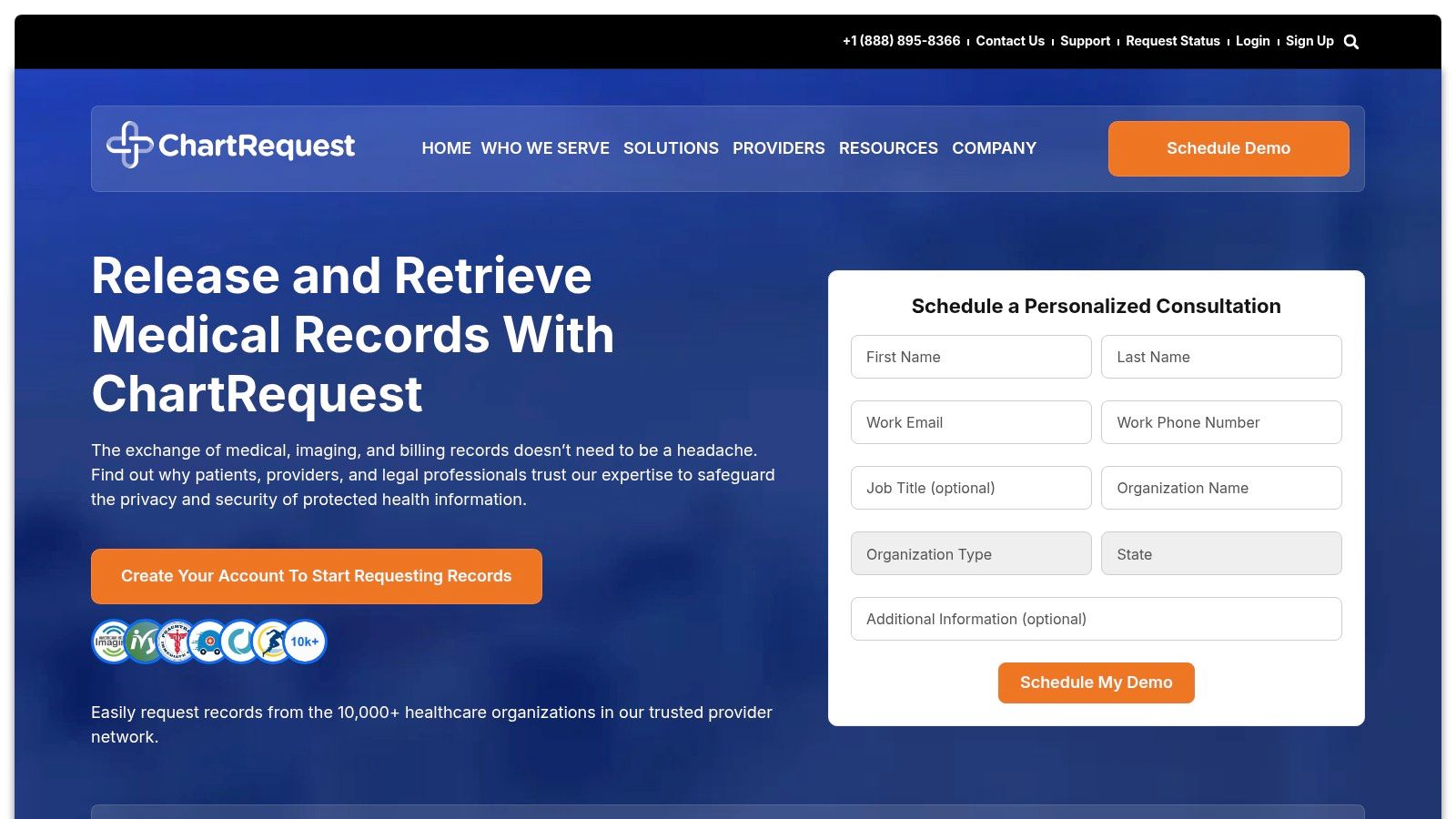
The platform’s standout feature is its transparent, real-time tracking dashboard. Users gain access to detailed activity logs and direct messaging with providers, which helps eliminate the ambiguity common in traditional follow-ups. This high level of visibility is critical for managing case timelines and ensuring compliance. For firms handling sensitive client data, maintaining a secure environment is paramount; you can explore key principles in our overview of HIPAA-compliant document management. ChartRequest also offers advanced options like notary services and medical imaging retrieval.
Core Features & Assessment
| Feature | Analysis |
|---|---|
| Workflow | Hybrid model offering both fully managed "Active Retrieval" and self-service options. Includes digital e-authorizations and provider chat. |
| Security | Strong. The platform is HITRUST certified, ensuring it meets comprehensive HIPAA security and privacy standards. |
| User Experience | The dashboard is designed for transparency, with real-time status updates and activity logs that are easy for staff to monitor. |
| Pricing Model | No subscription fees for CaseBinder. Costs are per-request and scale with volume, but specific pricing is not publicly available. |
Best For: Law firms that require the flexibility to switch between a fully outsourced retrieval service and a self-service portal, depending on their caseload and internal resources.
3. Record Retrieval Solutions (RRS)
Record Retrieval Solutions (RRS) offers a straightforward, US-wide service distinguished by its transparent flat-fee pricing model. Designed for law firms that prioritize predictable costs, RRS handles the entire retrieval process, from request submission and provider follow-ups to prepaying custodian fees and delivering records through a secure online portal. This all-inclusive approach simplifies budgeting and positions RRS as a dependable option among full-service record retrieval solutions.
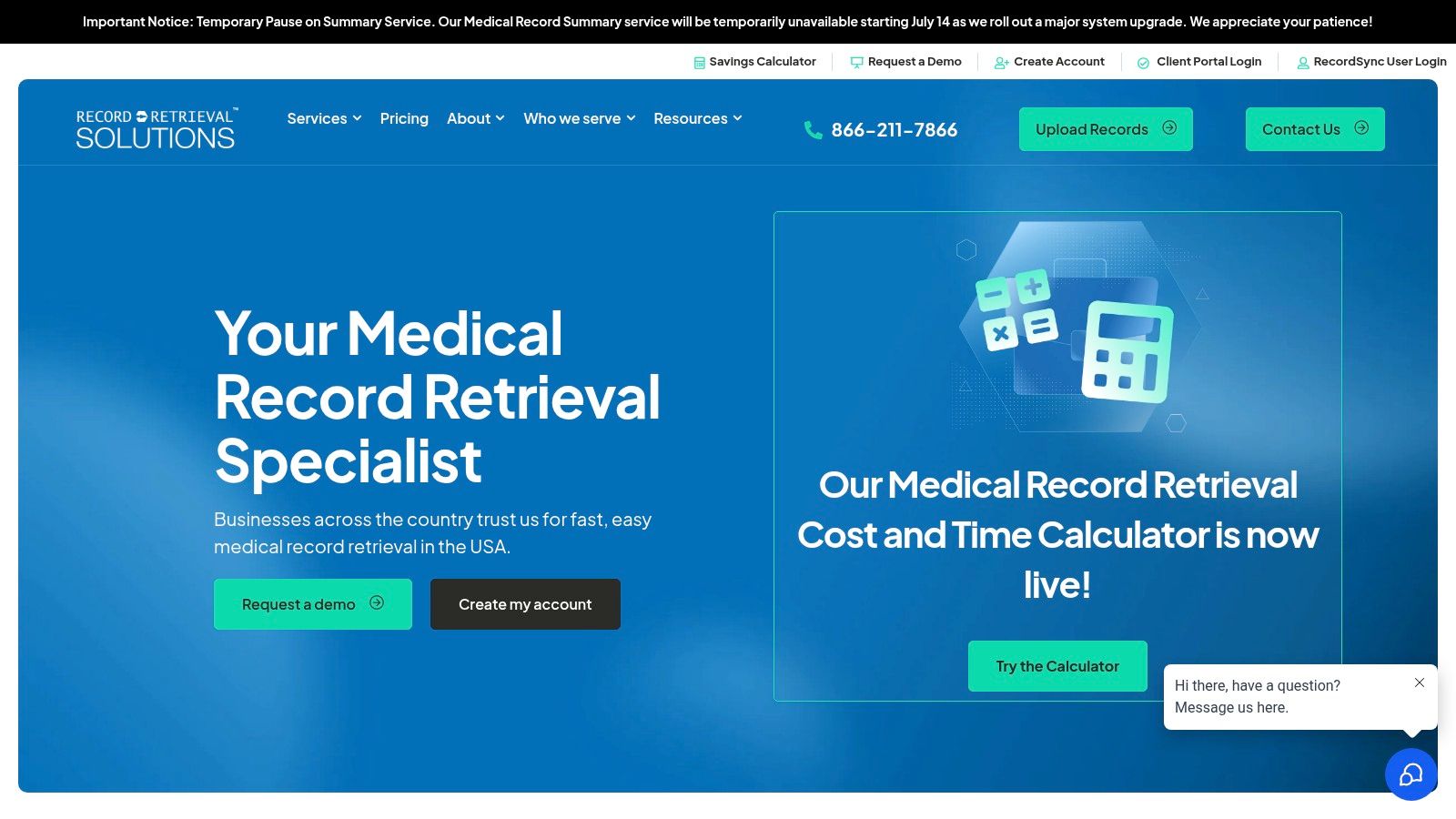
The primary appeal of RRS is its clear unit economics, which eliminates the guesswork associated with variable provider fees. The service also includes value-added features like OCR processing and Bates stamping at no extra charge, which is a significant benefit for litigation prep. While the service simplifies the front-end retrieval, firms must still manage the complex data within the records, a process that can be streamlined with a dedicated medical record review service.
Core Features & Assessment
| Feature | Analysis |
|---|---|
| Workflow | Full-service retrieval managed through a client portal for tracking and downloads. RRS handles all provider communication and fee payments. |
| Security | HIPAA-compliant processes and a secure portal for document delivery ensure the protection of sensitive client health information. |
| User Experience | The portal is designed for ease of use, allowing legal staff to submit new requests and monitor the status of existing ones with minimal effort. |
| Pricing Model | A flat fee of $45 per request. However, if a provider splits medical and billing records (e.g., using an external vendor), a separate $45 fee applies to each part. |
Best For: Law firms of any size that need predictable, fixed-cost budgeting for record retrieval and prefer to fully outsource the follow-up and payment process to a dedicated service provider.
4. Compex Legal Services
Compex Legal Services is a long-standing national provider that extends far beyond simple retrieval, offering a full suite of litigation support services. Firms can manage medical record requests through a proprietary online portal while also accessing medical summarization, deposition services, and an IME interface. This integrated approach allows legal teams to consolidate vendors and streamline workflows across various stages of a case, positioning Compex as a comprehensive partner among record retrieval solutions.
The primary advantage of Compex is its scale and decades of industry experience, which translates to a deep understanding of provider nuances and legal requirements nationwide. This makes them particularly well-suited for firms handling high-volume, complex litigation that requires more than just document collection. Their ability to bundle services like court reporting and record summarization provides a significant efficiency gain for legal teams looking to outsource multiple litigation support tasks to a single, trusted vendor.
Core Features & Assessment
| Feature | Analysis |
|---|---|
| Workflow | A fully outsourced model managed via a proprietary platform. Offers a broad menu of services beyond retrieval, including summaries. |
| Security | Maintains robust, industry-standard security protocols, including HIPAA compliance, to ensure the secure handling of sensitive data. |
| User Experience | The portal is designed for professional litigation support staff, with features for tracking, ordering, and managing diverse requests. |
| Pricing Model | Service-based pricing is not publicly available and is typically provided through custom quotes based on the scope and volume of work. |
Best For: Mid-sized to large law firms and insurance carriers that require a full-service litigation support partner for high-volume record retrieval, summarization, and other complex legal services.
5. ABI Document Support Services (ABI)
ABI Document Support Services offers a comprehensive, nationwide solution that combines traditional record retrieval with powerful document management tools. Serving the legal and insurance industries, ABI manages the entire retrieval process, from submitting requests to delivering organized, digitized records. The platform's strength is its dual focus: not only retrieving documents efficiently but also providing tools to make that information immediately useful for case analysis, positioning it as a full-service partner among record retrieval solutions.
What sets ABI apart is its eSummary tool, which accelerates the review process by offering keyword searching and creating chronologically organized views of the retrieved documents. This feature is particularly valuable for complex litigation where teams need to quickly identify key events and evidence within vast record sets. For firms that need both a reliable retrieval service and integrated tools to begin their analysis, ABI provides a streamlined workflow from request to review.
Core Features & Assessment
| Feature | Analysis |
|---|---|
| Workflow | Fully managed retrieval service with nationwide coverage. Integrates post-retrieval tools like eSummary for analysis. |
| Security | HIPAA-compliant processes are central to their service, ensuring the secure handling of protected health information. |
| User Experience | The platform is designed for enterprise-level management, offering portals to track requests and access delivered documents and summaries. |
| Pricing Model | Pricing is not publicly available and is typically customized for enterprise clients. Requires direct consultation for a quote. |
Best For: Mid-sized to large law firms and insurance carriers that require a fully outsourced, national retrieval service combined with integrated document organization and analysis tools to streamline post-retrieval workflows.
6. Datavant (includes Ontellus)
Datavant operates one of the largest health data networks in the U.S., connecting a vast ecosystem of healthcare providers and requestors. After its acquisition of Ontellus, the company expanded its offerings with a dedicated Legal & Insurance vertical, leveraging its extensive network to facilitate high-volume medical record retrieval. This positions Datavant as a heavyweight among enterprise-grade record retrieval solutions, serving law firms and insurance carriers that require broad, multi-state provider connectivity and centralized request management.
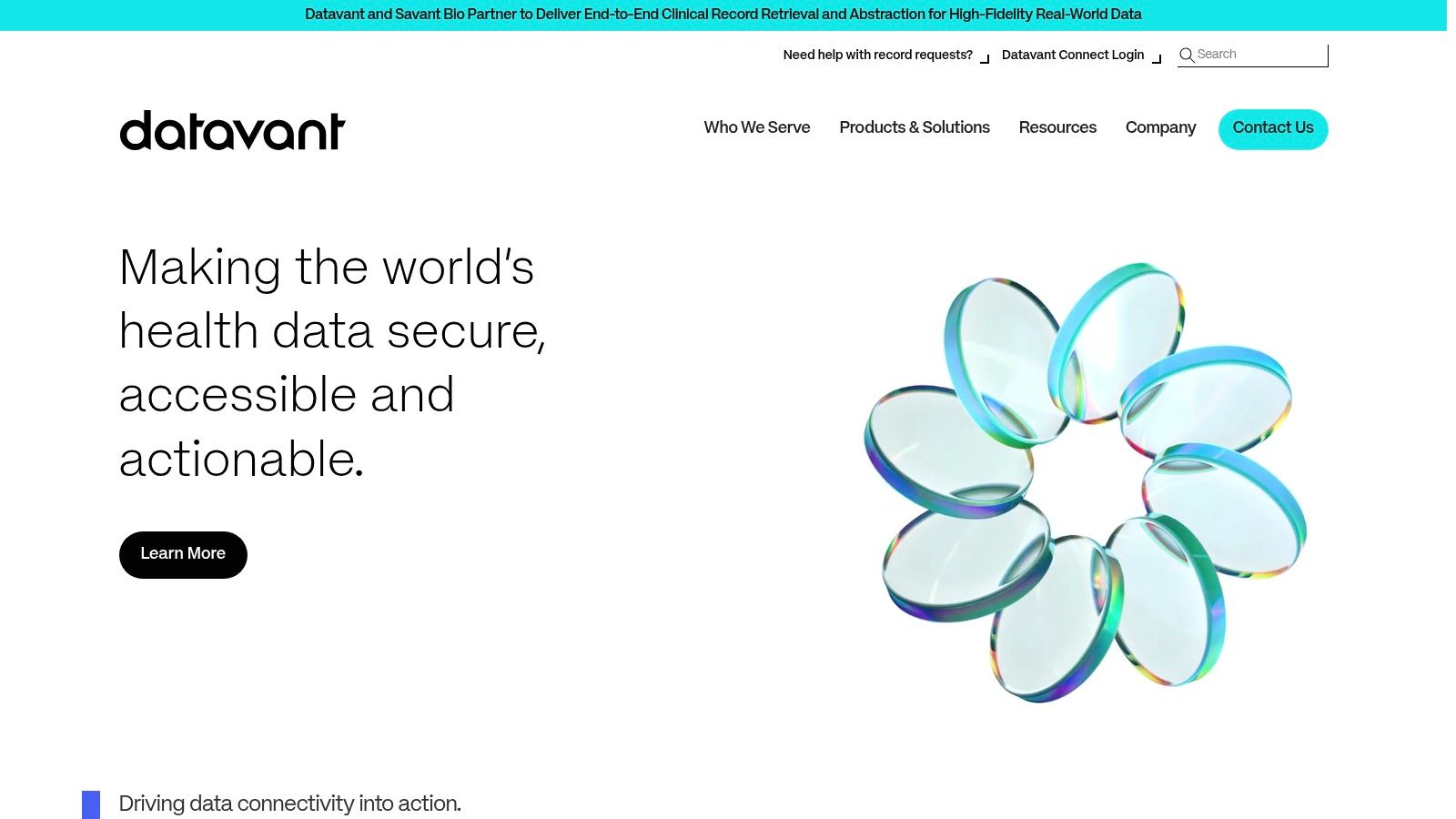
The platform’s core strength is its immense scale. Requestors submit and track requests through dedicated portals, which tap into the consolidated Datavant and Ontellus network, potentially shortening retrieval cycles for in-network custodians. This model is built for organizations that manage thousands of requests annually and need a robust, scalable system to handle the complex logistics of claims intelligence and litigation support.
Core Features & Assessment
| Feature | Analysis |
|---|---|
| Workflow | Centralized requestor portals ("Smart Request") for submission, status tracking, and invoice payments across a massive provider network. |
| Security | Operates within a secure, HIPAA-compliant framework designed for large-scale, sensitive health data exchange. |
| User Experience | The platform is geared toward enterprise users and may feel rigid or complex for smaller firms accustomed to more flexible workflows. |
| Pricing Model | Pricing is not publicly available. Requestor fees are variable and depend on the provider, state regulations, and the specific service agreement. |
Best For: Large law firms, insurance carriers, and enterprise-level organizations that need a powerful, high-volume retrieval service with extensive national provider connectivity and are comfortable with a structured, corporate process.
7. Lexitas — Records Retrieval
Lexitas offers a comprehensive suite of litigation support services where record retrieval is a core component. Built through strategic acquisitions, the company provides a national infrastructure for obtaining medical, billing, and other critical records. Law firms can use its online portal to place orders, track real-time progress, and securely download completed files, positioning Lexitas as a one-stop shop for firms needing more than just documents. This bundled approach makes it one of the more versatile record retrieval solutions available.
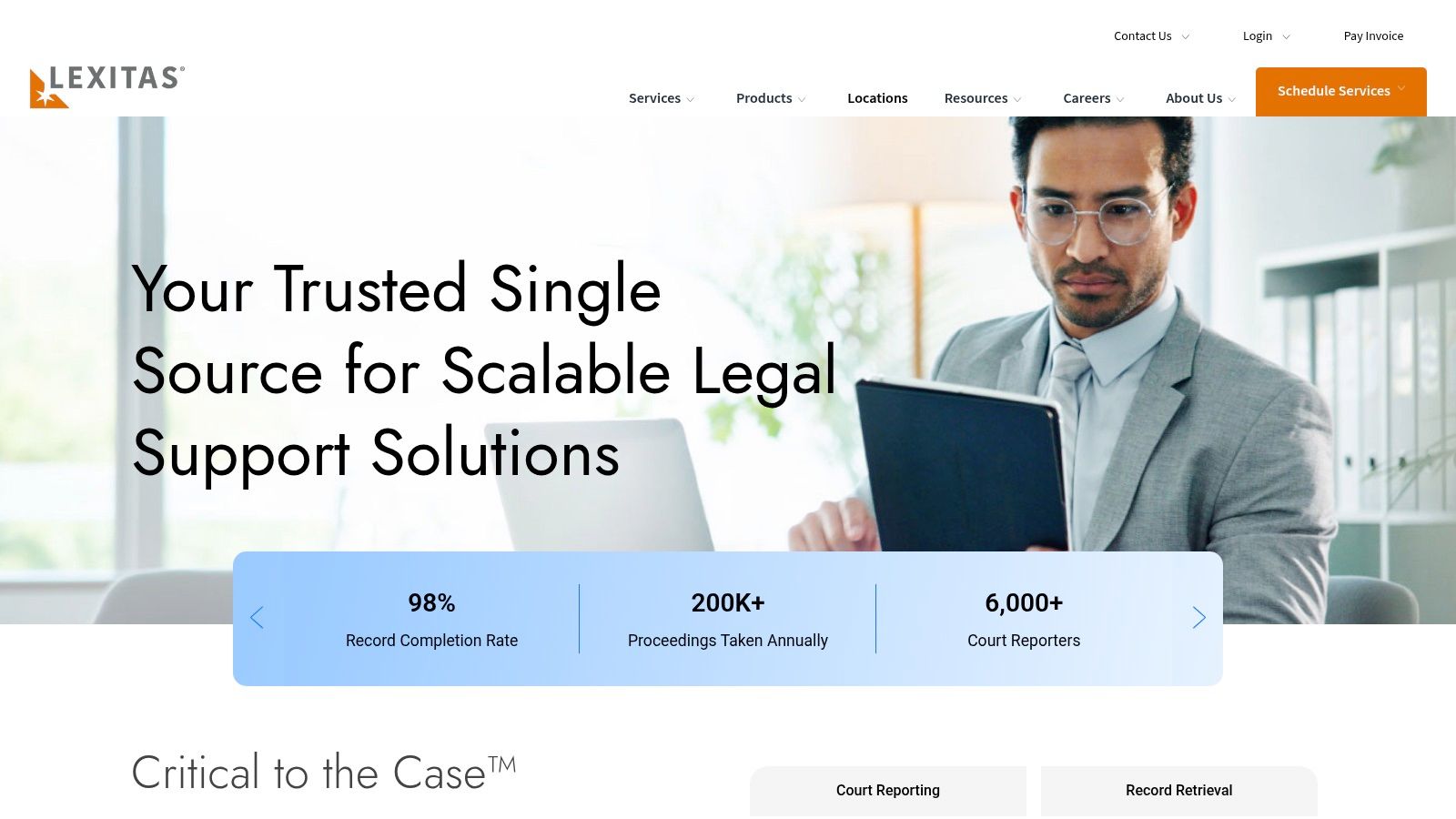
The primary advantage of Lexitas is its scale and the ability to consolidate vendors. A personal injury firm can use the same provider for court reporting, process service, and record retrieval, simplifying billing and case management. While the portal offers essential tracking tools, the experience may vary by region due to the company's acquisition-based growth model. For firms that frequently use a range of litigation support, Lexitas presents a compelling, integrated option that streamlines vendor relationships.
Core Features & Assessment
| Feature | Analysis |
|---|---|
| Workflow | Portal-based ordering and status management. It centralizes requests for a broad range of litigation support needs. |
| Service Integration | Excellent. A key differentiator is the ability to bundle retrieval with court reporting, staffing, and other essential legal services. |
| National Reach | Strong. The company leverages its national footprint and acquired local expertise to handle complex, multi-state retrieval needs. |
| Pricing Model | Opaque. Costs are provided via custom quotes, requiring direct contact for pricing and making budget forecasting less predictable. |
Best For: Law firms of all sizes looking for a single, established vendor to handle record retrieval alongside other essential litigation support services like court reporting and process serving, simplifying procurement and management.
8. Magna Legal Services (RecordTrak)
Magna Legal Services offers a comprehensive suite of litigation support services, with its record retrieval capabilities strengthened by the acquisition of RecordTrak. This service is designed for firms that require more than just retrieval, particularly those handling complex, large-scale litigation like mass torts and Multi-District Litigation (MDL). Through its TrakView portal, clients can order, monitor, and receive a wide array of documents, from medical and billing records to employment files, making it a robust option among enterprise-level record retrieval solutions.
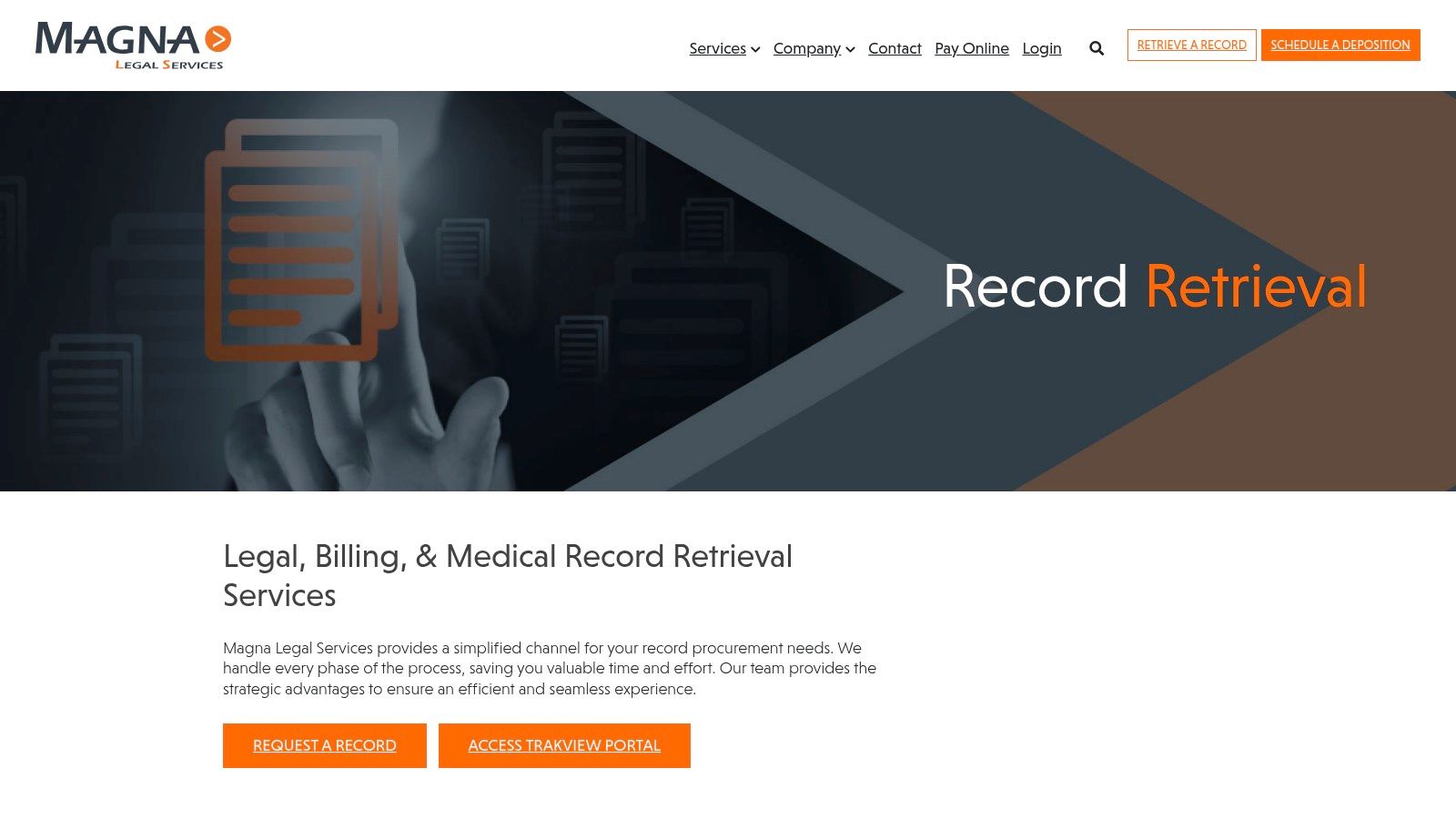
Magna’s key differentiator is its ability to bundle record retrieval with its other offerings, such as court reporting, jury consulting, and document review. This integrated approach appeals to firms looking to consolidate vendors for major cases, creating a streamlined workflow from discovery through trial. While the service is powerful, its enterprise focus means it is less suited for firms needing a simple, one-off solution and is geared more toward establishing a long-term litigation support partnership.
Core Features & Assessment
| Feature | Analysis |
|---|---|
| Workflow | A fully managed service accessed via the TrakView portal for centralized ordering, status tracking, and secure record delivery. |
| Security | Enterprise-grade security protocols are in place to handle sensitive data for high-stakes litigation, ensuring HIPAA compliance. |
| User Experience | The TrakView portal provides a clear, functional interface for managing large volumes of requests, typical of an enterprise system. |
| Pricing Model | Custom pricing is determined by scope and volume. Access and terms require direct engagement with the sales team and are not public. |
Best For: Large law firms or those managing mass torts/MDLs that need a high-volume, fully managed retrieval service and can benefit from bundling it with other litigation support services from a single, established provider.
9. MRO (Requester Portal / ROIlog)
MRO operates on the custodian side of the record retrieval equation, serving as a major release-of-information (ROI) vendor for countless healthcare facilities. For law firms, MRO’s Requester Portal offers a direct, digital channel to submit and track requests specifically with providers that have contracted MRO to handle their ROI process. This direct-line access can bypass slower, traditional methods like fax or mail when dealing with these specific facilities, making it a key component in a firm's multi-pronged record retrieval solutions strategy.
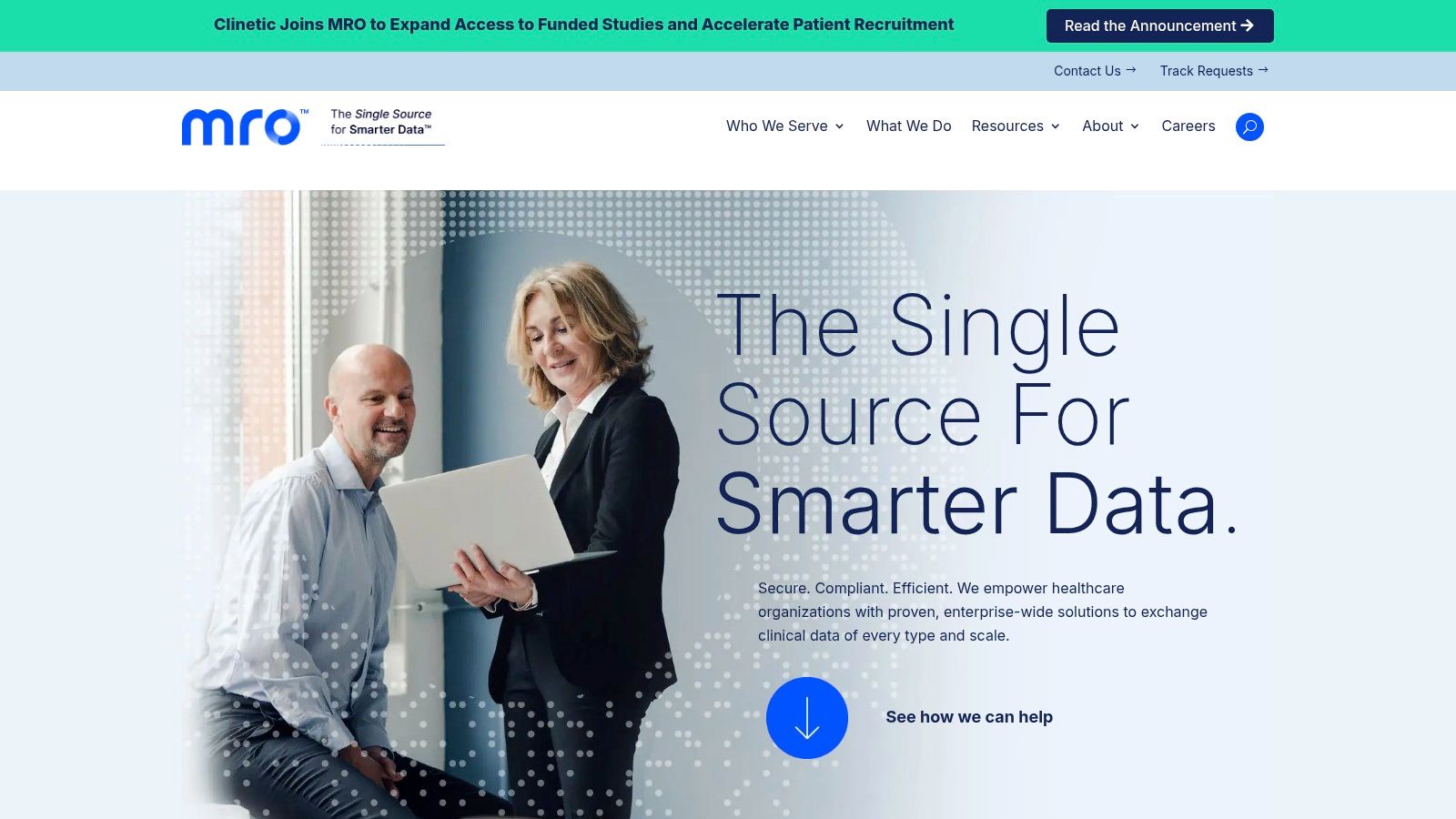
The platform, including its ROIlog.com tracking site, provides essential transparency with status updates, invoicing, and secure electronic delivery. High-volume firms can also leverage bulk sFTP delivery options to streamline their workflows further. While it’s not a universal retrieval service, MRO’s portal is an indispensable tool for any firm that frequently requests records from MRO-affiliated hospitals and clinics, as it provides a more efficient, integrated path to obtaining critical case evidence directly from the source’s official agent.
Core Features & Assessment
| Feature | Analysis |
|---|---|
| Workflow | Direct eRequest submission, status tracking (ROIlog), ePay, and multiple delivery options for facilities that use MRO as their ROI agent. |
| Security | Strong. As a major HIPAA Business Associate for providers, MRO maintains robust security protocols for handling protected health information. |
| User Experience | The interface is functional and purpose-built for submitting and tracking requests, though less modern than dedicated retrieval platforms. |
| Pricing Model | No portal subscription fee. Costs are based on the custodian's statutory and service fees for record production, paid on a per-request basis. |
Best For: Law firms of any size that want a direct, faster channel for submitting and managing record requests to the large network of healthcare providers that specifically use MRO as their release-of-information partner.
10. HealthMark Group (Request Manager)
HealthMark Group operates primarily as a release-of-information (ROI) service for healthcare providers, but its Request Manager portal is a key tool for law firms. This platform allows legal teams to submit, track, and download medical records from the thousands of practices and hospitals contracted with HealthMark. Its direct-to-custodian integration makes it one of the more efficient record retrieval solutions when dealing with providers in its network.
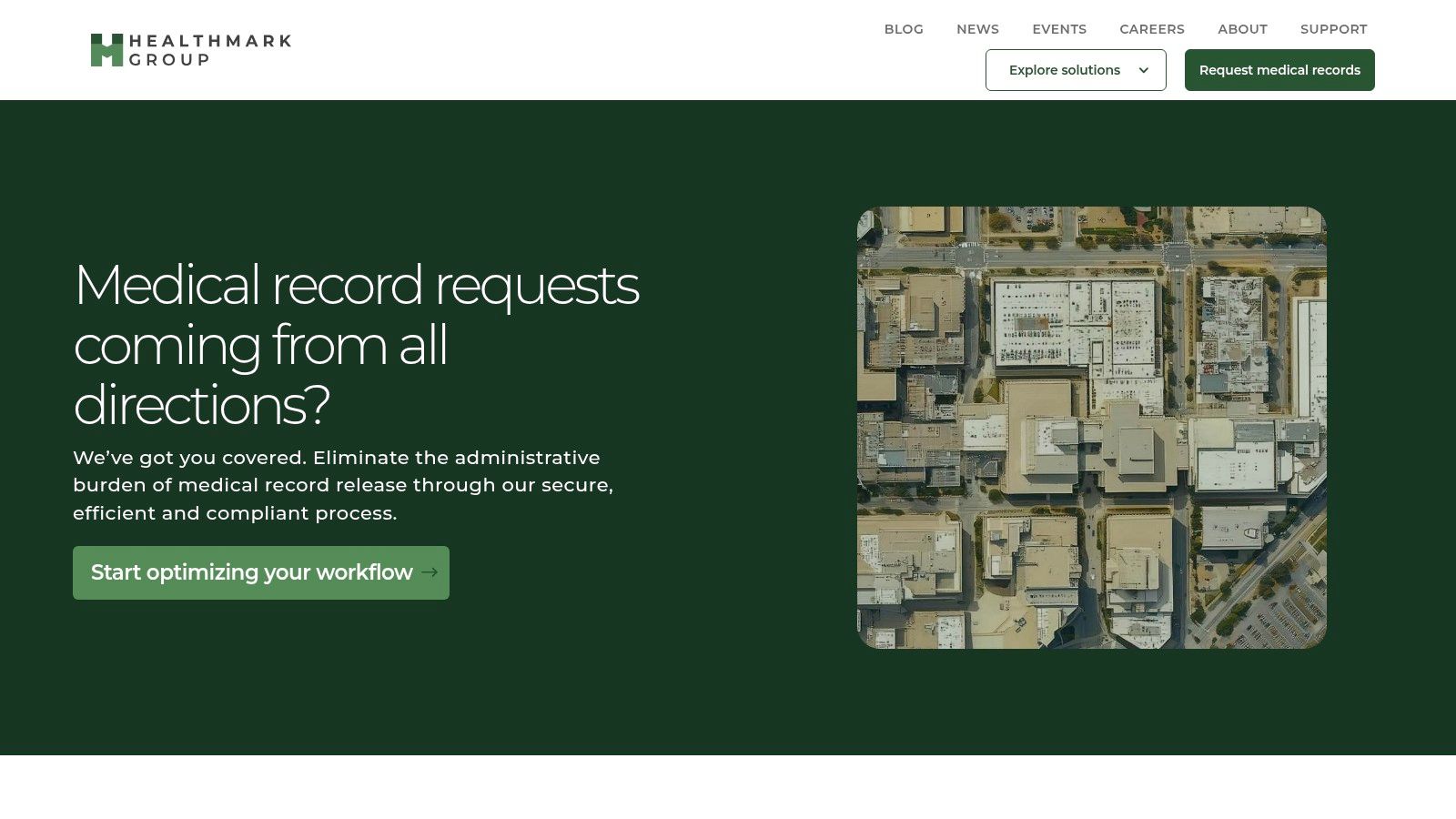
The primary advantage is speed. Because HealthMark manages the ROI process for its clients, requests submitted via the portal often see turnarounds in just a few business days, bypassing traditional custodian bottlenecks. The platform features email-verified access, which simplifies login, and provides 24/7 status visibility, live chat support, and options for both digital and physical delivery. While its scope is limited to its provider network, it excels at simplifying and accelerating retrieval within that ecosystem.
Core Features & Assessment
| Feature | Analysis |
|---|---|
| Workflow | Streamlined online submission directly to the provider's authorized ROI agent. Features digital delivery and status tracking. |
| Security | As a HIPAA business associate, HealthMark maintains robust security protocols to protect patient health information during transfer. |
| User Experience | The interface is very simple and user-friendly, designed for quick, one-off submissions without needing extensive user training. |
| Pricing Model | Fees are determined by the provider's fee schedule and statutory limits. Physical shipping incurs additional costs that vary by order size. |
Best For: Law firms of any size that frequently request records from healthcare providers known to use HealthMark for their release-of-information services, prioritizing speed and simplicity for those specific requests.
11. Verisma (Verisma Request App)
Verisma operates primarily as a provider-side Release of Information (ROI) vendor, partnering with hospitals and large healthcare systems to manage their record disclosures. For personal injury firms, this means interacting with their self-service portal, the Verisma Request App (VRA), when requesting records from a Verisma-affiliated facility. The VRA provides a direct digital channel for submitting, tracking, paying for, and downloading records, bypassing slower, paper-based workflows.
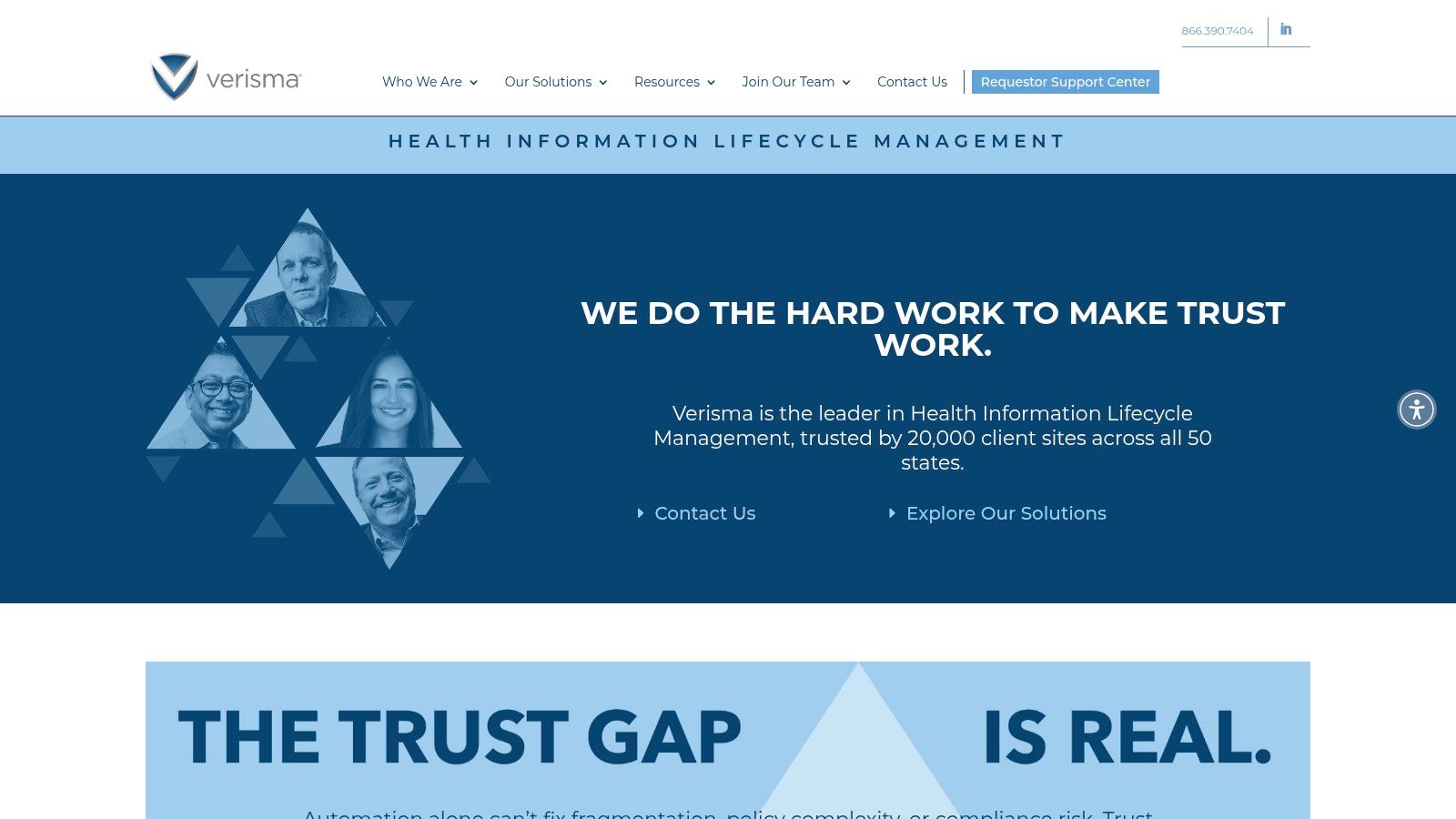
The primary advantage of using the VRA is efficiency. Because Verisma is the custodian's authorized agent, requests submitted through its portal are processed within their established system, often resulting in faster turnaround times compared to mailing or faxing. While it is not a universal platform, for firms that frequently request records from major health systems, becoming proficient with the VRA is a necessary and beneficial part of their record retrieval solutions toolkit.
Core Features & Assessment
| Feature | Analysis |
|---|---|
| Workflow | Direct-to-custodian request portal for facilities using Verisma. Supports online submission, status tracking, payment, and secure downloads. |
| Security | As a major HIPAA Business Associate for healthcare providers, Verisma maintains robust, compliant security protocols for its systems. |
| User Experience | The portal is functional and designed for requestors. High-volume firms can also inquire about more integrated solutions like SFTP access. |
| Pricing Model | Costs are determined by the healthcare provider and applicable state or federal regulations. All fees are transparently itemized before payment. |
Best For: Law firms of any size that regularly request medical records from hospitals and healthcare systems that have outsourced their ROI process to Verisma.
12. iCopy Legal
Founded by attorneys, iCopy Legal provides a national record retrieval service that combines technology with a strong emphasis on human oversight. The firm assigns dedicated case managers who conduct weekly follow-ups, ensuring that requests don't fall through the cracks. This hands-on approach is complemented by their Nimbus client portal, where law firms can get real-time status updates, set up alerts, and securely download records. This blend of personalized service and digital access makes it a notable option among record retrieval solutions.
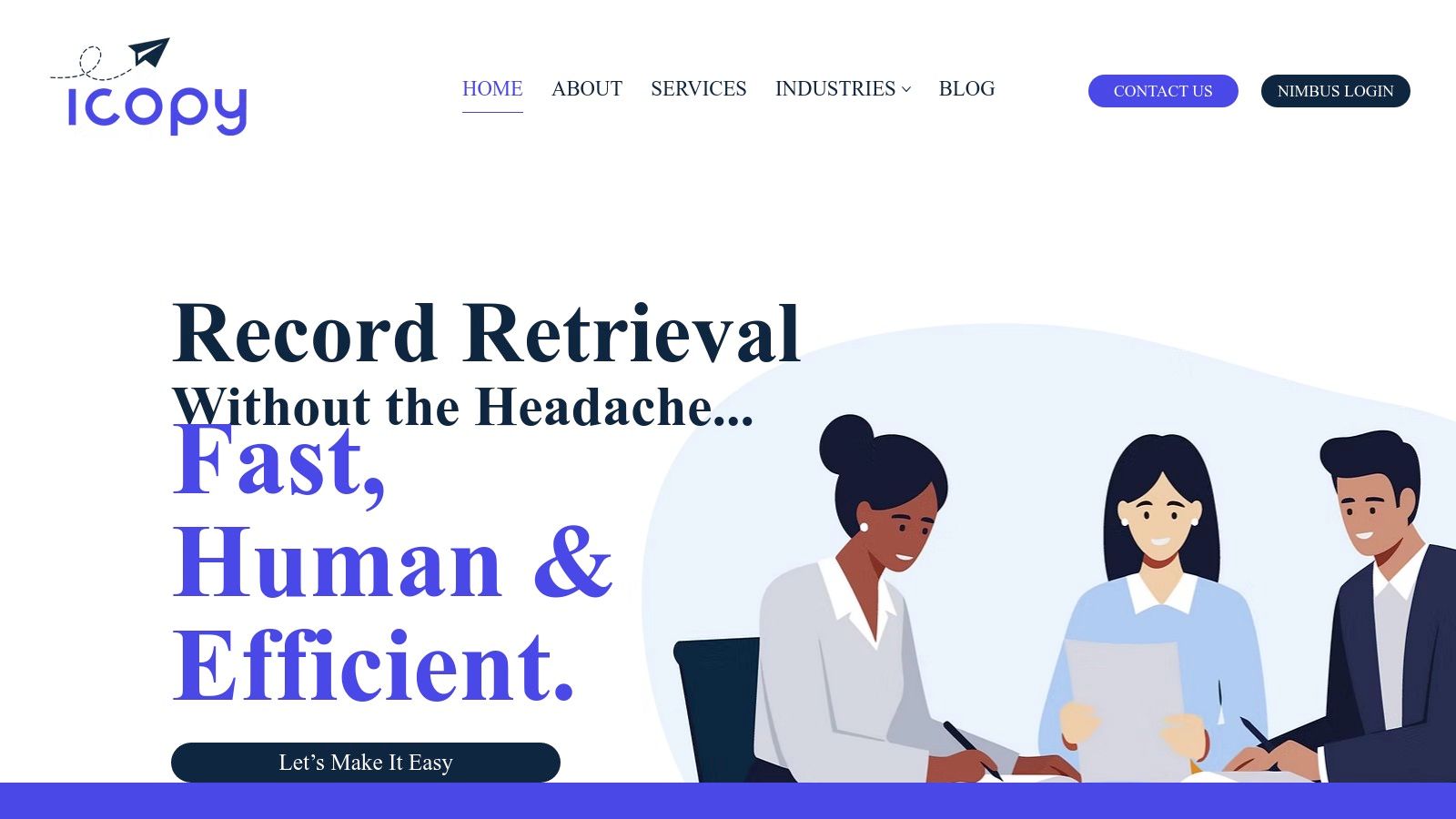
The platform stands out by offering valuable add-on services that go beyond simple retrieval, such as OCR processing, Bates stamping, medical chronologies, and legal nurse reviews. This allows firms to consolidate their post-retrieval workflow within a single vendor. While the reliance on human-led follow-ups ensures transparency and persistence, it’s important to note that turnaround times are still subject to custodian responsiveness, with an average cited at around 18 business days. The service is ideal for firms that value consistent communication and prefer a managed process with a human touchpoint.
Core Features & Assessment
| Feature | Analysis |
|---|---|
| Workflow | A fully outsourced model featuring a dedicated case manager, weekly follow-ups, and a client portal (Nimbus) for tracking and downloads. |
| Security | Strong. The company highlights its SOC 2 Type II and HIPAA-compliant controls, ensuring data is handled with appropriate safeguards. |
| User Experience | The Nimbus portal provides a transparent and user-friendly interface for monitoring requests, supplemented by direct human communication. |
| Pricing Model | Pricing is not publicly available and requires a custom quote based on request volume and services needed, which demands direct inquiry. |
Best For: Law firms that prioritize a high-touch, managed service with dedicated human support and transparent communication for retrieving a broad range of record types, including those requiring subsequent analysis or summarization.
Top 12 Record Retrieval Solutions Comparison
| Provider | Core features | Best for (target audience) | Pricing & turnaround | Unique selling point | Security & compliance |
|---|---|---|---|---|---|
| ChartSwap | National provider search; end‑to‑end digital requests, invoicing & downloads | Teams wanting centralized, paperless ordering and payments | Per‑request/provider fees (varies); turnaround custodian‑dependent | Platform pays custodians; marketplace Record Finder | HIPAA & SOC 2 |
| ChartRequest (CaseBinder) | Requests to 10k+ providers; managed CaseBinder or self‑service; API | Firms needing flexible self‑service or fully managed retrieval | No subscription for CaseBinder; volume‑based pricing; some SLAs provider‑dependent | Option to switch between self‑serve and Active Retrieval managed service | Real‑time logs/dashboards; industry controls |
| Record Retrieval Solutions (RRS) | Flat $45 per request (submission, follow‑ups, portal delivery); OCR & Bates | Teams wanting predictable, flat‑fee retrieval economics | $45 flat fee; extra $45 for split requests; custodian timing applies | Transparent flat‑fee covering follow‑ups and portal delivery | Portal tracking; nationwide coverage |
| Compex Legal Services | Retrieval + summarization + IME interface + court reporting; proprietary workflow | Firms needing broad litigation support beyond retrieval | Custom quotes; timeframes vary by custodian and case complexity | Decades of experience and full litigation support stack | Enterprise workflows; custom compliance options |
| ABI Document Support Services | Nationwide retrieval; eSummary for keyword search & chronological views | Teams wanting retrieval plus tools to speed evidence review | Enterprise onboarding; pricing not public; SLAs not standardized | eSummary tool for fast review and organized chronology | Standard enterprise compliance controls |
| Datavant (incl. Ontellus) | Smart Request portals; invoice/payment portal; extensive provider connectivity | Enterprise/high‑volume requestors seeking broad network reach | Pricing not public; requestor fees vary by provider/state; enterprise processes | Large network scale (Datavant + Ontellus) for expanded connectivity | Enterprise‑grade exchange controls; ROI network security |
| Lexitas — Records Retrieval | Portal ordering/tracking/delivery; bundled litigation services | Firms wanting retrieval plus court reporting, staffing, and related services | Custom quotes; response varies by regional team and custodians | One vendor for retrieval + broad litigation services via acquisitions | National operations with enterprise compliance |
| Magna Legal Services (RecordTrak) | TrakView portal; MDL/mass tort experience; multi‑record retrieval | Teams handling MDLs, mass torts, and large‑scale matters | Custom pricing and SLAs via sales; enterprise onboarding typical | Deep MDL/mass‑tort expertise paired with Magna services | Enterprise security and portal controls |
| MRO (ROIlog) | eRequest/eStatus/ePay/eDelivery; ROIlog tracking; bulk sFTP | Requestors targeting facilities where MRO is the ROI agent; high volume | No portal subscription fee; limited to MRO‑participating facilities; custodian timing applies | Direct channel to facilities using MRO; bulk delivery options | ROI agent controls; standard compliance |
| HealthMark Group (Request Manager) | Email‑verified portal; 24/7 status; live chat; digital & ship options | Simple submission flows at contracted providers; fast partner processing | Fast at some partners (1–3 business days); print shipping fees vary; limited to contracted sites | Very fast processing at partner providers; simple UX for non‑technical users | Portal access with verified accounts; provider contracts govern compliance |
| Verisma (VRA) | Verisma Request App; payments, tracking, downloads; SFTP support | Requestors targeting systems that route ROI through Verisma | Pricing varies by facility/state; follows custodian rules; reduces paper costs | Widely used by health systems to lower turnaround/cost vs paper workflows | Facility‑specific compliance; standard ROI security |
| iCopy Legal | Dedicated case manager; Nimbus portal; OCR, summarization, nurse review add‑ons | Firms wanting human‑led follow‑ups plus portal transparency | Average ~18 business days (custodian‑dependent); pricing by quote | Human case management with regular follow‑ups and portal alerts | SOC 2 Type II and HIPAA controls |
Beyond Retrieval: Turning Records into Case-Winning Insights
The journey to finding the right record retrieval solution is a pivotal strategic decision for any personal injury firm. As we've explored, the landscape is diverse, ranging from traditional third-party vendors like ABI and Lexitas to more agile, technology-driven platforms like ChartSwap and ChartRequest. Each option presents a unique set of trade-offs involving cost, speed, scalability, and integration capabilities. The choice between an established full-service provider and a modern SaaS tool ultimately depends on your firm's specific size, case volume, and internal workflows.
However, selecting a retrieval partner is only the first half of the equation. The true challenge, and the greatest opportunity for competitive advantage, lies in what happens after the records are delivered. Efficiently acquiring hundreds of pages of medical documentation solves a logistical problem, but it doesn't automatically translate into case-winning insights. The real bottleneck has shifted from acquisition to analysis.
The Next Frontier: From Document Collection to Data Activation
The fundamental takeaway from our analysis is that modern law firms must look beyond simple document collection. The goal is not just to possess records, but to activate the critical data trapped within them as quickly and accurately as possible. Manual review, the traditional method for digesting these complex documents, is no longer a sustainable practice for firms aiming to scale. It's a time-intensive, error-prone process that consumes valuable paralegal and attorney hours that are better spent on high-level legal strategy, client communication, and case development.
This is where the next evolution of legal technology becomes indispensable. The most forward-thinking firms are now integrating intelligent platforms into their post-retrieval workflows. By doing so, they are transforming a historically administrative task into a powerful strategic asset. To maximize the value of retrieved records and transform them into actionable intelligence, firms can leverage advanced strategies like document processing automation. This approach moves beyond simple retrieval and unlocks the full potential of your case files.
Actionable Steps for Choosing and Implementing Your Solution
As you move forward, the path to optimizing your firm’s operations requires a two-pronged approach. First, select the right retrieval partner, then, pair it with the right analysis technology.
Here are the key action steps to guide your decision-making process:
- Audit Your Current Process: Before making any changes, meticulously map out your existing workflow. Identify the precise pain points: Is it the initial ordering process? The follow-up calls? The cost per page? Or the hours spent summarizing records once they arrive? A clear diagnosis is essential for finding the right cure.
- Align the Solution to Your Firm's Scale: A solo practitioner has vastly different needs than a 50-attorney firm. Small firms may benefit from the flexibility of on-demand platforms, while larger firms might prioritize the robust security and deep integration offered by enterprise-level record retrieval solutions.
- Prioritize Integration and Workflow Automation: The most effective record retrieval solutions do not operate in a vacuum. Evaluate how a potential partner integrates with your existing Case Management Software (CMS). More importantly, consider how you will automate the subsequent steps. The goal is a seamless flow from request to review to demand letter.
- Plan for the Post-Retrieval Bottleneck: Acknowledge that even the fastest retrieval service will deliver a mountain of unorganized data. Proactively plan to solve this challenge. Investing in an AI-powered tool that can instantly organize, summarize, and analyze these records is the key to unlocking true efficiency and scaling your firm’s capacity.
Ultimately, the future of personal injury law belongs to firms that can not only acquire critical evidence efficiently but also interpret and leverage it faster than their opponents. By thoughtfully selecting your record retrieval solutions and pairing them with intelligent automation tools, you empower your team to focus on what they do best: building powerful arguments and securing justice for your clients.
Ready to eliminate the manual work that follows record retrieval? Ares uses AI to instantly transform disorganized medical records into structured chronologies, provider lists, and draft demand letters. Stop summarizing and start strategizing by visiting Ares to see how you can settle cases faster.