
It's late afternoon, the draft is open on one screen, and the records are stacked on the other. The adjuster has a claim number, the carrier runs a thirty-day clock, and the partner wants the letter out by Friday. You have a sample letter from a lawyer open in a browser tab, and it looks polished, persuasive, and silent on the one thing that determines whether the file settles: whether every sentence in it can be checked against a document in the folder.
That gap matters more than most drafters think. The Bureau of Justice Statistics tort case data found that 73% of tort cases were resolved through an agreed settlement, while only 3% ended in a trial verdict. The letter is not the warm-up to a fight. For most files, the letter is the fight.
Timing bears that out. The Ministry of Justice's first-year review of the Official Injury Claim service recorded an average of 164 days from claim initiation to settlement for represented claims, against 81 days for unrepresented ones. Every clarification cycle an adjuster has to request adds days to that count. A letter that answers the questions before they're asked is the cheapest speed you'll ever buy.
What follows is the letter itself, then the annotation: what each part must prove, where the exhibits attach, and where restraint beats volume.
Annotated Sample Letter from a Lawyer
[Firm Letterhead] [Firm Name], [Street Address], [City, State ZIP], [Phone], [Email]
[Date]
Sent via certified mail and email to [Adjuster Name], [Insurer], [Claims Address]
Re: [Claimant Name] v. [Insured Name]
Claim No.: [Claim Number]
Date of Loss: [Date of Loss]
Our File No.: [File Number]Dear [Adjuster Name]:
This firm represents [Claimant Name] for injuries sustained in the motor vehicle collision of [Date of Loss] on [Roadway] at [Location]. I write to present the claim, the supporting records, and our demand for settlement. Please direct all further contact about this matter to my office.
The collision. On [Date of Loss], at approximately [Time], [Claimant] was stopped for traffic in the eastbound lane of [Roadway] when [Insured] struck the rear of the vehicle. The impact pushed the vehicle forward into the lane ahead. [Claimant] reported immediate [neck and low back pain] at the scene and was transported by [EMS Provider] to [Emergency Department] the same day.
Liability. The [Police Department] crash report, Exhibit A, records that [Insured] stated [he did not observe traffic slowing] and was cited for [citation]. Photographs of the vehicles appear at Exhibit B. The recorded statement of independent witness [Witness Name] appears at Exhibit C.
Treatment. [Provider 1], [Date of Service]: examination, imaging, and diagnosis of [Diagnosis] (Exhibit D, pp. [4-6]). [Provider 2], [Date of Service]: [Treatment] for [Diagnosis] (Exhibit E, pp. [2-3]). [Provider 3], [Date of Service] through [Date of Service]: [Course of care] for [Diagnosis] (Exhibit F). Care [concluded on [Date] / remains ongoing with [Provider]].
Damages. Past medical charges total $[Amount], itemized by provider and date of service at Exhibit G and reconciled to the billing ledgers at Exhibit H. [Claimant] missed [Number] days of work at $[Rate] per [Unit], documented by payroll records and an employer letter at Exhibit I, for a wage loss of $[Amount]. Out-of-pocket costs, including [Prescriptions, Parking, Transportation], total $[Amount], receipts at Exhibit J.
Demand. We demand $[Amount] in settlement of this claim, comprising $[Past Medical], $[Wage Loss], $[Out-of-Pocket], and $[Non-Economic Component], using the method described at page [X]. This demand remains open for thirty (30) days, through [Date]. Please respond in writing with acceptance or a specific counteroffer. [Claimant]'s care [is continuing / may require future treatment], and we reserve the right to supplement this demand. Nothing in this letter waives any right or remedy.
Sincerely, [Attorney Name], [Firm Name], Counsel for [Claimant]
Enclosures: Exhibit Index; Exhibits A through [J]
Read it again as an adjuster would. The claim number is in the first block, the mechanism is dated and located, every diagnosis carries an exhibit cite, and the demand tells the carrier exactly what a response looks like. If you'd rather start from a structured shell than a blank page, a legal document generator can assemble the letterhead, caption block and exhibit index in the right order before you fill in a single fact.
Copy the order. Replace every bracket with a fact you can point to in a file, and don't send it while any bracket is still a bracket.
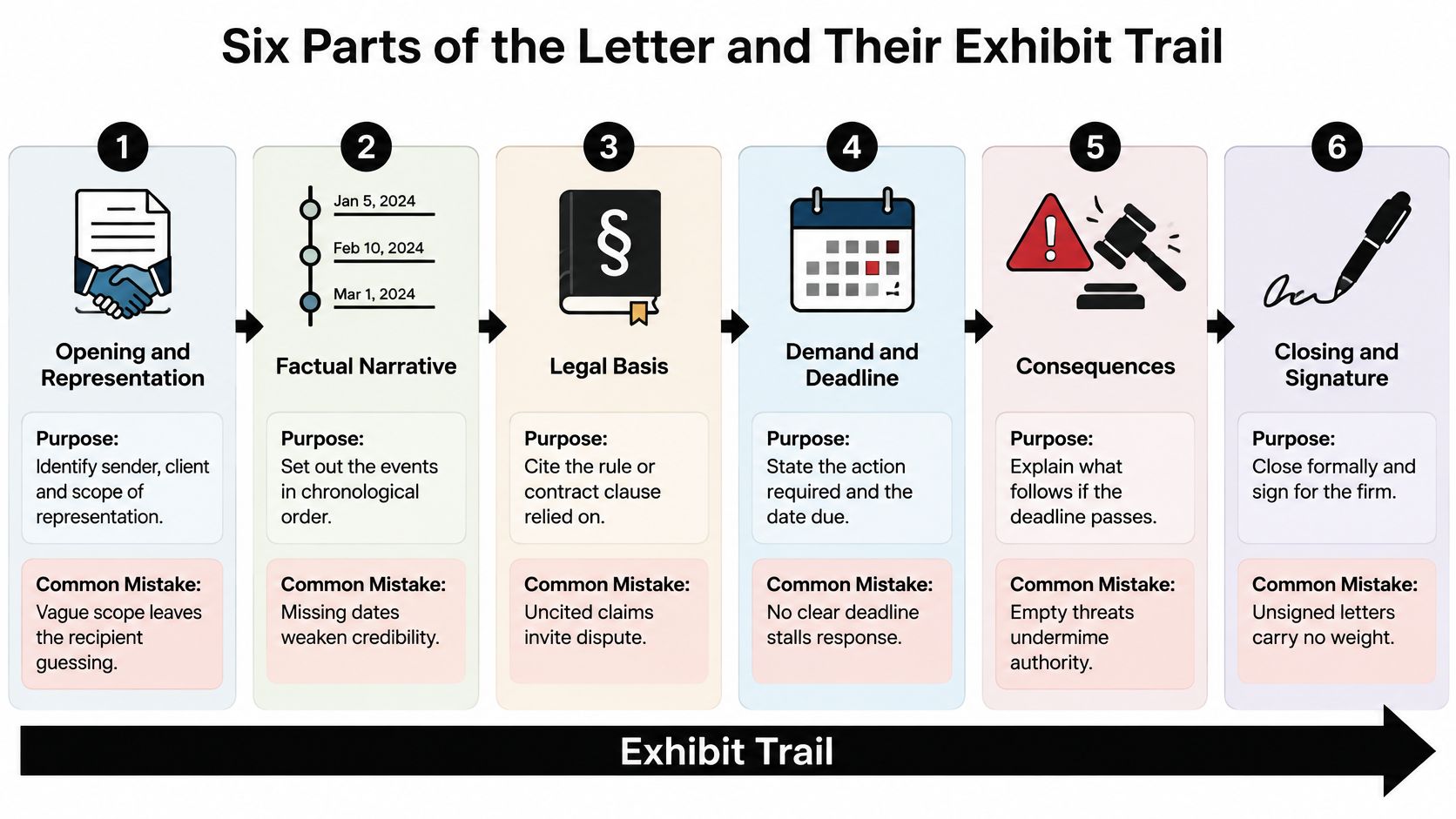
Six Parts of the Letter and Their Exhibit Trail
Six parts carry the argument. A seventh, the enclosure index, is what makes the other six checkable.
| Part | Purpose | Must include | Common mistake |
|---|---|---|---|
| Opening and representation | Identify who is writing and for whom | Firm name, client name, claim number, date of loss | Omitting the claim number, which delays routing |
| Factual narrative | Tell what happened in date order | Date, location, mechanism, immediate symptoms | Adding conclusions about fault the record does not support |
| Liability | Show the other party's responsibility | Police report, witness statements, photographs cited by exhibit | Relying on the client's account alone |
| Injuries and treatment | Link diagnoses to care | Each provider, date of service, diagnosis and treatment episode | Leaving gaps in the chronology unexplained |
| Damages | Quantify the losses | Past medical bills, wage loss, out-of-pocket costs, future care | A lump sum with no itemization |
| Demand and deadline | State the amount and the response window | Settlement figure, response deadline, method of response | A deadline with no date or unclear response instructions |
| Enclosures | Make every claim verifiable | Exhibit index with labels that match the body | Exhibits listed but never cited in the text |
Why the Order Does the Work
Each part sets up the next one. The damages total only means something after the treatment chronology has established what the care was for and why it was needed. Break that chain and the whole document loses authority.
Say the damages section totals charges from three providers and the treatment section names only two. The adjuster doesn't need a reason to discount the file. The missing provider is the reason. Once one figure fails to reconcile, every later figure gets read with suspicion, including the ones you got exactly right.
Build the Exhibit Trail Before You Draft
Split the package into two stacks. Liability evidence covers the police or incident report, photographs, and witness information. Damages evidence covers medical records, itemized bills, wage documentation, and physician statements. Label exhibits consistently, cite each one in the body, list each in an exhibit index, and send copies rather than originals. That structure creates an audit trail an insurer or opposing counsel can follow without rebuilding the file by hand, which is the standard described in the Super Lawyers guide to drafting a personal injury demand letter.
A cited sentence reads like this: "Dr. [Name] diagnosed a lumbar strain on [Date of Service] (Exhibit D, pp. 4-6)." The page range is not decoration. It tells the reviewer where to look and proves you looked.
The test before you send: every sentence should point to a record the reader could open, and every record you name should appear in the index.
A document-level reference map, connecting each extracted date, provider, diagnosis, procedure and charge to its page or exhibit, is the artifact that makes this repeatable across files, and it's what our demand drafting builds from your own records before an attorney reviews the result. A deeper walkthrough of assembling the package sits in this guide to the personal injury demand package.
How to Build the Damages Section
Damages fall into two groups with different proof requirements. Economic losses are documentary. Non-economic losses are descriptive, and they need treatment facts behind them.
| Category | Evidence to attach | How to present it |
|---|---|---|
| Past medical expenses | Itemized bills and payment ledgers | Listed by provider and date of service |
| Future medical care | Physician statement with a cost estimate | Stated as a separate figure from past costs |
| Lost wages | Pay records and employer verification | Dates missed and rate of pay shown |
| Future earning loss | Medical or vocational evidence | Tied to documented functional limits |
| Property damage | Repair estimates or invoices | Itemized with the same exhibit labels used in the body |
| Out-of-pocket costs | Receipts | Grouped by type and totaled to the receipts |
| Non-economic damages | Treatment records supporting the functional effects | Described through daily limits, not an unexplained lump sum |
Describe Limits, Not Suffering
Pain and suffering, loss of enjoyment, scarring and mental anguish should be told through function. The client can't lift a toddler above shoulder height. She stopped sleeping more than four hours. He gave up the Saturday league he'd played for years. Each of those statements should sit beside a treatment note that supports it, which is the approach the Draftiro damages guide recommends over a lump sum with no explanation behind it.
Disclose Your Valuation Method
You can use a multiplier of special damages, a per diem figure, or comparable verdicts and settlements. No universal multiplier fixes the value of a claim. Name the method you used in the letter and explain in one paragraph why it fits this file. An adjuster who can follow your arithmetic argues with the number. An adjuster who can't argues with the whole letter.
Run the Reconciliation Test
Take a file with three providers. Provider A bills for the initial visit, Provider B bills for imaging two weeks later, Provider C bills for a course of therapy across six weeks. The damages section lists each invoice by date of service next to its exhibit letter, then totals them, and the total matches what a reader can add by hand.
Before the letter goes out, confirm three things. Every dollar maps to a source document, every treatment episode fits the chronology, and past, future, economic and non-economic figures appear separately rather than blended. The distinction between those categories is worth getting precise, and this explanation of what economic damages cover is a useful refresher for the itemization.
Handling Gaps, Prior Conditions and Ongoing Care
Most templates list what to include. Almost none explain how to make the letter defensible when the record is incomplete, inconsistent, or still developing. That's where credibility is won or lost, and the Harris Law Firm demand letter template makes the point bluntly by warning against writing "War and Peace," against exaggeration, and against unsupported demands.
The instinct to write longer and louder is wrong. An unsupported figure costs you twice: once when the adjuster rejects it, and again at mediation when defense counsel reads your demand back to you. Restraint reads as confidence.
A Sequence for Every Gap
When the record has a hole, work through five steps in order. Identify the gap. Explain its cause. State what is known. Disclose what is still under investigation. Specify when supplementation will follow. That sequence turns a weakness into a scheduling fact the carrier can plan around.
| Situation | How to word it | What to avoid |
|---|---|---|
| Treatment resolved | State the discharge date and that care ended | Implying ongoing symptoms the records do not show |
| Treatment ongoing | State the current provider, the next visit and reserve future damages | Presenting a prognosis as settled |
| Pre-existing condition aggravated | Describe the documented baseline and the change after the incident | Claiming the whole condition is new |
| Unrelated treatment in the file | Separate it and state that it is not claimed | Bundling it into the damages |
| Missing record | Name the record, its cause and when it will be supplemented | Filling the gap with estimates |
| Conflicting provider dates | Cite both dates and state which one the chronology follows | Choosing the date that helps the claim without explanation |
For an aggravation case, the sentence does the work: "[Claimant] had documented intermittent low back pain treated in [Year] with [Provider], with no imaging and no work restrictions. Since the collision of [Date of Loss], [Provider] has recorded radicular symptoms, two epidural injections, and a lifting restriction of [ten] pounds, none of which appears in the earlier record."
The same discipline applies to reserving future damages. Say that care is continuing, name the treating provider, and state that the amount will be supplemented when that provider documents it. If you're working from a file where records arrive in batches, this guide to incomplete medical records covers how to sequence supplementation without stalling the demand.
Adapting the Letter to Other Situations
The skeleton transfers. The content doesn't. Every one of these letters keeps the same order: opening and representation, dated facts, basis of the claim, amount demanded, deadline, enclosures. What changes is the proof.
Unpaid contract or invoice. Keep the dated facts, the exhibit citations and the reserved rights. Replace the injury chronology with the agreement date, the performance you delivered, the invoice numbers and the amount owed, citing the specific contract clause breached. Remove injury and damages language entirely. Verify the contract's notice and cure provisions and the limitation period for a breach claim in your jurisdiction.
Debt or account demand. List the account number, original creditor, balance history and the payment requested, then set a cure period. Keep the exhibit index, since statements and the assignment chain are the proof. Drop any narrative about hardship or fault, which invites negotiation on sympathy rather than liability. Verify who holds the account and what your local law requires before you assert a right to collect.
Landlord-tenant dispute. Cite lease sections by number, the dates of notice, the repair requests and the rent or deposit figure at issue. Keep the deadline and the documented chronology. Remove personal-injury framing and any demand for emotional distress unless a statute supports it. Verify the notice period the lease and the local statute allow, because the days are usually set by law rather than preference.
Cease-and-desist. Describe the protected right, the infringing act with dates and concrete examples, and the exact action demanded. Keep the reservation of rights and the exhibit trail, since screenshots and correspondence are the whole case. Remove damages recitals you can't yet document. Verify the legal basis and whether the recipient's conduct falls inside it before you threaten anything.
What Travels and What Doesn't
Across all four, three habits stay constant. Facts get dates. Assertions get exhibits. Rights get reserved in writing. Deadlines, notice rules, limitation periods and the legal basis for the demand are local questions, and they change the letter more than tone ever will. Have a licensed attorney in the relevant jurisdiction review any demand that threatens litigation before it leaves the office.
Confirm Every Fact Before You Send the Letter
Automation doesn't remove drafting risk. It moves the risk to verification, privacy and supervision. Recent ABA Journal reporting on the 2025 legal industry survey found that three-quarters of surveyed legal professionals hesitant to adopt AI cited hallucination concerns, with the broader 2025 survey covering more than 2,800 professionals. The concerns are reasonable. The answer isn't avoidance, it's a review protocol you can document.
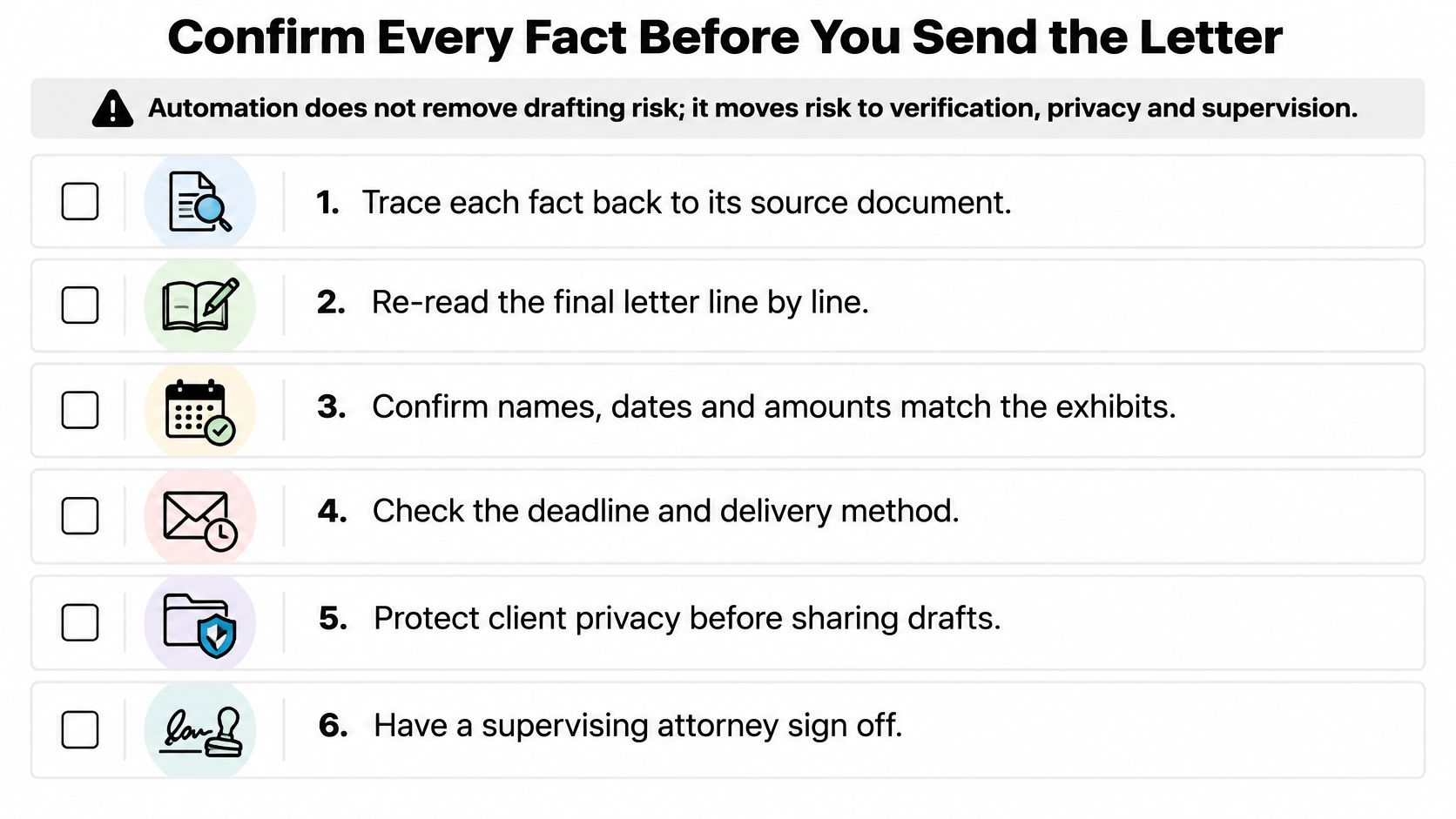
The Pre-Send Checklist
- Trace each factual sentence to a record in the file. A sentence with no record behind it is a sentence the adjuster can disregard, and it taints the ones that follow.
- Confirm every date, provider name and total against the bills and the chart. Transcription errors survive spellcheck and destroy credibility on the page where they appear.
- Remove causation or damages language the records don't support. Overreaching on causation invites a defense medical exam before the carrier has paid anything.
- Strip unnecessary personal information. Unrelated history, identifiers and treatment outside the claim don't need to travel, and confidentiality duties apply to every draft you circulate.
- Record the attorney's approval with a date. A documented review is the difference between a supervised draft and an unsupervised one.
- Preserve the final letter alongside the evidence set it cites. If the demand is ever challenged, you want the exact records the recipient received.
Supervision Is Not Optional
Current ethics guidance is consistent on this: lawyers using generative tools must understand their limits, protect client confidentiality, and keep supervising the final work product. Client consent does not eliminate the confidentiality duty. Ares doesn't provide legal advice, and the firm is solely responsible for every legal decision, client communication and filing made using anything we produce. Customers are responsible for reviewing and verifying all outputs before they go into legal proceedings or client correspondence.
Split the review. A paralegal checks totals and dates against source documents. The attorney checks the legal claims, the causation language and the demand figure. Two passes catch what one reader misses, and the split keeps the attorney's time on the judgment calls the file turns on.
Practical rule: if you can't name the exhibit that supports a sentence, cut the sentence rather than soften it.
For firms building a documented verification chain around AI-assisted drafting, this fact-checking guide for defensible AI workflows walks through what an auditable review trail looks like. Run the checklist on your own draft today and mark the three weakest sentences for revision before the letter goes out.
Ares builds demand letters from your own medical records and case file, with causation narratives, special damages and liability arguments cited back to source, and it drafts letters of representation from your templates with spoliation language included. When the difference between a settlement and a twelve-month detour comes down to whether the adjuster can verify your chronology, that citation trail is the whole product. Visit Ares to see how your next demand comes together from the records you already have.