

In personal injury litigation, the medical chronology is far more than a simple timeline of events; it is the narrative backbone of your entire case. A meticulously crafted chronology transforms a disorganized stack of medical records into a powerful strategic asset, capable of illuminating causation, substantiating damages, and preemptively dismantling defense arguments. However, manually compiling these documents is a painstaking process, demanding significant billable hours and carrying the inherent risk of overlooking a critical detail that could make or break a settlement or verdict.
This guide moves beyond generic templates. We will dissect seven distinct and strategic sample medical chronology formats, each tailored to address specific litigation challenges. You will learn not just what to include, but why a particular structure is superior for different case types, from soft-tissue injuries to catastrophic claims.
We will break down each example, offering actionable takeaways you can implement immediately. For each sample, we'll explore:
- Strategic Purpose: When and why to use that specific format.
- Key Components: The essential data points to include.
- Adaptation Tips: How to customize the template for your unique case facts.
Underpinning any powerful chronology is the accuracy and completeness of the source material. To ensure the highest quality of the underlying data, focusing on principles of Clinical Documentation Improvement (CDI) is crucial before analysis begins. This article will show you how to build upon that solid foundation, providing the frameworks needed to construct a compelling and persuasive case narrative. We will also touch on how modern tools like Ares can automate the foundational extraction work, freeing your team to focus on high-level analysis and strategy.
1. Tabular Timeline Medical Chronology
The Tabular Timeline is a foundational format for any sample medical chronology, prized for its clarity and efficiency. This approach organizes medical events into a straightforward, columnar chart, with distinct columns for dates, providers, diagnoses, treatments, and explanatory notes. Its power lies in its simplicity; it presents a clear, linear progression of care that is easy for attorneys, adjusters, and juries to scan and understand.
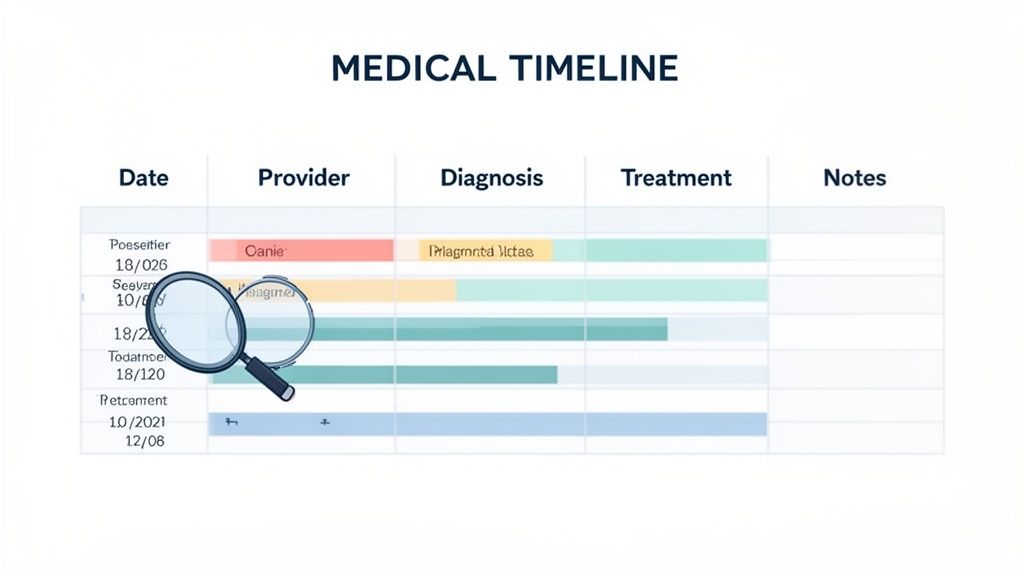
This format excels in personal injury cases where establishing causation and the sequence of medical interventions is paramount. By arranging data chronologically, the tabular layout makes it easy to track a client's journey from an initial emergency room visit to subsequent specialist consultations and ongoing physical therapy, visually connecting the injury event to the full scope of damages.
Strategic Analysis & Application
The true strategic value of a tabular chronology is its ability to quickly highlight critical case elements. For instance, in a motor vehicle accident case, a well-structured table can instantly show the progression from an ER diagnosis of "cervical strain" to a later MRI-confirmed "herniated disc," demonstrating a worsening condition over time.
This format also acts as a powerful diagnostic tool for your case strategy. A lengthy gap between treatments becomes immediately obvious, prompting you to investigate potential reasons like client non-compliance or a lapse in insurance coverage. Conversely, a dense cluster of appointments can underscore the intensity and severity of the client’s condition, justifying the damages claimed. This structure transforms a stack of records into a compelling, at-a-glance narrative.
Actionable Takeaways & Tips
To maximize the impact of your tabular timeline, consider these practical steps:
- Automate First, Refine Second: Use a tool like Ares to automate the initial data extraction of dates, providers, and basic event types. This saves countless hours and reduces human error, allowing your team to focus on adding the crucial clinical context and narrative details in the notes column.
- Implement Color-Coding: Assign specific colors to different event types. For example, use red for emergency/acute care, blue for diagnostic imaging, and green for ongoing physical therapy. This visual cue helps instantly identify patterns in treatment intensity and progression.
- Isolate Major Injuries: In complex, multi-injury cases, creating a separate tabular timeline for each major injury (e.g., one for a traumatic brain injury, another for an orthopedic fracture) can prevent the narrative from becoming convoluted and confusing.
For a deeper dive into constructing these timelines, you can explore our complete guide on mastering medical record chronology. This format is not just a summary; it's a strategic framework for building a winning case.
2. Narrative Medical Chronology with Symptom Progression
The Narrative Medical Chronology shifts the focus from a data-centric table to a compelling, prose-based account of the client's experience. This format weaves medical facts into a story that emphasizes the evolution of symptoms, pain, suffering, and the direct impact on the plaintiff’s daily life. Its strength lies in its ability to humanize the client and create an emotional connection for adjusters, mediators, or juries.
This approach is particularly powerful in personal injury cases where damages for pain and suffering are a primary component. By describing events in a flowing narrative, it connects a diagnosis to its real-world consequences, such as a client's inability to perform work duties or engage in family activities. The narrative format transforms sterile medical data into a persuasive story of human loss.
Strategic Analysis & Application
The strategic advantage of a narrative chronology is its power to control the case story. Rather than just listing a diagnosis, it contextualizes it. For example, a tabular entry might read "3/15/2023: Lumbar strain." A narrative entry can powerfully reframe this: "On March 15, 2023, following the collision, the plaintiff reported debilitating lower back pain that radiated into his right leg, rendering him unable to stand for more than ten minutes without excruciating discomfort."
This format is ideal for demand letters and settlement negotiations. It allows you to preemptively address potential defense arguments, like gaps in treatment, by explaining them within the narrative context (e.g., "The plaintiff was unable to attend physical therapy for two weeks due to transportation issues directly resulting from the collision-related property damage to his vehicle."). It moves beyond a simple list of events to build a persuasive argument from the very first sentence.
Actionable Takeaways & Tips
To create a powerful narrative medical chronology, integrate these practical techniques:
- Anchor with Dates: Begin each new paragraph or section with a specific date or time period (e.g., "In the initial 48 hours post-incident...") to maintain a clear chronological structure and prevent the narrative from becoming disorganized.
- Quote for Impact: Directly embed powerful quotes from medical records within your narrative. A provider's note stating the "patient is in clear distress" or that the "prognosis for a full recovery is guarded" lends significant third-party credibility to your claims of suffering.
- Structure by Recovery Phase: Organize the story into logical phases, such as an "Initial Injury & Acute Care Phase," "Diagnostic & Specialist Treatment Phase," and "Ongoing Management & Plateau Phase." This structure helps demonstrate the long-term, progressive nature of the injury and its enduring impact on the client's life.
For more guidance on structuring this type of document, explore our in-depth resources on the narrative medical chronology template. This method is not just a summary; it's a strategic tool for building empathy and maximizing case value.
3. Provider-Segmented Medical Chronology
The Provider-Segmented Medical Chronology organizes a client's medical history by healthcare provider or specialty rather than in strict chronological order. This format creates distinct, self-contained narratives for emergency care, orthopedic surgery, physical therapy, and pain management. Its power lies in isolating the treatment path within each discipline, making it easier to analyze the care provided by individual specialists in complex, multi-provider cases.
This approach is invaluable in catastrophic injury or medical malpractice cases where the coordination, or lack thereof, between different specialists is a central issue. By segmenting the records, it becomes simple to track a specific provider's diagnostic process, treatment plan, and follow-up, independent of other concurrent care. This clarity helps build a strong narrative around each specialist's contribution to the client's overall outcome.
Strategic Analysis & Application
The strategic advantage of a provider-segmented sample medical chronology is its ability to expose critical details that a purely linear timeline might obscure. For instance, in a workplace injury case, separating the occupational medicine physician's records from the workers' comp-approved physical therapist's notes can instantly highlight a significant delay between the referral and the first PT session, demonstrating a gap in care that worsened the client's condition.
This format also serves as a powerful tool for evaluating the consistency and quality of care. You can easily compare the orthopedic surgeon's post-operative instructions against the physical therapist's treatment plan to identify any discrepancies. In a motor vehicle accident case, you might find that the pain management specialist was unaware of a new medication prescribed by the client's primary care physician, revealing a communication breakdown that impacted the client's recovery and strengthens arguments for damages.
Actionable Takeaways & Tips
To effectively leverage a provider-segmented chronology, apply these targeted strategies:
- Categorize Providers from Intake: Use a platform like Ares to automatically categorize records by provider and specialty during the initial document processing. This foundational step saves dozens of hours and allows your team to immediately begin building out the segmented chronology.
- Create a Master Timeline Index: Develop a one-page summary chart that lists all providers chronologically with color-coding for each specialty. This provides a high-level overview and acts as a clickable index, linking to the detailed section for each provider.
- Explicitly Document Referrals and Delays: Within each provider's section, make a specific entry for referrals. Note the date of the referral and the date of the first appointment with the new specialist. A note like, "Referred to Orthopedics on 01/15/2023; First Appointment on 02/12/2023 (28-day delay)," makes these critical gaps impossible to miss.
- Flag Communication Lapses: Actively look for and flag instances where one provider's notes indicate a lack of awareness of another's treatment. Highlighting these communication failures can be crucial in demonstrating that the client's care was fragmented and poorly managed.
4. Damages-Focused Medical Chronology
The Damages-Focused Medical Chronology is a specialized format designed to directly link medical events to their financial and personal consequences. Unlike a purely clinical summary, this template integrates economic and non-economic damages, creating a powerful tool for trial preparation and settlement negotiations where damages are the primary point of contention. It maps treatments and diagnoses directly to quantifiable losses like medical bills, lost wages, and future care costs, as well as subjective impacts like pain and suffering.
This format is indispensable in high-stakes cases, such as a construction worker's catastrophic injury. It visually connects the diagnosis of an ACL tear on a specific date to the subsequent surgery, the exact period of lost wages, the total medical expenses incurred, and an expert's assessment of a permanent reduction in earning capacity. By doing so, it transforms the medical narrative into a clear and compelling damages calculation.
Strategic Analysis & Application
The strategic power of a damages-focused chronology lies in its ability to preemptively justify and substantiate your demand letter or trial exhibits. It moves beyond simply listing injuries and treatments; it quantifies their impact in a way that is difficult for opposing counsel or an insurance adjuster to dispute. This sample medical chronology builds a clear, logical bridge between a medical event and a specific dollar amount.
For example, in a case involving a professional athlete, this format can link a specific surgery to canceled competitions and lost sponsorship opportunities, presenting a clear calculation of financial harm. This structure also highlights permanent impairments by tying a physician's final report to a vocational expert's opinion on reduced future earnings. It frames the entire case around the central theme of loss, making the financial and human costs of the injury undeniable.
Actionable Takeaways & Tips
To build a compelling damages-focused chronology, leverage both medical and financial documentation:
- Create Parallel Timelines: Use a tool like Ares to generate the foundational medical timeline with all key dates and events. Then, create a parallel column or integrated entries that overlay financial data from employment records, medical bills, and expense receipts, directly linking costs to their corresponding medical events.
- Quantify Future Needs: Dedicate a specific section to future medical care. Include line items based on expert reports, such as "Projected lifetime orthopedic follow-up care estimated at $2,500/year," complete with the source of the projection. This anchors future damages in credible evidence.
- Separate and Define Losses: Clearly distinguish between different types of damages. Use distinct notations or columns for temporary functional losses (e.g., "Unable to lift more than 10 lbs for 6 weeks") versus permanent impairments ("15% permanent partial disability rating"). This clarity prevents ambiguity and strengthens your argument for both economic and non-economic awards.
5. Causation-Analysis Medical Chronology
The Causation-Analysis Medical Chronology is a highly specialized format designed to directly confront and overcome challenges to causation. It strategically organizes medical data to establish a clear, defensible link between an incident and the subsequent medical conditions, making it indispensable when defendants claim pre-existing conditions or intervening factors are to blame. This chronology juxtaposes pre-incident and post-incident health records to create a powerful before-and-after narrative.
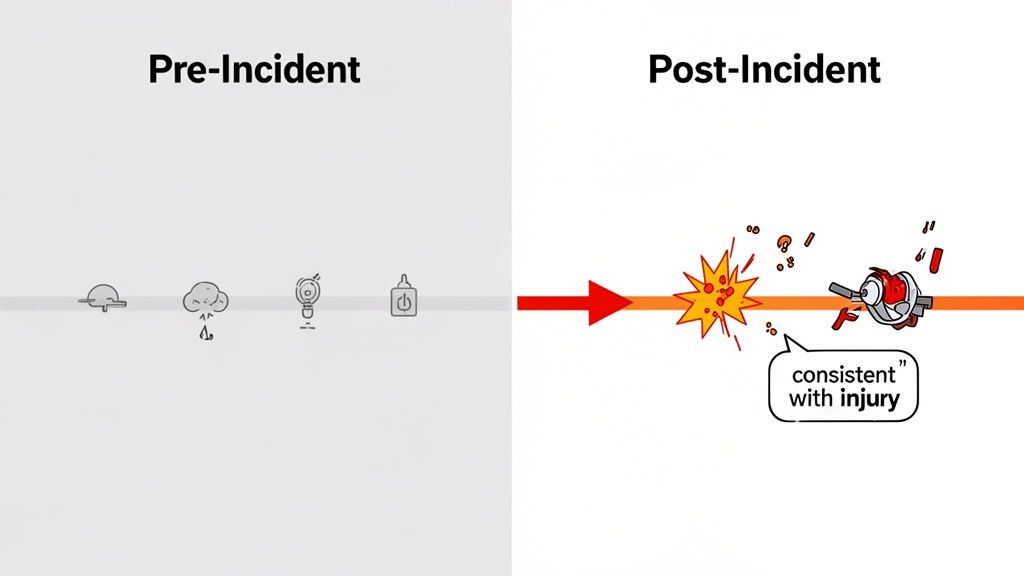
This format is crucial in cases where causation is the central disputed issue. For example, in a slip-and-fall case, this chronology would highlight a decade of no orthopedic complaints, followed immediately by consistent physical therapy and specialist visits post-incident. The temporal proximity and the stark contrast in treatment patterns create a compelling argument that the incident was the direct cause of the injuries.
Strategic Analysis & Application
The strategic power of a causation-analysis chronology lies in its ability to preemptively neutralize common defense arguments. By systematically presenting the plaintiff's baseline health, it isolates the incident as the sole logical trigger for the new medical problems. This approach transforms the medical records from a simple list of treatments into a persuasive argument tailored for a judge, jury, or claims adjuster.
This format becomes a critical tool for defending against Daubert challenges aimed at your medical experts. For instance, in a car accident case where the defense argues a client's neck pain is degenerative, a causation-analysis chronology can demonstrate zero pre-incident complaints of neck pain, followed by an immediate MRI showing a disc herniation post-accident. It provides your expert with a clear, fact-based foundation to state that the injury is "consistent with the mechanism of injury," directly linking the trauma to the diagnosis.
Actionable Takeaways & Tips
To build a compelling causation-analysis chronology, focus on creating a clear, evidence-based contrast:
- Establish a Clean Baseline: The first step is a thorough medical record review for attorneys to request and analyze complete pre-incident records. This allows you to document any gaps in treatment or a complete lack of relevant complaints, which strengthens your causation argument.
- Highlight Provider Statements: Use a distinct column or bold formatting to isolate any notes where a physician explicitly links the symptoms to the incident. Phrases like "symptoms began after MVA" or "pain consistent with fall" become powerful, objective evidence.
- Visualize the Contrast: Create a simple chart or visual timeline that compares the frequency and type of medical visits pre- and post-incident. The visual impact of seeing zero visits followed by dozens can be more persuasive than text alone, making the data easily digestible for a jury.
6. Gap Analysis Medical Chronology
A Gap Analysis Medical Chronology is a highly specialized format designed to isolate and scrutinize periods of inactivity or delay in a client’s medical care. This sample medical chronology moves beyond simply listing events; it actively identifies and documents gaps such as delayed diagnoses, missed follow-ups, or prolonged waits for treatment. Its primary purpose is to build a compelling narrative around how these interruptions in care negatively impacted the client's outcome.
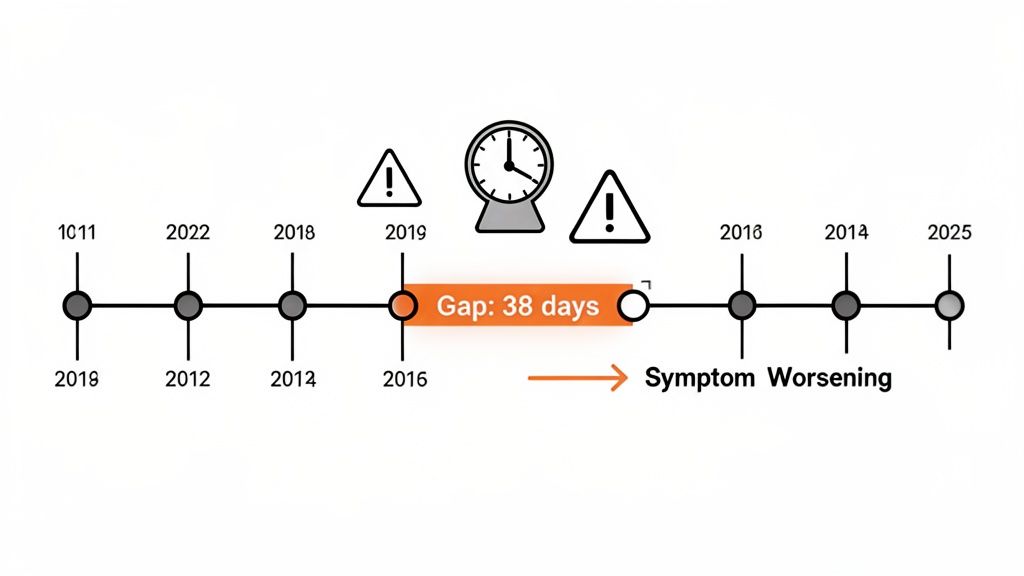
This format is indispensable in cases where the absence of care is as critical as the care received. It is particularly powerful in medical malpractice scenarios, premises liability cases with complex follow-up, and workers' compensation disputes where insurance delays exacerbate an injury. By highlighting these deficiencies, the chronology creates a clear visual record connecting the gap to the escalation of symptoms and increased damages.
Strategic Analysis & Application
The strategic power of a gap analysis chronology lies in its ability to quantify the impact of inaction. For example, in a personal injury case, it can visually demonstrate that an MRI ordered on March 15 but not performed until April 22 represents a 38-day delay. The chronology would then link this specific gap to subsequent entries showing the client’s escalating symptoms, which ultimately required a more invasive and expensive surgical intervention.
This approach transforms abstract delays into concrete evidence of negligence or systemic failure. In a workplace injury case, a 90-day gap between a physical therapy referral and the first appointment due to authorization issues becomes a focal point of the damages argument. The chronology can detail the client’s decline in mobility and increase in pain during this period, directly attributing this deterioration to the administrative gap and strengthening the claim for greater compensation.
Actionable Takeaways & Tips
To build a potent Gap Analysis Medical Chronology, focus on these tactical steps:
- Automate Gap Detection: Use a platform like Ares to automatically calculate time intervals between every medical event. Its features can flag any period exceeding a predefined threshold (e.g., 30 days) that lacks documentation, instantly pointing your team to potential gaps needing further investigation.
- Visually Emphasize Gaps: Create a secondary visual chart or use stark color-coding (like red or orange) within your primary timeline to highlight the gap periods. This makes the delays impossible for an adjuster or jury to ignore during a review.
- Calculate and Document Impact: For each identified gap, add a specific note calculating its impact. For example: "Gap resulted in 14 additional lost workdays ($3,500 in lost wages)" or "Delay in diagnosis led to the need for fusion surgery instead of a less invasive microdiscectomy."
- Distinguish Gap Types: Clearly differentiate between clinical gaps (a provider’s deviation from the standard of care) and administrative gaps (insurance denials, scheduling backlogs). This distinction helps direct liability and clarifies the root cause of the client’s worsened condition.
7. Treatment Outcome Medical Chronology
The Treatment Outcome Medical Chronology shifts the narrative focus from merely listing events to evaluating their effectiveness. This results-oriented format documents each intervention, its intended purpose, and its actual outcome, creating a powerful story of a client's journey through the healthcare system. It’s designed to highlight instances of treatment failure, the necessity for escalated care, and the persistent nature of an injury.
This format is particularly effective in cases involving chronic pain, complex regional pain syndrome (CRPS), or any condition where conservative treatments prove insufficient. It methodically builds the justification for more invasive or costly interventions, such as surgery or advanced pain management, by demonstrating that all less aggressive options were exhausted without success. This approach transforms a simple list of treatments into a compelling argument for higher damages.
Strategic Analysis & Application
The strategic power of this chronology lies in its ability to preemptively counter common defense arguments, such as the claim that a client’s condition would have improved with standard care. By explicitly documenting "minimal improvement" or "no change in pain scores" after each conservative step, you build an irrefutable record of the injury's severity and resistance to treatment.
Consider a chronic pain case where physical therapy, medication, and injections are attempted over many months. A Treatment Outcome Chronology would clearly show this progression: 'Physical therapy 3x/week for 8 weeks with minimal improvement in range of motion → prescribed lidocaine patches with no reduction in reported pain → escalated to gabapentin, resulting in side effects → referred to pain management specialist for nerve block injections.' This structure logically validates the need for each subsequent, more aggressive treatment, directly linking it to the failure of the previous one and strengthening the case for future medical costs.
Actionable Takeaways & Tips
To create a persuasive Treatment Outcome chronology, follow these targeted steps:
- Structure Entries by Outcome: For each intervention, create entries that explicitly state: 1) What was done, 2) The expected outcome, 3) The actual outcome, and 4) The next step. This formula ensures your narrative is always moving forward and focused on results.
- Quantify Subjective and Objective Data: Incorporate both objective measures (e.g., "ROM increased by only 5 degrees") and subjective reports (e.g., "Client's reported pain remained an 8/10 on the VAS scale"). Quantifying these outcomes adds significant weight and credibility to the documented treatment failures.
- Document Adverse Effects: Meticulously note any negative side effects from treatments, such as drowsiness from medication or increased pain following a procedure. These adverse outcomes represent additional layers of pain and suffering that are a direct consequence of the initial injury, further bolstering damages.
This sample medical chronology is not just a record of what happened; it's a strategic tool that proves the full extent of a client’s suffering and the medical necessity of every step taken.
Comparison of 7 Medical Chronology Types
| Template | Implementation Complexity | Resource Requirements | Expected Outcomes | Ideal Use Cases | Key Advantages |
|---|---|---|---|---|---|
| Tabular Timeline Medical Chronology | Low — columnar setup, easily automated | Moderate — full records; extraction tool (e.g., Ares); minimal expert input | Clear chronological display of dates, providers, treatments; quick fact-finding | Personal injury cases needing clear treatment sequencing across providers | Fast to build and export; easy to scan for gaps; jury- and settlement-friendly |
| Narrative Medical Chronology with Symptom Progression | Medium — requires interpretive writing skill | Moderate — records + plaintiff statements; time for drafting; Ares can seed content | Persuasive symptom-focused narrative showing functional impact over time | Cases emphasizing pain, suffering, and quality-of-life damages | Conveys nuance and emotion; aligns with demand letters; reduces redrafting |
| Provider-Segmented Medical Chronology | High — complex organization and cross-referencing | High — detailed provider records; Ares provider categorization; expert review as needed | Clear provider-specific treatment courses and coordination analysis | Complex multi-provider cases where coordination or referral gaps matter | Reveals coordination/standard-of-care issues; simplifies provider-focused discovery |
| Damages-Focused Medical Chronology | Medium–High — requires financial linking and validation | High — medical bills, wage/tax records, economic expert input, Ares integration | Quantified economic and non-economic impacts tied to medical events; trial-ready exhibits | Cases with contested economic damages or where quantification is central | Directly supports damages calculations; strengthens settlement and expert reports |
| Causation-Analysis Medical Chronology | High — extensive pre/post comparison and expert causation review | High — pre-incident records, expert causation analysis, Ares flagging of patterns | Strong before/after evidence to establish temporal causation and rebut pre-existing claims | Cases disputing causation or where defendant raises pre-existing conditions | Counters pre-existing defenses; creates expert-ready causation foundation |
| Gap Analysis Medical Chronology | Medium — interval analysis and comparative standards required | Moderate–High — records, communication logs, standard-of-care expert input, Ares gap detection | Identification and documentation of treatment delays and their impacts | Malpractice, premises liability, workers' comp cases alleging delayed or missed care | Visualizes delays; supports liability for worsened outcomes and additional damages |
| Treatment Outcome Medical Chronology | Medium — requires collection and interpretation of outcome measures | Moderate — objective tests, subjective reports, imaging, expert interpretation, Ares extraction | Demonstrates intervention effectiveness or failure and need for escalation | Cases highlighting failed treatments, persistent symptoms, or ongoing care needs | Shows treatment resistance and cumulative burden; supports claims for ongoing/permanent injury |
Choosing the Right Chronology to Maximize Case Value
We have explored seven distinct types of medical chronologies, moving far beyond a simple one-size-fits-all approach. From the straightforward Tabular Timeline to the deeply analytical Causation-Analysis format, it's clear that the true power of a sample medical chronology lies not merely in its structure, but in its strategic application. The central takeaway is this: the right chronology is the one that best tells your client’s unique story and most effectively dismantles the anticipated defense arguments.
Selecting the appropriate framework is the first step in transforming a dense stack of medical records into a compelling, persuasive, and value-driving case asset. Your choice dictates the narrative, focuses the reader’s attention, and builds the foundation for your demand letter, mediation presentation, or trial exhibits.
Recapping the Strategic Choices
Let's distill the core strategic applications for the chronologies we've examined:
- For demonstrating overwhelming treatment: The Tabular and Provider-Segmented chronologies are your workhorses. They visually communicate the sheer volume and duration of care, making it impossible for an adjuster to downplay the client's journey.
- For highlighting pain and suffering: The Narrative Chronology with Symptom Progression excels here. It translates clinical data into a human story, charting the day-to-day impact of the injury on your client’s life.
- For proving direct causation: The Causation-Analysis Chronology is purpose-built to connect the incident directly to the diagnosis and subsequent treatment, preemptively countering arguments about pre-existing conditions or intervening causes.
- For maximizing economic damages: The Damages-Focused Chronology aligns every medical entry with a specific cost. This format makes your demand tangible and justifies every dollar you claim.
- For preempting defense tactics: The Gap Analysis and Treatment Outcome chronologies are your best defensive tools. They allow you to proactively address and reframe potential weaknesses, such as lapses in care or less-than-perfect recovery, turning them into points of strength.
From Sample to Strategy: Your Actionable Next Steps
Mastering the art of the medical chronology requires moving from passive review to active construction. The samples provided in this article are not just templates; they are strategic blueprints. Your next step is to apply them with intent.
- Identify Your Case's Central Theme: Before drafting, ask yourself: What is the single most compelling aspect of this case? Is it the undeniable causal link? The severity of the pain and suffering? The high value of the medical specials? Your answer will point you to the most effective chronology format.
- Select a Primary and Secondary Format: You don't have to be limited to one style. Consider using a comprehensive Tabular chronology for your internal case file while developing a more focused Narrative or Causation-Analysis version for your demand package. The key is to adapt your tool to your audience.
- Integrate Technology as a Foundation: The manual extraction of dates, providers, diagnoses, and treatments is the most time-consuming and error-prone part of this process. This is where modern legal technology creates a significant competitive advantage. By automating the foundational data extraction, you free up your skilled legal team to focus on the high-value work: analyzing the data, identifying the narrative, and building the argument.
Ultimately, a well-crafted medical chronology is more than a summary; it's a strategic weapon. It’s the framework upon which you build your entire argument for damages. By moving beyond a generic, one-size-fits-all document and deliberately choosing a sample medical chronology that aligns with your case strategy, you gain control over the narrative. You are no longer just presenting facts; you are telling a story that is structured for maximum impact and designed to win. This strategic approach is what separates good outcomes from exceptional ones.
Ready to eliminate tedious data entry and focus on case-winning strategy? Ares uses advanced AI to instantly extract key data from medical records and auto-generate detailed chronologies, giving your team a powerful head start on building the strongest possible case narrative. Explore how Ares transforms your workflow at Ares.