Crafting High-Impact Settlement Demand Letters
A settlement demand letter isn't just a request for money. It's a strategic legal document that kicks off negotiations and frames the entire narrative of your client's personal injury case. Think of it as your opening argument, laying out the facts, liability, and damages for an insurance adjuster long before a lawsuit is even on the table.
Simply put, a well-crafted demand is the single most important tool for securing a fair settlement efficiently.
Why a Great Demand Letter Is Your Most Powerful Tool
Before we get into the nuts and bolts of drafting, it's critical to understand the strategic power a great demand letter wields. This isn't just procedural paperwork; it's an instrument of persuasion that sets the tone for the entire claims process. Its job is to present a clear, compelling, and evidence-backed argument that convinces the insurance carrier that settling is far more sensible than litigating.
This letter is your first—and often best—shot at controlling the story. You get to present your client’s case from a position of strength, laying out the hard facts of the incident and the very real impact it’s had on their life. It immediately establishes your credibility with the adjuster, showing them you’re organized, thorough, and ready for trial if it comes to that.
The Foundation of Successful Negotiation
A powerful demand letter cuts off common defense arguments at the knees. When you present a meticulously organized case file with irrefutable evidence, you leave very little room for an adjuster to poke holes in liability or downplay the damages. The numbers don't lie: this approach works. It’s the reason over 95% of personal injury cases reach a resolution without ever seeing the inside of a courtroom.
A strong demand doesn't just ask for a settlement; it logically proves why your valuation is fair and just. It transforms the adjuster from an adversary into a problem-solver by giving them all the documentation needed to justify the payout to their superiors.
The financial upside of a well-structured demand is huge. For instance, demands supported by a clean medical chronology—which clearly outlines key dates, diagnoses, and treatments—can increase settlement values by an average of 25%. That can turn a standard $50,000 offer into a $62,500 settlement, a clear return on the effort you put in upfront.
Setting the Stage for Settlement
Ultimately, your goal is to make the adjuster’s job easy. A confusing or poorly supported demand creates extra work and invites skepticism. A clear, logical, and well-documented package, on the other hand, builds trust and moves the whole process forward.
For a deeper dive into maximizing your impact, check out these insights on crafting a settlement demand letter that gets results. By mastering this document, you build a solid foundation for a stronger negotiation and a better outcome for your client. And if you need a refresher on the basics, our guide on what is a demand letter has you covered.
Building a Persuasive Demand Letter Structure
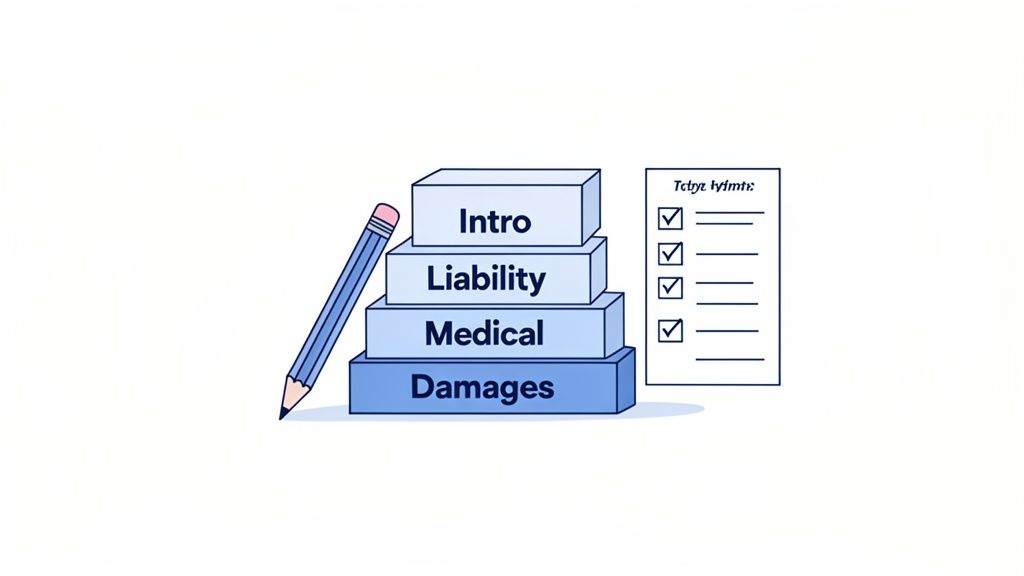
A great settlement demand letter isn't just a collection of facts; it’s a story. But it's a story with a very specific purpose: to lead an insurance adjuster, step-by-logical-step, to the inescapable conclusion that your settlement demand is fair and justified. The structure is your roadmap.
Each section must build on the one before it, creating a narrative that’s both compelling and difficult to poke holes in. You’re not just asking for money; you're showing them precisely why they owe it. Get the structure right, and you’ve won half the battle before the adjuster even picks up the phone.
The Introductory Framework
The first few lines set the tone for the entire negotiation. Don’t waste time with fluff or overly aggressive language. Your introduction should be direct, professional, and crystal clear about why you’re writing.
All you need to do here is identify the key players and the purpose of the letter. Make sure you include:
- Your client’s full name.
- The date the incident occurred.
- The name of their insured (the defendant).
- A clear, simple statement that this letter is a formal demand for settlement.
Think of it as the handshake before the real conversation begins. It establishes who you are and what this is about, allowing the adjuster to immediately pull the correct file and get down to business.
Crafting the Liability Narrative
With the preliminaries out of the way, it's time to prove fault. The liability section is where you lay out, in no uncertain terms, why their insured is responsible for your client’s injuries. This isn't just a summary of the police report; it's a persuasive argument constructed from evidence.
Walk the adjuster through the incident, explaining how the defendant’s actions—or lack thereof—breached their duty of care and directly caused the harm. This is where you bring in the proof: cite specific traffic laws, quote witness statements, and reference the photos you’ve enclosed that show the scene.
Your goal is to make liability a foregone conclusion. By the time the adjuster finishes this section, they should have no reasonable doubt that their insured is legally on the hook.
For instance, don’t just say, "The defendant ran the red light." Instead, frame it with authority: "Mr. Smith breached his statutory duty under Vehicle Code §1234 by failing to stop for a clearly illuminated red traffic signal at the intersection of Maple and Oak. This is corroborated by two independent witnesses, Ms. Davis and Mr. Chen, who both provided statements confirming the light for Mr. Smith’s direction of travel had been red for over five seconds prior to the collision." That detail shuts down ambiguity.
Detailing the Medical Journey
Once you’ve established why they are responsible, you need to show the human cost of that negligence. The medical narrative connects the defendant’s actions to your client’s suffering. It transforms a stack of medical bills into a relatable story of pain, treatment, and the long road to recovery.
Go beyond a simple list of injuries. Describe the immediate trauma at the scene, the chaos of the emergency room, the specifics of the surgeries, and the grueling physical therapy sessions that followed. You're painting a picture for the adjuster.
A strong medical story should illustrate:
- The initial diagnoses and what doctors expected.
- The exact treatments, procedures, and medications your client endured.
- The real-world physical pain and emotional toll of the experience.
- Any resulting permanent impairments or long-term challenges.
This is what humanizes the claim. It ensures the adjuster sees more than just line items on a bill; they see the full scope of the harm their insured caused a real person.
Breaking Down the Damages
Finally, after proving liability and detailing the injuries, you get to the number. This is the culmination of your entire argument, and it needs to be presented with absolute clarity and justification. Don't just throw out a single large number; break it down into logical, defensible categories.
A well-organized damages section shows the adjuster you’ve done your homework and that your valuation is based on concrete losses and established principles.
Here is a breakdown of the essential sections, their strategic goals, and the critical information needed to build a persuasive case for your demand.
Key Components of an Effective Settlement Demand Letter
| Section | Objective | Critical Information to Include |
|---|---|---|
| Introduction | To clearly state the letter's purpose and identify the parties. | Client's name, date of incident, insured's name, and a statement of demand. |
| Liability | To prove the insured's fault is undeniable. | A narrative of the incident, supporting evidence (police reports, witness statements), and relevant statutes. |
| Medical Narrative | To connect the negligence to the client’s suffering. | A chronological story of injuries, treatments, pain, and prognosis; description of long-term impacts. |
| Economic Damages | To quantify all direct, out-of-pocket financial losses. | All past and projected future medical bills, documentation of lost wages and lost earning capacity. |
| Non-Economic Damages | To assign a value to the human cost and suffering. | A compelling argument for pain, suffering, emotional distress, and loss of enjoyment of life. |
| Total Demand | To present the final, comprehensive settlement figure. | A clear, itemized summary leading to the total monetary amount you are demanding. |
Presenting your damages this way makes your math transparent and your reasoning sound. It forces the adjuster to argue with your specific calculations rather than just slashing a top-line number, putting you in a much stronger negotiating position from the very start.
Calculating and Justifying Your Damage Claim
This is where the rubber meets the road. After you've laid out a rock-solid case for liability and walked the adjuster through your client's ordeal, the damages section is what translates all that pain and disruption into a concrete number.
If your demand figure feels arbitrary or poorly supported, you're practically inviting the adjuster to make a lowball offer. Your goal here is to build an ironclad, evidence-based argument for every single dollar. This requires a meticulous breakdown of both the hard financial losses and the very real, but less tangible, human cost of the injury. When done right, your calculation doesn't just ask for money—it anchors the entire negotiation.
Nailing Down the Economic Damages
Economic damages, what we often call "specials," are the most straightforward part of the claim. These are the direct, out-of-pocket costs your client has incurred. But don't make the mistake of just throwing a pile of bills at the adjuster and expecting them to connect the dots. You need to present these losses with absolute clarity.
Breaking down the costs into clean, logical categories makes the adjuster's job easier, which is always a good thing. It shows you're organized and leaves no room for them to "misunderstand" the numbers.
- Past Medical Expenses: Don't just list a total. Itemize every single bill—from the initial ER visit and surgeon's fees to physical therapy sessions and prescription co-pays. A simple table or spreadsheet is perfect for this.
- Future Medical Needs: This is a huge one, and you can't guess. If your client's recovery is ongoing, you need an expert opinion. A report from a treating physician projecting future care is often enough, but for complex cases, a life care planner's report is the gold standard.
- Lost Wages and Income: Document every cent of income lost because your client couldn't work. This means gathering pay stubs, a letter from their employer confirming time off, and even tax returns to paint a full picture.
- Loss of Earning Capacity: If the injury is permanent and impacts your client's ability to earn a living long-term, this calculation becomes critical. You'll likely need a vocational expert or an economist to project these losses over your client's expected work life.
This level of detail forces the adjuster to confront your numbers line-by-line instead of just brushing off a lump sum.
An adjuster’s primary goal is to close the file. By providing a well-organized, thoroughly documented breakdown of economic damages, you give them the ammunition they need to justify your settlement figure to their superiors.
Valuing the Human Cost: Non-Economic Damages
This is where you put a number on your client’s suffering. Non-economic damages, or "general damages," are often the largest part of a personal injury settlement, but they're also the trickiest to value. Here, you're assigning a monetary figure to pain, emotional distress, and the loss of life's simple pleasures. A compelling narrative is everything.
While there’s no magic formula, experienced adjusters are used to seeing a few common methods. Using a recognized approach lends instant credibility to your valuation.
The Multiplier Method
This is the most widely used approach in the industry. You simply take the total economic damages (your "specials") and multiply them by a number, usually between 1.5 and 5. The key is justifying your multiplier. A minor soft-tissue injury with a quick recovery might only get a 1.5x multiplier. But a catastrophic injury that leads to permanent disability and chronic pain? You're looking at a 5x multiplier, or even higher in some cases.
The Per Diem Method
Another way to look at it is the "per diem" approach. You assign a daily value to your client's suffering, running from the day of the accident until they reach what doctors call maximum medical improvement. The daily rate is often tied to the client's daily earnings, based on the argument that enduring constant pain is at least as difficult as a day's work.
No matter which method you use, you have to connect it to the facts. Explain why you chose a 4x multiplier or a $200 per diem rate. Talk about the grueling recovery, the family vacations they missed, the hobbies they can no longer enjoy. For a deeper dive, check out our guide on how to calculate pain and suffering damages.
Presenting Your Final Demand
Once you've done the work, bring it all together in a final, clear demand figure. Don't bury it at the bottom of the letter. State it with confidence, right after you've laid out the mountain of evidence that justifies it.
The data shows just how powerful a well-supported demand can be. The value of U.S. class action and mass tort settlements hit an incredible $42 billion in 2024. More specifically, a 2019 study of personal injury analytics found that demands built with data-driven insights lifted settlement offers by an average of 30%, pushing the median offer from $25,000 to $32,500. You can see more on how data-driven demands impact settlement values on talli.ai.
When you meticulously calculate and justify every part of your damages, your settlement letter becomes more than just a request—it becomes a powerful tool of persuasion that puts you in control of the negotiation.
Compiling an Undeniable Evidence Package
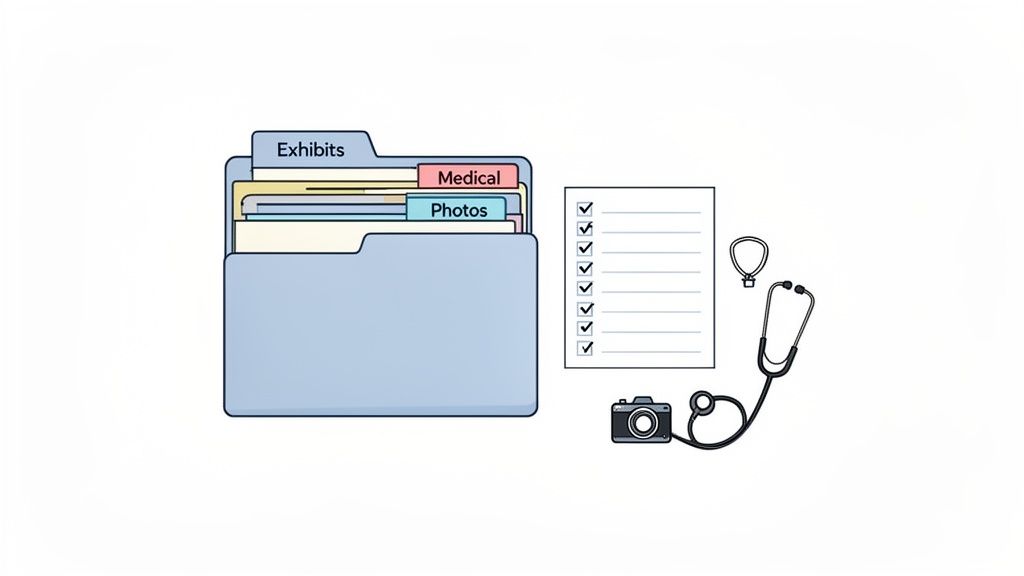
A great demand letter is really just a story backed by undeniable proof. Your arguments about liability and the extent of your client's damages are hollow without the evidence to support them. The real goal here is to assemble a comprehensive, organized, and—frankly—overwhelming exhibit package.
This isn’t about just dumping a disorganized pile of paper on an adjuster’s desk. It's about strategic presentation. You’re building a case so thoroughly documented that the adjuster sees settling is a much smarter move than fighting. I always tell my team to build a package that would make a trial lawyer smile if the case ever ended up in their hands.
Nailing Down Liability from the Start
Before we can even talk about money, we have to prove fault is a non-issue. Your evidence needs to be direct and clear, leaving no wiggle room for the adjuster to try and pin blame on your client.
Every exhibit package should lead with the liability essentials:
- The Official Police Report: This is ground zero for most adjusters. Be sure to highlight the officer's conclusions on fault, any citations issued, and witness contact information.
- Witness Statements: A signed statement from a neutral, third-party witness is gold. It provides independent confirmation of your client’s story and can shut down any "he said, she said" arguments.
- Scene and Property Damage Photos: Visuals are everything. High-quality photos of the accident scene, traffic controls, road conditions, and extensive shots of the vehicle damage help the adjuster see exactly what happened. They build a powerful visual story of the impact's force.
Together, these documents create a clear picture of liability that's hard to dispute.
Documenting the Human and Financial Cost
Once you’ve established fault, the focus pivots to proving your client’s losses. This is where painstaking organization pays dividends. An adjuster needs to be able to trace every single dollar you’re demanding back to a specific document in your exhibit list.
The medical evidence forms the core of your damages claim. You'll need:
- All Medical Records: Get everything. I mean everything—from the first responder reports and ER charts to surgical notes, physical therapy logs, and every follow-up visit.
- All Medical Bills: Compile an itemized list of every single bill. This list should correspond directly with the records, showing the cost for each phase of care.
- Diagnostic Imaging Reports: Don't just mention the MRI; include the radiologist's report that objectively documents the disc herniation or torn ligament.
- Photos of Injuries: A picture is worth a thousand words, and often, a thousand dollars. Document your client's injuries over time. Photos of the initial bruising, stitches, and subsequent scarring tell a story that clinical medical records simply can’t.
Pro Tip: Never send an evidence package without a detailed exhibit list. An index that labels every document (e.g., Exhibit A: Police Report, Exhibit B: Statement of Jane Doe) makes you look professional and makes the adjuster's job easier—which is always a good thing.
Don't forget to substantiate the other economic losses. Use pay stubs and a letter from your client's employer to verify lost wages. If they needed to hire lawn care or cleaning services because of their injuries, include those receipts. Every out-of-pocket expense counts.
Turning Raw Data into a Compelling Story
Let's be honest: no one wants to read 2,000 pages of dense medical records. The trick is to distill that mountain of information into a digestible summary that tells the story of your client's ordeal. A well-written medical chronology is your best friend here. It pulls out the most critical diagnoses, treatments, and prognoses and lays them out in an easy-to-follow timeline.
For law firms trying to handle this process more efficiently, looking into specialized tools for medical record review for attorneys can be a huge time-saver.
Ultimately, your evidence package needs to do more than just present facts. It must weave those facts into a cohesive and powerful narrative. When you present a meticulously organized and fully supported case, you send a clear message to the insurer: you are prepared, you are serious, and you are ready to go the distance if needed.
Using Technology to Draft Demands Faster and Better
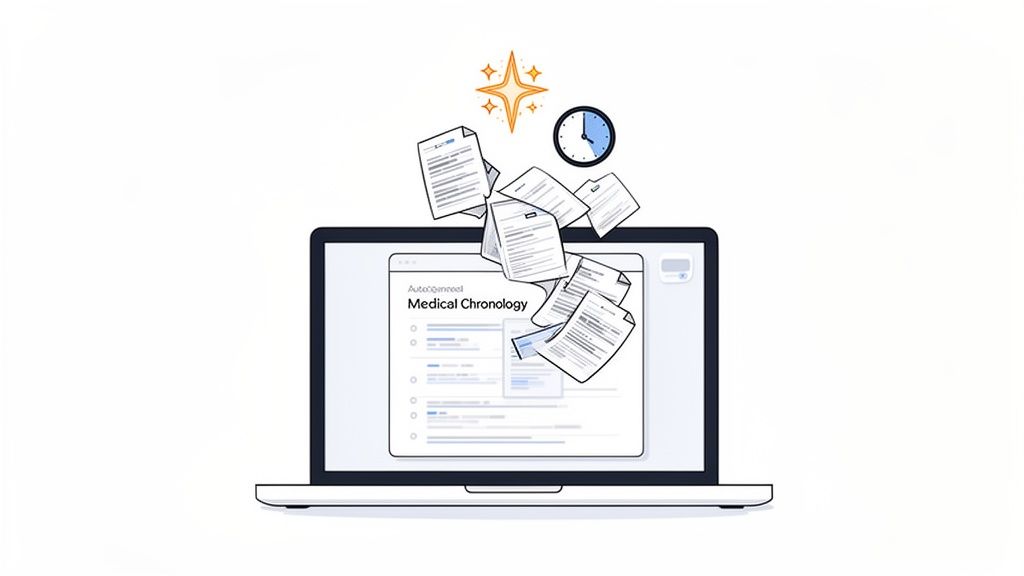
In any personal injury firm, time is our most precious commodity. We've all been there: staring at a mountain of medical records, knowing it'll take hours of manual review just to draft a single demand letter. This process isn't just tedious; it's a major bottleneck that caps how many cases your team can effectively handle and, frankly, limits your firm's growth.
But there's a better way. Smart firms are turning to AI-powered legal tech to overhaul their demand letter workflow. This isn't about replacing lawyers or paralegals. It's about augmenting their skills, freeing them from the drudgery of data entry so they can focus on what they do best: strategy and negotiation.
Automating the Core of Your Demand
The real magic of this technology is its ability to pull critical information from thousands of pages of medical records automatically. You can upload a client's entire file and, in a matter of minutes, get back a structured summary of every key detail.
Here’s what these platforms are designed to do:
- Diagnoses and Symptoms: They intelligently extract every diagnosis from physician notes and specialist reports.
- Providers and Facilities: They build a comprehensive list of every doctor, hospital, and clinic involved in the client's care.
- Treatment Dates and Details: They create an accurate, easy-to-follow timeline of the client's treatment journey.
- Billing Information: They meticulously connect medical services to their associated costs, building your specials.
This automated analysis gives you an accurate medical chronology and a solid first draft of the most time-consuming parts of your demand letter. A task that once took a skilled paralegal an entire day is now done in the time it takes to grab a coffee.
Reclaiming Hours and Boosting Capacity
The impact on a firm's bottom line is immediate and substantial. By cutting out the manual review and data entry for settlement demand letters, attorneys and their staff are getting back dozens of hours on every case. This isn't just a small efficiency boost; it's a complete game-changer for caseload capacity.
Firms using this tech are reporting they cut more than 10 hours of work per case. That time saved allows them to manage more cases without ever compromising the quality or detail of their work. A firm can suddenly handle twice the volume while producing stronger, more consistent, and more persuasive demand letters.
The data backs this up. A 2021 Rand Corporation study of California PI cases found that 73% settled after a demand was sent. Even better, settlement values jumped by 40% when the demand included a detailed chronology summary. It’s clear proof that a well-organized presentation of the facts leads directly to better outcomes.
Integrating Technology into Your Workflow
Adopting these tools is about more than just moving faster. It’s about elevating the quality and consistency of your work product. Automation ensures no critical detail from the medical records is overlooked and that every demand letter follows a proven, effective structure.
Many of these platforms also integrate with other tools you're already using. For instance, legal professionals looking for alternatives to Dragon Legal software will find modern speech-to-text solutions that can help dictate and refine the narrative sections of a demand. These connections create a much smoother process, from client intake all the way to settlement.
The takeaway is simple: firms that embrace this technology build stronger cases, manage larger caseloads, and secure better results for their clients. It's a strategic shift from manual labor to high-value oversight, and it's what positions a modern PI firm for real, sustainable growth.
Common Questions About Settlement Demand Letters
Even the most experienced personal injury attorneys hit a snag now and then when drafting demand letters. These documents are a unique mix of legal argument, compelling narrative, and raw negotiation strategy, so it’s no surprise that questions come up. Let's tackle a few of the most common ones I hear.
Getting the timing, response, and deadlines right is more than just procedural—it can dramatically shift the entire negotiation in your favor.
When Is the Right Time to Send a Settlement Demand Letter?
This is a big one. Sending a demand letter too early is probably one of the most common and costly mistakes you can make. The absolute best time to send it is after your client has reached Maximum Medical Improvement (MMI) or their condition is otherwise stable.
Why the wait? Because you need the full picture. Sending a demand before MMI means you’re flying blind. You won’t have a complete handle on all past medical bills, and more importantly, you won't have a medically-backed prognosis for future care. You risk leaving a massive amount of money on the table by underestimating future treatment needs or the real impact of a permanent injury.
Of course, the statute of limitations is always ticking in the background. My advice is to gather and organize medical records continuously as your client finishes their treatment. That way, the moment a doctor confirms MMI, you're ready to roll with a comprehensive, well-documented demand letter without missing a beat.
How Should I Respond to a Lowball Settlement Offer?
First, take a deep breath and don't take it personally. A lowball offer is a classic, almost predictable, opening move from the insurance adjuster. They're testing you, trying to anchor the negotiation low and see if you really know what your case is worth. The key is a strategic, professional response, not an emotional one.
Draft a formal counter-demand. This isn't just about naming a new number; it's your chance to methodically pick apart their low offer. Go back to the strongest parts of your case and hit them again:
- Clear Liability: Drive home the undeniable evidence that their insured was at fault.
- Severity of Injury: Reiterate the objective medical findings and connect them to the real-world, human impact on your client.
- The Evidence: Point them back to the specific exhibits—the expert reports, the powerful witness statements—that justify your valuation.
If an adjuster gives you a specific reason for their low offer—maybe they’re pointing to a supposed gap in treatment—address it directly and with proof. This signals that you're prepared for a fight and forces them to negotiate on the facts, which almost always leads to a better second offer.
Should I Set a Response Deadline in My Demand Letter?
Yes. Always. Putting a firm deadline in your letter isn’t being aggressive; it's just good practice. It communicates that you're serious and prevents the adjuster from using delay as a tactic to frustrate you or let the claim grow stale. Without a deadline, your carefully crafted demand can easily end up at the bottom of a very tall pile.
A 30-day timeframe is the industry standard and is considered perfectly reasonable. It gives the adjuster plenty of time to do their due diligence, review your file, and get the settlement authority they need from their superiors.
You don't need to be heavy-handed about it. A simple, professional line works best. Something like, "We request a response to this settlement demand within thirty (30) days of your receipt of this letter," sets a clear expectation and lays the groundwork for your next step if they don't comply. It shows you’re controlling the pace of the negotiation.
At Ares, we know that building a winning case is all about the details buried in the medical records. Our AI-powered platform transforms thousands of pages of medical history into a clean, usable chronology, empowering you to draft more powerful, fact-based settlement demand letters in a fraction of the time. Stop wasting hours on manual review and start settling cases faster and for what they're truly worth. See how Ares can sharpen your personal injury practice.