

Take the medical bills, multiply by three, and send the demand. That's the most popular advice about settlements for pain and suffering, and it's the fastest way to build a number you can't defend. A multiplier doesn't prove pain. It proves you did arithmetic. Adjusters know that, mediators know that, and jurors never hear the formula at all. What moves a number is proof of lived harm, how long it lasted, what it stopped the claimant from doing, and whether a treating provider connects the prognosis to the injury with enough certainty to survive cross-examination. Treat valuation as a proof problem first and a negotiation problem second, and the shortcuts become what they should be, checks on your work rather than substitutes for it.
What Pain and Suffering Settlements Actually Pay For
A bodily-injury payment has two different jobs inside it. Economic damages reimburse what can be billed or payroll-verified: treatment charges, prescriptions, mileage to appointments, missed income. Pain and suffering pays for the part no vendor invoices: physical pain, mental anguish, emotional distress, loss of enjoyment of life, disfigurement, disability, and fear of future harm.
That distinction changes how the number gets built. A surgical scar, a panic response in traffic, and six months of broken sleep are all real, but each needs a different kind of support. Provider notes can document pain complaints and functional limits. Family, coworkers, or friends can describe changes the claimant will understate. Photos, therapy records, medication logs, and a consistent treatment chronology show whether the harm faded, plateaued, or became permanent. Gaps in treatment, impeachable statements, or a claimant who looks better on surveillance than in the records pull the figure down faster than any argument can lift it.
The contrast with economic damages
Economic losses can be added and tested: an invoice exists or it does not; a wage statement can be checked against tax records. Noneconomic loss has to be translated from severity, duration, credibility, and venue expectations into dollars. Jurors do not price a receipt; they price whether the story of daily loss is consistent enough to believe.
If the only support for your number is the size of the medical bill, you've priced the treatment, not the suffering.
Why the averages mislead
Published averages sound precise because they are clean, but they usually blend medical costs, wage loss, noneconomic damages, claim expenses, and very different injuries into one payment figure. A settled soft tissue case, a fracture with hardware, and a permanent impairment should not be judged by the same blended benchmark, and venue changes the acceptable range even when the medicine looks similar. Use averages only to reset expectations about how mixed the data is. Build the demand category by category: pain shown in records, distress corroborated by third parties, activities lost with dates and examples, and future limits tied to prognosis. Credibility is the multiplier that matters.
Multiplier, Per Diem and Comparables
No valuation method is authoritative. Each one organizes evidence differently, exposes a different weakness, and gives an adjuster a different line of attack. I would use all four below, but I wouldn't let any one of them set the final figure alone.
The infographic below summarizes the four approaches before the table tests them side by side.
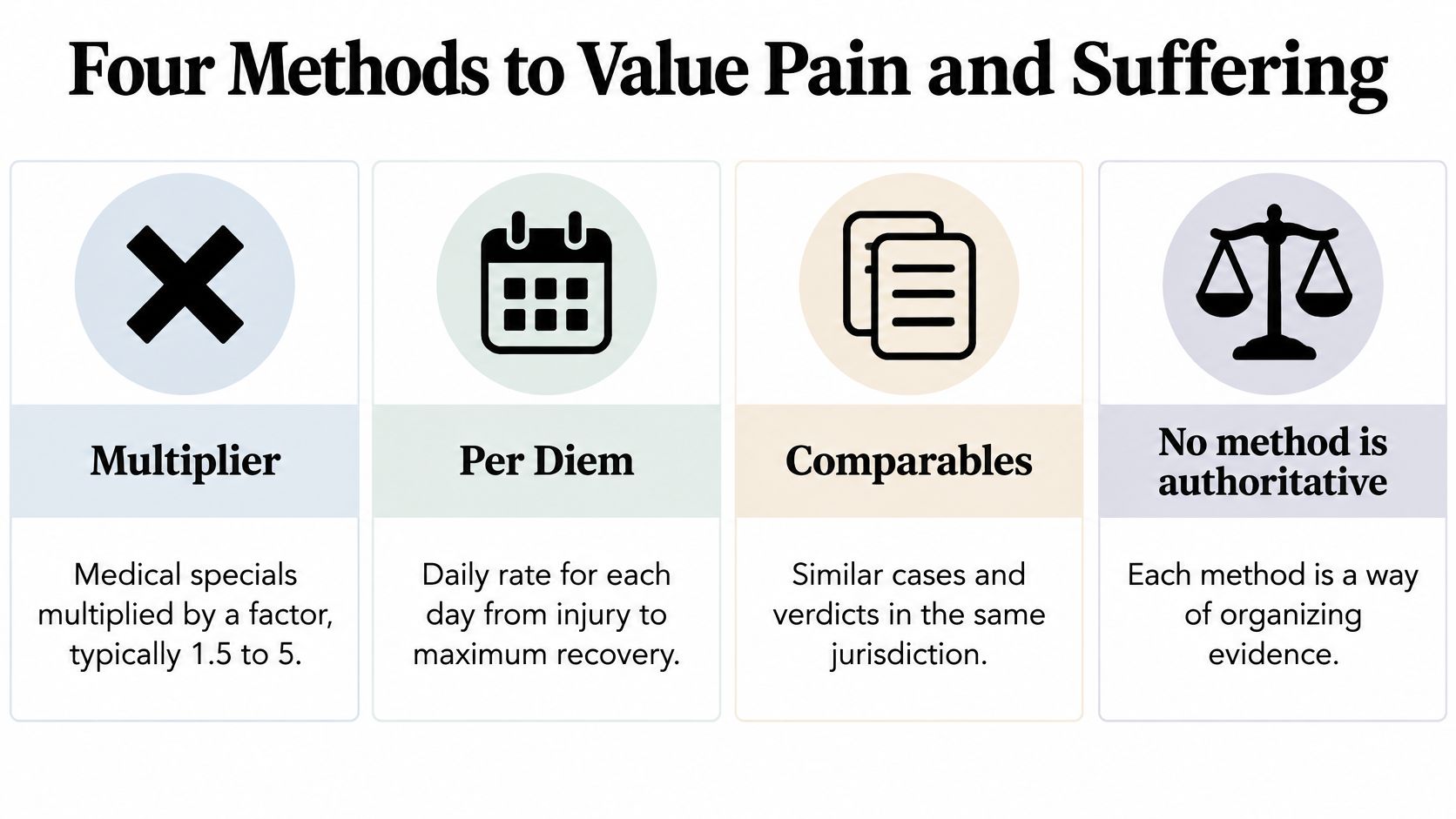
Pain and suffering valuation methods compared
| Method | How It Works | Best Used When | Main Weakness |
|---|---|---|---|
| Multiplier | Medical specials multiplied by a factor, typically 1.5 to 5 as a heuristic | Treatment is clear and specials are well documented | Ignores daily impact; the factor is a convention, not a rule |
| Per diem | A daily rate applied to documented days of suffering | Symptom duration is well recorded in the chronology | The daily rate is arbitrary and often hard to justify |
| Comparable verdicts and settlements | Similar injuries, treatment and venue used as reference points | Published or reliable data exists for the venue and injury type | Facts rarely match exactly; outliers distort the result |
| Narrative valuation | Figure built from severity, duration, functional loss, emotional impact and prognosis | Injury is complex, disputed or hard to reduce to a formula | Depends on persuasive evidence and carries jury variance |
What each method actually does for you
The multiplier is fast. It also smuggles in an assumption that more treatment always means more suffering, which fails for stoic claimants, underinsured claimants who stopped care early, and painful injuries treated conservatively. Use it to ask whether your range is wildly out of line with the specials, not to justify it.
Per diem forces discipline about time. If you claim 180 days of suffering, the chronology should show symptoms, visits, restrictions, or credible testimony across those 180 days. Its weakness is the daily rate. Pick a wage based rate, a modest round number, or any other anchor, and you still have to explain why that rate fits this claimant's day, not claimants in general.
Comparables test venue reality. A number that looks reasonable in the abstract can look reckless against verdicts for similar injuries, treatment, and demographics in the same county. The work is in the matching. Age, surgery, permanence, liability disputes, and policy limits all distort published results, so discard cases that only share a diagnosis label.
Narrative valuation is the slowest and, in disputed cases, the strongest. You build from what happened to this person, in sequence, with provider support. It's also the most exposed to credibility findings. If the claimant's account shifts, the narrative unravels faster than a formula does.
Combining them without stacking errors
Run the methods in sequence, not in parallel pursuit of the highest output.
- Multiplier as sanity check: Does the specials based range overlap with what the facts support?
- Per diem as duration test: Does the documented timeline sustain the period you're claiming?
- Comparables as venue test: Would a local jury recognize this range for this injury profile?
- Narrative as justification: Can you explain the final figure in plain sentences tied to records?
Practical rule: If the four methods converge, you have a range. If they diverge sharply, you have a research problem, not a higher demand.
Any single method can be attacked as arbitrary. Combined methods don't guarantee agreement, but they force you to answer the adjuster's best questions before the demand goes out.
Worked Examples and Illustrative Multiplier Ranges
The multipliers below are heuristics for orientation, not benchmarks, settlement promises, or jury instructions. They help you spot a demand that's disconnected from the record. They don't replace comparable verdicts in your venue, and they collapse when the underlying profile doesn't match your file. For additional context on how fact patterns affect outcomes, see these personal injury settlement examples.
One worked example
Say a claimant sustains a fracture treated surgically, completes three months of therapy, works under a documented return to work restriction, and receives a physician opinion describing residual limitation. Start with the multiplier only as a check against specials. A surgical case will often sit higher in the heuristic range than a nonoperative fracture because the treatment burden and recovery arc are heavier, but that observation alone doesn't set value.
Test duration with per diem. Count the days from injury through documented restriction and therapy, not through the last date pain is mentioned in passing. Then build the narrative around what surgery required, what therapy restored, what work and household tasks remained limited, and what the physician says will persist. If the narrative supports permanence, the range moves up. If follow up notes show a quick, full recovery, it moves down, whatever the initial multiplier suggested.
Illustrative pain and suffering profiles and multiplier heuristics
| Injury Profile | Typical Record Pattern | Heuristic Multiplier | What Moves It Up or Down |
|---|---|---|---|
| Soft tissue, resolved | Conservative care, short course, no imaging findings | About 1.5 to 2x specials | Gaps in care and prior similar complaints push it down |
| Fracture, non-surgical | Immobilization, follow-up imaging, several months of therapy | About 2 to 4x specials | Documented functional limits and return-to-work restrictions push it up |
| Fracture with surgery | Operative notes, rehabilitation, lasting restrictions | About 3 to 5x specials | Permanence and future procedures push it up; quick full recovery pushes it down |
| Permanent impairment | Ongoing care, future surgery opinions, disability documentation | Above 5x specials, often valued with future damages | Reasonable certainty of prognosis is the decisive factor |
How to read the table without misusing it
The record pattern column matters more than the injury label. Two fractures with the same diagnosis can support very different ranges if one claimant returns to unrestricted work and the other can't grip, climb, or stand for a full shift. Prior similar complaints don't destroy a soft tissue claim by themselves, but unexplained gaps plus a prior history give an adjuster a clean causation argument.
Jury outcomes in the same venue can vary widely, especially for mid range cases where pain is real but objective findings are modest. That's why you check every illustrative figure against comparables before you send it. Examples only help when your records match the profile. If they don't, adjust the profile first, not the multiplier.
Legal Standards and Evidence Behind the Number
California gives a clear example of why formulas don't control. Under California's Judicial Council civil jury instruction CACI 3905A, pain and suffering compensation is a fact based noneconomic damages award rather than an amount calculated by a statutory multiplier or fixed schedule, and the fact finder is directed to use judgment, evidence, and common sense when valuing physical pain, mental suffering, and emotional distress.
That instruction changes how you build a demand. You're not totalling bills and applying a factor. You're converting a medical chronology into proof of severity, duration, treatment burden, functional impairment, emotional consequences, and prognosis.
The courtroom image below captures the setting where that proof is ultimately tested if negotiation fails.

Future suffering needs reasonable certainty
For future pain and suffering, the claimant must establish that the future harm is reasonably certain to occur. Speculation about persistent symptoms weakens valuation. Consistent examinations, documented treatment, physician opinions, and credible activity limitations strengthen it.
Don't blur that line. A provider note saying symptoms may continue is not the same as an opinion that a restriction, procedure, or pain pattern is reasonably certain. If you can't get that opinion, value the future component conservatively and explain what is proven now versus what remains contingent.
The instruction also recognizes categories many demands lump together. Noneconomic harm may include bodily integrity loss, disfigurement, disability, impaired enjoyment of life, susceptibility to future injury, and shortened life expectancy. Capture each one separately in your record review when evidence supports it, rather than folding everything into a generic claim of suffering. A fuller discussion of proof techniques appears in this guide on how to prove pain and suffering.
Evidence factors that shift a pain and suffering valuation
| Factor | What to Document | Effect on Value |
|---|---|---|
| Severity | Imaging, surgical notes, objective findings | Raises value when corroborated by providers |
| Duration | Dated visits, symptom logs, gaps and resumptions of care | Longer documented duration raises value; unexplained gaps lower it |
| Treatment burden | Injections, therapy sessions, medications, procedures | Heavier burden supports a higher figure |
| Functional impairment | Dated examples of work, household and activity limits | Specific examples are persuasive; generic claims are discounted |
| Emotional impact | Treating-provider notes, counseling records, witness accounts | Supports mental suffering component when consistent with medical records |
| Prognosis | Physician opinion on permanence, future procedures, restrictions | Supports future pain and suffering only when reasonably certain |
Turning records into evidence
Severity needs objective anchors where they exist. Imaging, operative findings, range of motion measurements, and neurological signs don't measure pain directly, but they corroborate that reported pain fits the injury mechanism.
Duration is where files lose value. A three month gap with no explanation reads as recovery. A gap explained by insurance authorization delays, a provider referral wait, or a documented home program reads differently. Flag the explanation in the chronology, don't hope the adjuster infers it.
Functional impairment needs dates and specifics. Could not work is weak. Missed a warehouse shift on specific dates, needed help dressing for six weeks, and stopped coaching a child's team mid season is evidence a mediator can repeat in the other room.
Emotional impact carries weight when it's consistent across sources. Counseling records, treating provider notes about sleep or anxiety, and witness accounts that match the timeline support each other. A dramatic claim that appears only in the demand letter does not.
Build the file as if the person valuing it has never met your client and trusts paper more than advocacy. That is usually true.
California's approach isn't a universal standard. Other jurisdictions use different instructions, caps, and evidentiary rules. Check your governing law before you import any figure, method, or future damages assumption from another venue.
Build, Test and Confirm the Demand Range
A defensible range comes from a repeatable routine. The steps below keep valuation judgment separate from record assembly, so you can see where the number is strong and where it's exposed before an adjuster does.
The process flow below outlines the build, test, and confirm sequence.
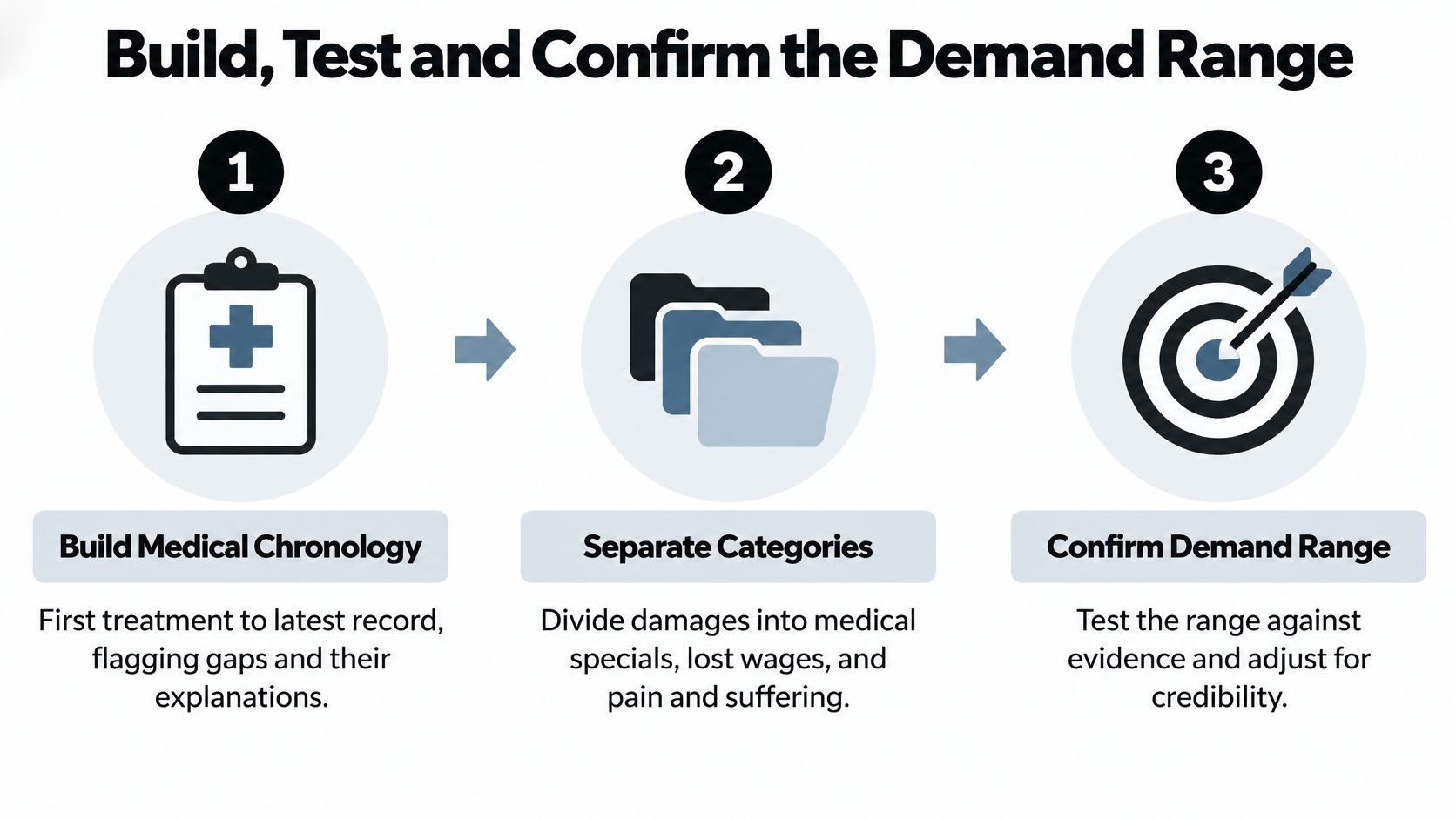
The seven step routine
Build the medical chronology. Start at first treatment and end at the latest record. Flag every gap, missed appointment, and resumption of care, then write the explanation next to it while the file is still open. This step exists because duration arguments fail on unexplained silence.
Separate the categories of harm. Divide the claim into pain, mental suffering, disability, disfigurement, and loss of enjoyment. Assign each category its own supporting records. Some categories will be empty. Leave them out rather than padding them.
Run the multiplier as a sanity check. Apply it to verified specials and note the resulting range in your work product. Don't put the calculation in the demand as if it were authority. You're checking scale, not proving value.
Test duration with per diem. Use it only where the chronology supports the number of days. If symptoms were severe for eight weeks and intermittent after that, don't price a full year at the acute phase rate. Tier the period or shorten it.
Pull comparables from the same venue and injury type. Match on treatment, surgery, permanence, and liability posture as closely as the data allows. Discard outliers in both directions and note why. A range built on three discarded outliers is worse than a range built on fewer, closer cases.
Check future damages against reasonable certainty. Identify projected symptom duration, expected permanence, anticipated procedures, functional restrictions, and the medical support for each. Then handle the dollars correctly. Under the Judicial Council of California Civil Jury Instructions, for future noneconomic damages in California the jury is instructed to award an amount stated in current dollars and not apply an additional present value discount. Future economic losses may require an explicit present value calculation when supported by evidence, but future noneconomic damages are already framed as today's dollar compensation. A model that automatically discounts every future category understates the noneconomic component and creates an inconsistent position. Present future suffering as a current dollar valuation, not an inflated nominal stream.
Set a range, not a single figure. Justify the high end with your strongest evidence and the low end with the facts you expect the other side to emphasize. A single figure invites a binary fight. A reasoned range gives you room to move without abandoning your logic.
The pre-send confirmation
Before anything goes out, confirm three things in writing. First, governing law, including any caps, instructions, or present value rules that differ from your assumptions. Second, record support for every component, with a citation to a page, visit, or opinion. Third, the reason for each anchor in the range, so a partner, mediator, or client can see why the numbers sit where they do.
Opening anchors can move results. Arbitrary anchors damage credibility, especially when the chronology doesn't sustain them. I would rather open high on well documented severity and duration than open higher on a multiplier I can't explain in mediation.
This is also where drafting support matters without replacing judgment. Ares builds Demand Letters from the customer's medical evidence and case records and includes causation narratives, special damages and liability arguments cited to source, and produces settlement demands and hearing briefs that include treatment narratives, medical specials, and impairment documentation. Goody Law Group saves 15 to 20 hours per case with Ares. Use that saved time on the valuation calls only a lawyer should make.
Your next step is concrete. Draft the chronology, run the four tests, confirm the law and record support, then send the demand.
Negotiation Tactics and Credibility Factors
A demand letter is a persuasion document, not a spreadsheet with a signature block. The number matters, but the reader's belief in the number matters more. The image below reflects the scrutiny every demand figure receives once it leaves your office.
Three tactics that hold up
Anchor with a defensible high figure tied to the chronology. Open where your best evidence, read favorably, can take you. Don't open where only your multiplier can take you. The first number frames the negotiation, but only a traceable number survives the first counter.
Hold the range with documented reasons. When an adjuster counters low, don't just split the difference. Respond by category. Point to the surgical record for severity, the dated restrictions for functional loss, and the prognosis opinion for future harm. Each concession should trade for something and cite a reason.
Use mediation to test jury risk. A good mediator tells you how a neutral listener hears credibility problems, gap arguments, and prognosis disputes. Treat that feedback as valuation data, not as pressure to settle. For a broader negotiation framework, see this guide on how to negotiate a personal injury settlement.
The video below offers additional context on presenting a demand under scrutiny.
The credibility factor most guides skip
Credibility isn't neutral, and pretending it is leaves money and fairness on the table. In a 2025 experimental study of 831 participants, participants perceived White victims with the same head injury as experiencing more pain than comparable Black victims, and Black male victims received damages at least $12,386 lower on average than White men.
An experiment isn't a direct measure of every negotiated claim. Don't overstate it. It does give you a concrete reason to examine how race and gender cues, claimant demeanor, communication style, employment history, and disability stereotypes may affect demand evaluation, mediation, and jury risk in your own cases.
Apply controls that reduce subjectivity without manufacturing evidence.
- Standardized symptom chronologies: Use the same structure for every claimant, so completeness doesn't track who tells the most polished story.
- Dated functional examples: Replace general claims of limitation with specific, dated tasks the claimant couldn't perform.
- Consistent provider narratives: Ask treating providers to address severity, restrictions, and prognosis in comparable terms across cases.
- Claimant testimony in the claimant's own words: Preserve voice and detail instead of translating every account into firm boilerplate.
- Periodic valuation audits: Compare demand ranges and outcomes across comparable cases and investigate unexplained differences.
Averages also don't travel across borders. Compensation structures divide awards differently among earnings loss, care, and noneconomic damages depending on the legal system. A figure that represents mostly pain and suffering in one country may represent mostly care costs in another, so don't import foreign settlement averages into a domestic demand.
Credibility work isn't cosmetic. It's how you make identical suffering harder to value unequally, and how you keep your own range honest when the other side tests it.
If your team is spending its best hours assembling chronologies instead of exercising valuation judgment, Ares can draft settlement demands from your medical evidence and case records with causation narratives, special damages, and impairment documentation cited to source. Visit Ares to see how a cleaner record, built faster, strengthens your next pain and suffering negotiation.