
In the world of personal injury law, the statute of limitations is the absolute, unyielding deadline to file a lawsuit. Miss it, and the courthouse doors slam shut on your client's case forever—no matter how strong the evidence or how severe the injury.
Understanding The Critical Personal Injury Deadline
Think of the statute of limitations as a countdown clock that starts the moment an injury happens. Once that clock hits zero, the legal right to sue is extinguished. It’s a harsh rule, but one the courts enforce without exception.
This isn’t just some obscure procedural rule. The entire system is built on the idea that claims should be brought forward while evidence is still available and memories are fresh. For a busy personal injury firm, this creates a constant, high-stakes pressure to track every single date with perfect accuracy.
The Game Clock Analogy
It’s like the final seconds of a championship game. Your team is down by one with the ball in hand. If you don't get the shot off before that final buzzer, you lose. It makes no difference how well-designed the play was or that your star player was wide open. The game is over.
That's the statute of limitations. It’s the final buzzer on your client's claim. Missing that deadline is one of the most clear-cut and devastating forms of legal malpractice, instantly nullifying an otherwise winnable case.
The core principle is straightforward: time is a critical element of every personal injury claim. Failing to respect the statutory deadline means a potentially valid case becomes worthless overnight, underscoring the high stakes involved in managing these dates.
Why This Deadline Matters for Law Firms
For any law firm, getting the statute of limitations right goes far beyond just avoiding malpractice claims. It's a fundamental operational responsibility that defines your firm's reliability and reputation. A solid grasp of this concept starts with understanding the basic principles of statutory interpretation and how they apply in the real world.
Managing these deadlines effectively requires a few non-negotiable skills:
- Accurate Date Extraction: You have to be able to pull the precise date of injury or discovery from dense documents like police reports and medical charts.
- Jurisdictional Awareness: You must know the specific statute of limitations for the state where the incident took place, because they can vary dramatically.
- Exception Identification: It's crucial to spot any facts that could pause—or "toll"—the clock, like when the victim is a minor.
This entire process is a foundational piece of the broader personal injury settlement timeline. Getting it right isn’t just good practice; it's essential for protecting your clients, your firm, and your professional integrity.
When Does The Statute of Limitations Clock Start Ticking?

Pinpointing the exact moment the statute of limitations begins is one of the most consequential tasks in any personal injury claim. For many cases, the starting line is straightforward.
If you’re dealing with a car wreck or a slip-and-fall, the clock typically starts running on the day the incident happened. The harm is immediate and obvious, so there's little room for debate about when the injury occurred.
But what happens when the injury isn't so obvious? The legal system has an answer for situations where the damage is hidden and a victim doesn't realize they've been harmed for weeks, months, or even years. This is where a crucial legal principle comes into play to ensure fairness.
The Discovery Rule Explained
The Discovery Rule is a vital exception to the standard start-date calculation for the statute of limitations in personal injury cases. Think of it as a legal safeguard that pauses the countdown clock until the date the injury was actually discovered—or reasonably should have been discovered.
This rule is designed for those complex situations where a reasonable person wouldn't have known about their injury right away. It prevents the unjust scenario where a deadline expires before the victim even knows they have a claim.
The pressure to get this right is immense. With fairly standard 2-3 year statutes for personal injury across major U.S. markets, there's no room for error. Firms are already managing 400,000 annual filings, and with federal product liability cases surging by 78% by March 2024, the Discovery Rule becomes an even more critical detail to manage.
Real-World Example of The Discovery Rule
To see how this works in practice, let’s walk through a classic medical malpractice scenario.
Imagine a patient has complex abdominal surgery in January 2023. They follow all the doctor's orders and seem to recover, but over the next three years, they suffer from chronic, unexplained pain that stumps their physicians.
Finally, in February 2026, new imaging scans reveal the culprit: a small surgical sponge was accidentally left inside their body during that 2023 operation.
Under the Discovery Rule, the statute of limitations clock would likely start ticking in February 2026—the date the injury was discovered—not back in January 2023 when the surgical error actually occurred. This gives the patient a fair chance to pursue justice.
Why The Discovery Rule Is So Important
This legal doctrine is absolutely essential in several types of personal injury cases where the harm isn't immediately obvious.
- Medical Malpractice: Just like in our example, retained surgical objects, misdiagnoses, or improper treatments might not cause noticeable harm until much later.
- Toxic Torts: Exposure to harmful substances like asbestos or contaminated water can lead to diseases that take decades to develop.
- Defective Products: A faulty medical implant or a slow-acting pharmaceutical drug might not reveal its dangerous side effects for years.
In these cases, meticulously documenting the timeline of symptoms and diagnoses is everything. Building a detailed https://areslegal.ai/blog/chronological-medical-record is non-negotiable for establishing when the injury was truly "discovered" and successfully arguing for a later start date. This careful work can make or break a case that depends on the Discovery Rule.
Pausing The Clock With Tolling And Other Exceptions
While statutes of limitations seem like a hard and fast rule, the law has built-in flexibility for certain situations. Think of it as a legal timeout. In some cases, the countdown clock can be legally paused, or "tolled," giving an injured person more time to act.
This isn't about finding loopholes. Tolling exists to ensure fairness when circumstances prevent someone from filing a claim or when a defendant’s behavior makes a fair lawsuit impossible. It’s a critical safeguard, and understanding when and how it applies can mean the difference between a valid claim and a lost opportunity.
Common Reasons for Hitting The Pause Button
So, what kind of situations warrant a timeout on the legal clock? While the specifics differ from state to state, courts generally agree on a few common scenarios where tolling the statute of limitations in personal injury cases is necessary.
Here are three of the most widely recognized reasons to pause the deadline:
- The Plaintiff Is a Minor: The legal system recognizes that a child can't file a lawsuit on their own. For that reason, the clock is usually paused until the minor turns 18. Imagine a 10-year-old is injured in a state with a two-year deadline. The clock won't start ticking on their 18th birthday, meaning they have until their 20th birthday to file a claim.
- The Plaintiff Lacks Mental Capacity: If an injury is so severe that it leaves the victim mentally incapacitated—say, in a coma or with a traumatic brain injury—they obviously can't manage their legal affairs. The statute of limitations will typically be tolled until they regain their competency. This prevents a person's inability to act from costing them their right to justice.
- The Defendant Is Hiding or Deceptive: The clock can also be stopped if a defendant actively tries to evade a lawsuit. This could mean fleeing the state to avoid being served with legal papers or using fraud to hide their identity or involvement in the incident. The law won't let a defendant benefit from trying to run out the clock.
How External Events Can Alter Timelines
It’s not just individual circumstances that can change the timeline. Sometimes, major external events can trigger widespread tolling across the entire legal system. We all saw a perfect example of this during the COVID-19 pandemic.
When a public crisis hits, courts often issue sweeping orders that toll statutes of limitations for all civil cases. It’s a necessary move when access to the legal system itself is disrupted for everyone.
New York's response is a great case study. The state government issued an executive order that effectively paused most legal deadlines from March 20, 2020, to November 3, 2020. This added a total of 228 days to the statute of limitations for any personal injury claims that were live during that period.
But this historical pause also had a definitive end. By November 2023, the standard three-year deadlines affected by this extension had expired, barring any claims that weren't filed in time. You can read a more detailed breakdown of this tolling order and its impact on personal injury cases on BestLawyers.com.
This example is a powerful reminder of how dramatically outside forces can shift case timelines. For any law firm, it underscores why you can't just track standard deadlines. You also have to stay on top of judicial and legislative orders that create these kinds of exceptions. A miscalculation here could be catastrophic.
Navigating Critical State-By-State Filing Deadlines
One of the biggest traps in personal injury law is assuming there’s a single, nationwide deadline for filing a claim. There isn't. Instead, every state sets its own rules, creating a complex patchwork of statutes that can easily ensnare even the most careful law firms, especially those managing cases across multiple jurisdictions.
This isn't just a minor legal detail; it's a major operational risk. A three-year filing window in one state might be just one year in the state next door. Getting that wrong isn't a simple mistake—it's a case-ending error that torpedoes a client's right to recovery and opens your firm up to a malpractice claim.
For this reason, mastering these state-specific nuances is a non-negotiable part of the job. It demands a rigorous, location-based approach to every new file that comes in the door.
A Comparative Look at Key States
To see just how much these deadlines can vary, a quick comparison of a few key states is all it takes. The differences are stark and make it crystal clear why a "one-size-fits-all" approach to calendaring is doomed from the start.
A firm handling a car accident claim in Florida is working against a completely different clock than one managing a similar case in New York. The same goes for claims involving medical malpractice or defective products, where the timelines can get even more complicated.
Personal Injury Statute of Limitations Across Key States
A comparative look at the standard filing deadlines for common personal injury claims across different U.S. states, illustrating the critical need for jurisdiction-specific knowledge.
| State | General Negligence/Personal Injury | Medical Malpractice | Product Liability |
|---|---|---|---|
| California | 2 Years | 1 Year from discovery (3 years max from injury date) | 2 Years |
| Texas | 2 Years | 2 Years from the date of the act or treatment | 2 Years |
| Florida | 2 Years (effective 3/24/23) | 2 Years from discovery (4 years max from incident) | 2 Years (effective 3/24/23) |
| New York | 3 Years | 2.5 Years (30 months) | 3 Years |
Disclaimer: These are general deadlines and can be affected by various exceptions and specific case details. Always consult with a legal professional for guidance on your specific situation.
As the table shows, a firm accustomed to New York's three-year window would be a full year too late filing a standard negligence claim in Texas. This is exactly the type of catastrophic error that solid case management and deadline-aware systems are built to prevent. The fate of a case often boils down to knowing which column in this table applies—and when the clock started ticking.
Why State-Specific Knowledge is Everything
These variations aren't arbitrary. They're the product of each state's unique legislative priorities and judicial history. For any personal injury practice, this means jurisdictional expertise isn't just a bonus—it's the bedrock of competent representation.
The bottom line is simple: you can't assume anything. The statute of limitations for the exact same injury can be 50% shorter just one state over. Every new case demands a fresh, location-specific deadline verification.
And it gets more complicated. The rules for tolling—or pausing—the statute of limitations also differ from state to state.
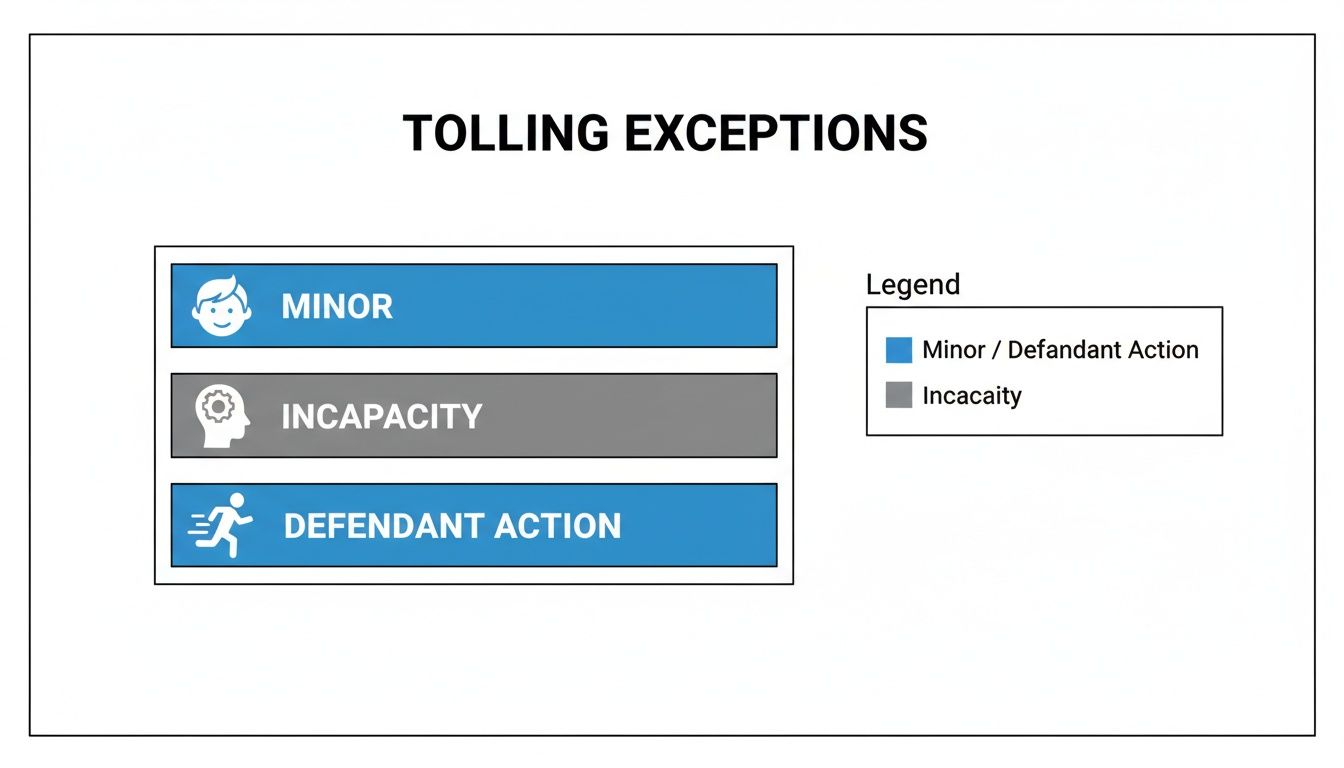
Whether it’s for a minor, someone who is mentally incapacitated, or a defendant who actively concealed their wrongdoing, the rules that pause the clock add yet another layer of complexity to the calculation.
Successfully managing a modern personal injury caseload requires more than just knowing the law in general. It demands a meticulous, state-by-state system for tracking dates and a deep understanding of the specific rules governing every single claim. Without that level of precision, you're just navigating a minefield blindfolded.
How Modern Law Firms Master Deadline Management
Manually tracking the statute of limitations for personal injury claims across a busy caseload is a high-wire act. It’s a system built on a fragile chain of human touchpoints—a paralegal digging through a police report, a legal assistant entering a date, an attorney double-checking a calendar. One slip, and the entire case can collapse into a malpractice claim.
This old way of doing things isn't just risky; it's a massive time sink. Think of the hours burned hunting for a single date of injury, verifying the right deadline for that jurisdiction, and then manually plugging reminders into a calendar. That administrative drag pulls your best people away from what they should be doing: building case strategy, talking to clients, and negotiating settlements.
Thankfully, the era of spreadsheets and sticky notes is drawing to a close. Forward-thinking firms are moving away from this reactive, manual model and embracing a more proactive, technology-first approach. It’s a shift that turns a firm’s biggest liability into a real competitive advantage.
The Power Of Automated Date Extraction
At the core of this shift is automation. Imagine being able to pull every critical date from a 500-page medical file or a messy accident report in an instant. That’s exactly what today’s AI-powered platforms are built to do.
Instead of a paralegal dedicating an afternoon to reading dense documents, these systems use smart algorithms to scan and pinpoint key information in seconds. This isn’t science fiction; it’s practical tech that can pull:
- The exact date of the incident from a police report.
- The date of injury discovery mentioned in a doctor's consultation notes.
- Timelines of medical treatment and diagnoses that are crucial for the discovery rule.
By automating this first, foundational step, firms sidestep the single biggest source of error: manual data entry. The system doesn't get tired, it doesn't get distracted, and it won't misread a "3" as an "8." You get a reliable, verified starting point for every case, every single time.
Reclaiming Billable Hours And Reducing Risk
The business impact here is huge. When you free your legal team from the tedium of hunting for dates, they can pour that energy back into work that actually moves the needle on a case. This isn't just a small efficiency boost; it fundamentally changes your firm’s capacity.
For instance, some platforms can wipe out 10+ hours of manual medical records review per case. This allows a firm to find and organize key dates—like the date of injury discovery—in minutes, which is a lifesaver when you're up against a tight deadline.
By automating deadline management, law firms don't just reduce the risk of malpractice; they unlock hundreds of hours of high-level legal talent that can be reinvested into building stronger, more valuable cases for their clients.
This reclaimed time lets attorneys dig deeper into evidence, write more persuasive demand letters, and get into more strategic negotiations. It transforms an administrative headache into a force multiplier for the entire practice. To stay ahead, many firms are now turning to sophisticated tools like AI intake for personal injury law firms.
Building A System For Flawless Execution
Of course, technology is only one piece of the puzzle. The most successful firms build these tools into a larger, smarter workflow designed for total accuracy and accountability. It's about using software not just to find dates, but to manage the entire lifecycle of a case deadline.
A modern, tech-driven workflow for deadline management looks something like this:
- Automated Intake and Data Extraction: New case files get uploaded, and AI immediately scans them, flagging every relevant date.
- Centralized Deadline Dashboard: The system then calculates and displays all upcoming statutes of limitations on a single, clean dashboard, often sorted by what’s most urgent.
- Redundant Alerts and Notifications: Automated reminders are sent to multiple team members at preset intervals—say, 90, 60, and 30 days out—so nothing ever slips through the cracks.
- Jurisdiction-Specific Rule Application: The software knows the rules and automatically applies the correct state-specific statute of limitations, whether it's for negligence, malpractice, or another claim type.
By putting a system like this in place, firms create a reliable, repeatable process that protects both their clients and their reputation. You can learn more about how technology fits into the bigger picture by exploring our guide on personal injury case management software. This approach isn't just about preventing mistakes; it’s about building a culture of precision that allows a firm to grow with confidence, knowing its most critical deadlines are locked down.
Answering Common Questions About Personal Injury Deadlines
Even after you get the hang of the basic concepts, statutes of limitations can still throw some curveballs. Understanding the rules is one thing; knowing how they play out in the real world is another. Let’s tackle some of the most persistent, high-stakes questions that legal professionals run into.
Think of this as a field guide to navigating the tricky terrain of personal injury deadlines. Getting these right protects your client, your case, and your firm.
What Happens If We Miss The Statute Of Limitations For A Client?
Missing the statute of limitations is about as catastrophic an error as you can make in personal injury law. The outcome is almost always the same: the client's case gets permanently dismissed.
It doesn't matter how severe the injury was or how much evidence you have piled up against the defendant. Once that deadline passes, the claim is legally dead. The court no longer has the authority to hear the case, and your client's right to compensation is gone for good.
This isn't just a lost case; it's often the grounds for a legal malpractice claim against the attorney or firm responsible. While there might be a few incredibly narrow, hard-to-prove exceptions, you never want to be in a position where you have to rely on them. The only safe bet is meticulous, proactive deadline tracking from day one.
Does The Deadline Apply To Insurance Settlement Talks?
Yes, absolutely. This is a point that is so critical and, unfortunately, so often misunderstood. The statute of limitations technically sets the deadline for filing a lawsuit, but it’s also the source of all your leverage in settlement talks.
Insurance adjusters have these dates circled in red on their calendars. As long as you have the power to take their client to court, they have a very real incentive to negotiate in good faith and make a fair offer. They want to avoid the time, expense, and uncertainty of a trial.
But the moment the statute of limitations expires, all your negotiating power vanishes. The threat of a lawsuit is off the table, and the insurance company has zero legal or financial reason to make a good offer—or any offer at all.
This is why it's a standard and non-negotiable best practice to file the lawsuit before the deadline runs out, even if settlement talks seem to be going well. Filing preserves your client’s rights and keeps you negotiating from a position of strength.
How Do Deadlines Work For Injuries To Minors?
Cases involving children have a special rule called tolling. For a minor, the **statute of limitations is typically "tolled"—or paused—**until the child turns 18, the age of majority in most states.
This legal principle makes perfect sense. It recognizes that children can't file lawsuits for themselves, and it protects their right to seek justice once they're old enough to do so. Essentially, the clock doesn't start ticking until their 18th birthday.
- Here's an example: Imagine a 12-year-old is hurt in a car crash. The state has a two-year statute of limitations for this type of injury.
- How tolling works: That two-year clock doesn't start on the day of the accident. Instead, it starts ticking on the day the child turns 18.
- The final deadline: This means the individual generally has until their 20th birthday to file a lawsuit for the injuries they suffered as a child.
This vital exception ensures a young person's right to legal action isn't forfeited simply because of their age when the injury occurred.
Does Sending A Demand Letter Pause The Clock?
No. This is another common and dangerous misconception. Pre-litigation work, no matter how formal or official it seems, has zero effect on the statutory deadline.
Let's be crystal clear about what does not stop the clock:
- Sending a comprehensive demand letter to the at-fault party.
- Filing a claim directly with an insurance carrier.
- Providing a notice of intent to sue.
- Participating in settlement talks or mediation.
These are all crucial parts of building a case, but they are no substitute for filing a lawsuit. The only action that officially stops the clock is filing a formal complaint or petition with the proper court before the deadline expires. Never assume that good-faith negotiations with an adjuster will protect your client's claim from the statute of limitations. It’s a mistake that can cost you everything.
At Ares, we know that mastering these deadlines is the bedrock of a successful personal injury practice. Our AI-powered platform automates the extraction of key dates from medical records and other case documents, transforming a high-risk manual chore into a quick, reliable workflow. By flagging critical timelines right from the start, Ares helps your firm eliminate malpractice risks so you can focus on what you do best: winning for your clients. See how you can reclaim hours and secure every deadline at https://areslegal.ai.