To effectively summarize a mountain of medical records, you need to do more than just list dates. The real goal is to transform a chaotic jumble of files into a clear, chronological narrative. This story needs to highlight every key diagnosis, treatment, and the real-world impact on your client's life, forming the backbone of your demand letter and negotiation strategy.
A truly well-crafted summary is one of the most powerful tools a personal injury firm has for maximizing settlement values.
Why Better Medical Summaries Win Bigger Settlements
We’ve all seen it: a paralegal, drowning in a disorganized stack of medical records, staring down a demand letter deadline. This isn't just a stressful moment; it's a critical juncture where case values are won or lost. Learning how to properly summarize medical records isn't just an administrative chore—it's a competitive advantage for any PI firm.
A sharp, well-organized summary cuts through dense medical jargon and scattered chart entries to build a powerful, persuasive narrative. It tells the story of your client's suffering, their long treatment journey, and the difficult road to recovery. This summary becomes the unshakable foundation for your demand letter, giving you a much stronger negotiating position and stopping insurance adjusters from trying to downplay the severity of the injuries. When you can draw a clean, undeniable line from the initial incident to every single medical intervention that followed, you leave very little room for argument.
The Modern Challenge of Digital Records
The sheer volume of medical documentation is becoming a serious problem. The global market for electronic health records (EHR) was valued at a staggering USD 33.43 billion in 2024 and is on track to hit USD 43.36 billion by 2030. For law firms, this explosion means sifting through thousands of pages of digital records for a single case. Learn more about the EHR market's growth and its impact on the legal field. Manual review is quickly becoming a thing of the past.
This guide isn't about the basics you already know. We're going to lay out a modern, efficient workflow designed to handle the challenges of massive EHRs. The focus is on building a process that saves countless hours, uncovers critical details you might otherwise miss, and ultimately drives better outcomes for your clients.
From Administrative Burden to Strategic Asset
The key is to shift your perspective. A medical summary isn't just another box to check on a case file; it's a strategic document that can dramatically influence the final settlement. By investing time in creating a better summarization process, your firm can unlock some major benefits:
- Faster Case Timelines: You can quickly pinpoint the core facts you need to draft demand letters, pushing cases toward settlement much sooner.
- Stronger Negotiating Power: When you present a clear, evidence-backed story of damages, it becomes incredibly difficult for adjusters to contest the facts.
- Improved Firm Efficiency: This frees up your paralegals and attorneys from tedious administrative work, allowing them to focus on high-level strategy and client interaction.
- Better Client Outcomes: By building a stronger case right from the start, you put your clients in the best possible position to receive the full compensation they deserve.
A great medical summary does more than just organize facts—it tells a story. It translates the clinical, often sterile, language of medicine into a human narrative of pain, persistence, and the true cost of an injury.
Ultimately, refining how your firm handles medical records is a direct investment in your success. It helps you manage a larger caseload more effectively, build stronger legal arguments, and consistently secure better results for the clients who are counting on you. The following sections will give you a practical framework to do just that.
Building Your Proven Workflow to Summarize Medical Records
Crafting a powerful medical summary isn't an art form; it’s a science built on a solid, repeatable system. A haphazard approach inevitably leads to inconsistent reports, missed details, and countless wasted hours. The key to winning bigger settlements faster is a battle-tested workflow your entire team can follow for every single case.
Forget disorganized notes and last-minute scrambles to piece everything together. A structured process ensures every summary is comprehensive, accurate, and strategically sound. It turns the administrative chore of record review into a core pillar of your case-building strategy, giving your firm a real advantage.
The goal is to transform a tangled mess of documents into a clean, valuable asset that drives case value from day one.
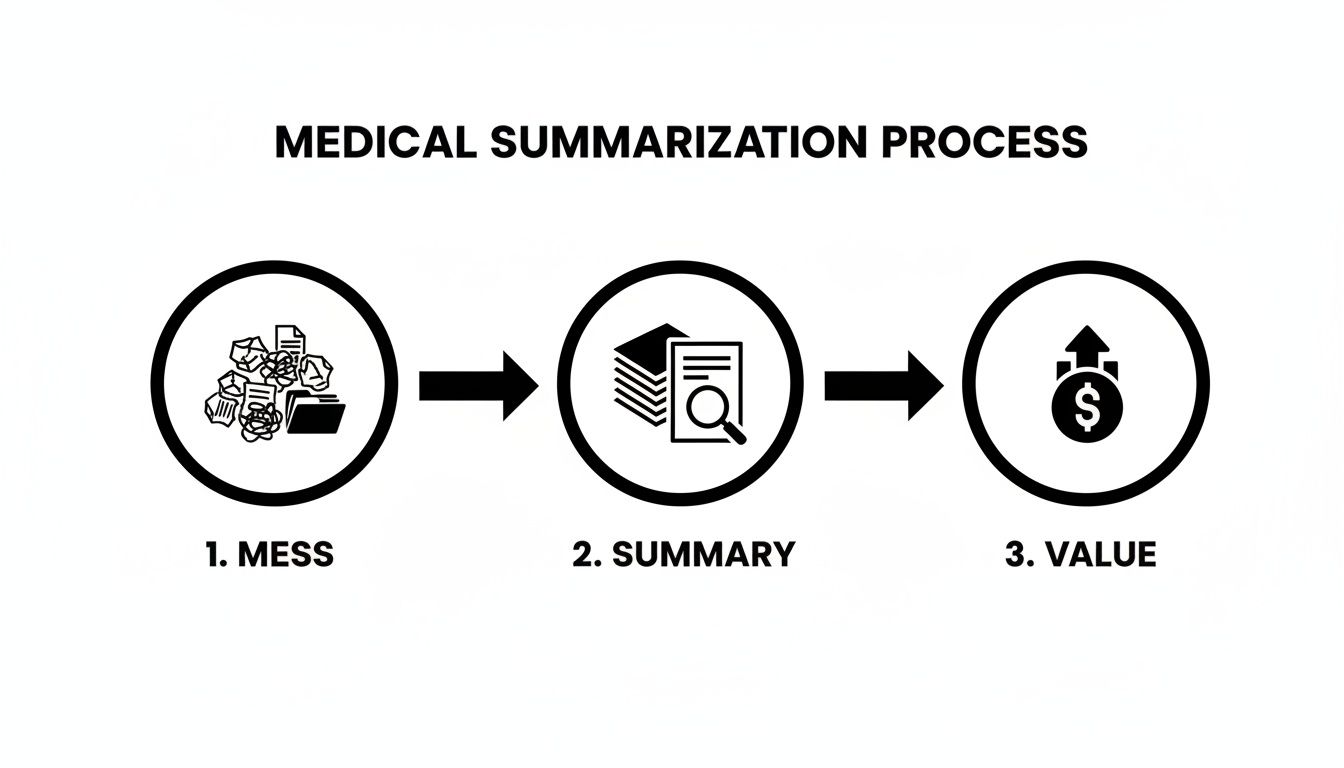
This simple flow highlights a critical point: the value of a case is directly tied to your ability to bring order and clarity to the chaos of medical documentation.
The Foundation: Document Intake and Organization
Your workflow kicks off the moment records start rolling in. For a typical PI case, you might get documents from an emergency room, multiple specialists, a primary care physician, and physical therapy clinics. Each provider uses their own format, making that initial organization a major hurdle.
First things first, establish a consistent naming convention for every file. This simple discipline prevents a world of confusion later and makes retrieval effortless. A file name like ClientName_ProviderName_DateOfService is infinitely more useful than a generic Scan_12345.pdf. You can find more practical tips in our detailed guide on how to organize medical records.
Once named, the next task is sorting. A common best practice is to arrange documents chronologically by date of service, regardless of who the provider is. This simple act immediately begins to build a preliminary timeline of your client's care journey.
Strategic Data Extraction: The Core of the Summary
With organized records in hand, the real work begins: extraction. This isn't about mindlessly copying every word. It's about surgically pulling out the specific facts that matter in a personal injury claim. You're isolating the data points that prove causation, document damages, and tell a compelling story.
Your extraction checklist should always include these essential elements:
- Dates of Service: Every single encounter, from the initial ER visit to the final follow-up.
- Diagnoses and ICD Codes: The official medical conclusions, like "Cervicalgia (M54.2)" or "Lumbar Disc Herniation with Radiculopathy (M51.16)."
- Treatment Types: Specific interventions, including medications prescribed, surgical procedures, physical therapy modalities, and injections.
- Providers and Facilities: A clear record of every doctor, specialist, and hospital involved in the client's care.
- Billing Costs: The total charges for each visit and treatment, which forms the basis of your economic damages.
Think of yourself as a detective. Each piece of extracted data is a clue. When you assemble them correctly, these clues create an undeniable picture of the client's experience.
Constructing a Powerful Chronology
After pulling the raw data, it's time to weave it into a narrative. A medical chronology is the backbone of your summary. It tells the story of the injury and recovery in a clear, linear fashion that anyone—an adjuster, opposing counsel, or a mediator—can understand instantly.
Start with the date of the incident and move forward. For each entry, include the date, provider, and a concise description of what happened.
Real-World Scenario: Car Accident
Imagine your client, Jane Doe, was in a rear-end collision. Her chronology might start like this:
- 01/15/2024 (Date of Accident): Jane Doe's vehicle was struck from behind. She experienced immediate neck and lower back pain.
- 01/15/2024 (Mercy Hospital ER): Diagnosed with cervical strain and lumbar sprain. Prescribed muscle relaxers and advised to follow up with her primary care physician.
- 01/22/2024 (Dr. Smith, PCP): Reports persistent neck pain with radiation into her right arm. Dr. Smith orders an MRI and refers her to an orthopedic specialist.
This format transforms a stack of records into a compelling story of cause and effect. It makes the connection between the accident and the subsequent medical treatment impossible to ignore.
A great chronology doesn't just list events; it builds momentum. It shows a clear progression from injury to diagnosis to treatment, demonstrating the continuous nature of the client's suffering and their efforts to recover.
This narrative structure is far more persuasive than a simple list of providers or diagnoses. It guides the reader through the client's journey, making the damages feel real and justifiable.
Red-Flag Analysis: Spotting Weaknesses Before the Defense Does
The final, and most crucial, step in your workflow is to analyze the summary for potential weaknesses. The defense will scrutinize these records, looking for anything that could diminish the claim's value. Your job is to find those issues first.
Look specifically for these common red flags:
- Gaps in Treatment: Unexplained breaks in care are a favorite target for adjusters. A month-long gap in physical therapy could be framed as the client feeling better, even if the real reason was a scheduling conflict.
- Pre-existing Conditions: Identify any mention of prior injuries to the same body parts. You must be prepared to argue that the accident aggravated a pre-existing condition, which is still compensable.
- Inconsistent Complaints: Note if the client's reported symptoms change or disappear between visits. Consistency is key to demonstrating the injury's true impact.
- Patient Non-Compliance: Did the client miss appointments or fail to follow medical advice? You need to understand the context and be ready to explain it.
By proactively identifying these red flags, you can prepare your counterarguments and strengthen the case before ever sending a demand. This strategic review is what separates an average settlement from an exceptional one.
Manual vs. AI-Powered Record Summarization: A Time and Accuracy Comparison
To see the real-world impact of a modern workflow, let’s compare the old-school manual approach with an AI-driven one. The table below breaks down the time and risks involved in a typical personal injury case.
| Task | Manual Workflow (Estimated Time & Risks) | AI-Powered Workflow (Estimated Time & Benefits) |
|---|---|---|
| Document Organization | 2–4 hours. Risk of misfiling or inconsistent naming. Tedious and prone to human error. | 15–30 minutes. Automated sorting, naming, and indexing. Guarantees consistency and fast retrieval. |
| Data Extraction & Chronology Building | 10–20+ hours. High risk of missing key details or transcription errors. Extremely time-consuming. | 1–2 hours. Comprehensive, automated extraction of key facts. Generates an instant, accurate chronology. |
| Red-Flag Identification | 3–5 hours. Relies entirely on the reviewer's experience and attention to detail. Easy to overlook subtle issues. | Under 1 hour. AI actively flags gaps in care, pre-existing conditions, and inconsistencies. Provides a strategic head start. |
| Total Time Investment | 15–29 hours per case | 2–4 hours per case |
The numbers speak for themselves. While a manual process can eventually get you there, it consumes a massive amount of billable time and introduces significant risk. An AI tool like Ares handles the heavy lifting of extraction and chronology-building, freeing up your team to focus their valuable time on high-level strategic analysis—the work that actually wins cases.
Uncovering the Narrative That Defines the Claim
A simple list of dates and diagnoses won't win a personal injury case. The real leverage is found in the narrative gold buried within those stacks of medical records. This isn't just data entry; it's about becoming a storyteller and strategically pulling out the details that reveal the claim's true value.
You have to connect the dots for the insurance adjuster. A well-crafted summary demonstrates how a seemingly minor complaint on the day of the accident blossomed into a chronic, life-altering condition. It’s this story of progression that justifies higher damages and builds an undeniable case for your client.
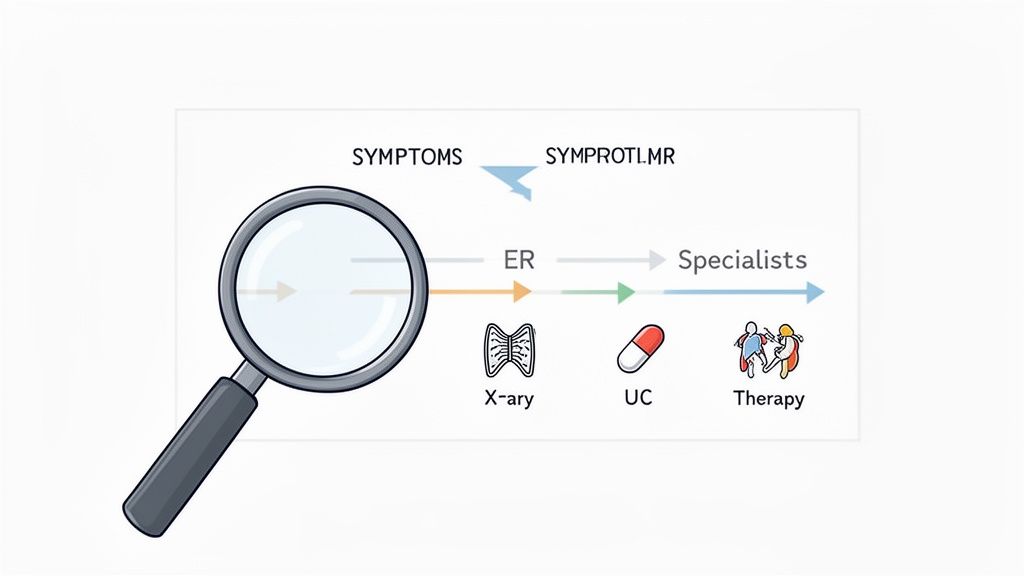
This means you have to dig deeper. You're searching for the specific details that prove causation, illustrate the client's suffering, and ultimately, maximize the settlement.
Tracing the Evolution of Symptoms
One of the most powerful parts of any medical summary is a clear timeline showing how the client's symptoms got worse over time. Your client may have only mentioned "neck soreness" at the ER, but three weeks later, they were describing "sharp, radiating pain" down their shoulder and arm. That evolution is critical evidence.
As you go through the records, meticulously track how these symptoms change.
- Initial Complaints: What were the very first symptoms reported right after the incident? Document them precisely.
- New or Worsening Symptoms: Pinpoint every instance where the client reports that their pain has intensified, moved, or that new symptoms have popped up.
- Impact on Daily Life: Capture any physician notes that describe how these symptoms are affecting the client's ability to work, sleep, or handle everyday tasks.
This kind of detailed tracking transforms a static injury into a dynamic story of ongoing suffering. It’s also the perfect way to shut down the defense's inevitable attempts to downplay the initial, less severe complaints.
Linking Treatments Directly to the Incident
Every single medical intervention—from a simple pain prescription to complex surgery—has to be explicitly tied back to the injuries from the incident. This forges an unbreakable chain of causation that is incredibly difficult for an adjuster to argue with.
Your summary needs to map out the entire web of care. It’s not enough to just list the providers; you have to show the logical progression of treatment that was medically necessary as a direct result of the accident.
A powerful summary doesn't just say what treatment the client received; it explains why they needed it. Each specialist referral, diagnostic image, and therapy session becomes another piece of evidence reinforcing the severity and legitimacy of the claim.
For example, make it crystal clear that the referral to an orthopedic surgeon was a direct result of the primary care physician's findings of persistent radiculopathy. Every link you forge in this chain strengthens the argument that these costs were unavoidable and necessary.
Translating Medical Jargon into Persuasive Language
Medical records are full of clinical shorthand and dense terminology that can easily mask the real severity of an injury. A huge part of your job is translating this technical language into clear, persuasive prose for the demand letter. How you frame a diagnosis can dramatically change a claim's perceived value.
Just look at the difference in impact between these two descriptions:
| Clinical Term | Persuasive Description |
|---|---|
| "Cervical Strain" | "A painful tearing of the muscles and ligaments in the neck, resulting in significant pain and restricted movement." |
| "Herniated Disc with Radiculopathy" | "A ruptured spinal disc pressing on a nerve root, causing debilitating radiating pain, numbness, and weakness in the arm." |
The first one sounds minor, almost temporary. The second paints a vivid picture of a serious, painful, and potentially permanent condition. Learning to make these translations is a skill that adds real dollars to every case you handle. You want the adjuster to feel the weight of the injury, not just scan a clinical term.
Thankfully, the widespread digitization of health data has made this easier. With the adoption of electronic medical records (EMRs) in primary care settings across OECD countries now over 93% on average, pulling the standardized data needed for these powerful summaries is more straightforward than ever. You can find more insights on the growth of digital health records on oecd.org.
Identifying the Details That Maximize Damages
At the end of the day, the goal is to leave no money on the table. This requires a meticulous hunt for every detail that can substantiate and increase the damages in your claim.
Here are some of the high-value details you should always be on the lookout for:
- Future Medical Needs: Find any mention by a provider of potential future treatments, like surgery recommendations, the need for ongoing pain management, or long-term physical therapy.
- Permanent Impairment: Identify any notes discussing a permanent impairment rating, loss of function, or chronic conditions that will plague the client for the rest of their life.
- Psychological Impact: Never overlook diagnoses of anxiety, depression, or PTSD related to the accident and the resulting injuries. These are absolutely compensable damages.
By focusing on these narrative-building elements, you turn a medical summary from a simple report into a strategic weapon. It becomes the definitive document that proves your client's case and justifies the full compensation they deserve.
Using AI to Speed Up and Strengthen Your Summaries
Trying to summarize medical records by hand just isn't working anymore. With electronic health records ballooning case files into thousands of pages, the old way of doing things is a major bottleneck. It slows down cases and, frankly, opens the door to costly human errors. Modern AI platforms are changing the game entirely.
Think about it: you could upload a chaotic stack of records from a dozen different providers and get a perfectly organized, searchable medical chronology back in minutes. This isn't some far-off idea. It's what's happening right now in firms that have brought AI into their process. Often, it's as simple as dragging and dropping the files into a secure system.
The AI gets to work immediately, parsing the documents and turning that jumbled data into something clean and useful. The real impact is in the results firms are seeing—slashing 10+ hours of manual work per case, freeing up paralegals to take on more clients, and getting to settlement talks much faster.
The Real-World Return on AI
The conversation around AI usually starts with speed, but the benefits run much deeper. It’s about producing a more accurate, detailed, and compelling summary that directly impacts your firm's revenue. This technology isn't just about saving time; it's a strategic tool that makes your entire practice more effective.
This shift is happening alongside explosive growth in AI's role in the medical field. The market for AI in digital healthcare is expected to jump from USD 15.1 billion in 2022 to over USD 187.9 billion by 2030. That's an astonishing growth rate of 37% every year. For law firms, this trend is a massive opportunity, as it fuels the very systems that can automatically pull key facts from records far more efficiently than any person ever could. You can discover more insights about AI's growth in healthcare and see what it means for legal work.
For a personal injury firm, this translates into concrete wins:
- Higher Caseload Capacity: When your paralegals aren't buried in data entry, they can manage more cases without the quality of their work slipping.
- Quicker Settlements: Demand letters can go out in days or hours, not weeks. This simple change gets the entire negotiation process moving much sooner.
- Fewer Mistakes: AI systems are built to spot and pull key data points with consistency, dramatically lowering the risk of a critical detail being missed or transcribed incorrectly.
Can You Really Trust AI with This?
It’s a fair question. Can you really rely on an algorithm for something as vital as a medical summary? The key is in the training. Legal AI platforms like Ares aren't your average chatbot. They are highly specialized tools trained on vast libraries of legal and medical documents.
This targeted training gives the AI an understanding of the specific context of personal injury law. It learns to zero in on what truly matters:
- Diagnoses and their associated ICD codes.
- The complete timeline of treatments and appointments.
- Provider notes that speak to causation or long-term prognosis.
- Gaps in treatment that the defense will almost certainly try to exploit.
AI isn't here to replace the sharp eye and critical thinking of an experienced paralegal or attorney. Think of it as the world's most efficient assistant. It handles the grueling first pass, so your team can focus their expertise on strategy, analysis, and negotiation—the work that actually wins cases.
By automating that initial, time-consuming review, the AI delivers a solid first draft of the summary. Your team can then step in to refine it, add strategic notes, and layer in the kind of human insight that makes all the difference. This teamwork between human and machine ensures both speed and accuracy. You can see more real-world examples in our guide on how AI is specifically benefiting personal injury lawyers.
Ultimately, using AI to summarize medical records is about building a more efficient and powerful foundation for every case you take on. It turns a drain on your resources into a genuine strategic advantage, helping your firm operate at a higher level and secure better outcomes for your clients.
Maintaining Security and HIPAA Compliance with Client Data

Bringing new technology into your firm to handle medical records is a game-changer for efficiency. But let's be clear: protecting your client's Protected Health Information (PHI) isn't just a best practice—it's an absolute legal and ethical requirement. A data breach doesn't just tarnish your firm's reputation; the consequences are severe.
We’re not talking about a slap on the wrist. HIPAA violations carry staggering financial penalties, with civil fines reaching over $2 million per violation. Criminal penalties can range from $50,000 to $250,000 and can even include prison time. These numbers alone show why a rock-solid security posture isn't optional.
Vetting Your Technology Partner
When you’re looking at any third-party tool, especially an AI platform that will be processing PHI, due diligence is everything. The right technology shouldn't introduce security risks; it should strengthen your existing defenses. Before you sign any contract, your IT team and managing partners need straight answers about how a platform protects your data.
Your evaluation process should feel more like an interrogation. A potential partner must be able to prove their security and compliance credentials. This is about building real trust that your client’s most sensitive information is secure. A critical piece of this is mastering data anonymization techniques to shield patient identities when working with medical files.
A good technology partner should function like a fortress for your client data. They shouldn’t just meet the bare-minimum HIPAA requirements; they should exceed them with enterprise-grade security that’s often stronger than what a firm can manage on its own.
Your vetting checklist needs to confirm a few non-negotiable security features. These are the pillars of any system built to handle the demands of PHI in a legal setting.
A genuinely compliant platform will always provide:
- End-to-End Encryption: Your data has to be encrypted while it's being uploaded (in transit) and while it's sitting on their servers (at rest). No exceptions.
- Secure Cloud Hosting: The provider should use a major, secure cloud infrastructure like AWS or Azure that is designed to meet HIPAA's demanding standards.
- Role-Based Access Controls: You need granular control. The system must let you decide precisely who in your firm can view, edit, or even access specific case files.
- Regular Security Audits: Ask for proof. The provider should be undergoing frequent, independent security audits to find and fix any potential weak spots.
Making these questions a central part of your evaluation is essential. For a more detailed breakdown, you can explore our complete guide to HIPAA compliant document management. By asking the tough questions upfront, you can adopt powerful tools that speed up your work without ever putting client data in jeopardy.
Common Questions About Summarizing Medical Records
Even with a solid workflow, a few questions always seem to pop up when you're deep in the weeds of summarizing medical records. Getting clear, practical answers to these common queries is what refines your process, making sure every summary is not just complete but strategically airtight.
Here are some of the most frequent questions I hear from personal injury paralegals and attorneys, along with some straight-to-the-point answers you can use on your very next case file.
How Long Should a Medical Summary Be?
This is the classic "it depends" answer, but it's true. There's no magic number. For a straightforward soft-tissue injury case, a tight 2-3 page summary might be all you need. But for a catastrophic injury involving multiple surgeries and long-term care, that summary could easily stretch to 15 pages or more.
The real goal isn't brevity for its own sake; it's clarity. Your summary has to be comprehensive enough to capture every critical diagnosis, treatment, and provider visit. At the same time, it needs to be direct enough that an insurance adjuster or opposing counsel can grasp the client's story in minutes, not hours.
What Are the Most Common Mistakes to Avoid?
I see a few recurring mistakes that can seriously undermine the power of a medical summary—and the entire claim. Knowing what these pitfalls are is the first step to sidestepping them completely.
Watch out for these common errors:
- Creating a Date List, Not a Story: A summary that's just a list of appointments is a huge missed opportunity. You have to build a narrative that directly connects the treatment back to the injury.
- Ignoring Gaps in Treatment: The defense loves to find unexplained gaps in care and will absolutely weaponize them. Your summary needs to flag these periods so you can get ahead of the issue.
- Overlooking Pre-Existing Conditions: You have to be the first one to find and frame any pre-existing conditions. The goal is to show how the incident aggravated a prior issue, not to let the defense "discover" it and use it against you.
- Relying on Medical Jargon: A summary loaded with clinical terms nobody understands is just confusing. Your job is to translate that medical-speak into plain, persuasive language that makes an impact.
An automated tool can be a great starting point here, as it can create a standardized first draft that helps you avoid many of these foundational errors right out of the gate.
A chronological summary tells the client’s story from the moment of injury through their entire recovery journey. This narrative format is fundamentally more persuasive for demand letters and negotiations than any other structure.
Is It Better to Summarize by Chronology or by Provider?
For personal injury work, a chronological summary is the gold standard. There’s really no contest. It logically walks the reader through the client's experience, making the cause-and-effect relationship between the incident and the medical care crystal clear. That linear story is the backbone of a compelling demand letter.
A provider-based summary isn't useless—it can be a helpful internal document if you need to analyze the treatment from a single orthopedic surgeon, for example. But your main, master summary should always follow the timeline. The best platforms, of course, give you both, generating a master chronology that you can instantly filter by provider. This gives you all the flexibility you need without ever losing the power of that core narrative.
Ready to transform your medical record review process? Ares provides an AI-powered platform that turns thousands of pages into clear, actionable summaries in minutes. Eliminate hours of manual work, build stronger cases, and settle faster. See how it works.