
Chapter 74 of the Texas Civil Practice & Remedies Code controls health-care liability claims, and the most consequential valuation rule is a $250,000 per-claimant cap on noneconomic damages against individual physicians and other individual health-care providers. Economic damages remain uncapped, while wrongful-death claims follow a separate, inflation-indexed framework under Section 74.303.
You may be looking at a file that seems straightforward. A patient reports a missed diagnosis, the records show a troubling delay, and the family wants to know what the claim is worth. In Texas, the answer won't come from liability facts alone. The Texas medical malpractice statute controls the filing window, expert proof, recoverable damages, and the pressure a claimant can apply in settlement.
A senior lawyer reviewing a new intake starts with the code, not with a general tort outline. Chapter 74 determines whether the defendant fits the statutory framework, when suit must be filed, when an expert report must be served, and whether the case involves ordinary noneconomic caps or the distinct wrongful-death limit. The mistakes that matter most are usually procedural and mathematical, not rhetorical.
Why the Texas Medical Malpractice Statute Shapes Every Case
A 49-year-old construction foreman calls intake about two years after a missed post-operative infection. He describes numbness, lost wages, and a marriage that has deteriorated under the strain of his care. The paralegal shouldn't begin by drafting a demand letter. The first task is to identify the treatment dates, the alleged omission, the providers involved, and the deadlines imposed by Chapter 74.
That intake decision affects the entire file. Section 74.251 governs limitations and repose, Section 74.351 governs expert reports, and Section 74.301 governs ordinary noneconomic damages. The statutory framework also determines how the claim is categorized, which defendants may be sued, and how the damages presentation should be organized.
Practical rule: Treat every medical-negligence intake as a deadline-and-proof problem before treating it as a damages story.
The 2003 reforms reshaped Texas malpractice law through House Bill 4 and Proposition 12. Voters approved Proposition 12 on September 13, 2003, giving the Legislature constitutional authority to impose health-care liability damage limits. The reforms replaced the older Article 4590i regime and created the cap structure associated with modern Texas practice, as detailed in this historical analysis of Texas medical-malpractice reform.
The pressure points are concrete:
- Timing: The ordinary limitations period and the harder 10-year statute of repose can operate differently.
- Expert proof: A qualifying report must be served within the statutory period after each defendant answers.
- Valuation: Noneconomic damages against individual providers are capped, but economic losses are not.
- Wrongful death: Section 74.303 uses a separate, inflation-indexed framework rather than repeating the ordinary cap analysis.
Good file management supports this statutory discipline. Firms evaluating workflow options can compare personal injury case management tools while still keeping legal judgment, deadline review, and expert selection in attorney hands.
How Chapter 74 Reorganized Texas Malpractice Law
Chapter 74 is the operating system for a Texas health-care liability claim. It doesn't merely add procedural requirements to a common-law negligence case. It defines the claim category, identifies covered providers, imposes an expert-report screen, and establishes the damages framework.
Start with Section 74.001. The definitions section determines whether the defendant and the alleged conduct fall within the statutory health-care liability structure. That classification matters because a claim styled as negligence, lack of informed consent, or another theory can still be treated as a health-care liability claim if it arises from medical treatment, a failure to provide treatment, or a departure from accepted standards.
Then move to Section 74.301. This provision addresses noneconomic damages in ordinary health-care liability claims. It separates the cap applicable to physicians and individual providers from the cap applicable to health-care institutions. The distinction is central to pleading, discovery, settlement modeling, and trial presentation.
Finally, Section 74.351 supplies the expert-report requirement. The claimant must serve each defendant with a report that gives a fair summary of the expert's opinions on the standard of care, breach, and causal relationship to the injury. A late or inadequate report can end the case before discovery reaches its expensive stages.
| Section | Function | Practical Impact |
|---|---|---|
| § 74.001 | Defines the statutory health-care liability framework and covered parties | Determines whether Chapter 74 applies and how the claim is characterized |
| § 74.301 | Establishes ordinary noneconomic-damages limits | Controls valuation against individual providers and institutions |
| § 74.351 | Requires service of a qualifying expert report | Creates an early merits screen and a dismissal risk |
The post-2003 structure replaced the earlier Article 4590i system. Texas had already experimented with statutory malpractice caps, and the Texas Supreme Court struck down parts of that earlier regime in 1988. The later reform therefore represented a statutory reset, not Texas's first attempt to limit malpractice liability, as discussed in the Texas Bar overview of the reform framework.
Federal courts sitting in diversity generally apply the same Texas substantive framework. A change in forum doesn't eliminate Chapter 74's classification, limitations, expert-report, or damages rules.
The Four Elements Every Texas Malpractice Claim Must Prove
Consider a radiologist who allegedly delayed reading imaging that showed a vertebral fracture. The patient leaves without appropriate intervention, develops permanent nerve injury, and claims lost earning capacity and continuing care needs. The file still requires proof of the traditional elements, but Chapter 74 dictates how the plaintiff develops and tests each one.
Duty comes from the relationship and the statute
The claimant must establish that the defendant owed a professional duty. The provider's status, the treatment relationship, and the nature of the services are analyzed within the statutory definition in Section 74.001. A complaint that labels someone a negligent actor won't substitute for showing why that person or institution had responsibility for the care at issue.
Breach requires a qualified medical opinion
The plaintiff must identify the applicable standard of care and explain how the defendant departed from it. That opinion normally comes from a qualified expert and must appear in the Section 74.351 report at the early stage of the case.
The report is more than a procedural ticket. It defines the theory that must eventually survive summary judgment and trial scrutiny. If the report says the radiologist should have recognized a particular finding but never connects that failure to the treatment delay, the causation theory may be incomplete even if the breach discussion is persuasive.
Causation must connect the error to the injury
A plaintiff must show that the alleged breach caused the claimed harm. In the fracture example, the expert needs to explain why a timely interpretation and intervention would have avoided or reduced the nerve injury. Texas practice requires the report to articulate the causal link with the required reasonable-probability standard, rather than relying on speculation or a bare temporal sequence.
Damages must be separated by type
The damages analysis should identify medical expenses, wage loss, lost earning capacity, future care, and other measurable losses separately from pain, mental anguish, physical impairment, disfigurement, and similar noneconomic categories. Economic damages remain uncapped, so detailed records and credible damages proof can materially affect case value even when noneconomic recovery is limited. The ordinary noneconomic cap analysis belongs under Section 74.301, not in a general damages paragraph that treats every loss as interchangeable.
Filing Deadlines, the Discovery Rule, and the 10-Year Repose Bar
A patient discovers a retained surgical sponge six years after an operation. The delayed discovery may support a liability theory, but it does not eliminate the need to test limitations and the separate repose bar. Texas timing analysis under Section 74.251 requires both calculations. As detailed in this Texas medical malpractice statute of limitations guide, the two-year limitations period generally runs from the breach or completion of the treatment forming the basis of the claim. The statute of repose generally bars a claim filed more than 10 years after the negligent act, even when the injury surfaced later, as summarized in this Texas medical-malpractice limitations guide.
The discovery rule is not a general extension for every latent injury. Texas courts apply it only when the nature of the injury is inherently undiscoverable and the injury was objectively verifiable. Counsel should identify the accrual facts and governing authority before treating delayed diagnosis as a filing extension.
Limitations and repose do different work
- Limitations: Measures when the claim accrued and whether a filing or tolling rule applies.
- Repose: Runs from the negligent act or omission and can extinguish the claim despite later discovery.
- Foreign-object situations: May receive specialized treatment, but that treatment should not be expanded to ordinary diagnostic or treatment disputes.
- Continuing treatment: May affect limitations during a qualifying course of care, but it does not erase the outer repose deadline.
The distinction can determine whether a case is viable. A hidden injury may remain undiscovered until after the ordinary limitations period, while the repose period continues running from the underlying act. Minors and other claimants with concealed injuries therefore require an early date analysis, not an assumption that discovery controls.
Pre-suit notice and expert-report practice also affect the calendar. Section 74.351 report deadlines interact with limitations through statutory tolling rules, so counsel should place filing, notice, answer, report, and repose dates on one litigation calendar. A late calculation can end the claim before its merits are tested.
The 120-Day Expert Report Requirement Under Section 74.351
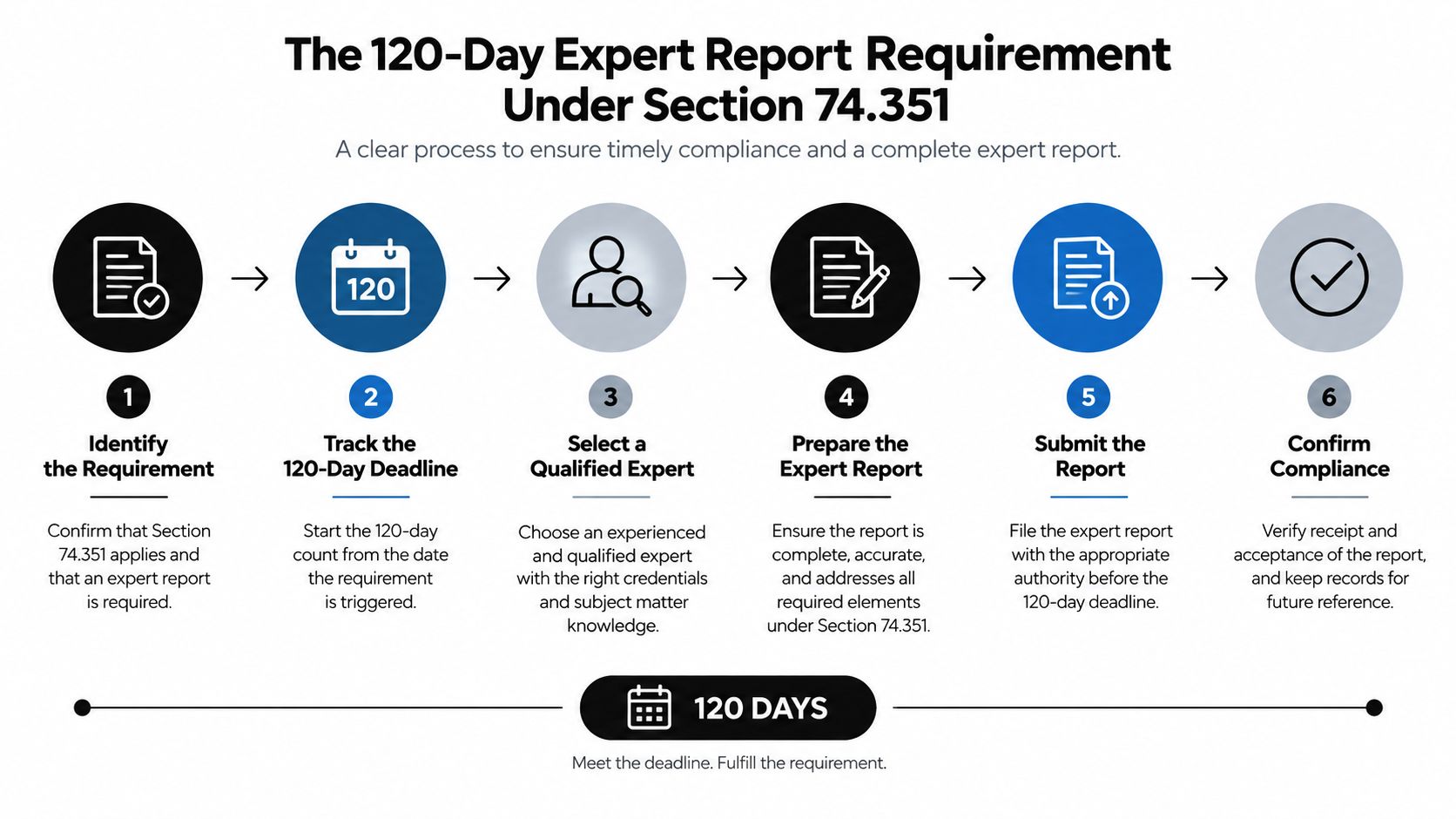
Section 74.351 requires a claimant to serve an expert report on each defendant physician or health-care provider within 120 days after that defendant's original answer, as stated in the statutory text of Section 74.351. The clock must be tracked by defendant. One answer date doesn't necessarily solve the deadline for every party in a case.
The report must provide a fair summary of the expert's opinions about the applicable standard of care, the alleged breach, and the causal relationship between the breach and the injury. The expert also must satisfy the qualification rules that apply to the opinion being offered. A standard-of-care expert under Section 74.401 isn't automatically qualified to offer every causation opinion under Section 74.402.
What happens when the report fails
A defendant may challenge a report as absent, late, or substantively deficient. When a court finds a curable deficiency, Section 74.351(c) provides a 30-day cure period in the circumstances covered by the statute. That opportunity isn't a license to file a skeletal report and hope the court supplies the missing opinions.
Failure to serve a qualifying report can trigger dismissal with prejudice, along with an award of attorney's fees and costs to the defendant under the statute. The early report requirement therefore screens both merit and preparation. New associates commonly focus on getting a medical professional's signature and overlook whether the expert's qualifications match the precise standard-of-care or causation opinion.
Associate warning: Calendar the answer date, identify the expert's statutory qualification, and read the report as if you're the defense lawyer looking for an unsupported conclusion.
A useful report should explain the medical standard, identify the specific departure, and connect the departure to the injury through reasoned medical causation. A report that merely says the care was poor or that the injury followed treatment may not give the defendant or court the fair summary Chapter 74 requires.
Damage Caps for Ordinary Claims Versus Wrongful Death Cases
The headline numbers don't tell the whole valuation story. Ordinary health-care liability claims and wrongful-death cases use different statutory frameworks, and a lawyer who carries the ordinary cap analysis into a wrongful-death file can misstate the case's ceiling from the start.
For ordinary claims, Section 74.301 limits noneconomic damages to $250,000 per claimant against all physicians and individual health-care providers combined. The statute also provides an institutional structure, with $250,000 against each health-care institution and a practical $500,000 limit when multiple institutions are involved, as described in this Texas medical-malpractice damages analysis.
A claimant suing one physician and two hospitals may therefore face a combined noneconomic ceiling of $750,000 under the statutory structure. That figure is not a free-standing verdict promise. It depends on the defendants, the claimant, the statutory categories, and the damages proved.
| Feature | § 74.301 Ordinary Claims | § 74.303 Wrongful Death |
|---|---|---|
| Damages covered | Noneconomic damages | All damages under the wrongful-death framework |
| Provider structure | Individual-provider and institutional limits operate separately | Applies under a distinct statutory formula |
| Inflation treatment | Ordinary provider cap remains the familiar fixed figure | Limit is indexed for inflation |
| Valuation focus | Separate economic losses from capped noneconomic losses | Calculate the indexed limit and preserve each recoverable damages category |
Wrongful-death and survival claims require separate attention under Section 74.303. The limit applies to all damages and is indexed for inflation from the statutory base framework. Later commentary has estimated the operative limit at more than $2.5 million in the relevant context, so counsel must verify the applicable figure for the claim rather than copy the ordinary $250,000 analysis.
That distinction changes settlement strategy. In an ordinary personal-injury case, wage loss and future care may remain outside the noneconomic ceiling. In a wrongful-death file, counsel must calculate the Section 74.303 framework and distinguish it from the ordinary provider and institution limits. The broader tort-reform context can be useful, but it shouldn't replace a claim-specific review of Chapter 74, as practitioners can see in this comparison of tort reform states.
A Practitioner Workflow for Running a Texas Malpractice File
A reliable file moves in a fixed order. The lawyer who starts with a polished demand before confirming dates and expert viability is working backward.
Begin with notice and calendar control
Review the medical records, identify every possible provider and institution, and send the required pre-suit notice under Section 74.051. Build a master calendar for notice, filing, each defendant's answer, the 120-day expert-report deadline, and the repose date.
The 120-day period is measured from each defendant's original answer, not from the date the associate happens to open the file. Track defendants individually, especially when service and answers occur on different schedules.
Select the expert before the pleading hardens
Match the expert to the opinion. Section 74.401 qualification analysis matters for standard of care, while Section 74.402 addresses other expert opinions, including causation-related issues. Obtain the records the expert needs, then ask for a report that states the standard, breach, and causal connection with enough detail to meet the fair-summary requirement.
A paralegal or case manager can support this process with a disciplined medical malpractice paralegal workflow, but the attorney must own the legal deadline and qualification decisions.
Draft the demand around provable value
Organize economic damages first. Tie medical expenses, wage loss, earning-capacity impairment, and future care to records and competent evidence. Then present noneconomic damages with the applicable Section 74.301 limits in mind. If the file involves a death, stop and recalculate under Section 74.303 rather than recycling an ordinary injury template.
Medical-record platforms can help organize dates, diagnoses, treatments, providers, and symptom chronology. Ares is one option that generates medical chronologies and narratives for expert review, with clinical events tied to source records. The tool can reduce document sorting, but it doesn't decide whether an expert is qualified or whether the statutory report is sufficient.
Key Takeaways for Litigating Under the Texas Malpractice Statute
Chapter 74 rewards early classification and punishes casual calendar management. The strongest liability facts won't rescue a claim filed outside the governing period, and a persuasive damages narrative won't cure a missing or inadequate expert report.
Use these four pressure points at intake:
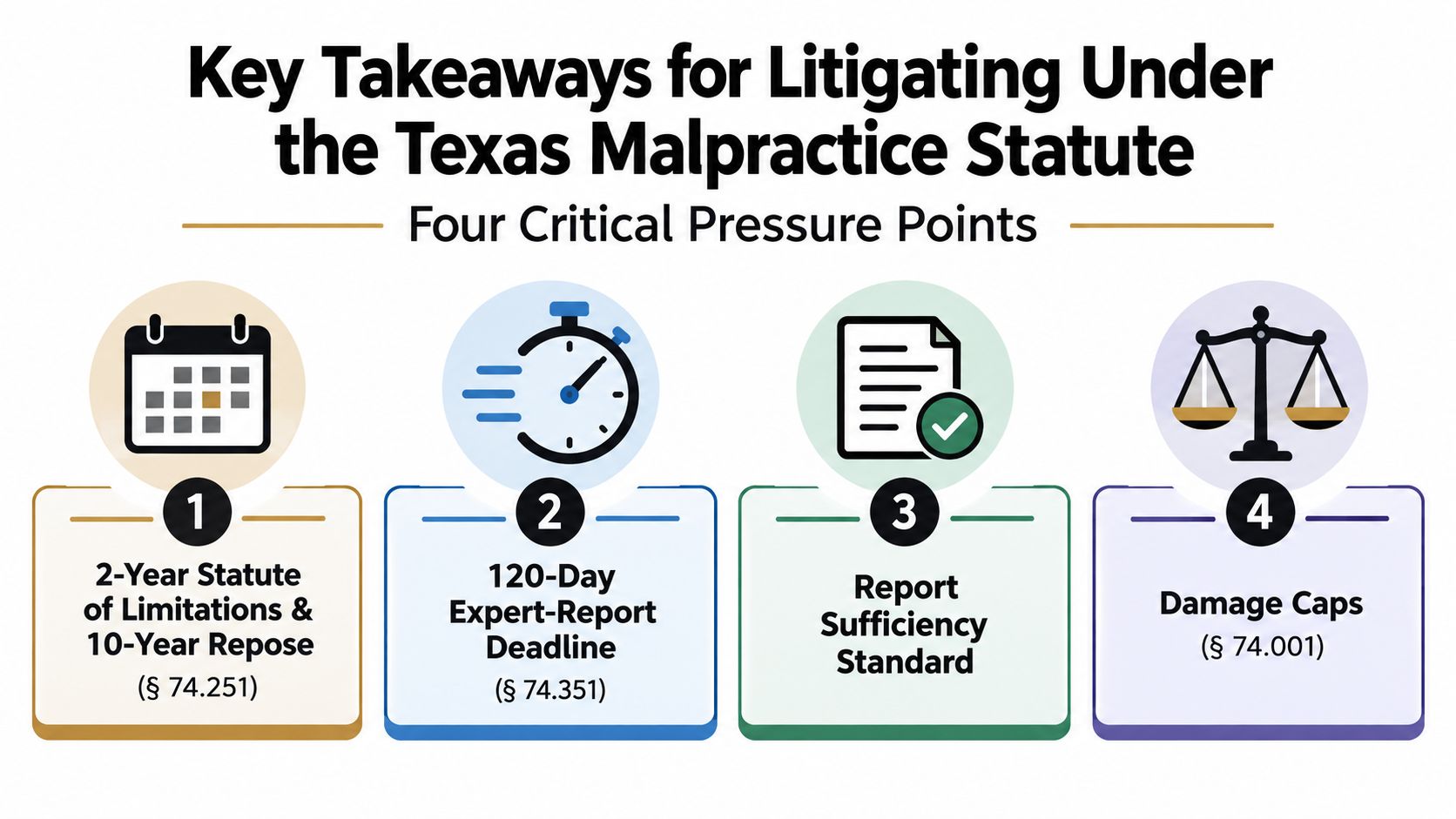
- Deadlines: Analyze the two-year limitations period and the 10-year repose bar under Section 74.251. Identify the alleged act, treatment-completion date, discovery facts, and any potentially applicable tolling doctrine.
- Expert reports: Track the 120-day deadline under Section 74.351 separately for each defendant's answer. Confirm the expert's qualifications before relying on the report.
- Caps: Apply the $250,000 individual-provider noneconomic cap to ordinary claims, then calculate institutional exposure. Don't use that framework for wrongful death without analyzing Section 74.303.
- Wrongful-death math: Determine whether the claim involves wrongful death or survival issues and calculate the separate inflation-indexed limit. Preserve economic and other recoverable damages categories in the proof.
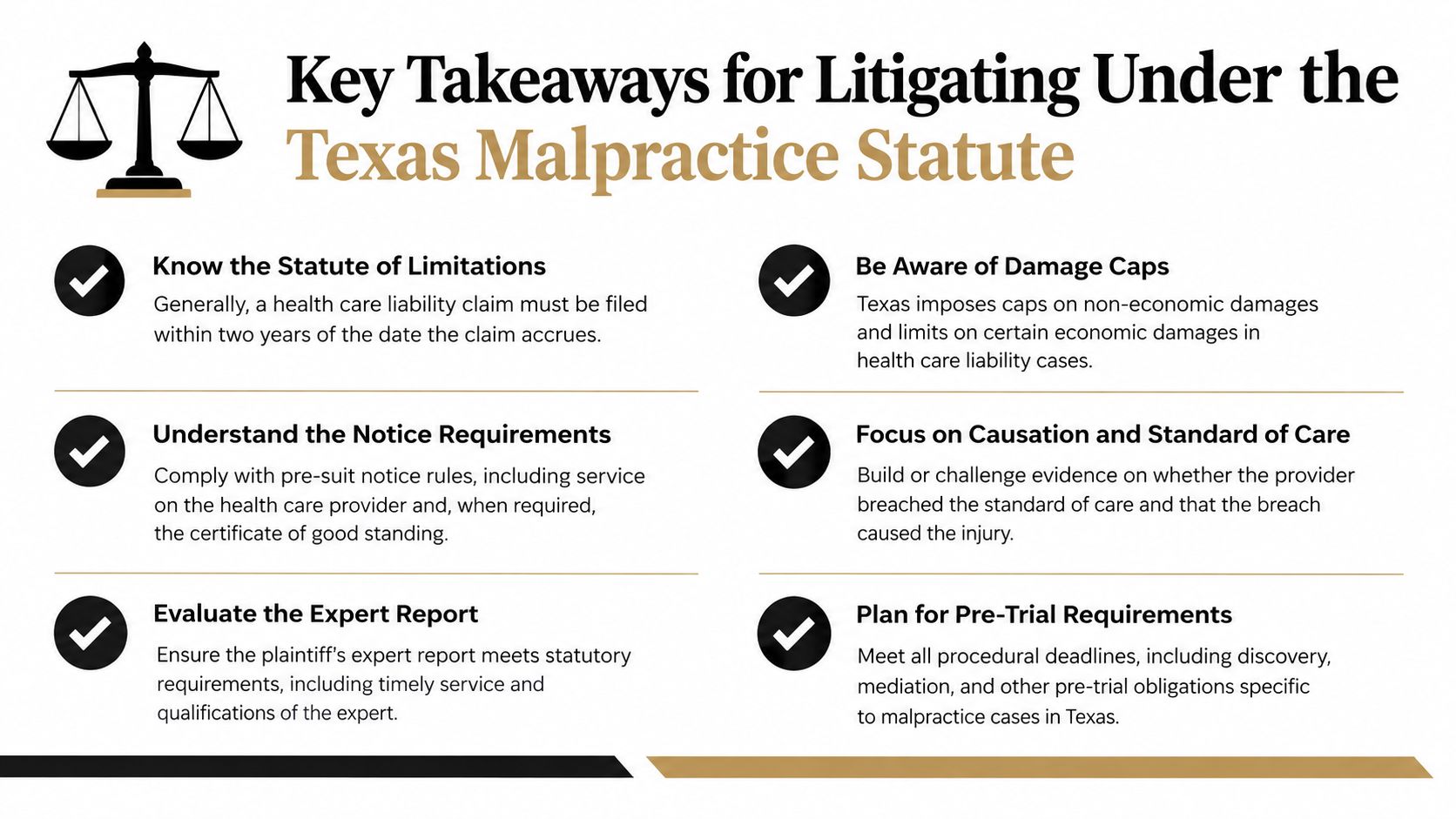
A practical file checklist should answer four questions before settlement pressure builds:
- What date controls? Record the negligent act, treatment completion, discovery facts, notice date, filing date, and each answer date.
- Who is the defendant? Separate individual providers from institutions and confirm Chapter 74 applies.
- What does the expert say? Test standard of care, breach, causation, qualifications, and fair-summary sufficiency.
- Which damages framework governs? Separate ordinary noneconomic caps from the wrongful-death limit, then document uncapped economic losses.
That is the working discipline behind a defensible Texas malpractice valuation. Review the statute before you value the injury, select the expert before the report deadline approaches, and calculate the correct cap before making a demand.
Ares helps personal injury firms organize medical records into cited chronologies and case-ready narratives, which can support expert review and cap-aware demand preparation in Texas malpractice files. Visit Ares to see how the platform can fit into your firm's medical-record workflow.