A legal brief is a multi-part court filing built around navigation, authority tracking, and persuasion, typically containing a caption, table of contents, table of authorities, jurisdictional statement, statement of issues, statement of facts, argument, and conclusion. In some U.S. Supreme Court amicus filings, the limit is 6,000 words at the certiorari stage, 8,000 words for most merits-stage filers, and 9,000 words for governmental entities.
But what does a legal brief look like when the answer changes with the court, the filing type, and the local rule? A document that looks complete in a trial court may be missing required appellate sections, and a format accepted in one state may violate another court's typography, cover, appendix, or electronic-filing requirements.
The safe approach is to identify the court and brief type first, then build the document around that court's governing rule. Federal appellate practice generally points you to the Federal Rules of Appellate Procedure, while state appellate courts and trial courts impose their own requirements. The structure below will help you understand the document's components, distinguish appellate briefs from trial motions, check formatting, organize a persuasive argument, manage citations, account for jurisdictional differences, and move from a dense case file to a court-ready filing.
What a Legal Brief Is and Why Its Structure Matters
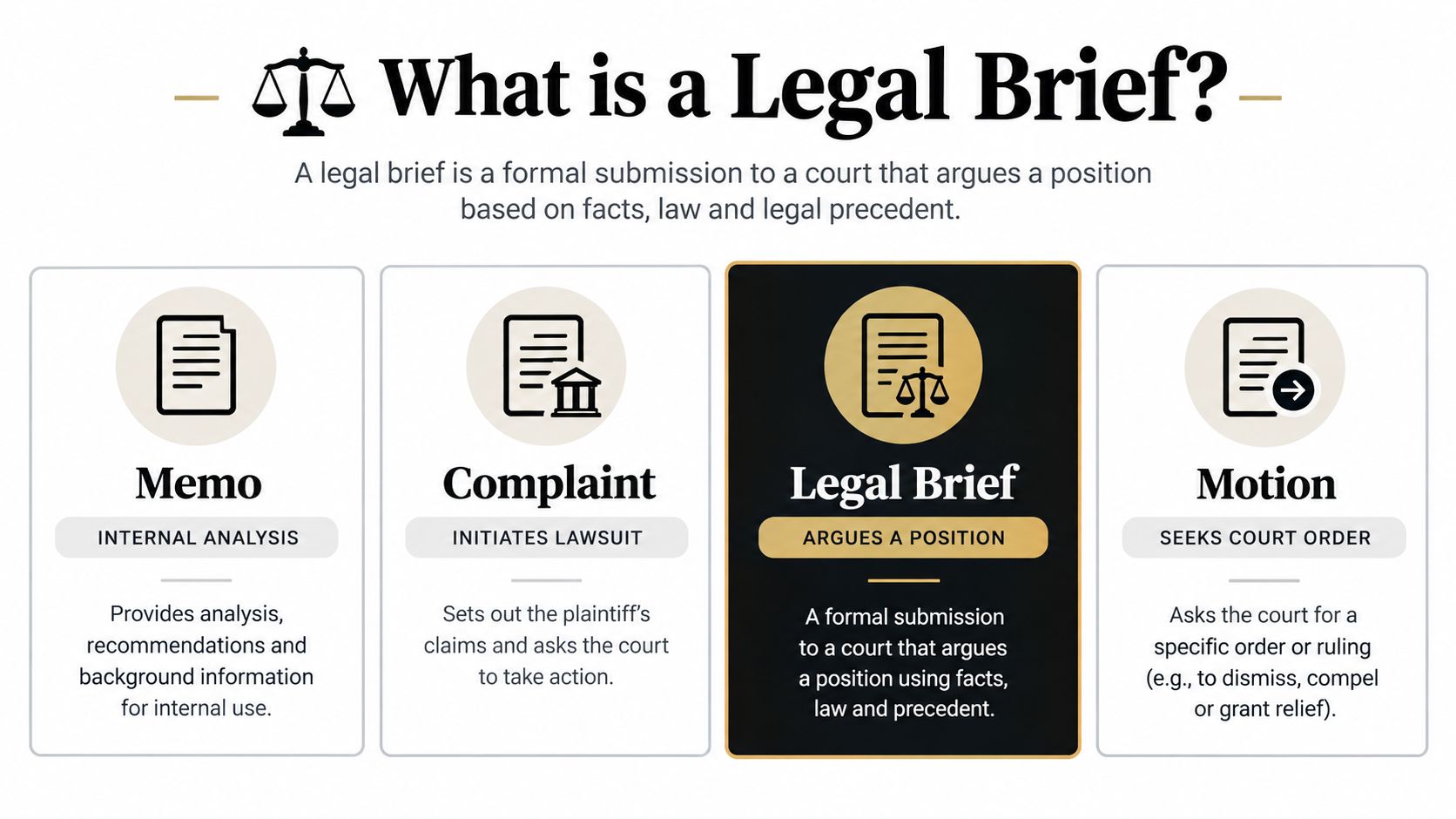
A legal brief is a written submission filed with a court to persuade the judge or appellate panel to resolve a legal issue in a particular way. It isn't the same as a legal memorandum, which usually analyzes an issue for an internal reader. It also differs from a complaint, which initiates a lawsuit and states claims for relief, and from a motion, which asks the court to enter a specific order. A motion may be accompanied by a supporting brief, but the motion and the memorandum serve different procedural functions.
Federal appellate practice supplies a useful baseline. Federal Rule of Appellate Procedure 28 organizes appellate advocacy around the court's authority to hear the matter, the issues presented, the relevant facts and procedural history, the governing law, the application of that law, and the requested relief. The precise arrangement and additional requirements still depend on the applicable appellate rule and local practice.
Why courts impose a fixed structure
A brief performs three practical jobs:
- Navigation: Headings, page references, tables, and predictable ordering let judges, clerks, and opposing counsel find the relevant material quickly.
- Authority tracking: A table of authorities and accurate citations show which cases, statutes, and rules support each proposition.
- Persuasion: The argument connects the governing rule to the record and explains why the court should grant the requested relief.
The format isn't decoration. The legal brief format overview describes the modern brief as a formal document with a caption, table of contents, table of authorities, jurisdictional statement, issues, facts, argument, and conclusion. The same source notes that the U.S. Supreme Court requires a table of contents and table of authorities once an amicus brief exceeds 1,500 words.
The practical takeaway is simple: don't begin with a blank page. Begin with the governing rule, identify every required component, and use the finished document to give the court a clear path from jurisdiction to decision.
The Core Sections of a Standard Brief Explained
A standard appellate brief moves through a recognizable sequence, although local rules may add, remove, or reorder parts. Before drafting, compare the court's rule with its formatting guide and any standing order in the assigned case.
Caption and cover page
The caption identifies the court, parties, docket or case number, and the nature of the filing. The cover page may separately identify the filing, counsel, firm, address, telephone number, email address, and appearance for a party.
Practical rule: Copy the case caption from the court's docket or most recent order. A misspelled party name or incorrect docket number can create avoidable filing trouble.
An annotated example might look like this:
IN THE UNITED STATES COURT OF APPEALS
FOR THE [CIRCUIT]JANE DOE, Plaintiff-Appellant, v. ACME INSURANCE COMPANY, Defendant-Appellee
Appeal from the United States District Court for the [District]
Appellant's Opening Brief
The caption tells the clerk where the filing belongs and tells the court who is asking for what.
Table of contents
The table of contents lists the brief's headings and the pages where they appear. It should match the final document exactly. If you revise headings after generating the table, update it again before filing.
A useful entry is specific:
I. The district court applied the wrong accrual rule to Doe's statutory claim ........ 18
“Argument” alone is much less helpful than a heading that communicates the legal theory.
Table of authorities
The table of authorities groups cited sources, commonly by cases, constitutional provisions, statutes, rules, and other authorities. Page references let the reader move directly from a proposition to the place where the brief uses it.
This section is frequently mishandled because automatic generation can miss citations, include a source used only in a quotation, or fail to distinguish short forms from full citations. Check every entry against the body of the brief.
Jurisdictional statement
The jurisdictional statement explains why the reviewing court has authority to hear the appeal. It normally identifies the statutory or constitutional basis for jurisdiction, the relevant order or judgment, its date, and the procedural events that make the appeal timely.
The district court exercised jurisdiction under the applicable federal jurisdiction statute. It entered final judgment on [date], and Appellant filed a notice of appeal from that judgment.
Don't treat this as boilerplate. A jurisdictional defect can end an appeal before the court reaches the merits.
Issues presented
The statement of issues frames the questions the court must decide. Each issue should identify the legal question, the operative facts, and the ruling you seek without becoming argumentative or opaque.
Whether the district court erred by dismissing the statutory claim where the complaint alleged that the insurer withheld benefits after receiving the required documentation.
A strong issue statement gives the argument a destination. A vague issue forces the court to reconstruct the dispute.
Statement of the case and facts
The statement of the case supplies procedural history. The statement of facts supplies the record-supported narrative. Some courts combine them, while others require separate sections.
The facts should be selective but accurate. Cite the record where each material proposition appears, and organize events so the legal issue becomes understandable without requiring the reader to reconstruct the file.
Summary of argument
The summary gives the court the theory of the appeal in compressed form. It shouldn't merely repeat the headings. It should state the result, the controlling rule, and the decisive reason the rule favors your client.
The judgment should be reversed because the court treated a factual dispute as a pleading defect. The complaint identifies the policy provision, alleges the insurer's refusal to pay, and connects that refusal to the claimed loss.
Argument
The argument contains the legal analysis. Use issue-driven headings, state the governing rule, explain the rule through controlling authority, apply it to the record, address adverse authority, and close with the relief that follows.
The canonical structure is substantial enough that the U.S. Supreme Court's amicus guide regulates both content and physical presentation. It limits amicus briefs to 6,000 words at the certiorari stage, 8,000 words for most merits-stage filers, and 9,000 words for governmental entities, and requires a booklet measuring 6⅛ by 9¼ inches, bound in at least two places on the left margin.
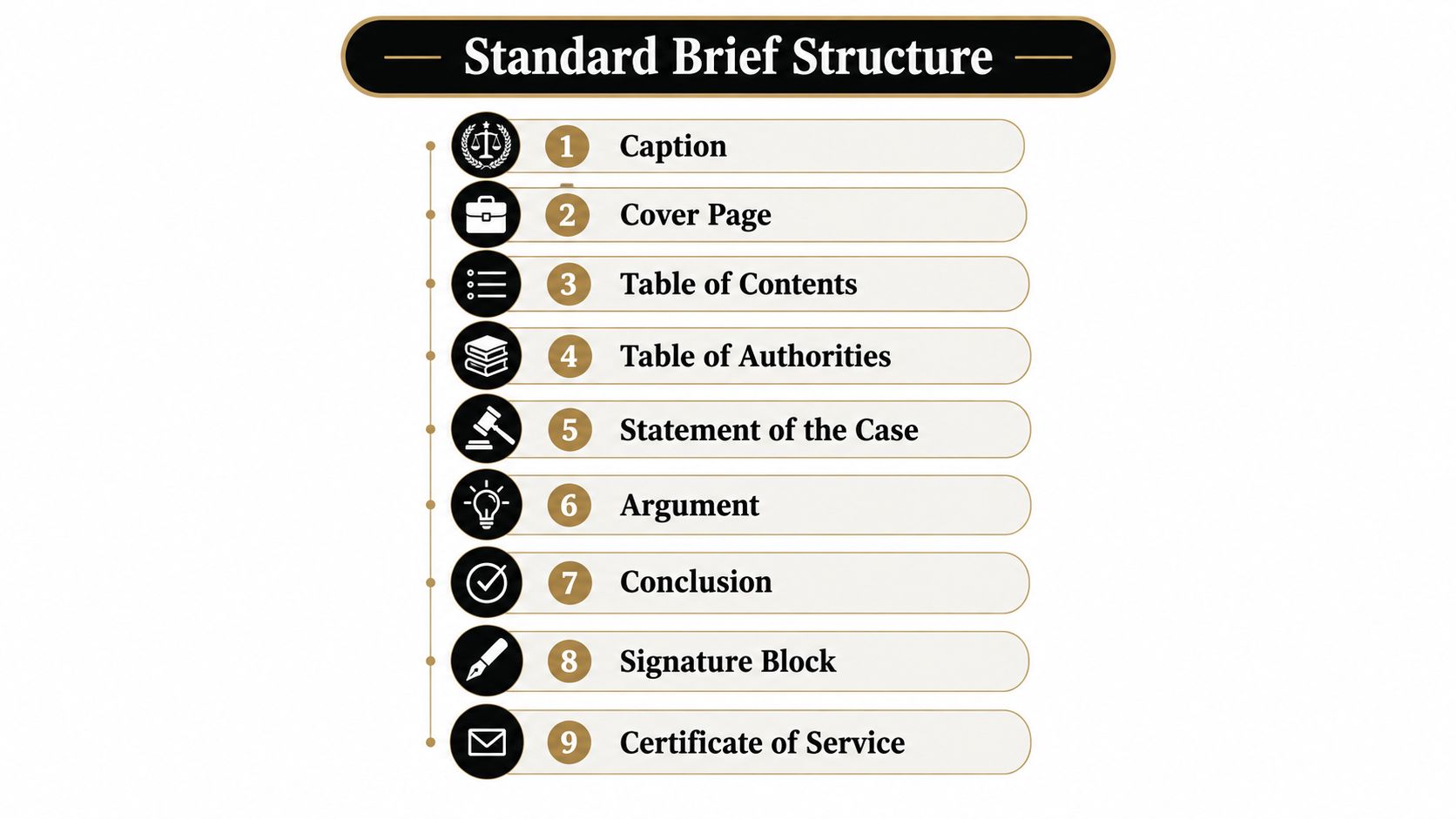
Conclusion, signature block, and certificates commonly follow. The conclusion should state the exact disposition requested, while the signature block and certificate of service must comply with the court's filing rules. Some courts also require disclosure statements or other certifications.
How Federal Appellate Briefs Differ from Trial Court Motions
The same lawyer may prepare both documents, but an appellate brief and a trial-court motion memorandum answer different institutional needs. An appellate court reviews a developed record and a prior ruling. A trial judge usually decides a motion within an active case and may already know the pleadings, exhibits, and procedural history.
| Feature | Federal Appellate Brief | Trial Court Motion |
|---|---|---|
| Governing framework | Federal Rules of Appellate Procedure, including Rules 28 through 32, plus circuit rules | Federal or state civil rules, local rules, and the judge's standing orders |
| Core purpose | Explain why the appellate court should affirm, reverse, vacate, or remand | Explain why the trial court should grant or deny a specific order |
| Typical structure | Caption, cover, contents, authorities, jurisdiction, issues, facts, summary, argument, conclusion, signature, and certificates | Caption, notice or motion, introduction, facts, argument, conclusion, and supporting materials as required |
| Record posture | Works from the existing record and must identify the standard of review | May address pleadings, declarations, exhibits, discovery, or live evidence depending on the motion |
| Argument emphasis | Standard of review, preservation, reversible error, and the limits of appellate review | Elements, procedural entitlement, evidentiary support, and the requested trial-level relief |
A trial memorandum may be shorter and more focused, but that doesn't make it informal. It still needs accurate authority, record support, and a clear explanation of the order the judge should enter. An appellate filing usually carries more navigation requirements because the reviewing court must understand the jurisdictional basis, the precise issues, and the record before reaching the legal analysis.
The distinction also affects reuse. A statement of facts may provide raw material for both documents, and a legal rule may carry over unchanged. The organization usually cannot. Appellate counsel must rewrite for the standard of review, preservation, record citations, and the claimed error. A trial motion generally starts with the procedural basis for the requested order and the evidence currently before that court.
Don't assume a federal appellate template works for a state motion. Pull the relevant rule and local order before adapting text.
Formatting Rules Courts Actually Enforce
Formatting rules answer the visual part of what does a legal brief look like. They govern page dimensions, type, spacing, margins, page numbering, covers, binding, and electronic submission. The baseline often comes from Federal Rule of Appellate Procedure 32, but a circuit's local rule can refine that baseline.
| Element | Federal Rule (FRAP 32) | Common State Variation |
|---|---|---|
| Page size | Commonly standard letter-size pages for ordinary federal filings | A state rule may specify page size, margins, or filing-paper conventions |
| Typeface | Proportionally spaced or monospaced type within the rule's required minimum size | State rules may prescribe a different typeface, size, or certificate method |
| Spacing | Body text, quotations, and footnotes may have distinct spacing requirements | Local rules may impose different spacing or permit exceptions for headings |
| Pagination | Sequential page numbers help the court navigate the filing | Some courts specify placement, numbering of preliminary pages, or cover treatment |
| Physical submission | Paper copies, covers, binding, or filing mechanics may apply when required | State appellate courts may impose color, binding, appendix, or portal rules |
Treat these as compliance requirements, not design preferences. A clean-looking document can still fail if its margins, font, spacing, or word-count certificate doesn't match the governing rule.
What to verify before filing
- Page and margin settings: Confirm the document size and margins in the court's rule, not in a saved office template.
- Typeface and spacing: Check body text, headings, quotations, and footnotes separately.
- Page numbering: Make sure preliminary pages and the argument use the court's required sequence.
- Word or page limit: Use the court's counting method and complete any required certificate.
- Binding and copies: Determine whether the court requires staples, a binder, a particular cover, or only electronic filing.
- Electronic conversion: Open the final PDF and inspect bookmarks, page order, footnotes, exhibits, and searchable text.
A rule can distinguish between mandatory federal provisions and matters delegated to local practice. The Supreme Court's amicus requirements illustrate how specific a court can be about both length and physical form. State courts may focus instead on cover colors, appendices, hyperlinks, or portal-specific upload rules. Always confirm the current rule before finalizing the layout.
Building a Persuasive Argument Section
A persuasive argument lets the court see the requested result in the heading before the supporting analysis begins. Replace generic labels such as “Negligence” or “The Court Erred” with complete, issue-driven propositions.
Start with the court's decision rule
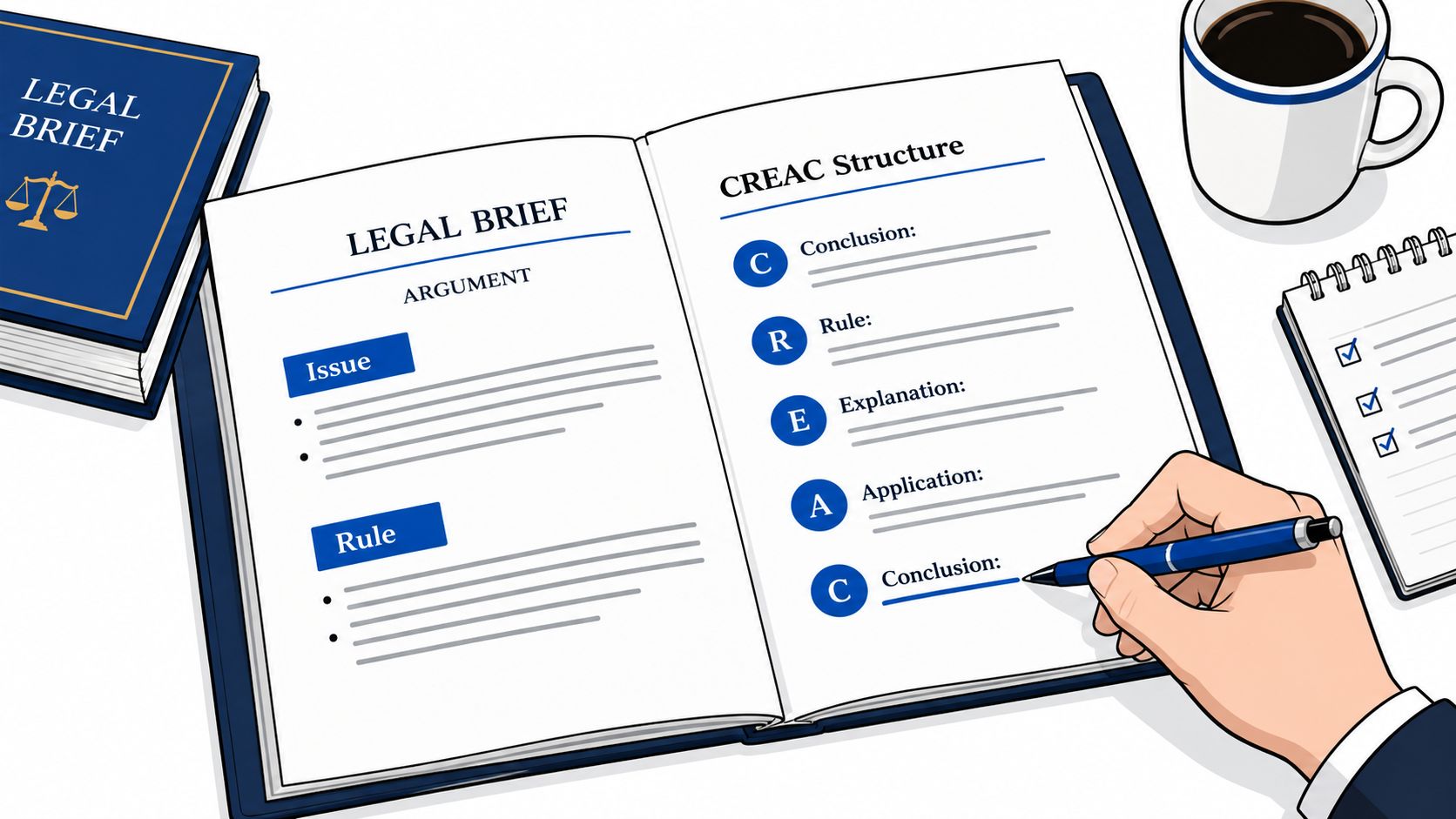
A useful CREAC or IRAC sequence moves from conclusion or issue, to rule, explanation, application, and conclusion. The framework isn't a court-mandated formula, but it disciplines the analysis and prevents a paragraph from becoming a collection of disconnected authorities.
A weak version might read:
The court erred in dismissing the claim because the evidence supports the plaintiff.
That sentence announces a position but gives the court no rule, record reference, or explanation.
A stronger version has a legal path:
The claim should not have been dismissed because the record creates a factual dispute about notice. The governing statute requires proof of notice, and the record shows that the insurer received the claimant's medical documentation before denying benefits. [Record citation.] Because the timing of that notice affects whether the statutory obligation arose, the issue required resolution under the applicable fact-based standard rather than dismissal as a matter of law.
The revised paragraph does four jobs. It states the conclusion, identifies the legal requirement, connects that requirement to evidence, and explains why the requested ruling follows.
Use headings as a map
Read the headings in sequence. They should tell a coherent story:
- The complaint plausibly alleges the statutory notice requirement.
- The insurer's records create a factual dispute about receipt.
- The contrary authority addresses a different procedural posture.
Place the standard of review near the beginning of each appellate argument when the court's rules or practice call for it. Then apply that standard, rather than mentioning it once and reverting to trial-level advocacy.
For a fuller drafting workflow, review how to write legal briefs, but keep the court's governing rule in control. A writing framework can organize reasoning. It can't replace jurisdiction-specific compliance.
Citations, Signals, and Footnotes in Legal Briefs
Citations do more than identify sources. They show the court how strongly an authority supports the proposition and where the reader can verify it. A full citation generally appears when a source is first introduced, followed by a permitted short form when the same source returns.
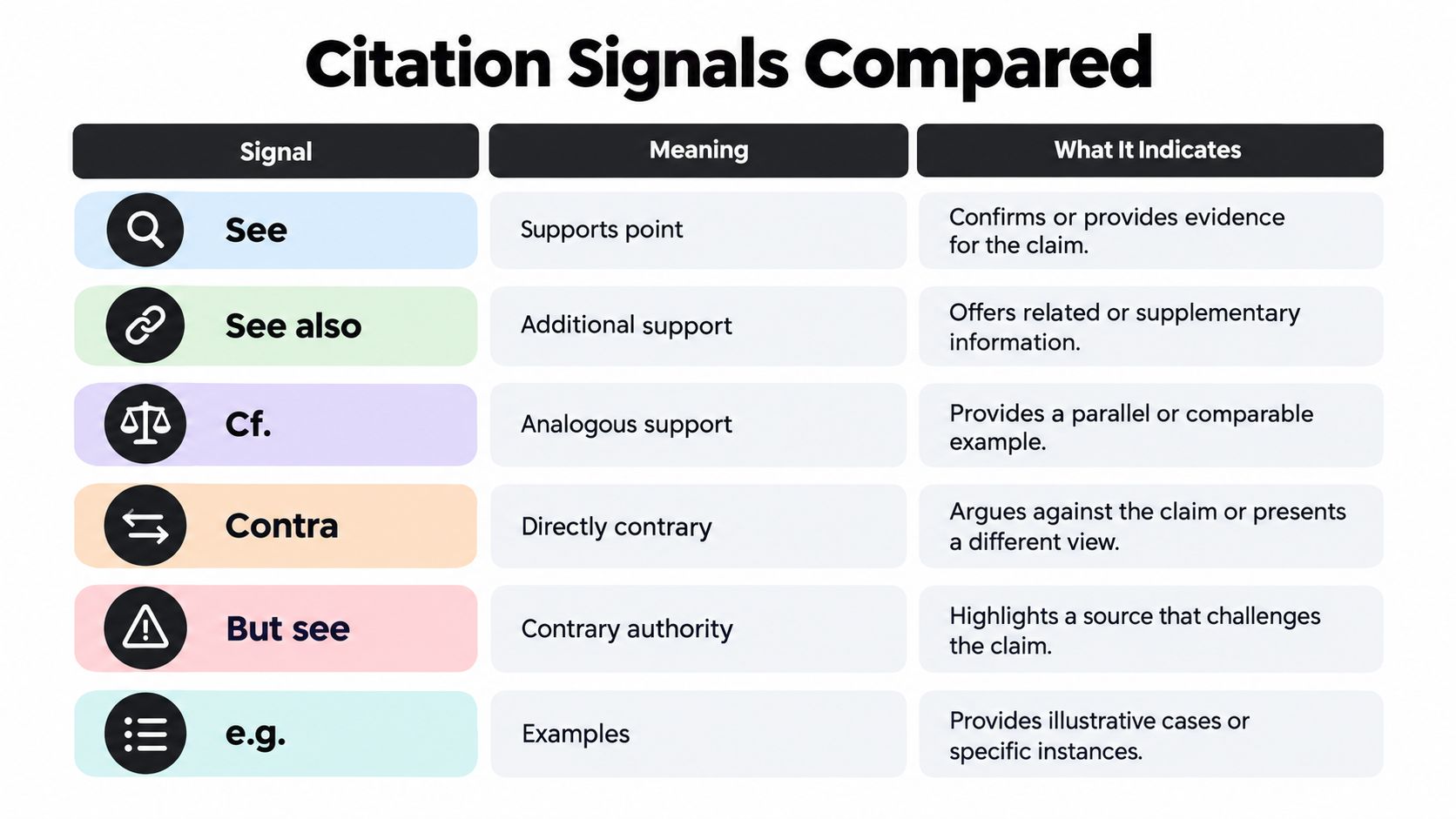
Signals carry meaning:
- See: The authority supports the proposition, but the connection requires explanation.
- See also: The authority provides additional support.
- Cf.: The authority supports the point by analogy.
- Contra: The authority directly supports the opposite position.
- But see: Contrary authority deserves attention.
- E.g.: The cited sources are examples rather than an exhaustive list.
Use a pinpoint citation for the page, paragraph, or other precise location supporting the sentence. A case citation without a useful pinpoint can force the judge to search the entire opinion. That weakens navigation, especially when the proposition depends on a particular passage rather than the case's general holding.
Match the citation system to the forum
The Bluebook is common in federal practice, but state courts may use their own manuals or conventions. California practice can differ from Bluebook presentation, and Texas lawyers may need to follow the Texas Guide to Legal Style alongside the Texas appellate rules. Differences can affect italics, abbreviations, case names, statutory references, and short forms.
Footnotes should support the argument, not hide it. Put a proposition essential to the requested ruling in the body. Reserve a footnote for clarification, a limited qualification, or additional authority that would interrupt the main line of reasoning.
Before filing, verify every citation against the actual authority. The CUNY Legal Writing Center's guidance on drafting briefs emphasizes logical sequencing, record-supported facts, concise paragraphs, and direct treatment of the opposing side's strongest arguments. Those writing choices work only when the citations accurately support them.
Jurisdictional Variations in Brief Format
A brief doesn't have one universal appearance. Federal and state appellate courts can differ on word limits, covers, appendices, typography, footnotes, and electronic filing. The rule governing the assigned court controls, even if a respected treatise or firm template suggests another format.
| Element | Federal (FRAP 32) | California (CRC 8.25–8.42) | New York (1st Dept. Part 600) | Texas (TRAP 38–39) |
|---|---|---|---|---|
| Governing source | Federal Rules of Appellate Procedure and circuit rules | California Rules of Court | CPLR 5528 and First Department rules | Texas Rules of Appellate Procedure |
| Structure | Federal appellate components, with circuit-specific additions | Required appellate sections and California-specific filing rules | Specific cover and appendix requirements may apply | Rule 38.1 identifies required brief sections, while rules address appendices and filing |
| Length | Court rules establish word or page limits for the filing type | California rules establish their own limits, including a 14,000-word cap for California Supreme Court briefs | Limits and presentation requirements depend on the applicable court rules | Texas rules govern length, sections, and related filing mechanics |
| Physical and visual presentation | FRAP 32 provides the federal baseline, subject to circuit rules | Rules address page size, margins, spacing, and pagination | Cover and appendix requirements can materially affect the final document | Appendix and brief requirements operate together under the appellate rules |
| Local refinement | Circuits may add requirements for electronic filing, covers, and binding | State appellate rules and court procedures control | Department-specific practice matters | Court-specific and local requirements still need checking |
The federal baseline can be refined by individual circuits. A digital-submission rule may govern how a document is uploaded, while another circuit may impose cover-color or binding requirements. State rules can be equally specific, especially when they regulate appendices or pagination.
The filing check that prevents rework
Before formatting, identify:
- The court and division.
- The filing type and party role.
- The rule governing length.
- Required preliminary sections and certificates.
- Cover, appendix, binding, and portal requirements.
- Whether hyperlinks, bookmarks, or searchable PDF features are required or restricted.
The legal brief history and format discussion reinforces the central point: a full appellate brief can require a caption, contents, authorities, jurisdiction, issues, facts, summary, argument, conclusion, signature block, and certificates, while California and Ninth Circuit practice add their own presentation and filing requirements. Pull the current local rule immediately before filing. Amendments can make an old template unreliable.
Tone, Persuasion, and Ethical Writing Standards
A persuasive brief sounds confident because it is precise, not because it is loud. Use professional language, restrained characterizations, and record-supported descriptions. Let the legal theory do the persuasive work instead of relying on adjectives about the opposing party or the trial judge.
Federal appellate practice expects an argument supported by authority and reasoned application. Under Federal Rule of Appellate Procedure 28(a)(8), the argument must contain the appellant's contentions and reasons, with citations to authorities and parts of the record relied on. A credible brief also confronts adverse authority rather than pretending it doesn't exist.
A filing-stage ethics check
- Verify primary authority: Confirm every case, statute, rule, quotation, and pinpoint.
- Disclose contrary authority: Explain controlling or materially adverse decisions fairly.
- Separate fact from inference: Don't present an attorney's assertion as sworn evidence.
- Protect sensitive material: Follow sealing and confidentiality procedures for protected references.
- Confirm length compliance: Check the applicable word or page limit and certification.
- Identify authorship and responsibility: Follow court, firm, and professional requirements for attorney review.
- Obtain factual approval: Have the responsible lawyer and client process confirm material factual statements.
- Review AI-assisted text: Never file generated language without checking its sources, record support, and meaning.
Model Rule 3.3, candor toward the tribunal, and Model Rule 1.1, competence, frame these choices. They also affect seemingly small decisions, such as whether a qualification belongs in a footnote or in the body, and whether a signal accurately describes the relationship between a case and the proposition.
For a practical discussion of responsible technology use, see the use of AI in law firms. The lawyer remains responsible for the filing, regardless of who or what produced the first draft.
From Case File to Court-Ready Filing
A personal-injury brief begins with a file, not a word processor. The working set may include a demand letter, medical records, a police report, insurance correspondence, deposition transcripts, and trial transcripts. The attorney first builds a reliable chronology, then maps each disputed fact to the elements of the claim and the issue the court must decide.
The outline should identify the source for each material assertion. A medical record may support treatment chronology, a deposition may establish notice, and an insurance exchange may show the basis for a denial. That source map makes later citation checking faster and exposes gaps before the argument is written.
AI-assisted tools can help with mechanical organization. Ares can generate mediation briefs, motions, and letters of representation from case records with cited evidence throughout, giving a personal-injury team a structured starting point for fact organization and drafting. The attorney still verifies every citation, checks the record, controls tone, and approves the final text.
Use this trial preparation checklist to keep the case file aligned with the issues that will matter in court. The final stage is filing through the applicable electronic system, state portal, or paper-service process, followed by a court-specific proofread of the PDF, certificates, signature block, and submission requirements.
Quick Reference Checklist and Template Pointers
Before filing, work through the document in order:
- Caption: Confirm court, parties, docket number, and filing designation.
- Navigation: Reconcile the table of contents and table of authorities with the final text.
- Jurisdiction: State the court's authority and the relevant procedural dates.
- Issues: Frame each question around the ruling requested.
- Facts: Check every material sentence against the record.
- Argument: Use claim-based headings and a clear CREAC or IRAC progression.
- Citations: Apply Bluebook or the jurisdiction's required style, including signals and pinpoints.
- Execution: Verify the signature block, certificates, service details, and required disclosures.
- Limits: Confirm word or page limits under FRAP 32 or the controlling state rule.
A circuit-specific template is safest for a federal appeal. A state appellate template is better for a state filing, while a blank document can be appropriate when the court's rules require unusual components. No template can verify the accuracy of your record citations, the current local rule, the requested relief, or the factual characterization of the opposing position. Those checks require attorney review.
For personal-injury teams, Ares helps organize medical records and draft case documents from the underlying file, including cited evidence that can support a court-ready narrative. Visit Ares to see how your firm can turn scattered case materials into a structured starting point for briefs, motions, and related filings.