A litigation paralegal is an attorney's right-hand person in a lawsuit—part investigator, part project manager, and part strategist. They are the ones in the trenches, managing the day-to-day nuts and bolts of a case, from the initial client meeting all the way through to the final verdict.
Think of them as the central nervous system of the case, making sure every moving part is connected and functioning smoothly.
What Does a Litigation Paralegal Really Do?
The best way to understand the role is to move past the idea of a simple "legal assistant." A great litigation paralegal is more like a case's general contractor. While the attorney is the architect—designing the overall legal strategy and vision for the case—the paralegal is on the ground making it happen. They are the ones who organize the materials, coordinate with all the players, and manage the project timelines to ensure the whole structure is built correctly and on schedule.
Without that hands-on management, even a brilliant legal argument can fall apart. Missed deadlines, lost evidence, and communication breakdowns can derail a case before it ever gets to court. The paralegal is the hub that connects the attorney, the client, the opposing counsel, and the court system, turning the inherent chaos of litigation into a structured, manageable process.
This timeline gives you a bird's-eye view of where a paralegal fits into the three main stages of litigation, from the initial fact-finding to the final trial.
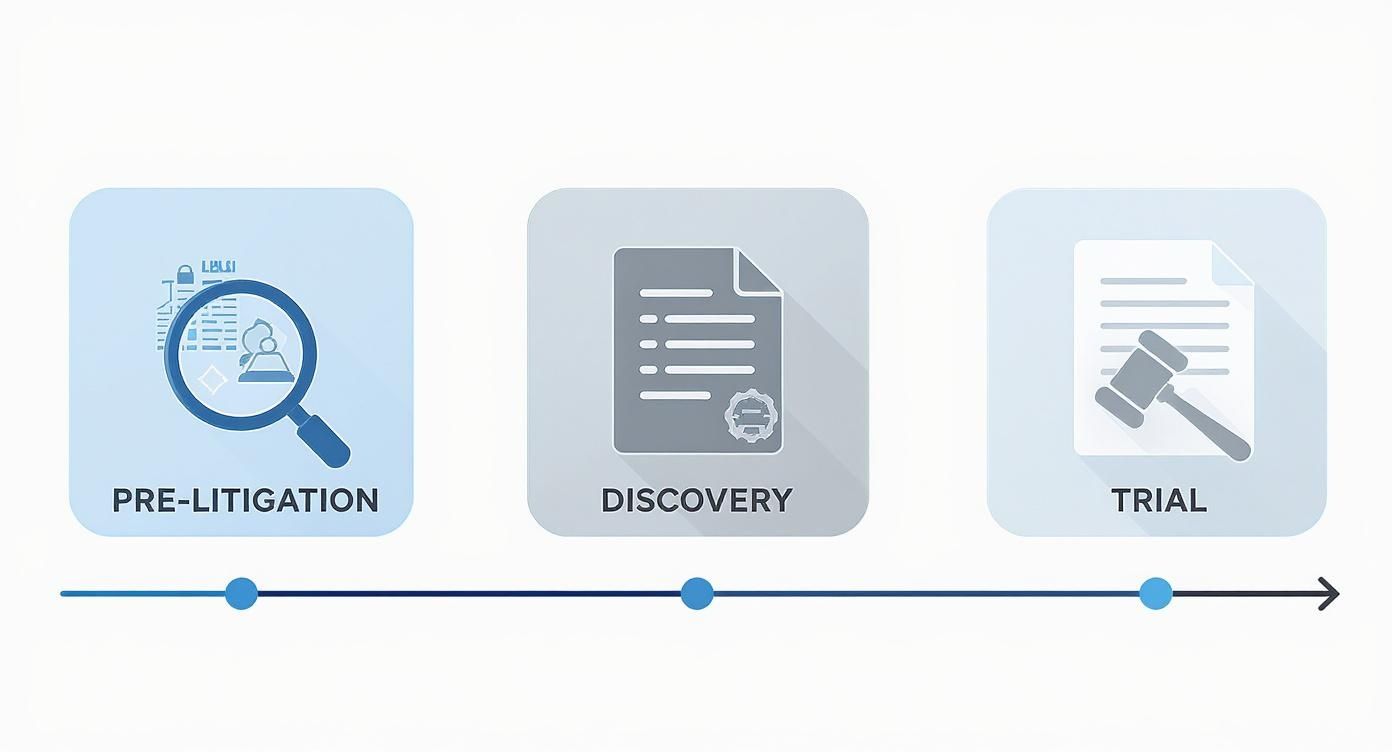
As you can see, their duties aren't static. They shift and adapt to the needs of the case as it moves from one phase to the next, but their involvement is constant and critical.
A Litigation Paralegal's Responsibilities Across the Case Lifecycle
To really appreciate the value a litigation paralegal brings, it helps to break down their duties stage by stage. Their work is far from just administrative—it's woven directly into the fabric of the case's tactical execution.
This table provides a snapshot of their core functions throughout a lawsuit.
| Litigation Stage | Paralegal's Key Responsibilities |
|---|---|
| Pre-Litigation/Case Intake | Conduct initial client interviews, gather preliminary facts and documents, run conflict checks, and open the official case file. |
| Pleadings | Draft foundational court documents like the Complaint (which starts the lawsuit) or the Answer (the response) for the attorney to review. |
| Discovery | Manage the massive information exchange by drafting written questions (interrogatories), document requests, and scheduling depositions. |
| Motion Practice | Help draft motions, gather the evidence and exhibits to support them, and track the critical court filing deadlines. |
| Trial Preparation | Organize all trial exhibits, prepare witness binders, coordinate witness availability, and manage any courtroom technology. |
| Post-Trial/Appeal | Assist with motions after the trial, organize the complete trial record for appeal, and manage the strict appellate court deadlines. |
As the table shows, a paralegal's work is cumulative. The thoroughness of their work in the early stages, like discovery and document management, directly sets the attorney up for success later on in motions and at trial.
Mastering the Daily Workflow of Litigation
To really understand what a litigation paralegal does, you have to look past the job title and into the nitty-gritty daily tasks that push a lawsuit forward. Think of them as the engine of the case. They’re the ones methodically managing the constant flow of information, critical deadlines, and crucial evidence that forms the very backbone of the legal strategy. Their work is a dynamic mix of investigation, organization, and communication.
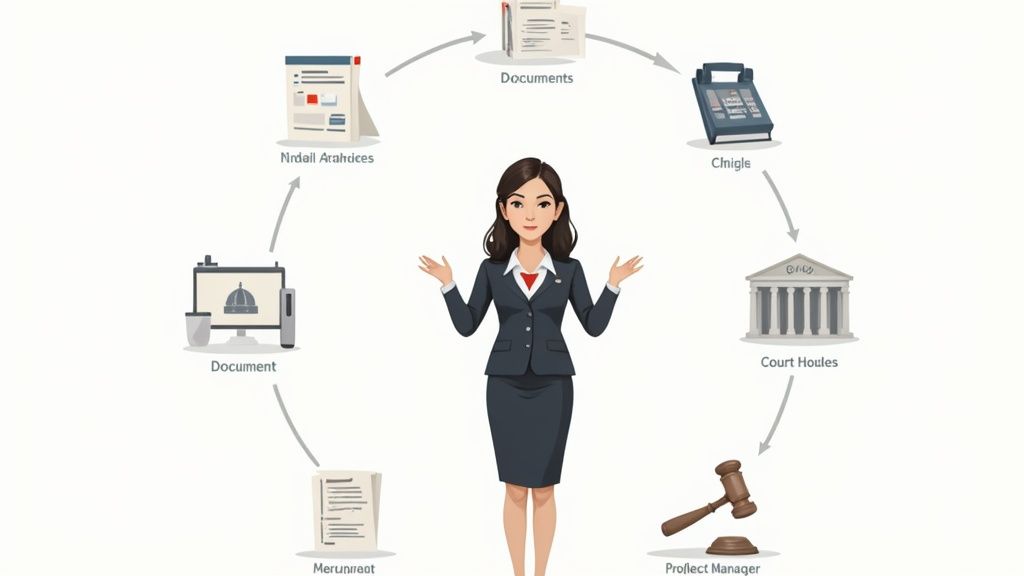
The workflow isn't a straight line; it's more of a cycle. New information uncovered during discovery might spark a fresh round of investigation, while managing documents is a constant, overarching responsibility. Every single action is a building block for the next phase of the case.
Laying the Groundwork with Case Intake and Investigation
It all starts with a story. A potential client comes in with a problem, and the litigation paralegal is often one of the first people to hear the details. This initial case intake phase is about so much more than just collecting contact info—it’s about building the foundational narrative of the entire lawsuit.
During this stage, a paralegal’s duties include:
- Initial Client Interviews: Asking sharp, targeted questions to get the who, what, when, where, and why of the incident.
- Evidence Gathering: Requesting and collecting all the early documents, like accident reports, contracts, medical bills, or important correspondence.
- Factual Investigation: Digging into background research, tracking down witnesses, and verifying the key details of the client's story.
In this phase, the paralegal is essentially a detective. They meticulously piece together fragments of information to create a coherent, fact-supported picture for the attorney. This early work is absolutely critical; it helps the legal team decide if the case has merit before committing significant time and resources.
Navigating the Discovery Maze
Once a lawsuit is officially filed, the "discovery" phase kicks off. This is the formal process where both sides are required to exchange information and evidence. For a litigation paralegal, this is often the most demanding and document-heavy part of the job. They become the gatekeepers of information, ensuring their team gets what it needs while properly responding to requests from the other side.
A paralegal’s discovery tasks often involve drafting and managing crucial documents like:
- Interrogatories: These are written questions sent to the opposing party that must be answered under oath.
- Requests for Production: These are formal demands for documents, emails, photos, and any other tangible evidence.
- Requests for Admission: These are specific statements the other party has to either admit or deny, which helps narrow down the facts in dispute.
The paralegal doesn't just send these documents and forget them. They have to track deadlines, review the responses for completeness, and organize the mountain of information that comes pouring in. Their keen eye for detail can uncover that "smoking gun" email or contradictory statement that completely changes the direction of a case.
A crucial aspect of a litigation paralegal's daily work involves processing and understanding vast amounts of documentation. The skill of mastering summarization in reading can significantly enhance efficiency and comprehension, turning dense legal files into concise, actionable insights for the attorney.
Building the Fortress of Document Management
In modern litigation, cases are often won or lost based on the strength of their documentation. A single case can easily involve tens of thousands of emails, contracts, medical files, and other records. The litigation paralegal is both the architect and the guardian of this fortress of information. Meticulous organization isn't just a nice-to-have; it's a tactical necessity.
This responsibility has exploded with the rise of electronically stored information (ESI). In fact, technology is now central to a paralegal’s workflow. An industry report found that 90% of law firms now use cloud-based document management systems and 87% rely on legal research platforms—both tools that paralegals use heavily to organize and retrieve case files.
A paralegal's document management duties include:
- Creating a Centralized System: Setting up a logical electronic folder structure or database where every document can be stored, coded, and pulled up in an instant.
- Bates Stamping: Applying unique identifying numbers to every single page of evidence produced in discovery, which creates an official, trackable record.
- Managing Medical Records: For personal injury or med mal cases, this means organizing huge, complex medical files. To get a better handle on this specific skill, check out our guide on how to organize medical records for legal cases.
- Preparing Exhibit Lists: Identifying and cataloging the key documents that will be used as evidence in motions or at trial.
Without this systematic approach, critical evidence could get lost, deadlines could be missed, and the entire case could be put in jeopardy. The litigation paralegal makes sure every piece of the puzzle is exactly where it needs to be, ready for the attorney to use at a moment's notice.
Developing Advanced Skills for Courtroom Success
A truly exceptional litigation paralegal does far more than just keep the files in order. They become a strategic partner, the person who gives their attorney a genuine competitive edge in the courtroom. This means moving beyond the daily grind of administrative tasks and developing a deeper, more analytical skill set.
It's a shift from being a case organizer to an indispensable member of the trial team. Instead of just completing assignments, a top-tier paralegal starts to anticipate what the attorney will need next, connecting the dots between disparate pieces of evidence and spotting potential strengths—or weaknesses—in the case long before anyone else does. That's what separates a good paralegal from a great one.
Mastering the Art of Trial Preparation
As trial looms, the pressure ramps up, and a litigation paralegal's role becomes absolutely critical. This is where their meticulous organization and eagle-eyed attention to detail truly shine. They are essentially building the entire operational infrastructure that allows an attorney to walk into court and perform at their best.
Think of the trial binder as the attorney's script, playbook, and encyclopedia, all rolled into one. The paralegal is the architect of that crucial resource.
Key trial prep responsibilities include:
- Assembling Trial Binders: This isn't just about putting papers in a folder. It’s about creating a perfectly organized system with every key pleading, motion, deposition highlight, and discovery response tabbed and indexed for instant retrieval under pressure.
- Managing Exhibits: They are the keepers of the evidence. This involves creating detailed exhibit lists, marking every piece of evidence correctly, and often running the courtroom technology to present digital exhibits seamlessly.
- Coordinating Witnesses: Getting witnesses to the right place at the right time is a logistical masterclass. Paralegals handle everything from scheduling pre-trial prep meetings to booking travel and making sure everyone is ready to testify.
This kind of specialized support is more vital than ever. In fact, the number of paralegals focused on litigation has jumped by 25% in the last five years, a clear reflection of just how complex modern court cases have become. These professionals are tasked with creating detailed chronologies and pulling vital legal citations—the very building blocks of a winning argument. For more on this trend, you can find helpful paralegal marketing statistics on amraandelma.com.
Becoming a Communication Linchpin
An elite litigation paralegal is the central hub for all case communications. Their ability to speak and write with clarity, professionalism, and efficiency keeps the entire team—and the case—on track. This is so much more than just passing along messages; it's about actively managing relationships and expectations.
They are the go-to liaison between:
- The Attorney and Client: Providing regular updates, gathering information, and serving as a calm, professional contact for clients navigating a stressful experience.
- The Firm and Opposing Counsel: Handling the day-to-day back-and-forth of scheduling, exchanging documents, and maintaining professional courtesy.
- The Legal Team and the Court: Speaking with the clerk's office about filing deadlines, hearing dates, and specific courtroom logistics.
A paralegal who is a master communicator can defuse conflicts before they start, prevent costly misunderstandings, and build a reputation for the entire firm as being reliable and on top of their game. They become the voice of the case when the attorney can't be.
Transforming Data into Actionable Insights
Perhaps the most valuable skill a litigation paralegal develops is the ability to wade through mountains of information and pull out the golden nuggets that matter. They're often the first set of eyes on voluminous records, and what they find can fundamentally shape the direction of a case.
A perfect example is reviewing medical records in a personal injury lawsuit. It's a massive undertaking, often involving hundreds or even thousands of pages of dense clinical notes, test results, and billing codes. The paralegal’s job is to spot the key diagnoses, map out treatment timelines, and find the specific provider notes that prove the client’s damages. A well-crafted medical record chronology is absolutely essential for telling a clear and persuasive story.
The same goes for deposition summaries. After hours of testimony, the paralegal pores over the transcript to find every crucial admission, contradiction, or key statement. This summary becomes the attorney’s cheat sheet, allowing them to instantly find the exact quote needed for a motion or to cross-examine a witness at trial. It's an analytical skill that saves an incredible amount of time and focuses the entire legal strategy on what will actually win the case.
How Technology Is Reshaping the Paralegal Role
https://www.youtube.com/embed/_rNlZH-5R48
The classic image of a paralegal surrounded by teetering stacks of paper is officially a thing of the past. Today’s best litigation paralegals are the firm’s resident experts on a growing arsenal of legal tech, and their role is more critical than ever. This isn’t about replacing people with software; it’s about augmenting their expertise, freeing them from tedious manual work to focus on more strategic parts of the case.
To really grasp what a litigation paralegal does today, you have to understand their relationship with technology. Proficiency in case management software, e-discovery platforms, and legal research databases isn't just a nice-to-have skill anymore—it's table stakes. These tools are the new file room, trial binder, and law library, all rolled into one.
This shift allows paralegals to wrangle enormous amounts of information with a speed and accuracy that was once unimaginable. Think about it: instead of manually sifting through thousands of emails for a keyword, they now use e-discovery software to run sophisticated searches, tag critical documents, and prepare a clean, defensible production for the other side.
The Rise of AI as a Paralegal Power Tool
Artificial intelligence is pushing this evolution even further, turning some of the most complex, time-consuming tasks into streamlined workflows. AI adoption in law firms is picking up serious steam. In fact, the 2025 State of the Legal Market Report noted that the number of lawyers using AI has doubled in the last year, a trend that directly impacts paralegal work. What does this mean in practice? AI-powered tools can slash manual document review time by up to 50%, a massive boost for any firm’s bottom line. For more on this, you can explore the full findings on legal market trends.
AI isn't coming for a paralegal's job; it's here to make them better at it. Take, for example, the monumental task of reviewing a client’s complete medical history in a personal injury case.
- Before AI: This meant a paralegal could spend days, or even weeks, painstakingly reading through hundreds of pages of records, manually building a timeline, and trying to connect the dots.
- With AI: Now, a tool like Ares Legal can ingest those same records and, in just minutes, spit out a structured medical chronology, pinpoint key providers, and even flag potential gaps in treatment.
This completely changes the game. It frees the paralegal to do what they do best: think critically. Instead of just organizing data, they can now analyze the AI-generated summary to spot weaknesses in the case or identify the most powerful evidence needed to draft a high-value demand letter.
Essential Tech Skills for the Modern Paralegal
To succeed in this environment, a litigation paralegal must be nimble with a range of digital platforms. The ability to learn and master new software on the fly is what separates a good paralegal from a great one. It’s about leveraging these advancements to work smarter, whether that’s managing a document review or sourcing accurate legal court transcription services for a deposition.
Technology empowers the modern paralegal to act as a data analyst and a strategic asset. By handling the heavy lifting of information processing, these tools allow paralegals to focus their critical thinking skills on what truly matters—helping to build a winning case.
At the end of the day, technology doesn't diminish the paralegal role—it elevates it. It transforms a support position into a deeply strategic one, enabling a higher level of case involvement. As firms continue to embrace more sophisticated tools, the most valuable litigation paralegals will be the ones who see technology not as a threat, but as a powerful partner in winning for their clients.
Your Roadmap to Becoming a Litigation Paralegal
Thinking about a career as a litigation paralegal? It’s a rewarding path, but law firms are looking for a specific blend of education, hands-on skills, and practical experience. Let's break down what it really takes to get your foot in the door and succeed in this fast-paced field.

The first step for most is getting the right education. While the exact requirements can differ from firm to firm, a solid starting point is an associate's or bachelor's degree in paralegal studies, especially from a program approved by the American Bar Association (ABA). These programs are designed to give you a strong grasp of the legal principles, court procedures, and ethical rules that are the bedrock of everything you'll do.
Building Your Credentials
Once you have your degree, professional certifications are the best way to stand out. Think of them as a stamp of approval that tells potential employers you’ve met a high professional standard and are serious about your career. They show you're committed.
Two of the most respected certifications in the industry are:
- Certified Paralegal (CP) from NALA: This credential from the National Association of Legal Assistants is a true benchmark in the paralegal world.
- Registered Paralegal (RP) from NFPA: Offered by the National Federation of Paralegal Associations, this is another top-tier designation for experienced professionals.
Earning these usually involves passing a tough, comprehensive exam that tests you on core paralegal skills. This formal validation does more than just look good on a resume; it often leads to better job opportunities and higher salaries.
Essential Skills Beyond the Books
Formal training is crucial, but it’s the intangible skills that separate a good litigation paralegal from a great one. These are the qualities that help you navigate the high-stress, deadline-driven world of a lawsuit and become an attorney’s right hand.
The most successful litigation paralegals are a unique mix of analytical thinkers, unflappable problem-solvers, and excellent communicators. They are the ones who stay calm and focused, untangling complex issues and managing timelines when everything is on the line.
When I’m hiring, I’m always looking for people who can clearly show me they have:
- Critical Thinking: You need the ability to sift through a mountain of facts, pinpoint the critical issues, and think ahead to the next move without needing your hand held.
- Resilience Under Pressure: Litigation runs on deadlines that don’t move. Being able to stay meticulous and focused when the clock is ticking is absolutely essential.
- Flawless Communication: Your writing has to be clear and concise. This isn't just about emails; you'll be drafting everything from simple letters to the first pass at motions or a persuasive what is a demand letter that sets the stage for a settlement.
The best way to develop these skills is by getting your hands dirty with an internship or an entry-level role. That's where the classroom theory meets the real world, turning you into the kind of well-rounded, capable candidate every law firm wants on its team.
Common Questions About Litigation Paralegals
As you get a feel for what a litigation paralegal does, a few questions tend to pop up again and again. Let's tackle them head-on to clear up some of the finer points of the job, building on the duties and skills we've already covered.
What Is the Biggest Difference Between a Litigation Paralegal and Other Paralegals?
The biggest distinction boils down to one thing: the courtroom. While a corporate paralegal might live in a world of contracts and compliance filings, a litigation paralegal’s entire universe orbits around the lifecycle of a lawsuit.
Their daily work is dictated by the unforgiving rhythm of the court. Everything is driven by filing deadlines, the specific rules of civil procedure, and the big-picture strategy of getting a case ready for trial. This means they are deeply involved in discovery, drafting motions, and the intense, detailed work of trial prep.
How Much Client Interaction Does a Litigation Paralegal Have?
Quite a bit, actually. Litigation paralegals often have a lot of direct contact with clients and can become a primary point of contact for them. They're on the front lines, giving case updates, helping clients track down the information we need, and explaining what's happening next in the process.
While they can't give legal advice—that's strictly for the attorneys—they play a crucial role in keeping the client relationship strong. They help clients feel heard and informed during what is usually a confusing and stressful time, serving as a reliable and accessible touchpoint for the firm.
What Are the Most Challenging Aspects of This Job?
The toughest parts of the job are juggling tight, often conflicting, deadlines while trying to make sense of a mountain of information. The legal system doesn't wait for anyone, so paralegals have to be masters of organization and time management.
The work can be incredibly intense. In the weeks leading up to a trial, for example, you can expect long hours and a need for absolute precision. The pressure to get every single detail right when the stakes are high is just part of the job.
Is Being a Litigation Paralegal a Good Step Toward Law School?
Absolutely. It’s one of the best ways to get real-world experience that you just can't find in a textbook. Working as a litigation paralegal gives you a front-row seat to the legal world, showing you how a lawsuit really works and how a law firm operates day-to-day.
Many future lawyers take this path to gain practical skills and make sure a legal career is truly what they want before diving into the massive commitment of law school. It’s a fantastic way to build a solid foundation and make a smart, informed decision about your future.
At Ares, we know firsthand how much pressure litigation teams are under to manage complex medical information quickly and accurately. Our AI platform handles the painstaking work of reviewing medical records and drafting demand letters, freeing up your paralegals to focus on the high-level strategic tasks that win cases. Find out how you can cut out hours of manual work and build stronger claims at https://areslegal.ai.